Table of Contents
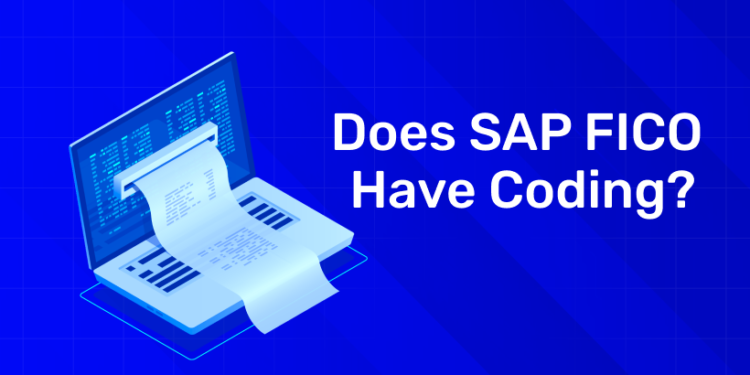
Answer First – Does SAP FICO Require Coding?
SAP FICO doesn’t need any programming knowledge at all. It is a functioning ERP module which is defined by its business accounting capabilities.
- The Functionality Focus: Deals with the system setup, creating the financial records and transforming business processes in SAP.
- The Technical Complexity: Any programming aspects (writing special coding, modifying the database, creating special applications) are done by technical experts in ABAP and do not concern functional consultants who only work on the functional side.
- The Jobs of a Consultant: The functional workers understand the current legal situation and give specifications to the technical people regarding what needs to be changed in the standard system.
Key Takeaways
- No Coding Required: SAP FICO implementation and management involves setting up existing financial software structures through the use of tick boxes, menus, and T-codes.
- Well-defined Roles: It is the responsibility of functional consultants to design the financial processes; the coding aspect is left to the developers.
- Low Entry Barrier for Finance Professionals: Prior accounting knowledge or a commerce background is significantly more valuable for mastering this module than a background in computer programming.
Introduction
Talk to any accountant or commerce graduate thinking about moving into tech consulting, and the exact same anxiety pops up within five minutes: Do I need to learn how to code? It is a completely fair question. SAP handles the financial backbone of nearly every Fortune 500 company on the planet, tracking billions in real-time capital. When a system operates at that scale, it is easy to assume you need to be a software engineer just to keep the lights on.
But here is the reality of the enterprise software world: writing code and setting up business systems are two entirely different jobs. For professionals trying to escape standard banking tracks or repetitive desk routines, understanding this boundary changes everything. In the SAP universe, knowing how a corporate balance sheet actually works will always beat knowing how to write lines of software script.
Join Entri’s SAP FICO Training Course today!!
Master SAP with Expert-Led Courses
Unlock your potential with our comprehensive SAP courses! Learn essential modules like SAP MM (Materials Management), SAP SD (Sales and Distribution), and SAP FICO (Financial Accounting and Controlling) from industry experts.
Know MoreWhat is SAP FICO?
To understand why coding isn’t part of the job, look at what the software actually does. SAP FICO is broken into two distinct halves that handle an organization’s complete financial profile:
- SAP FI (Financial Accounting): This is the external facing side. It tracks money moving in and out of a business to generate the standard reports required by auditors, banks, and tax authorities. It covers General Ledgers (FI-GL), Accounts Payable (FI-AP), Accounts Receivable (FI-BR), and Asset Accounting (FI-AA).
- SAP CO (Controlling): This side looks inward. It is built for internal management, tracking internal cost centers, budgets, and production costs so corporate leadership can see exactly which business units are making money and which are losing it.
Combined, these sub-modules form a giant financial web. The goal of the system isn’t to create new software; it’s to make sure a multinational corporation’s real-world transactions match up with local tax laws and internal financial goals.
Does SAP FICO Involve Coding?
Let us clear up the confusion completely: being an SAP FICO consultant means spending your day in system configuration, not software programming.
Configuration refers to the process of tailoring an advanced spreadsheet software program to the needs of a given business. Although some serious programming would need to go into the configuration since programming of the application is not part of the configuration process. The configuration process is done using a menu driven approach known as the Implementation Guide (IMG), where consultants gain access to the menu through the transaction code SPRO.
[Business Process Documented] ➔ [Open SPRO Configuration Menu] ➔ [Adjust Ledger Fields via GUI] ➔ [Test Accounting Entry Flow]
When setting up a system for a client, you are navigating deep dropdown menus, filling out standardized fields, linking charts of accounts, and checking validation parameters. It is logical, structured work, but it isn’t coding. Now, occasionally, a client will demand a highly specific, customized automation that the standard SAP framework simply cannot do out of the box. When that happens, the FICO consultant doesn’t start coding. They write a functional specification document essentially a blueprint explaining the accounting logic and hand it off to a technical programmer who does the heavy lifting in the codebase.
SAP FICO vs Other SAP Modules
The division of labor within an enterprise project is incredibly strict. You are paid for your specific domain expertise, and the work stays firmly in its own lane:
| Module Category | Primary Modules | Coding Requirement | Core Responsibility |
| Functional (FICO) | FI (Financials), CO (Controlling) | None | Mapping financial logic, general ledgers, and taxation rules into the GUI. |
| Functional (Logistics) | MM (Materials Management), SD (Sales & Distribution) | None | Designing supply chain paths, inventory tracking, and sales workflows. |
| Technical | ABAP (Advanced Business Application Programming) | High | Writing custom code, building database scripts, and modifying standard software logic. |
| Technical/Infrastructure | BASIS (Business Application Software Integrated Solution) | Medium | System administration, database patches, security architecture, and user access. |
Master SAP with Expert-Led Courses
Unlock your potential with our comprehensive SAP courses! Learn essential modules like SAP MM (Materials Management), SAP SD (Sales and Distribution), and SAP FICO (Financial Accounting and Controlling) from industry experts.
Know MoreSkills Required to Learn SAP FICO
Since you don’t need to spend months memorizing software syntax, your success depends on a completely different set of professional muscles.
- Business Process Mapping: You need to look at how a company manages its invoices or tracks asset depreciation on paper, and then translate that exact real-world flow into the software structure.
- Mastery of SAP T-Codes: Developing muscle memory for the specific transaction codes (like FB50 for journal entries or FBL3N for scanning general ledger accounts) that let you navigate the backend efficiently.
- System Troubleshooting: Analyzing the system log when a month end cost allocation rule fails or a tax calculation balance drops an error flag during system testing.
Ideal Backgrounds
Who actually thrives in this module? The system is built for people who already understand the language of business:
- Commerce and Management Graduates: Anyone with a B.Com, M.Com, or MBA in Finance who already knows the difference between a debit and a credit.
- Accounting Professionals: CAs, CMAs, or ACCA candidates who want to pivot away from traditional tax auditing and move into enterprise tech strategy.
- Experienced End-Users: Bank tellers, corporate bookkeepers, or billing clerks who have spent years using accounting applications and want to switch to configuring them instead.
Advantages of SAP FICO Without Coding
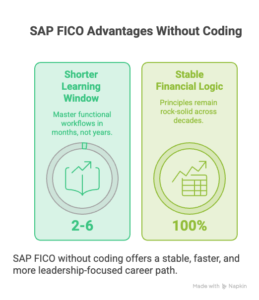
Skipping the coding requirement gives you a massive tactical advantage if you are planning a mid-career pivot.
💡 Pro Tip for Career Strategy:
Software programming languages change completely every few years, frameworks go obsolete, syntax updates, and developers have to constantly relearn their tools. Financial logic doesn’t do that. Double-entry bookkeeping, asset depreciation, and corporate cost balancing operate on principles that remain rock-solid across decades and borders. Your value stays locked in your business knowledge, not a temporary code stack.
- Shorter Learning Sprints: Instead of losing a year to software engineering principles, you can focus entirely on mastering specific functional workflows within a 2-to-6-month window of intense training.
- Closer to Leadership Rooms: Because you are designing reports that directly impact cash flow tracking, you end up collaborating directly with CFOs and business leads, rather than working deep inside background development environments.
Practical Implications (Career Perspective)
Choosing a purely functional enterprise path shapes your daily life and career trajectory within global consulting firms:
[Junior Associate Consultant] ➔ [Senior Functional Consultant] ➔ [Lead Solution Architect] ➔ [Enterprise Delivery Director]
Early on, your days are highly tactical. You will be running system simulation tests, making sure multi-currency invoices settle correctly, and troubleshooting user authorization issues. Move up the ladder into architecture roles, and the job shifts to strategy planning global system rollouts. Handling massive corporate migrations to cloud environments like SAP S/4HANA, and designing enterprise workflows. Your market value scales based on your ability to solve complex organizational puzzles, not your typing speed in a text editor.
Join Entri’s SAP FICO Training Course today!!
Conclusion
Framing SAP FICO in terms of code can be misleading. If one tries to earn an income out of doing work in SAP FICO it would not be worth their while to lose time over coding. It is an easy option available for finance professionals and business graduates to switch from finance and accounting to specialist work in the field of global information technology consultancy.
| Related Links | |
| What Is SAP? Where is it Used? | Top MNCs Hiring SAP Global Certified Professionals |
| Who Can Take Sap Global Certifications? | Top Companies Hiring SAP FICO Roles in Chennai |
Master SAP with Expert-Led Courses
Unlock your potential with our comprehensive SAP courses! Learn essential modules like SAP MM (Materials Management), SAP SD (Sales and Distribution), and SAP FICO (Financial Accounting and Controlling) from industry experts.
Know MoreFrequently Asked Questions
Do I need to learn ABAP to build a career in SAP FICO?
No. ABAP is the programming language used by the technical development team. While knowing basic technical terms helps you talk to the developers on a project, you never need to write or debug ABAP code yourself to work as a functional consultant.
What happens when standard SAP FICO configuration cannot meet a client's business requirements?
When the standard configuration options reach their limit, you will write a Functional Specification document. This is essentially a business map detailing the accounting requirements and logic. You hand this to an ABAP programmer, who uses it to write the custom software extension.
Can a programmer transition into a functional SAP FICO role?
Yes, but a technical background isn’t a shortcut here. A software engineer moving to FICO has to step back from code and invest real effort into learning core business concepts, corporate taxation rules, and cost-allocation frameworks from scratch.