Table of Contents
Automation Engineers create automated solutions for industries. They design systems that reduce manual work. They also maintain and improve existing systems. PLCs and SCADA systems are commonly used.
HMIs help operators control processes easily. Their work improves productivity and efficiency. Product quality also becomes more consistent.
Many industries now use automation technologies. Demand for skilled professionals continues growing. This makes Automation Engineering a promising career choice.
New to Robotics? Start from the Basics. Join Now!
🚀 Why Automation Engineering is Becoming a High-Demand Career
Automation continues transforming modern industries. Businesses seek faster and more efficient operations. Automated systems help achieve these goals.
The Rise of Industrial Automation
Industries increasingly automate routine processes. Automation improves consistency and productivity. It also reduces operational errors.
Factories now use advanced automation systems. Automated equipment handles repetitive tasks efficiently.
Industry 4.0 and Smart Manufacturing
Industry 4.0 combines automation with digital technologies. Connected systems exchange data continuously. Real-time information improves decision-making.
Key technologies include:
- Industrial IoT.
- Robotics.
- Smart sensors.
- Data analytics.
- Cloud connectivity.
Automation Engineers support these technologies.
Growing Demand Across Industries
Automation extends beyond manufacturing today. Many industries depend on automated systems.
Examples include:
- Manufacturing.
- Automotive.
- Pharmaceuticals.
- Logistics.
- Energy.
- Food processing.
This creates diverse career opportunities.
Why Companies Invest in Automation
Organizations invest in automation for several reasons.
Benefits include:
- Higher productivity.
- Better quality.
- Reduced costs.
- Improved safety.
- Faster operations.
👨💻 Who is an Automation Engineer?
Automation Engineers develop and maintain automation systems. Their work improves operational performance and reliability.
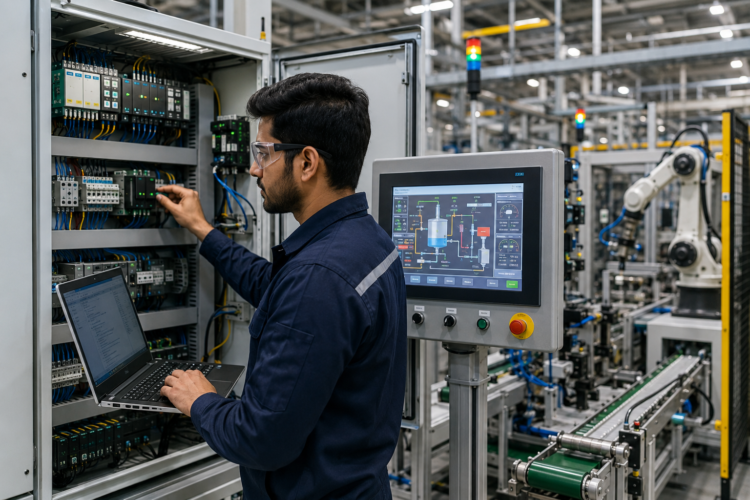
Definition of an Automation Engineer
An Automation Engineer designs automated solutions. They configure, test, and optimize industrial systems.
Their goal is improving efficiency and productivity.
Core Responsibilities
Common responsibilities include:
- Designing automation systems.
- Programming PLCs.
- Developing HMI interfaces.
- Configuring SCADA systems.
- Testing automation solutions.
- Monitoring system performance.
- Troubleshooting issues.
Typical Work Environment
Automation Engineers work in different environments. Some work in factories and plants. Others work in engineering offices.
Common workplaces include:
- Manufacturing facilities.
- Industrial plants.
- Automation companies.
- Engineering consultancies.
- Energy facilities.
Industries that Hire Automation Engineers
Automation skills remain valuable across sectors.
Industries include:
- Manufacturing.
- Automotive.
- Pharmaceuticals.
- Oil and gas.
- Logistics.
- Power generation.
- Food processing.
Master Robotics and AI!
Ready to build the future? Join our comprehensive robotics course to bridge the gap between complex code and physical motion. You’ll gain hands-on experience giving you the technical edge needed to lead in the age of automation.
Know More🔧 What does an Automation Engineer Actually Do?
Automation Engineers handle many technical activities. Their work supports efficient industrial operations.
Designing Automated Systems
Every automation project starts with planning. Engineers analyze operational requirements carefully.
They design systems that improve productivity. Proper design improves long-term performance.
Programming PLCs and Controllers
PLCs control industrial machines and processes. Programming remains a core responsibility.
Engineers develop logic for:
- Motors.
- Conveyors.
- Pumps.
- Sensors.
- Production systems.
SCADA and HMI Development
SCADA systems monitor industrial operations. HMIs provide user-friendly control interfaces.
These tools support:
- Process monitoring.
- Data collection.
- Alarm management.
- System visualization.
Process Monitoring and Optimization
Continuous monitoring improves performance. Engineers review operational data regularly.
They identify bottlenecks and inefficiencies. Optimization improves productivity significantly.
Troubleshooting and Maintenance
Technical problems occasionally occur. Engineers diagnose and resolve issues quickly.
Common activities include:
- Fault identification.
- Equipment testing.
- System maintenance.
- Performance verification.
Project Implementation and Testing
Automation systems require proper validation. Engineers test systems before deployment.
Implementation often includes installation, integration, and performance testing.
💡 Skills Required to become an Automation Engineer
Automation Engineers need technical and professional skills. Strong foundations improve career success.
Technical Skills
PLC Programming
PLC programming controls industrial operations. Most automation systems depend on PLCs.
SCADA Systems
SCADA platforms support monitoring and control. Engineers use them extensively.
HMI Development
HMIs improve operator interactions. Well-designed interfaces improve efficiency.
Industrial Networks
Industrial devices require reliable communication. Networking knowledge supports integration.
Control Systems
Control systems regulate industrial processes. Understanding them remains essential.
Instrumentation
Sensors provide important operational data. Instrumentation supports automation systems.
Electrical Fundamentals
Basic electrical knowledge improves troubleshooting. Strong fundamentals support technical growth.
Software Skills
Important software skills include:
- AutoCAD.
- MATLAB.
- Automation software.
- Basic programming.
These tools support automation projects.
Soft Skills
Problem Solving
Automation Engineers solve technical challenges regularly. Strong troubleshooting skills remain valuable.
Analytical Thinking
Engineers analyze system performance frequently. Data-driven decisions improve results.
Communication
Automation projects involve multiple teams. Clear communication improves collaboration.
Team Collaboration
Successful projects require teamwork. Strong collaboration supports better outcomes.
🎓 Educational Qualifications Needed
Education provides technical foundations. Practical experience strengthens learning.
Degree Options
Popular degree programs include:
- Electrical Engineering.
- Electronics Engineering.
- Instrumentation Engineering.
- Mechatronics Engineering.
- Automation Engineering.
Diploma Pathways
Diploma holders can also enter automation careers.
Relevant diplomas include:
- Electrical Engineering.
- Electronics Engineering.
- Instrumentation Technology.
- Mechatronics Technology.
Can Non-Engineering Graduates Enter Automation?
Yes, career transitions remain possible. Technical training becomes especially important.
Certification programs and practical projects can support entry into the field.
Importance of Practical Training
Practical experience improves employability greatly.
Benefits include:
- Real equipment exposure.
- Better troubleshooting skills.
- Industry familiarity.
- Improved confidence.
Master Robotics and AI!
Ready to build the future? Join our comprehensive robotics course to bridge the gap between complex code and physical motion. You’ll gain hands-on experience giving you the technical edge needed to lead in the age of automation.
Know More🛣️ Step-by-Step Roadmap to Become an Automation Engineer
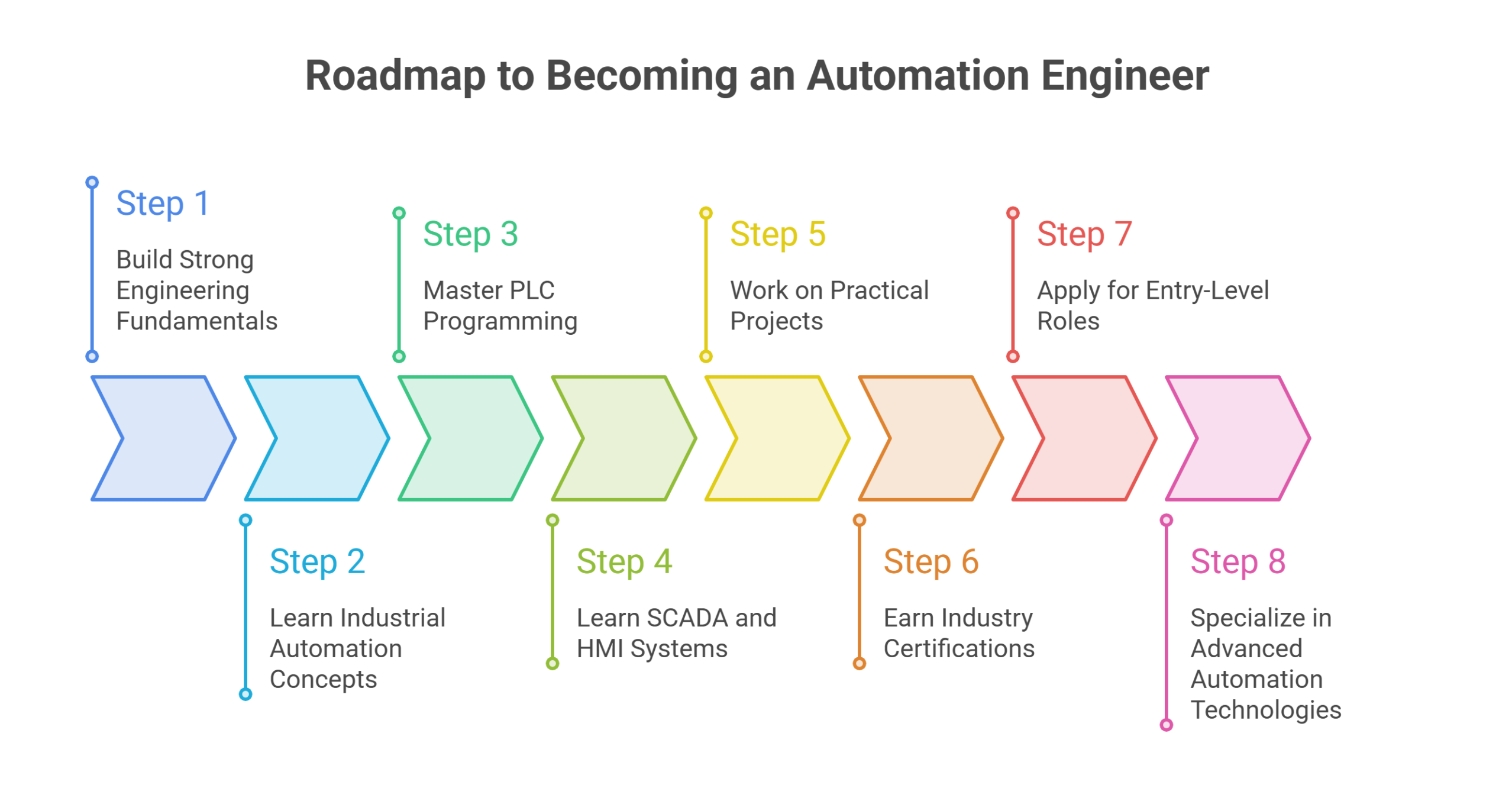
Step 1 – Build Strong Engineering Fundamentals
Learn electrical, electronics, and control system basics. Strong foundations support future learning.
Step 2 – Learn Industrial Automation Concepts
Study automation architectures and industrial processes. Understand how automated systems operate.
Step 3 – Master PLC Programming
Learn PLC logic and programming concepts. Practice regularly using simulations and projects.
Step 4 – Learn SCADA and HMI Systems
Understand monitoring and visualization tools. These skills remain highly valuable.
Step 5 – Work on Practical Projects
Build automation projects whenever possible. Practical experience strengthens technical abilities.
Step 6 – Earn Industry Certifications
Certifications validate technical knowledge. They also improve professional credibility.
Step 7 – Apply for Entry-Level Roles
Look for trainee and junior positions. Industry experience accelerates learning.
Step 8 – Specialize in Advanced Automation Technologies
Explore Industrial IoT, robotics, and AI. Advanced skills improve future opportunities.
🏆 Best Certifications for Automation Engineers
Certifications improve technical knowledge and industry credibility. They can also strengthen job opportunities.
PLC Certifications
Popular options include:
- Siemens PLC Certification.
- Allen-Bradley PLC Training.
- Mitsubishi PLC Certification.
SCADA Certifications
Useful SCADA certifications include:
- WinCC Certification.
- Ignition SCADA Training.
- Wonderware Certification.
Industrial Automation Certifications
These programs cover broader automation concepts.
Examples include:
- Industrial Automation Certification.
- Process Automation Training.
- Mechatronics Certification.
Vendor-Specific Certifications
Many automation companies offer specialized certifications.
Examples include:
- Siemens Certifications.
- Rockwell Automation Certifications.
- ABB Certifications.
Certification Selection Tips
Choose certifications matching career goals. Industry demand should also guide decisions.
Certification Comparison Table
| Certification | Skill Focus | Suitable For | Career Impact |
|---|---|---|---|
| Siemens PLC | PLC Programming | Beginners | High |
| Allen-Bradley PLC | Industrial Controls | Manufacturing Roles | High |
| WinCC SCADA | Monitoring Systems | SCADA Engineers | Medium |
| Ignition SCADA | Visualization | Automation Engineers | High |
| Industrial Automation | Multiple Skills | Freshers | High |
⚖️ Automation Engineer vs Related Engineering Careers
Several engineering careers overlap with automation. However, their focus areas differ.
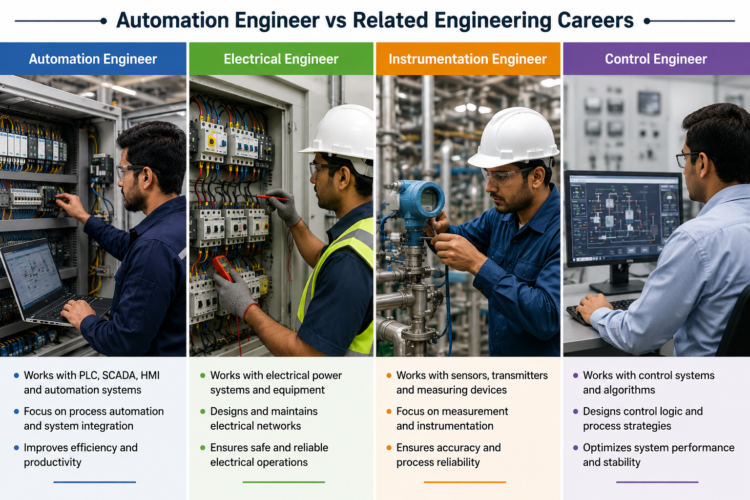
Comparison Table
| Feature | Automation Engineer | Electrical Engineer | Instrumentation Engineer | Control Engineer |
|---|---|---|---|---|
| Primary Focus | Automation Systems | Electrical Systems | Measurement Systems | Control Systems |
| PLC Programming | Extensive | Limited | Moderate | Moderate |
| SCADA Usage | Extensive | Limited | Moderate | Moderate |
| Instrumentation Work | Moderate | Limited | Extensive | Moderate |
| Process Optimization | Extensive | Limited | Moderate | Extensive |
Key Differences
Automation Engineers focus on complete automation solutions. Electrical Engineers focus on power systems.
Instrumentation Engineers specialize in sensors and measurements. Control Engineers focus on process regulation.
Which Career Path is Better for You?
Automation Engineering suits technology-driven individuals. It combines programming, engineering, and industrial systems.
It may be suitable for those interested in:
- Smart manufacturing.
- Industrial technologies.
- Problem solving.
- Automation systems.
🛠️ Tools and Technologies Used by Automation Engineers
Automation Engineers work with several technologies daily. Practical knowledge improves employability.
PLC Platforms
Common PLC platforms include:
- Siemens S7.
- Allen-Bradley.
- Mitsubishi PLC.
- Omron PLC.
SCADA Software
Popular SCADA platforms include:
- WinCC.
- Ignition SCADA.
- Wonderware.
- FactoryTalk View.
HMI Tools
Common HMI tools include:
- WinCC HMI.
- FactoryTalk View.
- Pro-face.
- Wonderware InTouch.
Industrial Communication Protocols
Industrial devices require reliable communication.
Common protocols include:
- Modbus.
- Profinet.
- Profibus.
- Ethernet/IP.
- CAN Bus.
Robotics and AI Integration
Modern automation increasingly uses:
- Industrial robots.
- Collaborative robots.
- Machine vision systems.
- AI-powered monitoring.
- Predictive maintenance tools.
💰 Automation Engineer Salary and Career Growth
Automation Engineering offers attractive earning potential. Experience and skills significantly influence salaries.
Entry-Level Salary
Freshers typically earn between ₹3 LPA and ₹6 LPA.
Mid-Level Salary
Professionals with experience often earn ₹6 LPA to ₹12 LPA.
Senior-Level Salary
Senior professionals may earn ₹12 LPA to ₹25+ LPA depending on expertise.
Factors Affecting Salary
Important factors include:
- Technical skills.
- Certifications.
- Experience.
- Industry sector.
- Location.
Future Job Outlook
Demand remains strong across industries. Automation adoption continues increasing globally.
Salary Progression Table
| Experience Level | Typical Salary Range |
|---|---|
| Fresher | ₹3 LPA – ₹6 LPA |
| 2–5 Years | ₹6 LPA – ₹12 LPA |
| 5–10 Years | ₹12 LPA – ₹20 LPA |
| Senior Professionals | ₹20 LPA+ |
👔 Job Roles You Can Pursue After Learning Automation
Automation skills support several career paths.
Automation Engineer
Designs and maintains automation systems.
PLC Programmer
Develops PLC programs for industrial operations.
SCADA Engineer
Creates monitoring and visualization systems.
Control Systems Engineer
Designs and optimizes control strategies.
Instrumentation Engineer
Works with sensors and measurement systems.
Industrial Automation Specialist
Provides expertise on advanced automation projects.
🌟 Benefits and Challenges of Becoming an Automation Engineer
Automation Engineering offers many advantages. However, certain challenges also exist.
Advantages
Strong Demand
Industries increasingly adopt automation technologies. Skilled professionals remain highly valuable.
Competitive Salaries
Automation expertise often commands attractive compensation. Experience further improves earning potential.
Global Opportunities
Automation technologies are used worldwide. International opportunities remain available.
Diverse Industry Exposure
Professionals can work across many sectors. Career paths remain highly flexible.
Future-Ready Profession
Industry 4.0 continues expanding globally. Automation skills remain relevant for years.
Challenges
Continuous Learning Requirement
Technology changes rapidly. Engineers must update skills regularly.
Complex Troubleshooting
Technical issues can be difficult. Strong analytical abilities remain important.
Project Deadlines
Projects often operate under tight schedules. Effective planning becomes essential.
Technology Evolution
New tools appear frequently. Continuous adaptation supports career growth.
⚠️ Common Mistakes Beginners Make
Avoiding common mistakes improves career development.
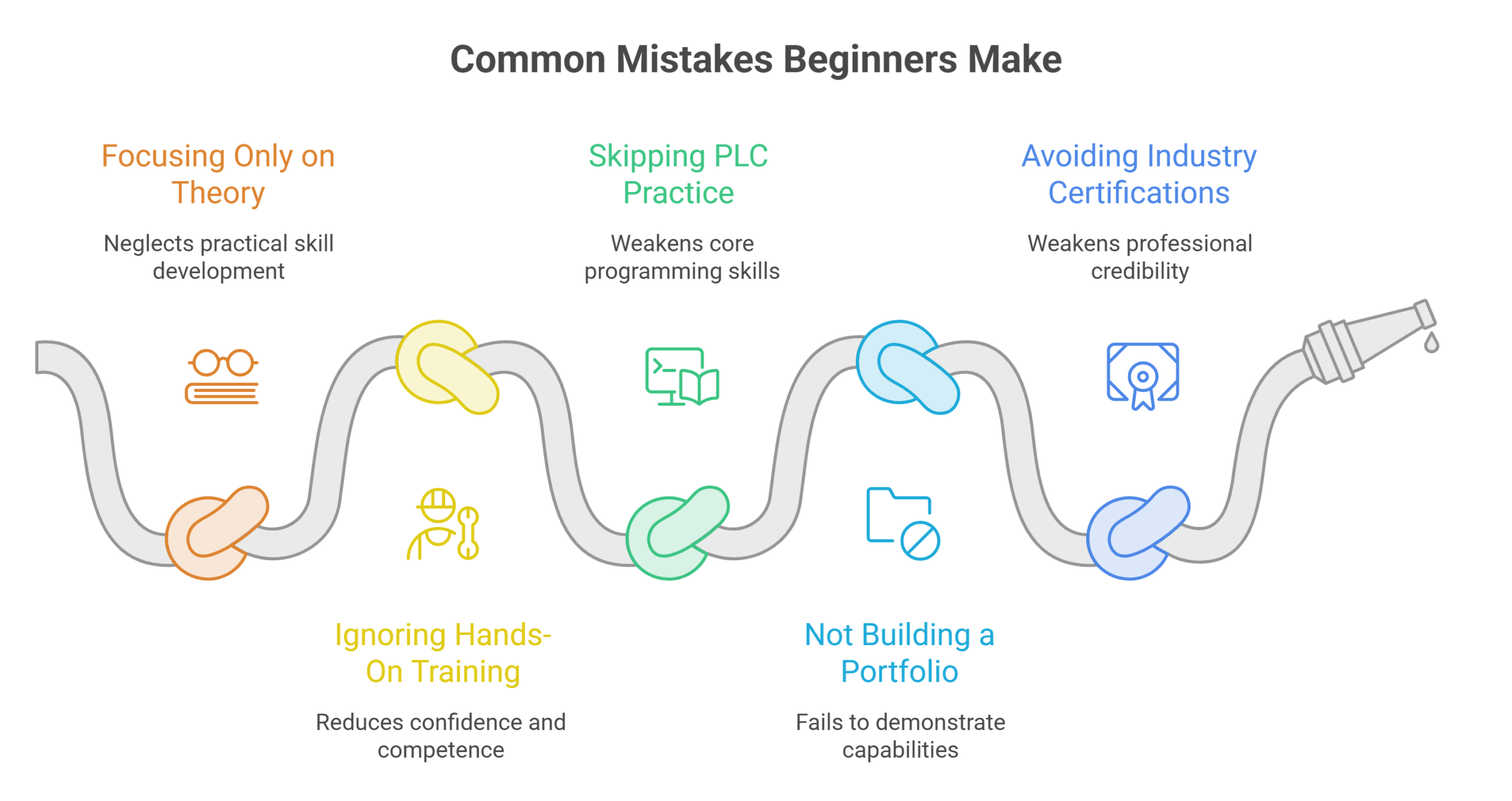
Focusing Only on Theory
Theory provides important knowledge. Practical skills remain equally valuable.
Ignoring Hands-On Training
Practical exposure improves confidence and competence. Real equipment strengthens understanding.
Skipping PLC Practice
PLC programming remains a core skill. Regular practice improves proficiency.
Not Building a Project Portfolio
Projects demonstrate technical capabilities clearly. Employers often value practical work examples.
Avoiding Industry Certifications
Certifications strengthen professional credibility. They can improve career opportunities.
New to Robotics? Start from the Basics. Join Now!
🔮 Is Automation Engineering a Good Career in 2026 and Beyond?
The future remains highly promising. Automation adoption continues expanding worldwide.
Future of Smart Factories
Smart factories increasingly use connected technologies. Automation Engineers support these transformations.
Automation and Artificial Intelligence
AI enhances modern automation systems. Intelligent solutions improve efficiency and performance.
Global Employment Trends
Organizations continue investing in automation. Demand for skilled professionals remains strong.
Long-Term Career Stability
Businesses increasingly depend on automated systems. This supports long-term career stability.
🏁 Final Thoughts
Automation Engineering combines technology, innovation, and problem-solving. It offers opportunities across multiple industries and technologies.
Professionals with strong PLC, SCADA, HMI, and automation skills can build rewarding careers. As smart manufacturing, Industrial IoT, robotics, and AI continue growing, Automation Engineering is expected to remain a valuable and future-focused profession.
Master Robotics and AI!
Ready to build the future? Join our comprehensive robotics course to bridge the gap between complex code and physical motion. You’ll gain hands-on experience giving you the technical edge needed to lead in the age of automation.
Know MoreFrequently Asked Questions
How long does it take to become an Automation Engineer?
The time required depends on prior knowledge, learning pace, and practical experience. Most learners can develop core automation skills within six months to one year by studying PLCs, SCADA systems, instrumentation, and industrial automation concepts while working on projects.
Can a Mechanical Engineer become an Automation Engineer?
Yes, many Mechanical Engineers successfully transition into Automation Engineering. Learning PLC programming, control systems, industrial networks, and automation software can help build the skills needed for automation roles.
Is coding required for Automation Engineering?
Basic coding knowledge is useful because many automation systems require programming and configuration. PLC programming remains essential, while Python and scripting skills can help with automation tasks, data handling, and system integration.
Which PLC should beginners learn first?
Siemens PLC is often recommended because it is widely used across many industries and offers strong learning resources. Allen-Bradley, Mitsubishi, and Schneider Electric PLCs are also valuable depending on regional industry demand and career goals.
What is the salary of a fresher Automation Engineer?
Freshers typically earn between ₹3 LPA and ₹6 LPA, although salaries can vary based on skills and location. Candidates with certifications, internships, and practical project experience often receive better starting packages.
Are automation certifications worth it?
Yes, automation certifications can improve technical knowledge and strengthen a professional profile. Many employers value certifications because they demonstrate practical skills, industry awareness, and commitment to continuous learning.
Can diploma holders become Automation Engineers?
Yes, diploma holders can build successful careers in automation through technical training and hands-on experience. Many professionals begin as automation technicians or trainees and gradually progress into engineering and specialist roles.
Which industries hire Automation Engineers?
Automation Engineers are hired across manufacturing, automotive, pharmaceuticals, food processing, logistics, oil and gas, and power generation sectors. Demand exists wherever automated equipment, industrial control systems, and production processes are used.
Is Automation Engineering future-proof?
Automation Engineering offers strong long-term career prospects because industries continue investing in smart technologies and digital transformation. Growth in Industry 4.0, Industrial IoT, robotics, and Artificial Intelligence is expected to create additional opportunities in the future.
What skills are most important for automation jobs?
PLC programming, SCADA systems, HMI development, industrial networking, and instrumentation remain among the most important technical skills. Employers also value problem-solving ability, analytical thinking, communication skills, and the ability to work effectively within teams.