Table of Contents
HR Generalist vs HR Specialist: Which Is Better?
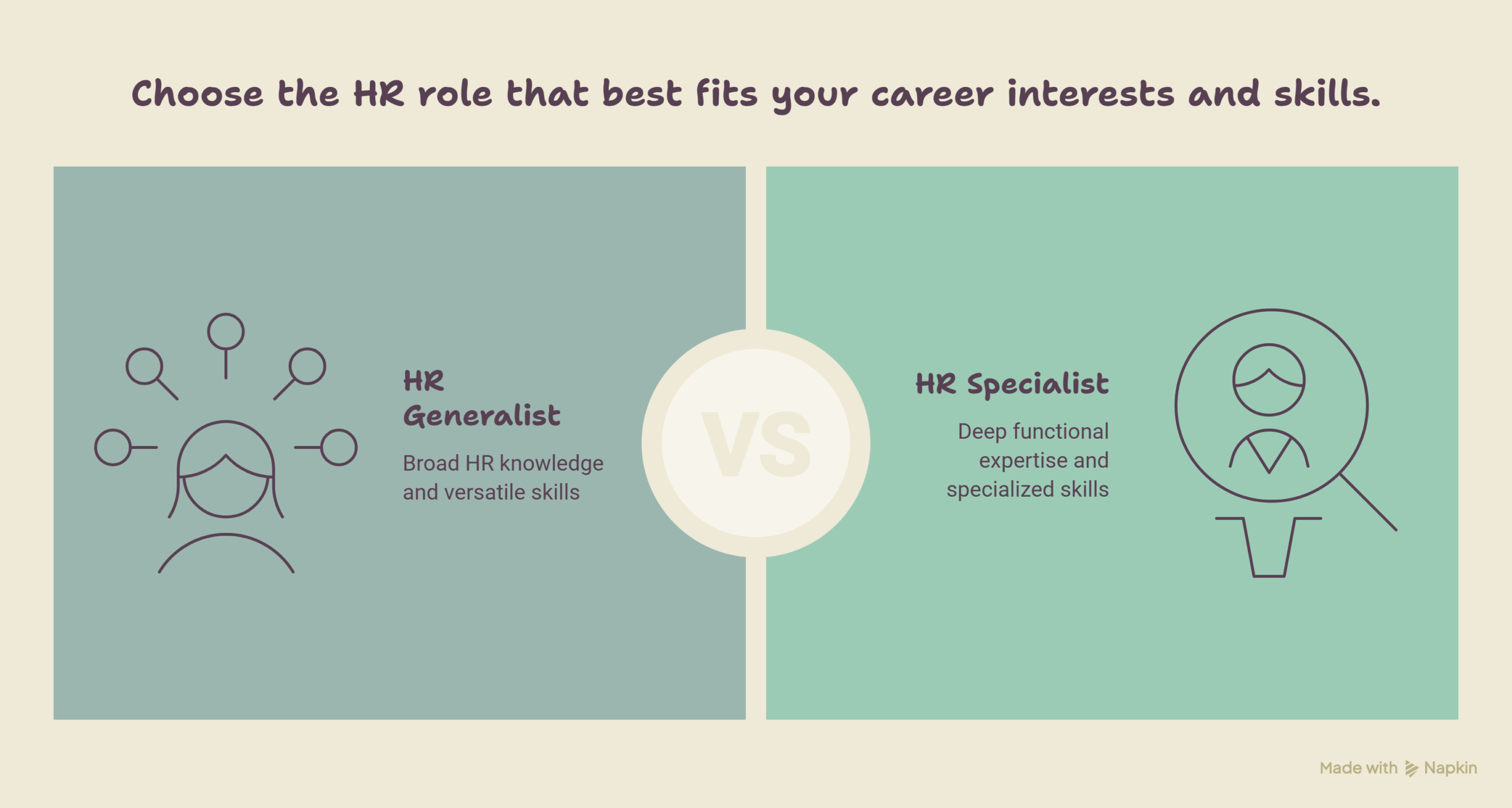
An HR Generalist handles several HR functions. An HR Specialist focuses on one HR function. Generalists have broader responsibilities across HR operations. Specialists develop deeper expertise within specific areas. Neither path is universally better for everyone. Career goals should guide the choice.
| Factor | HR Generalist | HR Specialist |
|---|---|---|
| Scope | Broad | Focused |
| Responsibilities | Multiple HR functions | One specific HR function |
| Skill profile | Versatile | Specialized |
| Career direction | Broad HR leadership | Functional expertise |
Is being an HR your dream? Enrol now for our course on Human Resource!
Understanding the Difference Between HR Generalists and HR Specialists
Human resources includes many different functions. These functions support employees and organizational goals. HR teams often divide these responsibilities among roles.
An HR Generalist works across several HR areas. Their responsibilities can change throughout the workday. They may support recruitment and employee relations. They may also handle HR documentation and policies.
An HR Specialist focuses on one HR function. Their work requires deeper knowledge within that area. Common specializations include recruitment and payroll. Other areas include compensation and employee development.

The main difference involves the scope of work. Generalists work across multiple HR functions. Specialists concentrate on specific HR responsibilities.
Generalists often suit broader HR environments. They gain exposure to many workplace processes. This exposure can build versatile HR knowledge.
Specialists develop deeper functional expertise instead. They often handle complex function-specific responsibilities. Their work may require advanced technical knowledge.
Organizations can benefit from both roles. Generalists can coordinate different HR activities. Specialists can provide expertise within specific functions. The role structure also depends on company size. Smaller companies often need broader HR roles. Larger companies may employ multiple HR specialists.
For example, a small business may hire one generalist. That person could manage several HR activities. A large organization may employ recruitment specialists. It may also employ separate payroll specialists.
Both career paths can provide valuable experience. The right choice depends on individual career goals.
Become an HR Expert – Enroll in Our HR Management Course Today!
Unlock the secrets to effective Human Resource Management with our expert-led course! Learn recruitment, employee relations, performance management, and more to build a thriving workplace. Start your journey toward a successful HR career today!
Know MoreHR Generalist vs HR Specialist: Key Differences
HR Generalists and Specialists differ in several areas. Their responsibilities, skills, and career directions vary.
1. Scope of Responsibilities
Generalists manage multiple HR functions. Their work can cover the employee lifecycle.
They may support:
- Recruitment and selection.
- Employee onboarding.
- Attendance and leave.
- Performance management.
- Employee relations.
- HR policies.
- Training coordination.
- HR documentation.
- Compliance activities.
Specialists focus on narrower responsibilities. Their duties usually center around one function.
A recruitment specialist focuses on hiring activities. A payroll specialist manages payroll processes. A learning specialist focuses on employee development.
2. Knowledge Depth
Generalists need broad HR knowledge. They understand different HR functions at working levels. Specialists develop deeper knowledge in one area. They may handle complex function-specific tasks.
For example, compensation specialists study pay structures. They may also analyze benefits and salary practices.
3. Daily Work
Generalist work can change frequently. Different employee needs can require immediate attention.A generalist might conduct interviews today. Tomorrow may involve policy documentation and employee support.
Specialist work can be more function-focused. Tasks often remain connected to one HR area.
A payroll specialist may review payroll data. They may also resolve salary-related employee queries.
4. Skill Profile
Generalists need versatility and adaptability. They must understand several HR processes. Specialists need technical and functional expertise. Their knowledge often goes deeper within one area.
Generalist skills often include:
- Communication.
- Employee relations.
- Recruitment.
- Organization.
- Problem-solving.
- HR administration.
Specialist skills depend on their chosen function. Analytics specialists need strong data skills. Recruitment specialists need strong sourcing skills.
5. Employee Interaction
Generalists often interact with many employees. They may support employees across different departments. Specialists usually interact around specific processes. Their employee contact depends on their function.
For example, employee relations specialists handle workplace concerns. Payroll specialists handle compensation-related queries.
6. Career Direction
Generalist roles can provide broad HR exposure. This can support movement across HR functions. Specialist roles can build strong functional expertise. They can support careers within specific HR areas.
Generalists may later pursue HR management roles. Specialists may pursue senior functional positions.
7. Work Variety
Generalists usually experience greater task variety. Their responsibilities can change frequently. Specialists often experience greater functional consistency. Their tasks remain connected to their specialization.
Neither approach suits every working preference. Career interests can influence this choice.
8. Organizational Position
Generalists often connect different HR activities. They can coordinate several employee-related processes. Specialists often support specific HR requirements. Their expertise can strengthen specialized operations.
Large organizations may use both structures. Each role can address different organizational needs.
What Does an HR Generalist Do?
An HR Generalist handles various human resource functions. Their work covers multiple stages of employment.
They often support employees from hiring onward. Their responsibilities can continue through employee exit.
Recruitment and Hiring
Generalists may support recruitment activities. They can prepare job descriptions and screen applications. They may also coordinate interview schedules. Generalists can communicate with candidates throughout hiring.
Some generalists conduct initial candidate interviews. Others support recruiters during selection processes.
Employee Onboarding
Generalists often coordinate new employee onboarding. They prepare documents and orientation activities. They may explain workplace policies and procedures. Generalists can also coordinate necessary HR documentation.
Effective onboarding helps employees understand workplace expectations.
Employee Relations
Generalists often serve as employee contact points. They may address workplace concerns and questions. They can also support conflict resolution processes. Sensitive matters may require specialist or legal support.
Performance Management
Generalists can coordinate performance management activities. They may organize appraisal cycles and documentation. They can also support managers during review processes. Their work helps maintain consistent HR procedures.
HR Policies
Generalists may help implement workplace policies. They can communicate policy requirements to employees. They may also maintain employee handbooks and records. Policy work requires careful attention to organizational rules.
Attendance and Leave
Generalists often monitor attendance information. They may also coordinate employee leave requests. These responsibilities support accurate employee records. They can also help identify attendance concerns.
Training Coordination
Generalists may organize employee training programs. They can coordinate schedules, trainers, and participants. Specialized learning teams may handle complex programs. Generalists often provide broader coordination support.
Compliance Support
Generalists may maintain basic compliance documentation. They can help organizations follow employment requirements. Complex legal matters may require specialist support. External professionals may also provide additional guidance.
Employee Engagement
Generalists can support workplace engagement activities. They may coordinate surveys and employee events. They can also gather employee feedback. This information can support workplace improvement efforts.
Overall, HR Generalists connect multiple HR functions. Their role requires flexibility and broad HR knowledge.
What Does an HR Specialist Do?
An HR Specialist focuses on one HR function. Their responsibilities depend on their chosen specialization.
Specialists often develop advanced functional knowledge. They may manage complex tasks within their area.
Recruitment Specialist
Recruitment specialists focus on hiring activities. They may source candidates through multiple channels.
Their responsibilities can include:
- Candidate sourcing.
- Resume screening.
- Interview coordination.
- Employer branding.
- Recruitment analytics.
- Candidate communication.
They often develop strong talent acquisition knowledge.
Compensation and Benefits Specialist
These specialists manage compensation-related activities. They may analyze salary structures and benefits programs. Their work can involve detailed financial information. Strong analytical skills can support these responsibilities.
Payroll Specialist
Payroll specialists focus on employee payment processes. They verify payroll data and resolve payment issues. Their work requires accuracy and confidentiality. Knowledge of payroll systems can also be valuable.
Learning and Development Specialist
Learning specialists focus on employee development. They help design and coordinate training programs.
Their work may include:
- Training needs analysis.
- Program development.
- Learning coordination.
- Training evaluation.
- Employee development planning.
Employee Relations Specialist
Employee relations specialists focus on workplace relationships. They may handle complex employee concerns. Their responsibilities can involve investigations and conflict management. Strong communication skills are important in this area.
HR Analytics Specialist
HR analytics specialists work with workforce data. They transform HR information into useful insights.
Their work can include:
- Workforce reporting.
- Employee data analysis.
- Turnover analysis.
- Performance metrics.
- Workforce planning.
- HR dashboards.
Strong analytical and technology skills are valuable here.
Talent Management Specialist
Talent specialists focus on employee development strategies. They may support succession and talent planning. Their work helps organizations identify future workforce needs. They may also support leadership development programs.
Compliance Specialist
HR compliance specialists focus on employment requirements. They help maintain compliant HR processes. Their responsibilities can require detailed regulatory knowledge. They may also monitor policy and documentation practices.
An HR Specialist therefore develops focused expertise. Their responsibilities remain centered on a particular function. This depth can support specialized career development.
Become an HR Expert – Enroll in Our HR Management Course Today!
Unlock the secrets to effective Human Resource Management with our expert-led course! Learn recruitment, employee relations, performance management, and more to build a thriving workplace. Start your journey toward a successful HR career today!
Know MoreHR Generalist vs HR Specialist: Career Growth and Opportunities
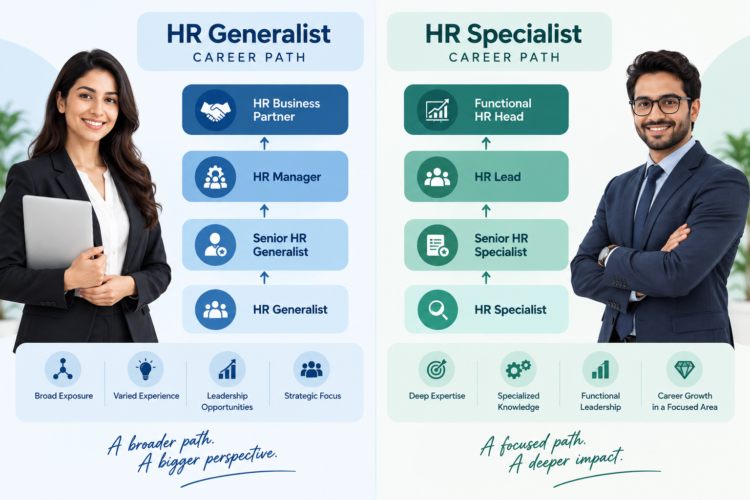
Both HR Generalists and Specialists have career opportunities. Their career paths usually develop in different directions. Generalists gain experience across multiple HR functions. Specialists build deeper expertise within one function.
HR Generalist Career Growth
Generalists can progress through broader HR roles. Their experience can prepare them for management responsibilities.
A typical progression may include:
- HR Assistant.
- HR Executive.
- HR Generalist.
- Senior HR Generalist.
- HR Manager.
- Senior HR Manager.
- HR Business Partner.
Generalist experience can support leadership roles. Managers often need knowledge across different HR functions.
HR Specialist Career Growth
Specialists usually progress within their chosen function. Their careers can develop through increasing technical responsibility.
Possible progression includes:
- HR Specialist.
- Senior HR Specialist.
- HR Lead.
- HR Manager.
- Functional HR Head.
Career progression varies across organizations. Job titles and responsibilities can differ significantly.
Specialists may also develop expertise in areas like:
- Talent acquisition.
- Compensation and benefits.
- Learning and development.
- HR analytics.
- Employee relations.
- HR compliance.
Both paths can lead to senior HR positions. Experience, performance, skills, and qualifications influence progression.
HR Generalist or HR Specialist: Which Career Path Is Right for You?
Choosing between these roles depends on career preferences. Each path offers a different professional experience.
An HR Generalist role may suit people who prefer variety. The work involves multiple HR responsibilities and employee needs.
A generalist path may be suitable when someone enjoys:
- Working across different HR functions.
- Handling varied responsibilities.
- Communicating with different employees.
- Understanding complete HR processes.
- Developing broad workplace knowledge.
- Supporting different business requirements.
An HR Specialist role may suit people seeking deeper expertise. The work focuses strongly on one particular HR function.
A specialist path may be suitable when someone enjoys:
- Developing technical expertise.
- Working within one HR function.
- Analyzing specialized HR information.
- Managing function-specific responsibilities.
- Building advanced professional knowledge.
- Solving specialized HR problems.
Organization size can also influence opportunities. Smaller companies often need versatile HR professionals. Larger companies may offer more specialist positions.
Career goals should also influence the decision. Someone seeking broad HR exposure may prefer generalist work. Someone seeking functional expertise may prefer specialization.
Neither path guarantees a specific career outcome. Opportunities depend on experience and organizational requirements. Professional interests can also change over time.
Is being an HR your dream? Enrol now for our course on Human Resource!
Can You Move From an HR Generalist to an HR Specialist?
Yes, HR Generalists can move into specialist roles. Their broad experience can provide a useful foundation. Generalists already understand several HR processes. This knowledge can help them understand their chosen specialization.
The transition usually starts with identifying one function. The professional can then develop deeper knowledge in that area.
For example, a generalist may prefer recruitment. They could develop skills in candidate sourcing and recruitment analytics.
A transition can involve several steps:
- Choose a preferred HR function.
- Study its processes and practices.
- Gain relevant practical experience.
- Take specialized HR training.
- Work on function-specific projects.
- Seek internal specialist opportunities.
- Build a strong professional portfolio.
Certifications can also support specialized learning. Practical experience remains important for career development. Some organizations allow internal role transitions. Employees can move after demonstrating relevant knowledge and skills.
Generalist experience does not need to be discarded. It can provide useful context for specialized HR work.
Skills and Qualifications to Build an HR Career
HR professionals need both technical and interpersonal skills. The exact requirements depend on their chosen role.
Important HR Skills
Strong communication remains important across HR roles. Professionals regularly interact with employees and managers.
Other valuable skills include:
- Employee relationship management.
- Problem-solving.
- Conflict management.
- Organization.
- Documentation.
- Negotiation.
- Time management.
- Decision-making.
- Data interpretation.
- Confidentiality.
- HR technology.
Generalists benefit from versatility across these skills. Specialists may need deeper functional capabilities.
Educational Qualifications
Many HR professionals begin with relevant academic qualifications. Common educational backgrounds include:
- Human resources.
- Business administration.
- Management.
- Commerce.
- Psychology.
- Industrial relations.
A bachelor’s degree can support entry-level opportunities. A postgraduate HR qualification can provide additional knowledge.
Professional Certifications
HR certifications can strengthen professional knowledge. Specialized certifications can also support particular career directions.
For example, professionals may pursue training in:
- Recruitment.
- Payroll.
- Compensation.
- HR analytics.
- Learning and development.
- Employment compliance.
Practical experience should complement formal qualifications. Employers may consider both knowledge and workplace capabilities.
Advantages and Challenges of HR Generalist vs HR Specialist Roles
Both roles provide distinct professional experiences. Their advantages and challenges depend on responsibilities and workplace conditions.
HR Generalist Advantages
Generalists gain exposure to multiple HR functions. This creates a broad understanding of HR operations.
Other advantages include:
- Varied daily responsibilities.
- Broad HR knowledge.
- Diverse employee interactions.
- Flexible career movement.
- Exposure to different business functions.
- Opportunities to understand complete HR processes.
HR Generalist Challenges
Broad responsibilities can also create challenges. Generalists may need to manage several priorities simultaneously.
Common challenges include:
- High task variety.
- Frequent priority changes.
- Broad knowledge requirements.
- Managing multiple HR processes.
- Balancing employee and business needs.
HR Specialist Advantages
Specialists can develop deep functional expertise. Their focused work allows them to build specialized knowledge.
Other advantages include:
- Clear functional focus.
- Advanced technical knowledge.
- Specialized career development.
- Expertise in complex HR processes.
- Opportunities for functional leadership.
HR Specialist Challenges
Specialization can create narrower responsibilities. Professionals may spend most of their time within one function.
Potential challenges include:
- Repetitive responsibilities in some roles.
- Narrower functional exposure.
- Need for continuous specialization.
- Dependence on specific HR processes.
- Fewer opportunities across unrelated functions.
The workplace itself can change these experiences. Job descriptions, company size, and management structures matter.
Conclusion
HR Generalists handle multiple HR functions. They develop broad knowledge across HR operations. HR Specialists focus on specific HR functions. They build deeper expertise within their chosen area. Generalist roles offer greater functional variety. Specialist roles offer more focused career development.
Both paths can lead to rewarding HR careers. The right choice depends on career interests and goals. Work preferences and skills also matter. Professionals can move between both career paths. Building strong HR knowledge supports long-term career growth.
| Related Links | |
| Top Human Resource Blogs to Follow | How to build a remote HR career |
| HR Certification vs HR Degree | Which one to choose? | 15 HR Intern Interview Questions and Sample Answers |
Become an HR Expert – Enroll in Our HR Management Course Today!
Unlock the secrets to effective Human Resource Management with our expert-led course! Learn recruitment, employee relations, performance management, and more to build a thriving workplace. Start your journey toward a successful HR career today!
Know MoreFrequently Asked Questions
What is an HR Generalist?
An HR Generalist handles multiple HR functions. Their work covers several areas of human resources.
What is an HR Specialist?
An HR Specialist focuses on one HR function. They develop deeper expertise in that area.
What is the difference between an HR Generalist and an HR Specialist?
An HR Generalist handles broader HR responsibilities. An HR Specialist focuses on a specific HR function.
Which role has broader responsibilities, HR Generalist or HR Specialist?
An HR Generalist usually has broader responsibilities. They work across multiple HR functions.
Which role offers deeper specialization in human resources?
An HR Specialist generally develops deeper specialization. Their work focuses on one particular HR area.
Can an HR Generalist become an HR Specialist?
Yes, an HR Generalist can transition into specialization. Relevant training and practical experience can support this move.
What skills are required to become an HR Generalist?
HR Generalists need communication and organizational skills. They also need broad knowledge of HR processes.
What skills are required to become an HR Specialist?
HR Specialists need strong functional knowledge. Analytical and technical skills can also be valuable.
Can an HR Specialist move into an HR Generalist role?
Yes, HR Specialists can transition into generalist roles. Their specialized experience can support broader HR responsibilities.
Is an HR Generalist or HR Specialist better for a career?
Neither role is universally better for every professional. Career goals, interests, skills, and work preferences can guide the choice.