Table of Contents
Toddlers can improve their focus through simple play and daily activities. Short games, picture books, puzzles, and simple tasks can help them stay with one activity for a little longer.
You can give them simple activities to try during the day. Read a short book together. Build something with blocks. Let them sort toys or do a small puzzle. These activities give them a chance to sit, look, and play for a little longer.
Key Takeaways
- Toddlers need short activities to build focus.
- Puzzles, blocks, and matching games give them time to concentrate.
- Reading together helps children listen and follow along.
- A quiet space can help children stay with an activity.
- Regular sleep and breaks are also important for attention.
- Let the child try, repeat, and learn at their own pace.
Register for the Entri Elevate Montessori Teacher Training Program! Join Now!
Why is Focus Important for Toddlers?
How Long Can Toddlers Concentrate?
Toddlers do not focus for long. They may play with a toy for some time. Then, they may leave it and play with something else. The time can be different for each child. It can also change from day to day.
Toddlers Have Short Attention Spans
A toddler may focus on an activity for only a few minutes. This is normal at this age.
For example, a child may:
- Build a few blocks
- Look at a picture book
- Do a simple puzzle
- Sort some toys
- Draw for a short time
After this, the child may lose interest or move to another activity.
Age can Make a Difference
A toddler’s focus can change as they get older. Some children may sit with a toy for a few minutes. Later, they may spend more time with the same toy.
Toddlers do not all focus for the same amount of time. One child may stop quickly, while another may keep playing.
Interest Also Matters
Children often focus longer when they like the activity.
A child who enjoys blocks may play with them for a longer time. Another child may prefer drawing, water play, or puzzles. When an activity is interesting, the child may stay with it without being asked.
Simple Activities Can Hold Attention
Toddlers usually do better with short and simple activities. Too many steps can make the activity hard to follow.
Parents can try:
- Simple puzzles
- Matching games
- Sorting objects
- Stacking blocks
- Looking at books
- Pouring and transferring activities
These activities give children a chance to focus without making the task too difficult.
Focus Takes Time
A toddler will not focus for a long time right away. Short play, books, puzzles, and daily tasks can give them more time to practise. Do not worry if they stop after a few minutes. This is normal for toddlers.
Simple Ways to Improve Toddler Focus and Concentration
Toddlers learn to focus through simple play and daily activities. Parents do not need long study sessions. Small and fun activities are enough to give children practice.
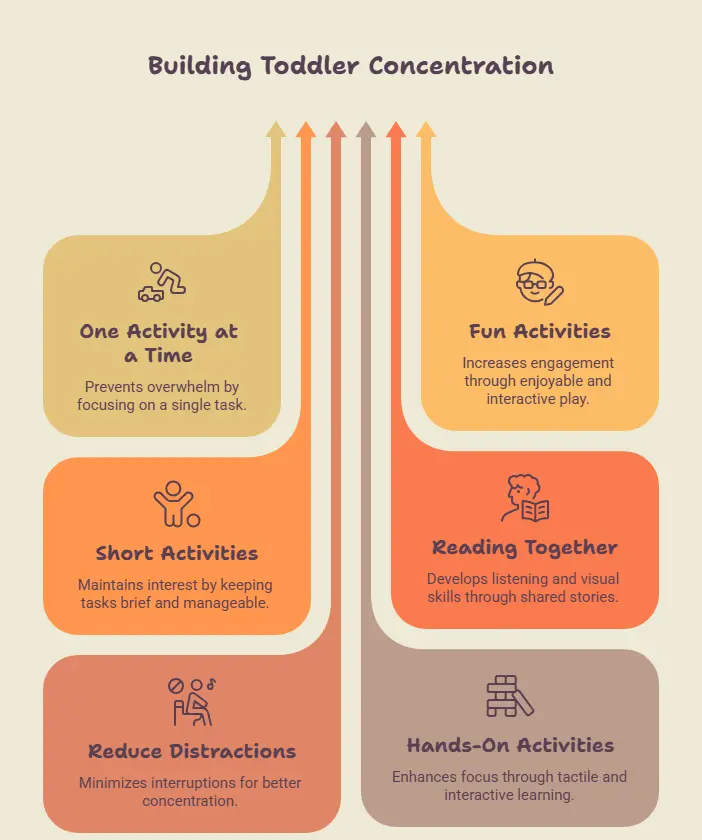
1. Give One Activity at a Time
Give your child one activity instead of many things at once. This helps the child stay with the task.
For example, give a simple puzzle first. After that, the child can play with blocks.
2. Choose Fun Activities
Children often focus better when they enjoy an activity.
Try:
- Drawing
- Blocks
- Puzzles
- Matching games
- Sorting toys
Let the child choose between two activities when possible.
3. Keep Activities Short
Do not expect a toddler to sit for a long time. Start with a short activity. If the child loses interest, give a break. They can come back to the activity later.
4. Read Together
Simple books can help children practise listening and looking. Choose books with big pictures and short stories. Ask easy questions like, “Where is the dog?” or “What is this?”
5. Reduce Distractions
Too much noise can make it hard for a child to focus.
During an activity:
- Turn off the TV
- Keep the phone away
- Use a quiet place
- Keep fewer toys nearby
6. Try Hands-On Activities
Children can focus while using their hands.
They can:
- Stack blocks
- Sort objects
- Pour water
- Fit puzzle pieces
- Build simple towers
These activities also make learning fun.
7. Give Simple Instructions
Use short and clear instructions. Give one step at a time. For example, say “Pick up the red block.” After the child does it, give the next instruction.
8. Give Breaks and Enough Sleep
Toddlers need time to move and rest. Do not make them sit for too long. A tired child may also find it harder to focus. Give enough time for sleep and short breaks between activities.
Focus-Building Activities for Toddlers
Play time is a good time to work on focus. Keep the activity small. A toddler does not need a long activity.
Simple Puzzles
Take a puzzle with a few big pieces. Put the pieces on the table.
The child can pick them up and put them back. Start with an easy one. Move to a harder puzzle when the child is ready. You can start with puzzles that have only a few large pieces.
They help children practise:
- Looking carefully
- Finding the right piece
- Thinking
- Staying with one task
Do not rush the child. Let them take their time.
Building With Blocks
Give the child a few blocks. Let them build a tower or a small house. The tower may fall. Let the child build it again.
This can help with:
- Focus
- Hand control
- Balance
- Simple problem-solving
Sorting Games
Sorting is easy to do at home. Give the child safe objects and ask them to put similar things together.
For example, they can sort objects by:
- Colour
- Size
- Shape
- Type
Start with two groups. Add more only when the child is ready.
Matching Games
Matching games ask children to look at two things and find what goes together.
You can use:
- Picture cards
- Socks
- Shapes
- Toys
- Colours
For example, ask the child to find two socks that look the same. This simple task makes them look closely at the objects.
Drawing and Colouring
Give the child paper and some crayons. Let them draw freely. They do not need to make a perfect picture. Colouring helps the child stay with one activity for some time. It also gives practice in holding and moving a crayon.
You can also ask simple questions like:
- “Can you colour this?”
- “Where is the red crayon?”
- “Can you draw a circle?”
Picture Book Time
Sit with your child and read a small picture book. Point to the pictures and talk about them. Pick books with big pictures and little text. Let the child turn the pages. Ask simple questions about the pictures.
For example:
- “Where is the cat?”
- “What is this?”
- “Can you find the ball?”
Keep the reading time short if the child starts to lose interest.
Simple Memory Games
Memory games can be very simple for toddlers. Show the child two or three objects. Let them look at them for a few seconds.
Then cover one object and ask what is missing. You can also use matching picture cards. Start with only a few cards so the activity does not become too hard.
Practical Life Activities
Everyday tasks can also help children focus. Toddlers enjoy doing small jobs that they see adults doing.
You can let them:
- Put toys in a box
- Wipe a small table
- Put clothes in a basket
- Carry a light object
- Help arrange spoons
Give the child one thing to do. Show it once. Then let the child have a go. Keep the activity short. A puzzle, blocks, or sorting game is enough. If the child stops, they can come back to it later.
How Montessori Activities Improve Concentration
Montessori has many hands-on activities for children. They can sort, match, build, and arrange things. A child can do one activity at a time. They can stop and come back to it later.
One Activity at a Time
Montessori activities usually have one clear task. The child does not need to do many things at once.
For example, a child may put blocks in order or match two similar pictures.
This helps the child:
- Look at one task
- Follow simple steps
- Stay with the activity
- Finish the work
Hands-On Work Keeps Children Busy
Toddlers learn a lot by using their hands. Montessori activities give them something to touch and move.
They may:
- Stack blocks
- Pour water
- Move beads
- Match shapes
- Sort objects
When the child is using their hands, they also need to watch what they are doing. This can help them stay focused.
Simple Activities are Easier to Follow
Montessori work is often simple and clear. The child can see what needs to be done.
For example, a child may need to put a piece into the right place. There are not too many steps to remember. This can help the child focus on the task without feeling confused.
Children Learn to Finish Small Tasks
Montessori activities are often small enough for toddlers to complete. Finishing a simple task gives the child a clear end point.
For example, the child may finish putting all the blocks in a basket.
This teaches the child to:
- Start a task
- Keep working
- Finish it
- Put things away
The Child Learns to Notice Mistakes
Some activities make mistakes easy to see. A puzzle piece may not fit. A block may be in the wrong place.
The child can stop and try another way. This makes the child look closely at the work instead of giving up quickly.
Less Adult Help
The adult first shows the child how to do the activity. Then the child gets a chance to try.
The adult can stay nearby and help when needed. But there is no need to give constant instructions. This gives the child space to focus on the activity.
The Child Can Work at Their Own Pace
Every toddler is different. Some children may finish an activity quickly. Others may need more time.
Montessori activities give children time to work without rushing. A child can stop when they are done and return to the activity later.

Tips for Creating a Focus-Friendly Environment at Home
A noisy room can easily take a toddler’s attention away. The TV may be on. Someone may be talking. There may also be toys everywhere.
You can keep the play space small. A mat, a few toys, and some books are enough.
Keep the Play Area Simple
Do not put all the toys out at once. Leave a few for the child to play with. The rest can stay in a box or cupboard. You can bring them out later.
You can keep:
- Blocks
- Puzzles
- Books
- Sorting toys
- Drawing items
Change the toys from time to time. This can make old toys feel new again.
Reduce Loud Sounds
Noise can easily take a toddler’s attention away. TV sounds, loud music, or constant talking can make it harder to focus.
Try to keep the space quiet when the child is doing an activity. A quiet room can help the child listen and watch better.
Give the Child a Small Work Space
A small table or a clear floor space can be enough. The child can sit there and do one activity. Keep only the things needed for that activity nearby.
For example, if the child is doing a puzzle, give only the puzzle. There is no need to keep many other toys around.
Keep Screens Away During Activities
Phones, TVs, and tablets can quickly take a child’s attention. Try to keep screens away when the child is playing or doing a simple learning activity.
Instead, give the child:
- A picture book
- Blocks
- Crayons
- Simple puzzles
- Matching cards
This gives the child more time to play with one thing.
Keep Things in the Same Place
Children can focus better when they know where their things are. Keep toys and books in easy-to-reach places.
You can use:
- Small baskets
- Low shelves
- Simple boxes
After play, ask the child to put the things back. This also teaches order.
Follow a Simple Routine
Toddlers often feel comfortable when they know what comes next. A simple daily routine can make activities easier.
For example:
- Play time
- Snack time
- Reading time
- Outdoor time
- Sleep time
The routine does not have to be strict. A simple pattern is enough.
Register for the Entri Elevate Montessori Teacher Training Program! Join Now!
Allow Movement Breaks
Toddlers are active. They cannot be expected to sit and focus for a long time.
Let the child:
- Walk around
- Stretch
- Play outside
- Jump
- Run
After some movement, the child may be ready to sit and play again.
Stay Calm and Patient
Parents do not need to keep saying, “Focus” or “Sit still.” Toddlers are still learning how to pay attention. Sit nearby when needed. Give simple help. Let the child try.
Small changes at home can make focus time easier. A simple space, fewer distractions, enough rest, and short activities can help toddlers stay with their play for longer.
Conclusion
Focus and concentration are important skills for toddlers. These skills help children learn, play, listen, and complete small tasks. Toddlers cannot focus for a long time. This is normal at this age. Parents do not need to force children to sit and focus.
Simple activities can help children build focus slowly. Reading, puzzles, blocks, sorting, drawing, and matching games are good choices. Daily tasks can also give children a chance to practise.
A calm home, fewer distractions, enough sleep, and short activities can also help. Give your child time to try and learn. Every child learns at a different pace. With regular practice, gentle support, and fun activities, children can slowly improve their focus and concentration.
Get Certified & Start Your Montessori Career
Montessori Teacher Training Course by Entri App: Gain expert skills, earn certification, and kickstart your teaching career.
Join Now!Frequently Asked Questions
How can I improve my toddler's focus and concentration?
You can improve your toddler’s focus with simple and fun activities. Try puzzles, blocks, drawing, matching games, and picture books. Give one activity at a time and let your child finish it without too many distractions.
How long can a toddler concentrate on one activity?
Toddlers usually have a short attention span. The time can also change based on their age, mood, and interest. Some children may focus for a few minutes, while others may stay with an activity for longer. There is no fixed time for every child.
What activities help toddlers improve concentration?
Many simple activities can help build concentration. Puzzles, sorting games, memory games, colouring, building blocks, and matching games are useful. Practical activities like pouring, transferring, and arranging things can also help children stay focused.
Do Montessori activities help improve toddler focus?
Yes. Montessori activities give children simple tasks that they can do with their hands. Children can work on one activity at a time and repeat it as needed. This gives them time to practise focus, hand control, and completing small tasks.
Does screen time affect a toddler's concentration?
Too much screen time can take time away from play, movement, sleep, and hands-on activities. A simple routine with active play, quiet activities, and enough sleep can support healthy attention habits.
How can I create a good environment for my toddler to focus?
Keep the activity area clean and simple. Remove toys that are not being used and reduce loud sounds when the child is working. Give the child a small space for activities and keep useful materials within easy reach.
Should I force my toddler to sit and focus?
No. Toddlers are still learning how to control their attention. Forcing them to sit for a long time may make activities stressful. Instead, offer short and interesting activities and give the child breaks when needed.
Can sleep and routine improve a toddler's concentration?
Yes. Good sleep and a regular daily routine can support a child’s attention. Toddlers need enough rest to stay active and alert. Regular times for meals, play, sleep, and quiet activities can also make the day easier for the child.