Table of Contents
Facility services experts such as MEP Commissioning Engineers inspect, test, verify and ensure that mechanical, electrical and plumbing (MEP) systems operate properly before they turn over the facility to the client.
Essential Duties:
- HVAC, Electrical, Plumbing & Fire Protection Testing.
- Checking installed equipment for accordance with design.
- Testing functional performance and troubleshooting of systems.
- Contractor, consultant and project team collaboration.
- Commissioning and give over reports.
Average salary: Salaries are affected by experience, location, project complexity and certifications. The experienced specialists receive higher salaries in large commercial and healthcare projects, industrial and infrastructure.
Key Takeaways
- MEP commissioning engineers ensure that all systems in a building work as they should.
- It is their role to check, test, solve errors and provide the system.
- The key systems employed are BMS, electrical, plumbing, HVAC and fire protection.
- It is good to know the ASHRAE, NFPA, and BSRIA standards.
- It is useful to have a background in mechanical or electrical engineering.
- Professional certificates and work experience can improve your career prospects.
- Good opportunities for skilled MEP commissioning professionals would be available in India and the Gulf countries.
Introduction: Why Is MEP Commissioning Important?
A building can look finished on the surface and still have everything on the inside not working properly. The air conditioning system needs to maintain a comfortable temperature , the electrical systems need to operate safely , the plumbing and fire protection systems need to operate as specified .
This is when the value of MEP commissioning becomes clear. This confirms that the building’s services have been constructed, tested and are operational. In addition, commissioning helps to identify technical difficulties prior to the building’s occupants occupying the facility, thus reducing operational issues, energy waste, and maintenance costs.
The MEP commissioning engineer is of crucial importance in ensuring that buildings are safe, efficient and fully functional.
Get Career oriented MEP training with Expert Mentors! Get Free Demo Here!
Master MEP Design with Industry-Leading Training!
Gain in-depth knowledge of Mechanical, Electrical, and Plumbing (MEP) Design with expert-led courses. Learn HVAC, fire safety, sustainable building strategies, and BIM applications to excel in the construction industry.
Know MoreWhat Is MEP Commissioning?

The mechanical, electrical, and plumbing (MEP) commissioning process is an exhaustive procedure that guaranties that all three systems are compatible with one another and that they fulfilll the requirements of the design and operation.
In most cases, there are four important periods:
1. Pre-commissioning
- Before beginning, it is important to inspect all of the installations and equipment.
- Verify that the installation is in accordance with the plans.
- Check to see that the electrical connections, wiring, and hardware are all functioning properly.
- Organize the papers and perform some basic checks.
2. Commissioning
- Check that the tools are usable and that they are up to date.
- Evaluate the system as well as the conditions.
- You may have problems with the installation or operation.
- Deal with problems that arise with service providers.
3. Testing and Balancing (TAB)
- The airflow and water flow in HVAC systems should be measured.
- Modify the apparatus in order to attain the desired level of performance.
- Examine the temperature, pressure, and the effectiveness of the system.
- Document the findings of the tests for approval.
4. Handover
- Ensure that all commissioning reports and test certifications are finished.
- Documentation for operation and maintenance (O&M) should be prepared.
- Educate the team in charge of facilities management.
- The client should be provided with the finished system records.
Roles and Responsibilities of an MEP Commissioning Engineer
- MEP designs for review, technical drawings and project specifications to be validated.
- Ensure mechanical, electrical and plumbing (MEP) systems are installed correctly.
- Development of testing standards and creation of testing programs including commissioning dates.
- Check the HVAC, electrical, plumbing and fire prevention systems operation.
- Spot Problems: Diagnose problems and oversee the execution of any required fixes.
- Performance Monitoring: Check all systems are functioning as per the specifications in the design.
- Work along with teams, including working with consultants, contractors and project managers.
- Reports are to be produced and testing records and commissioning documents are to be kept.
- The assurance of safety has to be done by checking the compliance of all systems to the applicable safety requirements.
- Handover care: Before turning over the building to the customer, ensure all systems have been tested and are ready.
Systems Commissioned by an MEP Commissioning Engineer
The commissioning engineer (MEP) will verify and test the various systems in a building to ensure they are working properly.
- HVAC Systems: Testing of pumps, chillers, cooling towers, air conditioners..
- Electrical systems are inspected for items such as switchgear, lighting and electrical distribution panels.
- Plumbing Systems: Tests water tanks, rivers, drains, sewage systems, and pumps.
- Fire Fighting Systems: Checking fire pumps, sprinklers, fire hydrants and water reels.
- The building management system (BMS) provides monitoring of the building’s sensors, controllers, alarms and automated systems.
Master MEP Design with Industry-Leading Training!
Gain in-depth knowledge of Mechanical, Electrical, and Plumbing (MEP) Design with expert-led courses. Learn HVAC, fire safety, sustainable building strategies, and BIM applications to excel in the construction industry.
Know MoreCommissioning vs design vs site execution roles
The three roles are all part of the same construction project, but they have separate responsibilities.
| Comparison | MEP Design Engineer | MEP Site Engineer | MEP Commissioning Engineer |
|---|---|---|---|
| Main role | Designs building systems | Supervises installations | Tests system performance |
| Work concentration | Planning and calculations | Site implementation | Testing and verification |
| Main activities | Drawings and layouts | Installation and coordination | Functional testing and troubleshooting |
| Equipment | AutoCAD, Revit, HAP | AutoCAD, Revit, site tools | Testing instruments and BMS |
| Project stage | Primarily design | Construction | Construction and completion |
| Primary purpose | Build designs that work | Properly install systems | Make sure the systems are working well |
Standards and Guidelines for MEP Commissioning
The building’s MEP commissioning experts will make sure that all of the systems are working and free of any risk in compliance with the norms and guidelines set by the international organizations.
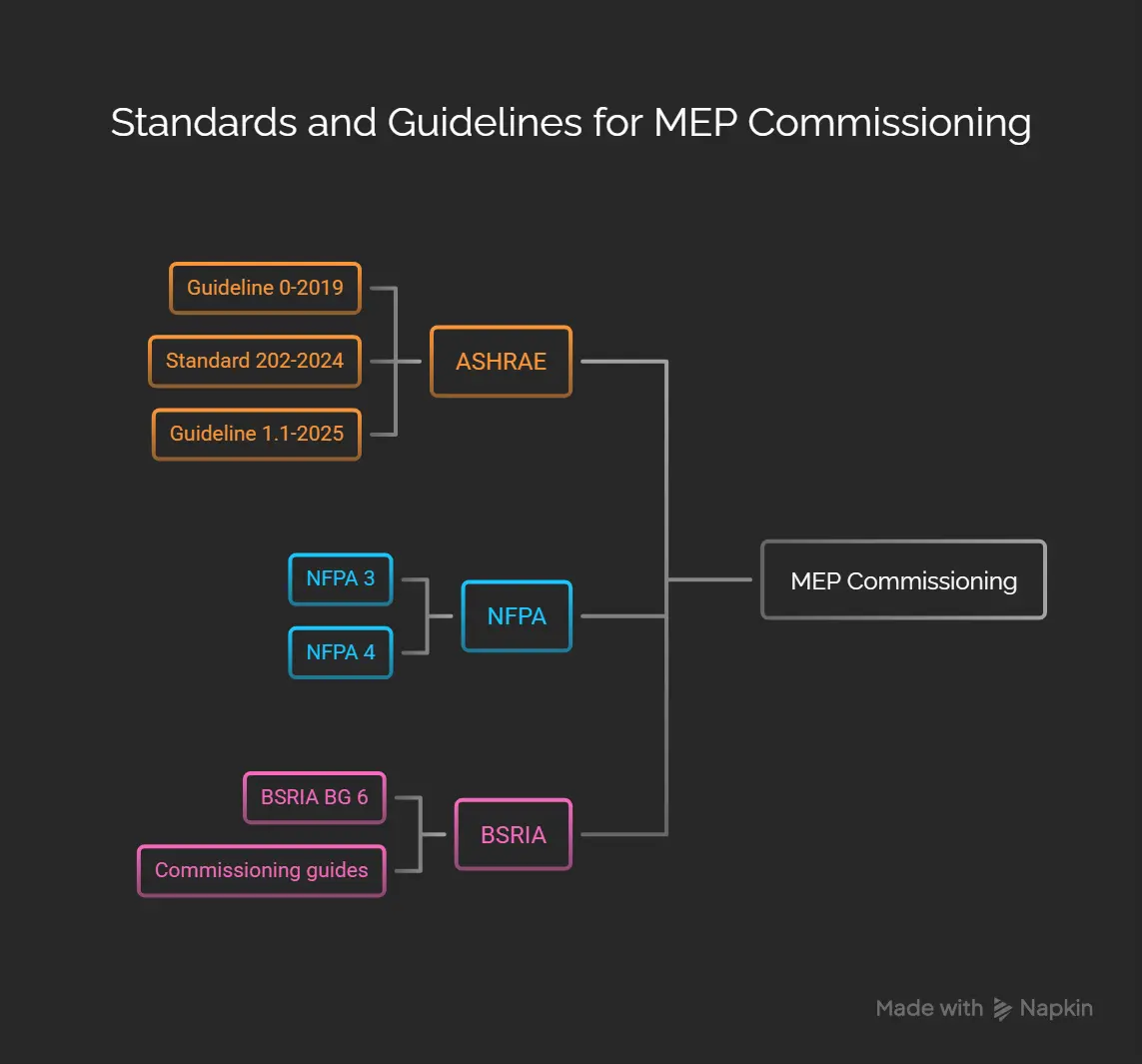
ASHRAE is an acronym for American Society of Heating, Refrigerating, and Air-Conditioning Engineers
- ASHRAE Guideline 0-2019 addresses the entire commissioning procedure.
- ASHRAE Standard 202-2024 addresses the commissioning of new buildings and systems.
- ASHRAE Guideline 1.1-2025 provides technical guidance for the installation and operation of modern HVAC and refrigeration systems.
NFPA (National Fire Protection Association): Develops and publishes codes and standards for fire protection and life safety
- .NFPA 3: Commissioning of fire prevention and life safety systems.
-
NFPA 4: Integrated testing of fire prevention and life safety systems.
It provides technical assistance, commissioning procedures and best practice for building services systems.
guidance, commissioning procedures and best practices for building services systems.
BSRIA (Building Services Research and Information Association): It provides technical assistance, commissioning procedures and best practice for building services systems.
- BSRIA BG 6: Guidance on design activities and information required for building services.
- BSRIA commissioning guides: They provide practical information on the commissioning of HVAC and other building services systems.
Skills Required to Become an MEP Commissioning Engineer
A commissioning engineer for an MEP needs to know their technology and be skilled at their profession to work on complex building systems.
| Technical Skills | Soft Skills |
|---|---|
| How HVAC systems function | Communication skills |
| Knowledge of pipelines and electricity | Problem-solving |
| Fire suppression systems | Working as a team |
| Testing and commissioning procedures | Time management |
| Checking everything works (tab) | Heeding |
| BMS and Controllers | Making decisions |
| Checking the MEP drawings | Writing a report |
| Understanding of international law | Looking after projects |
Qualifications and Certifications for an MEP Commissioning Engineer
A commissioning engineer working with MEP will often require an engineering qualification in mechanical, electrical or building services engineering. Depending on the role and experience, employers may also consider suitable technical diplomas and vocational qualifications.
Educational Requirements:
The following qualifications are applicable.
- BE/B.Tech Mechanical Engineering: HVAC, Chilled Water Systems, Ventilation and Mechanical Commissioning
- BE/B.Tech in Electrical Engineering : Useful for electrical distribution, generators, transformers and electrical testing.
- BSc Building Services Engineering: This is about the mechanical and electrical services in buildings.
- Diploma in mechanical or electrical engineering: Prepares students for technician and some commissioning engineering positions, according on employer requirements.
Relevant technical or vocational qualification. Experienced commissioning technician may be considered.
Professional Certifications
- BCxP: ASHRAE offers Building Commissioning Professional (BCxP) Certification: This certification means you understand building commissioning.
- CxA: The ACG offers the CxA (Certified Commissioning Authority) curriculum, which is largely focused on the management and supervision of commissioning projects.
- BSC Certified Professional: This qualification, offered by the NEBB, shows that an individual is professionally qualified to commission building systems.
- BSC Certified Technician: This is a NEBB certification that verifies your hands-on commissioning expertise .
- TAB Certification. The NEBB offers a TAB Certification that is primarily concentrated on the testing, adjusting and balancing of HVAC systems.
Tools and Instruments Used by MEP Commissioning Engineers
The commissioning professionals use a lot of tools to assess the system’s performance and detect any technical problems. Some tools that are commonly utilized are:
Anemometer: It is used to measure the velocity of the air flow in air exits and ventilation pipes.
Digital manometer: Measures the difference in pressure between air and gas.
Multimeter: Measures electrical voltage, current and resistance.
Clamp meter: It is used to measure current without having to disconnect wires .
Thermal imaging camera: Can detect abnormal temperature patterns in mechanical and electrical devices.
Flow meter: Measures the speed of water flow in pipes.
Tachometer. Used for monitoring speed of motors and fans.
Data loggers: Used to measure temperature, pressure and other operating characteristics as time passes.
BMS software: Monitors and checks automated building systems.
Engineers need to know how to securely utilize testing equipment and how to execute tests in a particular way.
MEP Commissioning Engineer Salary in India and the Gulf
The pay of an MEP commissioning engineer is determined by their experience, technical competence, the size of the project, the location and the company. People who have worked on HVAC, electrical systems, BMS and large scale finishing projects may get paid extra.
Salary in India
Indicative annual salary (in INR)
| Experience | Anticipated Annual Salary |
|---|---|
| Fresher (0-2 yrs) | ₹3–6 LPA |
| Mid-level (3–5 years) | ₹5–9 LPA |
| Experienced (6–10 years) | ₹8–15 LPA |
| Senior (10–15 years) | 12-18 Lakhs PA |
| Lead / Manager (15+ yrs) | ₹15–22 LPA |
Gulf Countries Salary
Monthly wage in UAE (AED) (indicative)
| Employment History | Monthly Salary Expectation |
|---|---|
| Fresher (0–2 years) | AED 4,000–5,000 |
| Mid-level (3-5 Yrs) | AED 5,000–7,000 |
| Mid-career (6-10 years) | AED 6,000–9,000 |
| Senior (10–15 years) | AED 8,000–12,000 |
| Lead / Manager (15+ yrs) | AED 12,000–17,000+ |
The remuneration of a commissioning engineer MEP varies on the experience, technical expertise, project size, location and employer. Experienced professionals in HVAC, electrical systems, BMS and large-scale commissioning projects can command greater compensation.
How to Become an MEP Commissioning Engineer
Step 1: Get a degree in engineering.
Consider a certificate or degree in mechanical or electrical engineering. Acquire a sound general knowledge of the principles of building services and engineering.
Step 2: Get to know the fundamentals of mechanical, electrical and plumbing systems
Understand the Functioning of Building Automation Systems, Heating, Ventilation and Air Conditioning (HVAC), Plumbing and Fire Prevention Systems.
Step 3: Learn how to use the right software and technology tools
You should be familiar with AutoCAD, Revit MEP, HVAC design software, and BMS platforms. Learn to read technical drawings and equipment spec lists.
Step 4: Familiarize yourself with the commissioning procedure
You should become familiar with pre-commissioning, functional testing, testing and balancing, troubleshooting and handover papers.
Step 5: Gain experience in the real world
If you are working in MEP contracting, an engineering consultancy or testing and commissioning firm, search for internships or graduate positions.
Step 6: Know international standards
Look into the ASHRAE, NFPA, BSRIA and any state rules that may be pertinent.
Step 7: Get better at your work
Improve your skills in the areas of writing technical reports, speaking with others, working with others and solving problems.
Step 8: Look for a job that involves commissioning
Develop a resume that showcases your engineering education, project experience, technical skills and practical ability. Please fill out an application to apply for opportunities in India and the Gulf region.
Get Career oriented MEP training with Expert Mentors! Get Free Demo Here!
Conclusion
MEP commissioning is a crucial stage in the building process, designed to verify that all of the systems within a building operate safely, effectively and as intended. Commissioning engineers verify that buildings are completely operational, and they examine everything from plumbing and fire safety to HVAC and electrical.
With the necessary engineering degree, technical expertise, practical experience and an understanding of international standards you can forge a fulfilling career in this industry. Students aspiring to be an engineer can also master the principles of MEP design, which helps them understand how building services are designed and arranged.
Master MEP Design with Industry-Leading Training!
Gain in-depth knowledge of Mechanical, Electrical, and Plumbing (MEP) Design with expert-led courses. Learn HVAC, fire safety, sustainable building strategies, and BIM applications to excel in the construction industry.
Know MoreFrequently Asked Questions
What does an MEP commissioning engineer do?
An MEP commissioning engineer inspects, tests and verifies mechanical, electrical and plumbing systems to ensure they function according to project specifications before building handover.
Is MEP commissioning a good career?
Yes. It offers opportunities in commercial construction, infrastructure, healthcare, industrial facilities and data centres. Professionals can progress into senior engineering and project management positions.
What qualifications are required for an MEP commissioning engineer?
A degree or diploma in mechanical or electrical engineering is commonly preferred. Relevant practical knowledge and commissioning experience are also important.
Is MEP commissioning different from MEP design?
Yes. MEP design involves planning and preparing building services layouts, while commissioning involves testing and verifying the installed systems to ensure they perform as intended.
Can freshers become MEP commissioning engineers?
Yes. Fresh engineering graduates can start as junior commissioning engineers or testing and commissioning assistants. Practical training and site exposure help them develop the required skills.
Which country offers good opportunities for MEP commissioning engineers?
The UAE, Saudi Arabia, Qatar and other Gulf countries offer opportunities in commercial construction, infrastructure, healthcare and industrial projects. India also has opportunities in these sectors.