
Table of Contents
Parents can provide their toddlers with simple and entertaining activities to help them develop strength in their hands and fingers. They will be able to obtain a better grip on the pencil as a result of these activities, which will provide them with an advantage over the other competitors.
On a consistent basis, parents should engage in play with their children to facilitate the development of their children’s fine motor skills, hand strength, finger coordination, and control of the pencil.
They should assist their children in developing these talents primarily through this strategy. Parents should not expect their children (or themselves) to have perfect handwriting.
Register for the Entri Elevate Montessori Teacher Training Program! Join Now!
Key Takeaways:
- As children grow their hand and finger strength, they progressively develop the ability to handle a pencil.
- Cooperation and control of the pencil can be improved through the use of fine motor activities.
- Tweezers, playdough, stickers, and threading are all easy activities that can help strengthen the hands of young children.
- Drawing and coloring are also great ways for children to develop control of their hand motions.
- Encouraging a flawless pencil grip at an early age should be avoided by parents.
- Keep exercises involving the pencil grip brief, enjoyable, and devoid of pressure.
- Pencil control is something that develops at a different rate for each youngster.
What is the Correct Pencil Grip for Toddlers?
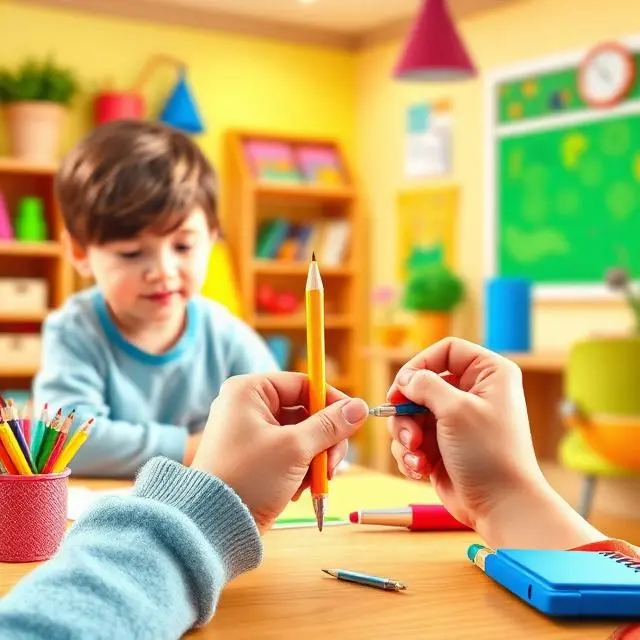
The development of a mature pencil grip does not occur immediately in toddlers. The natural progression of their grasp occurs when the muscles in their hands and fingers grow more developed. Teaching a child the proper pencil-holding technique is crucial for their development, yet it is often overlooked despite being one of the most important skills.
Toddlers as young as two years old may use their entire hand to grip crayons or pencils. They will progressively start using their fingers in a more independent manner as they continue to develop. In the act of writing, the tripod hold is a typical technique. This grip involves placing the pencil between the thumb and index finger, with the middle finger providing support for the pencil.
However, parents should avoid imposing a particular grasp on their children too soon. The primary objective is to assist children in developing a method of controlling writing tools that is both comfortable and functional.
Why is a Good Pencil Grip Important?
1: What is the primary focus of the first plane of development in the Montessori method?
To ensure proper development of fine motor skills, toddlers’ pencil grips are essential. Fingers, hands, and wrists need to be coordinated to use writing implements such as pencils, crayons, and other writing tools.
Toddlers can acquire these skills through play, sketching, coloring, and other activities such as daily activities. Kids are able to regulate their behaviors and enjoy early writing when they have access to functional pencil grips.
1. Improves the ability to use fine motor skills
Fine motor abilities include the actions of the fingers and hands. Children require these skills to carry out activities such as sketching, coloring, flipping pages, buttoning clothing, and using utensils.
Holding and moving crayons and pencils around is a particularly effective way for toddlers to practice their coordination. Toddlers can improve their ability to control motions through practice.
2. Improves Pencil Control
A functional grip allows children to steer a writing instrument in the desired direction. When children draw lines, circles, shapes, characters, and numbers, the grip is an important consideration.
Improved management enables children to:
- Make different line types
- Color in larger portions
- Draw basic shapes
- Pattern tracing
- Change the direction of strokes
- Start building pre-writing skills
3. Enhances the strength of the hands and fingers
The use of a pencil is not sufficient for writing. In order for youngsters to be able to write without discomfort, their fingers, hands, and wrists need to be strong and sturdy.
In addition to increasing learning, activities such as coloring, playdough, threading, peg games, and tongs help strengthen these muscles.
4. Contributes to Hand-Eye Coordination
Observation of the movements of the children’s pencil or crayon is required. Because of this, hand-eye coordination is improved.
In the process of gazing at it, a child moves a crayon down a line that is located between two points. Practicing this ability can be done by drawing, tracing, and joining dots.
5. Assists Children in Writing
Beginning with scribbling, toddlers eventually develop the ability to draw lines, shapes, and other pre-writing skills. These skills are built on functional grips.
Instead of expecting youngsters to write letters instantly, parents can encourage their children to become proficient in handwriting.
6. Promotes a comfortable writing practice
When children draw or write for extended periods of time, they may experience fatigue due to an inadequate grasp. A comfortable grip helps children play without strain.
When it comes to tripod grips, toddlers should not be expected to have perfect control. As children develop their skills, they may use various grips.
7. Inspires a sense of self-reliance
When children are able to manipulate crayons and pencils, they may experience a greater sense of calm when drawing and practicing pre-writing. Children can be motivated to attempt more challenging activities by completing simpler tasks such as coloring or drawing a circle.
This helps students become more independent in the classroom as well as in their day-to-day lives.
8. Improves Students’ Readiness for School
The ability to handle a pencil, fine motor coordination, visual attention, hand strength, and basic pattern following are all components of school readiness.
Allowing toddlers to draw, move objects, and use their hands is a particularly effective way for parents to assist their children in getting ready for school.
Get Certified & Start Your Montessori Career
Montessori Teacher Training Course by Entri App: Gain expert skills, earn certification, and kickstart your teaching career.
Join Now!When Should Toddlers Learn Pencil Grip?
Toddlers acquire the pencil grip as their hand and finger muscles get stronger over time. A superb grip at a very young age is not required. Initially, children may hold crayons in their whole hand when they are scribbling. Over time kids learn to control their fingers slowly.
From the age of 2-3 years, parents can begin working on fine motor skills with simple activities such as coloring, drawing lines, playing with playdough, and using stickers. By 3 to 4 years, youngsters might show improved control in sketching forms and tracings.
Many children will acquire a more mature pencil grip around 4 to 5 years and can start practicing fundamental pre-writing and handwriting abilities.
The most crucial is to offer regular, enjoyable opportunity for practice without mandating a particular grip. Every youngster learns pencil control at their own rate.
Easy Activities to Improve Pencil Grip
Easy, enjoyable games that build toddlers’ fingers and strengthen their pencil grip and hand control. But these activities need not appear to be typical writing practice. Allow children to have a variety of materials and tools and to utilize their fingers and hands in an organic way.
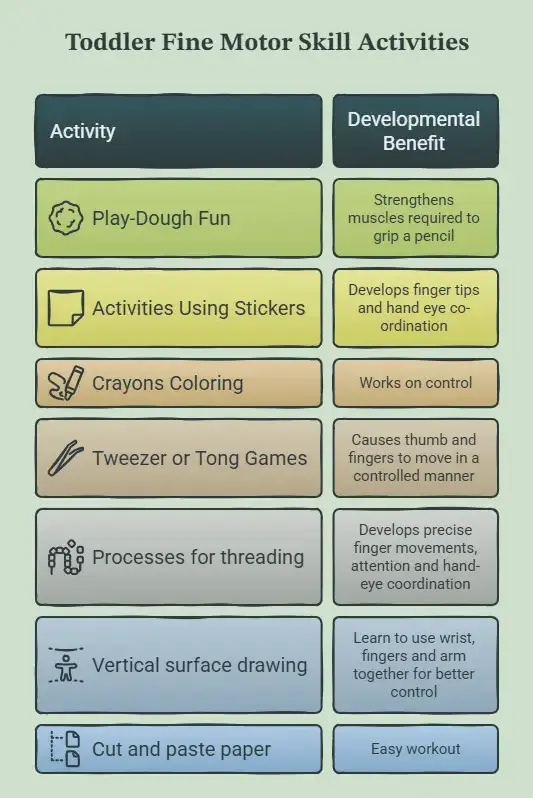
1. Play-Dough Fun
Let your toddler roll, squeeze, compress and flatten play dough. Pinching small bits between your thumb and fingers also helps to strengthen up the muscles you require to grip a pencil.
2. Activities Using Stickers
Provide your child with small stickers that peel and stick. Stickers are good to handle and place as they aid to develop the use of finger tips and improve hand eye co-ordination.
3. Crayons Coloring
Offer lots of thick crayons and simple coloring sheets. Encourage your child to draw lines and circles and all sorts of shapes. Short coloring sessions work on control, with no pressure on the child.
4. Tweezer or Tong Games
Children can pick up appropriate objects using child safe tweezers or tongs and place in a bowl. This causes the thumb and fingers to move in a controlled manner.
5. Processes for threading
By stringing large beads or other age appropriate materials onto a thread, the youngsters learn to develop precise finger movements. It also develops attention and hand-eye coordination.
6. Vertical surface drawing
Hang a big sheet of paper on a wall or on an easel and let your child draw. Children learn to draw vertically to learn to use their wrist, fingers and arm together to have better control.
7. Cut and paste paper
Let your child tear up some paper into small pieces, then glue them onto another piece of paper. This easy workout will help to develop the fingers and prepare them for fine hand movements.
Fine Motor Activities for Better Pencil Control
By strengthening their fingers and improving their coordination, toddlers who participate in fine motor activities are better prepared for writing in the future.
A few easy activities that parents can participate in are as follows:
- Stringing together huge beads
- Putting together with blocks
- Using pins for clothing
- The act of tearing and adhering paper
- Exchanging the pages of books
- Making balls out of paper
- Moving things around with the use of tongs
- Scissors that are safe for children
- Dealing with straightforward puzzles
- Drawing on a vertical surface
Drawing on a vertical surface, such as a large sheet of paper that is affixed to a wall or an easel, can enable youngsters to move their wrists and arms while also gaining stronger control while they are doing so.
Get Certified & Start Your Montessori Career
Montessori Teacher Training Course by Entri App: Gain expert skills, earn certification, and kickstart your teaching career.
Join Now!Montessori Activities to Develop Pencil Grip
By engaging in the use of hands-on, practical experiences, children can develop their independence and strengthen their hands via activities that are inspired by the Montessori principles.
Activities Required in Everyday Life
There are a variety of activities that can help build hand and finger coordination, including transferring things, opening containers, pouring, squeezing, and utilizing equipment that are intended for children.
Activities using Pegs
With the help of a board or container, children are able to insert and remove pegs. This fosters controlled movements of the fingers as well as strength in the hands.
Threading Activities
The development of hand-eye coordination and finger control can be facilitated by stringing large beads or other objects that are suitable for the task.
Monitoring the Activities
It is important to provide simple lines, curves, and forms for a kid to trace once they have demonstrated an interest in pre-writing. Be sure to keep the activity brief and lighthearted.
Writing on a Sand or Salt Tray
Give children a tray that contains a thin layer of sand or salt and allow them to use their fingers to create lines, circles, and forms in the tray or salt. In this way, pre-writing practice can be approached from a sensory perspective.
Common Pencil Grip Mistakes to Avoid
It is not uncommon for parents to place an inordinate lot of importance on modifying the manner in which their toddler holds a pencil. There are a few easy tips that have the ability to make practice more positive.
Avoid putting too much pressure on a particular grip
Toddlers go through a process that takes some time in order to develop the strength and coordination of their fingers.
Participating in activities that need people to constantly reposition their fingers over and over again might be a frustrating experience for those individuals.
Avoid sitting down for extended periods of time to write
Additionally, toddlers are still in the process of developing their hand muscles and have a limited capacity for attention.
It is important that the activities that involve the pencil be kept brief and that they include a significant amount of opportunity for mobility and play.
Always make an effort to avoid using only pencils
Crayons, chalk, paintbrushes, playdough, stickers, tweezers, and other materials that need hands-on engagement are some of the things that can be utilized to assist in the development of writing abilities. Other objects that can be used include tweezers.
Make every effort to refrain from drawing comparisons between children
It takes a varying amount of time for each and every child to develop their fine motor skills over the course of their childhood.
Instead than comparing your child’s current abilities to those of other children, the most effective method for evaluating their progress is to compare them to their own former abilities.
It is essential to abstain from making writing a burdensome task
It is important to keep a humorous attitude when sketching and other pre-writing exercises. Your child should be commended for the efforts that they have made, and you should encourage them to make new experiences.
Register for the Entri Elevate Montessori Teacher Training Program! Join Now!
Conclusion
Providing assistance to toddlers in the development of a pencil grip does not need hours of practice with handwriting. Playdough, sticker games, painting, threading, puzzles, tweezers, and other Montessori-inspired practical life activities are some of the simple activities that parents can use to help their toddlers develop their pencil grip.
Before the beginning of formal writing, the objective is to strengthen the hands of the children, develop their coordination, and increase their confidence. It is possible for children to gradually improve their pencil control at their own rate if they are provided with regular opportunities to play and practice.
Get Certified & Start Your Montessori Career
Montessori Teacher Training Course by Entri App: Gain expert skills, earn certification, and kickstart your teaching career.
Join Now!Frequently Asked Questions
How can I improve my toddler's pencil grip?
You can improve your toddler’s pencil grip by offering activities such as playdough, coloring, stickers, threading, puzzles, tweezers, and drawing. These activities strengthen the fingers and improve fine motor control.
At what age should a child hold a pencil correctly?
Pencil grip develops gradually during the toddler and preschool years. Children may begin with a whole-hand grip and gradually move toward more controlled finger-based grips as their fine motor skills develop.
How can I strengthen my toddler's hands for writing?
Playdough, building blocks, threading beads, using tongs, sticker activities, clothespins, and simple puzzles can help strengthen the hands and fingers needed for early writing.
Are crayons good for developing pencil grip?
Yes. Crayons provide opportunities for toddlers to practice holding and controlling a writing tool. Short, thick crayons can be particularly easy for small hands to manage.
What activities help with pencil control?
Coloring, tracing, drawing lines and shapes, sticker activities, finger painting, threading, tweezing, and drawing on a vertical surface can support pencil control.
Should I correct my toddler's pencil grip?
You can gently guide your child, but avoid constantly correcting their grip. Young children need time to develop the hand strength and coordination required for a mature pencil grip.
Are Montessori activities good for pencil grip development?
Yes. Montessori-inspired practical life activities such as transferring, pouring, threading, using tongs, and tracing can support fine motor skills and hand control.
Why does my toddler struggle to hold a pencil?
A toddler may struggle because their hand and finger muscles are still developing. Providing regular fine motor activities can help build strength and coordination.
How long should toddlers practice holding a pencil?
There is no need for long practice sessions. Short, enjoyable activities combined with plenty of hands-on play can provide valuable opportunities to develop pencil control.