Table of Contents
Neither is better for everyone. It depends on what you want from your career.
An MNC gives you a clear path, steady pay and deep skills in one area. A startup gives you speed, variety and more work to own early on.
How they differ:
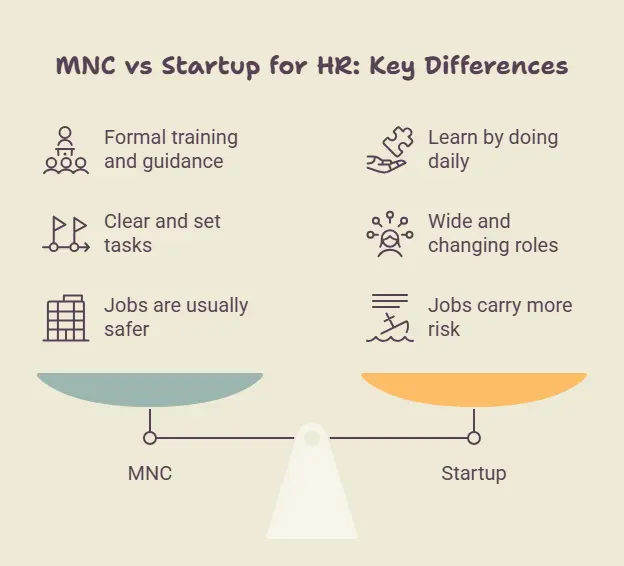
- Learning: MNCs teach in depth. Startups teach by doing.
- Work: MNC roles are narrow. Startup roles are wide.
- Pay: MNC pay is steady. Startup pay can vary.
- Growth: MNC promotions are slow and clear. Startup promotions can be fast, but not always.
- Job safety: MNCs are usually safer.
- Specialization: MNCs make experts. Startups make all-rounders.
Freshers can learn well in either place. Experienced people should pick based on what they want next.
Is being an HR your dream? Enrol now for our course on Human Resource!
Key Takeaways
- No place is best for every HR person.
- MNCs give training, structure and steady growth.
- Startups give speed and more responsibility.
- Freshers should think about how they like to learn.
- Experienced people should think about their next goal.
- The company and the manager matter as much as the type.
Introduction: Why the Choice Matters for HR Professionals
Your first few jobs shape a lot. They decide what you learn and who you meet. They also decide how fast you move up.
Take two people who finish their HR course together. One joins an MNC. The other joins a startup. After three years, they may know very different things.
The first person may know one area very well, like hiring. The second may have touched payroll, hiring, policies and exits, all in the same year.
Why It Is Hard to Choose
People love to say one is better. In truth, both have good days and bad days.
- MNCs look good on a resume
- Startups can grow you faster
- MNCs pay on time, every time
- Startups give you more freedom
What You Will Get from This Blog
- A clear idea of how each place works
- The main differences, one by one
- The good and hard sides of both
- A simple way to decide
MNC vs Startup: Understanding the Two Work Environments
Let us start with what each one is.
What Is an MNC?
MNC means multinational company. It has offices in more than one country. It is usually big and well known.
- Thousands of employees
- Fixed rules and steps
- Separate teams for each HR task
- Set job levels
Think of large banks, IT firms and big consumer brands.
What Is a Startup?
A startup is a young company. It is small and trying to grow. Most things are still being built.
- A small team
- Rules that change often
- Few fixed processes
- People who do many jobs
Think of a new app company or a small online brand.
What HR Looks Like in an MNC
In an MNC, HR is a full department. Many people work in it.
- One person only hires
- One only handles payroll
- One only runs training
- One only handles employee issues
Each person goes deep into one thing.
What HR Looks Like in a Startup
In a startup, HR can be one or two people. Sometimes it is just you.
- You may do interviews in the morning
- Fix a payroll error after lunch
- Write a leave policy by evening
You do a little of everything.
Something in Between
Not every company is at one end. Mid-size firms sit in the middle. They have some rules and some speed. Many people find this a good place to work.
Become an HR Expert – Enroll in Our HR Management Course Today!
Unlock the secrets to effective Human Resource Management with our expert-led course! Learn recruitment, employee relations, performance management, and more to build a thriving workplace. Start your journey toward a successful HR career today!
Know MoreMNC vs Startup for HR: Key Differences
Now let us go through the main differences.
1. Learning
In an MNC:
- You get formal training
- You learn set processes
- Senior people guide you
- You go deep into one area
In a startup:
- You learn by doing
- New problems come up daily
- You pick up many HR areas at once
- Fewer people are there to guide you
If you like guidance, an MNC feels comfortable. If you like figuring things out, a startup can be fun.
2. Responsibilities
In an MNC:
- Your role is clear
- Your tasks stay the same for a while
- You handle one part of HR
In a startup:
- Your role is wide
- Your tasks keep changing
- You may handle all of HR
Some people enjoy the clear lines. Others get bored with them.
3. Salary
In an MNC:
- Pay is steady
- Raises usually come once a year
- Benefits like insurance and leave are often better
In a startup:
- Pay may start lower
- Raises can be quick if the company grows
- Some offer shares in the company
- Pay may be late if money is tight
Always ask about pay timing in a startup interview. It is a fair question.
4. Career Progression
In an MNC:
- Promotions follow set levels
- Each step may take a few years
- The path is easy to see
In a startup:
- Promotions can come fast
- Titles can change quickly
- The path is not always clear
5. Job Stability
In an MNC:
- Jobs are usually safer
- The company has more money to handle bad times
- Layoffs can still happen
In a startup:
- Jobs carry more risk
- The company may run out of money
- Some startups shut down
6. Specialization
In an MNC:
- You can become an expert
- Areas like hiring and pay are separate roles
In a startup:
- You become an all-rounder
- It is harder to go deep
- But you see how the whole thing fits
Quick Comparison
| Point | MNC | Startup |
|---|---|---|
| Learning | Deep and formal | Wide and hands-on |
| Role | Narrow | Broad |
| Salary | Steady | Varies |
| Growth | Slow but clear | Fast but unclear |
| Stability | Higher | Lower |
| Specialization | Strong | Limited |
How Career Growth Differs in MNCs and Startups
Growth does not look the same in both places.
Growth in an MNC
Think of a ladder. Each step is clear. You know what comes next.
A common path:
- HR Executive
- Senior HR Executive
- HR Manager
- Senior HR Manager
- HR Director
What helps you move up:
- Good performance reviews
- Years of experience
- Certifications and training
- A manager who backs you
What slows you down:
- Many people want the same few seats
- You may wait for someone to leave
- Approvals can take time
Growth in a Startup
Think of a climbing wall. You pick your own route. There are no marked steps.
A common path:
- HR Executive
- HR Lead
- Head of HR
This can happen in a few years. But it only happens if the company grows too.
What helps you move up:
- Taking on work no one else wants
- Solving problems without being told
- Building things from nothing
- The company doing well
What slows you down:
- The company stops growing
- No one around to teach you
- A role that is never clearly defined
Skills You Build
In an MNC:
- Deep HR knowledge
- Working with big teams
- Using HR software
- Following set processes
In a startup:
- Making quick decisions
- Handling many tasks
- Writing policies from scratch
- Working close to founders
How Employers See Both
Many employers respect both. Some like MNC experience because it shows a strong base. Others like startup experience because it shows you can handle messy work.
What matters most is what you did there. A clear result beats a big company name.
Switching Between the Two
Many people switch at some point. Some start in an MNC and later join a startup in a senior role. Others begin in a startup and move to an MNC for stability.
Both moves work. Keep a note of your wins in each job. You will need them for the next interview.
MNC vs Startup for HR: Advantages and Challenges
Each one has good and hard sides.
MNC: Advantages
1. Good training
Most MNCs have training plans and learning paths.
2. Steady pay and benefits
Salary arrives on time. Benefits are often better.
3. Job safety
A big company can handle a rough year more easily.
4. A known name
It adds weight to your resume.
5. A clear path
You can see your next step.
6. Global exposure
You may work with teams in other countries.
MNC: Challenges
1. Slow promotions
A step up may take years.
2. A narrow role
You may do one task for a long time.
3. Many rules
A new idea may take weeks to get approved.
4. Little say in big decisions
Senior people decide most things.
5. Office politics
This can happen in any large team.
Startup: Advantages
1. Fast learning
You face many tasks and learn quickly.
2. Early responsibility
You may lead something big in your first year.
3. Quick promotions
If you do well and the company grows, you move up.
4. Room to try ideas
Fewer rules mean you can test new things.
5. Close to leaders
You may talk to the founder every day.
6. A chance at shares
Some startups give shares. If the company does well, they can be worth a lot.
Startup: Challenges
1. Job risk
The company may cut staff or close down.
2. Lower or late pay
Some startups struggle with cash.
3. Long hours
Small teams often stay late.
4. Little training
You may have to teach yourself.
5. Unclear roles
You may not know where your job ends.
6. Stress
Fast change and heavy work can wear you out.
Become an HR Expert – Enroll in Our HR Management Course Today!
Unlock the secrets to effective Human Resource Management with our expert-led course! Learn recruitment, employee relations, performance management, and more to build a thriving workplace. Start your journey toward a successful HR career today!
Know MoreWhich Is Better for Different HR Career Goals?
It depends on what you want. Here are some common goals.
If You Are a Fresher
An MNC may suit you if:
- You want proper training
- You like clear steps
- You want a known name on your resume
- You learn better with guidance
A startup may suit you if:
- You like learning by doing
- You can handle some risk
- You want to try many HR tasks
- You are happy to find answers on your own
Both work for freshers. The real question is how you like to learn.
If You Want to Be a Specialist
Say you want to focus on one area, like hiring or pay.
- An MNC is usually better
- You get deep training
- You work with experts
- You build a strong profile in one area
If You Want to Be a Generalist
Say you want to handle all parts of HR.
- A startup is usually better
- You touch every HR area
- You see how the whole function works
- You may set up HR from the start
If You Want to Move Up Fast
- A startup may promote you faster
- But only if the company grows
- An MNC is slower, but more steady
If You Want Stability
- An MNC is usually the safer pick
- Pay and benefits are more reliable
- This helps if you have a loan or a family to support
If You Want to Start Your Own Business Later
- A startup shows you how a business runs
- You see money, hiring and decisions up close
- An MNC can also help, because it teaches strong processes
If You Want to Work Abroad
- An MNC with global offices can open doors
- You may get a chance to move to another country
- Some startups work globally too, but it is less common
If You Are Experienced
Experienced people ask a different question. What do I want next?
An MNC may help if:
- You want a bigger title in a big company
- You want to specialize
- You want steady pay
A startup may help if:
- You want to build HR from scratch
- You want a senior role sooner
- You are ready for some risk

What Should HR Professionals Consider Before Choosing?
Take some time before you say yes. Think about these things.
1. Your Goal
Where do you want to be in five years? Write it down. Then see which place gets you closer.
2. How You Learn
- Do you like guidance or freedom?
- Do you like set steps or open problems?
3. Your Money Needs
- Do you need steady pay?
- Do you have loans or family costs?
- Can you accept lower pay for faster growth?
4. Your Comfort With Risk
- Can you handle an uncertain job?
- Would it stress you if the company struggled?
5. The Company Itself
Not all MNCs are the same. Not all startups are the same. Look at the actual company.
- How is its money situation?
- How long has it been running?
- Do people stay for long?
- What do current and past employees say?
6. Your Manager
A good manager can matter more than the company name. Try to meet the person you would report to.
7. The Role
Read the job details well.
- What will you do each day?
- Who will you learn from?
- Where can you be in two years?
8. Work-Life Balance
- How long do people work?
- Is there flexibility?
- Can you take leave when you need it?
Questions to Ask in an Interview
- What will I learn in the first year?
- How do people grow here?
- How big is the HR team?
- Who will guide me?
- How is the company doing?
A Simple Way to Decide
Make two lists. On one, write what you want from your next job. Then see which place gives you more of those things. That is a good place to start.
Is being an HR your dream? Enrol now for our course on Human Resource!
Conclusion
An MNC is not better than a startup. A startup is not better than an MNC. They are different, and that is fine.
If you like clear steps and want to go deep, an MNC may fit. If you like speed and want to try everything, a startup may fit.
Think about your own goals first. Then look at the specific company and the manager. And remember, this is not a final choice. Many HR people try both over the years.
Whichever you pick, take on tasks that stretch you. That will help your career more than the company name.
| Related Links | |
| Top Human Resource Blogs to Follow | How to build a remote HR career |
| HR Certification vs HR Degree | Which one to choose? | 15 HR Intern Interview Questions and Sample Answers |