
Table of Contents
Answer First: 10 Things to Cover Weekly in Team Meetings
Ten important topics should be covered weekly. Team progress should be reviewed regularly. Problems and upcoming tasks should also be discussed. A meeting of 30 to 45 minutes is usually enough.
- Team Wins Should Be Shared.
- Completed tasks should be mentioned.
- Good results should be recognised.
- Team efforts should be appreciated.
- Previous Tasks Should Be Reviewed.
- Pending tasks should be checked.
- Completed work should be marked.
- Delayed tasks should be discussed.
- Weekly Priorities Should Be Set.
- Important tasks should be listed.
- Main goals should be shared.
- Work duties should be assigned.
- Work Progress Should Be Checked.
- Project updates should be shared.
- Completed work should be reviewed.
- Delays should be reported.
- Work Problems Should Be Discussed.
- Current problems should be identified.
- Required support should be arranged.
- Suitable solutions should be considered.
- Upcoming Deadlines Should Be Reviewed.
- Important dates should be listed.
- Pending tasks should be checked.
- Delayed work should be identified.
- Other Team Updates Should Be Shared.
- Department updates should be discussed.
- Shared tasks should be reviewed.
- Important changes should be explained.
- Feedback and Ideas Should Be Discussed.
- Team suggestions should be heard.
- New ideas should be shared.
- Work improvements should be considered.
- Good Work Should Be Recognised.
- Individual efforts should be appreciated.
- Team achievements should be mentioned.
- Positive results should be shared.
- Action Items Should Be Recorded.
- New tasks should be listed.
- Task owners should be assigned.
- Due dates should be recorded.
- Final questions should be discussed.
Is being an HR your dream? Enrol now for our course on Human Resource!

Introduction
Weekly team meetings are held in many workplaces. These meetings can help teams stay organised. They can also waste valuable working time. This often happens when no clear agenda is followed.
A simple meeting plan can make discussions useful. Work progress can be reviewed regularly. Problems can be discussed before delays become serious. New tasks and deadlines can also be shared. This guide covers ten important meeting topics. A sample agenda and a ready-to-use template are included. Tips for better weekly meetings are also explained.
Become an HR Expert – Enroll in Our HR Management Course Today!
Unlock the secrets to effective Human Resource Management with our expert-led course! Learn recruitment, employee relations, performance management, and more to build a thriving workplace. Start your journey toward a successful HR career today!
Know MoreWhy a Structured Weekly Meeting Matters
A structured meeting helps work stay organised. Important updates are shared with everyone. Tasks and responsibilities can also be reviewed. This helps the team stay focused.
Alignment, Accountability and Morale
Team goals should be shared during weekly meetings. Work duties should also be explained clearly. Progress should be checked regularly. Problems should be discussed. This helps work stay organised.
- Shared Goals. Team goals should be discussed.
- Clear Duties. Work should be assigned clearly.
- Regular Updates. Progress should be shared.
- Task Reviews. Previous work should be checked.
- Problem Solving. Work issues should be discussed.
- Team Support. Help should be provided when needed.
- Recognition. Good work should be appreciated.
- Accountability. Pending tasks should be followed up.
- Better Planning. Upcoming work should be reviewed.
- Clear Decisions. Important decisions should be recorded.
These steps help meetings stay useful. Work duties can be understood clearly. Progress can be checked regularly. Problems can also be reported early.
Signs Your Meetings Need a Reset
Some weekly meetings may become less useful. Important topics may also be missed. Certain problems can affect meeting quality. These signs should be checked regularly.
- No Agenda. Meeting topics are not planned.
- Long Discussions. Too much time is used.
- Repeated Topics. The same matters are discussed.
- Unclear Duties. Tasks are not assigned clearly.
- Low Participation. Few members take part.
- Missing Updates. Work progress is not shared.
- No Follow-Ups. Earlier tasks are not reviewed.
- Unfinished Meetings. Important topics remain uncovered.
- No Meeting Notes. Decisions are not recorded.
- Frequent Delays. Meetings often exceed their time.
A few changes can improve these meetings. A clear agenda should be prepared. Each topic should receive a time limit. Meeting notes should also be maintained. Tasks should be reviewed during the next meeting.
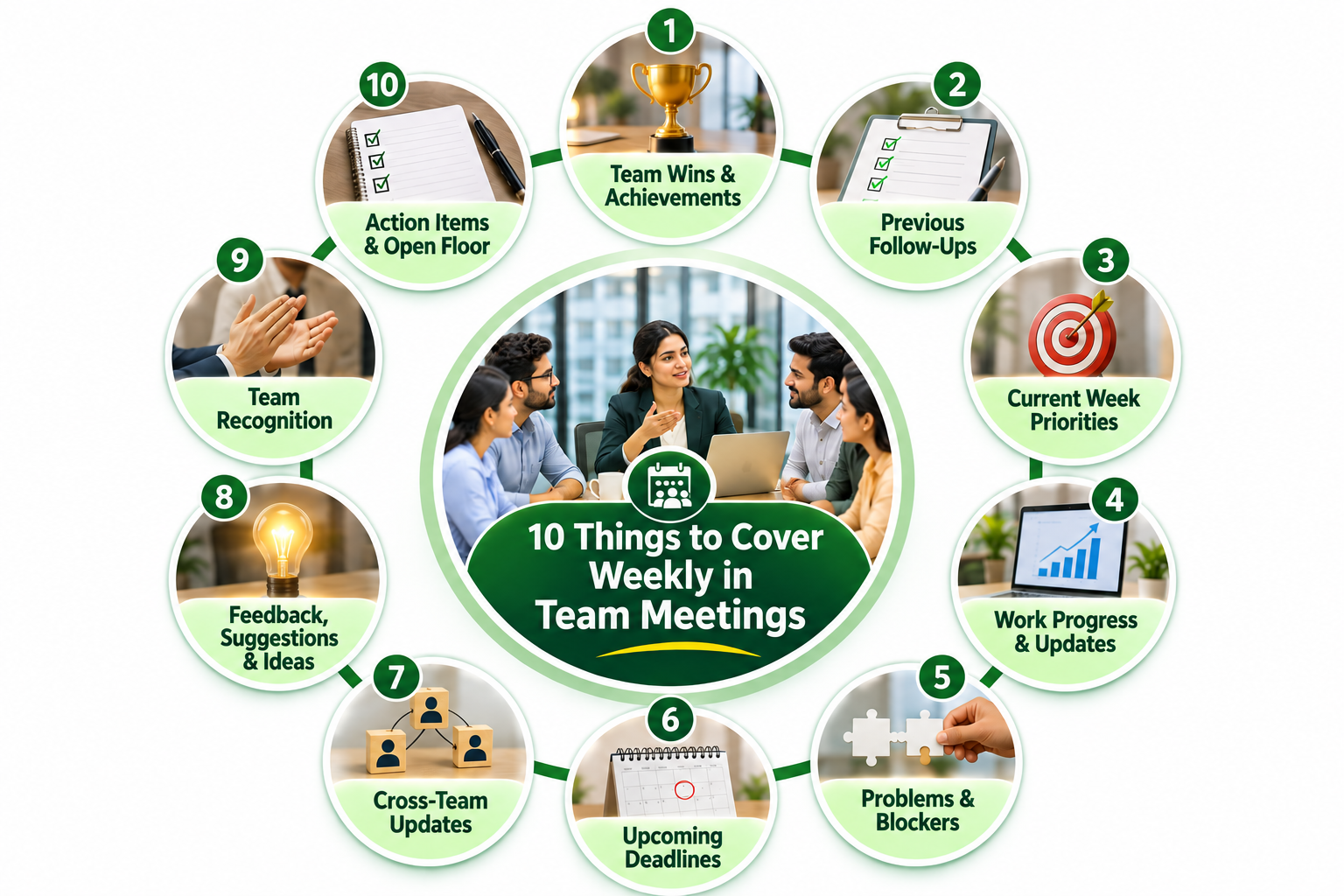
10 Things to Cover Weekly in Team Meetings
Ten main topics should be included in the agenda. Each topic should have a clear purpose. Enough time should be provided for discussion. The order can be adjusted when needed.
1. Team Wins and Achievements
The meeting can begin with team wins. Completed tasks should be mentioned first. Good results can also be shared. Positive feedback can be included.
Purpose
- Completed tasks.
- Good results.
- Positive feedback.
- Team achievements.
Suggested time: 3 minutes.
Discussion questions
- What went well last week?
- Which tasks were completed?
- Was any positive feedback received?
This section helps good work get recognised. Small achievements can also be mentioned. Team efforts should be included. This can help members feel appreciated.
2. Previous Week’s Follow-Ups
Earlier action items should be reviewed next. Completed tasks can be marked. Pending work should also be listed. Delayed activities should be discussed briefly.
Purpose
- Previous tasks.
- Pending work.
- Delayed activities.
- Earlier decisions.
Suggested time: 4 minutes.
Discussion questions
- Which tasks were completed?
- Which tasks are still pending?
- Is any extra support required?
Each earlier task should be checked. The current status should be recorded. Delays should also be explained. New completion dates can be assigned when needed.
3. Priorities for the Current Week
The week’s main priorities should be shared. Important tasks should be listed clearly. Each member should understand the work plan. Urgent activities should receive attention.
Purpose
- Main goals.
- Important tasks.
- Planned activities.
- Weekly targets.
Suggested time: 4 minutes.
Discussion questions
- What should be completed this week?
- Which tasks need more attention?
- What should be done first?
A short priority list can be prepared. The most important work should be identified. Each task should have a clear owner. Expected completion dates should also be shared.
4. Work Progress and Project Updates
Current work progress should be reviewed. Project updates should also be shared. Completed tasks can be reported. Delays and changes should be mentioned.
Purpose
- Project status.
- Completed work.
- Ongoing tasks.
- Work quality.
Suggested time: 5 minutes.
Discussion questions
- What progress was made?
- Are any tasks delayed?
- Has any project detail changed?
Each project should be briefly reviewed. Important updates should be recorded. Delayed work should receive attention. Any change in project plans should be shared. This helps everyone stay informed.
5. Problems and Work Blockers
Problems affecting daily work should be discussed. Delays should also be reported. Required support can then be arranged. Important issues should be given attention.
Purpose
- Work problems.
- Technical issues.
- Resource shortages.
- Delayed tasks.
Suggested time: 5 minutes.
Discussion questions
- What is stopping the work?
- Is any decision required?
- Who can provide support?
Problems should be explained clearly. Their effect on work should be mentioned. A suitable solution should be discussed. The person responsible for follow-up should be identified. This helps problems receive proper attention.
6. Upcoming Deadlines and Important Dates
Important dates should be reviewed every week. Upcoming deadlines should be clearly listed. Urgent tasks should receive more attention. Changes in schedules should also be shared.
Purpose
- Project deadlines.
- Submission dates.
- Client meetings.
- Planned events.
Suggested time: 4 minutes.
Discussion questions
- Which deadlines are approaching?
- Are any tasks at risk?
- Is the current schedule suitable?
A shared deadline list can be maintained. Important dates should be checked regularly. Tasks nearing their due dates should be identified. Extra support can be arranged when required.
7. Cross-Team Updates
Updates from other departments should be shared. Changes affecting shared work should be discussed. Important information should reach everyone. Pending work between teams should also be reviewed.
Purpose
- Department updates.
- Shared projects.
- Work dependencies.
- New requirements.
Suggested time: 4 minutes.
Discussion questions
- Has another team shared an update?
- Is support needed from another department?
- Are any shared tasks delayed?
Cross-team work should be reviewed briefly. Important changes should be explained. Shared responsibilities should be made clear. Delays between departments should also be reported. This can help work continue smoothly.
8. Feedback, Suggestions and New Ideas
Feedback should be included in weekly meetings. Team members should be given time. Useful suggestions can then be shared. New ideas can also be discussed.
Purpose
- Employee feedback.
- Work suggestions.
- Process changes.
- New ideas.
Suggested time: 4 minutes.
Discussion questions
- What can be improved?
- Has any new idea been suggested?
- Is any process causing problems?
Suggestions should be recorded for review. Useful ideas can be discussed further. Work processes may also be improved. Every member should be given a chance to contribute.
9. Team Recognition
Good work should be recognised regularly. Individual efforts can be mentioned. Team contributions should also be appreciated. Completed targets can be included.
Purpose
- Individual efforts.
- Team support.
- Good performance.
- Completed targets.
Suggested time: 3 minutes.
Discussion questions
- Who made a useful contribution?
- Which team effort deserves recognition?
- Was any target achieved?
Recognition can be given for different tasks. Small contributions should also be considered. Support given to other members can be mentioned. Good results should be shared with the team.
10. Action Items and Open Floor
The meeting should end with clear action items. New tasks should be assigned. Due dates should also be recorded. Remaining questions can then be discussed.
Purpose
- New tasks.
- Assigned owners.
- Due dates.
- Final questions.
Suggested time: 4 minutes.
Discussion questions
- What needs to be done next?
- Who will handle each task?
- When should the work be completed?
Each action item should have an owner. A clear due date should be recorded. Pending questions should also be noted. The final task list should be shared. These details can be reviewed next week.
Is being an HR your dream? Enrol now for our course on Human Resource!
Sample Weekly Meeting Agenda
A weekly meeting should be planned beforehand. The time can depend on team needs. A 30-minute meeting can cover short updates. A 45-minute meeting allows more discussion.
| Item | Time | Owner |
| 30-minute meeting | ||
| Team wins | 2 minutes | Team leader |
| Previous follow-ups | 3 minutes | Task owners |
| Weekly priorities | 3 minutes | Team leader |
| Work progress | 4 minutes | Team members |
| Problems and blockers | 4 minutes | Task owners |
| Deadlines | 3 minutes | Team leader |
| Cross-team updates | 3 minutes | Team members |
| Feedback and ideas | 2 minutes | All members |
| Recognition | 1 minute | Team leader |
| Action items and open floor | 5 minutes | Team leader |
| 45-minute meeting | ||
| Team wins | 3 minutes | Team leader |
| Previous follow-ups | 4 minutes | Task owners |
| Weekly priorities | 5 minutes | Team leader |
| Work progress | 6 minutes | Team members |
| Problems and blockers | 6 minutes | Task owners |
| Deadlines | 4 minutes | Team leader |
| Cross-team updates | 5 minutes | Team members |
| Feedback and ideas | 4 minutes | All members |
| Recognition | 2 minutes | Team leader |
| Action items and open floor | 6 minutes | Team leader |
The time can be adjusted when required. Urgent matters may receive more time. Short updates can be shared beforehand. The meeting leader should keep discussions focused.
Become an HR Expert – Enroll in Our HR Management Course Today!
Unlock the secrets to effective Human Resource Management with our expert-led course! Learn recruitment, employee relations, performance management, and more to build a thriving workplace. Start your journey toward a successful HR career today!
Know MoreFree Agenda Template
A simple template can be used every week. The same format can be followed regularly. Meeting details and action items can be recorded. This also helps earlier discussions get reviewed.
Weekly Team Meeting Checklist
Meeting Details
- Meeting date:
- Meeting time:
- Team or department:
- Meeting leader:
- Members present:
Meeting Agenda
- Team wins and achievements.
- Previous week’s follow-ups.
- Current week’s priorities.
- Work progress and project updates.
- Problems and blockers.
- Upcoming deadlines.
- Cross-team updates.
- Feedback and new ideas.
- Team recognition.
- Action items and open discussion.
Action Items
| Task | Assigned to | Due date | Status |
The checklist can be copied before each meeting. Completed topics can be marked. Important decisions should be recorded. Pending tasks should also be added. The completed notes can be shared with members.
Tips to Run Effective Weekly Meetings
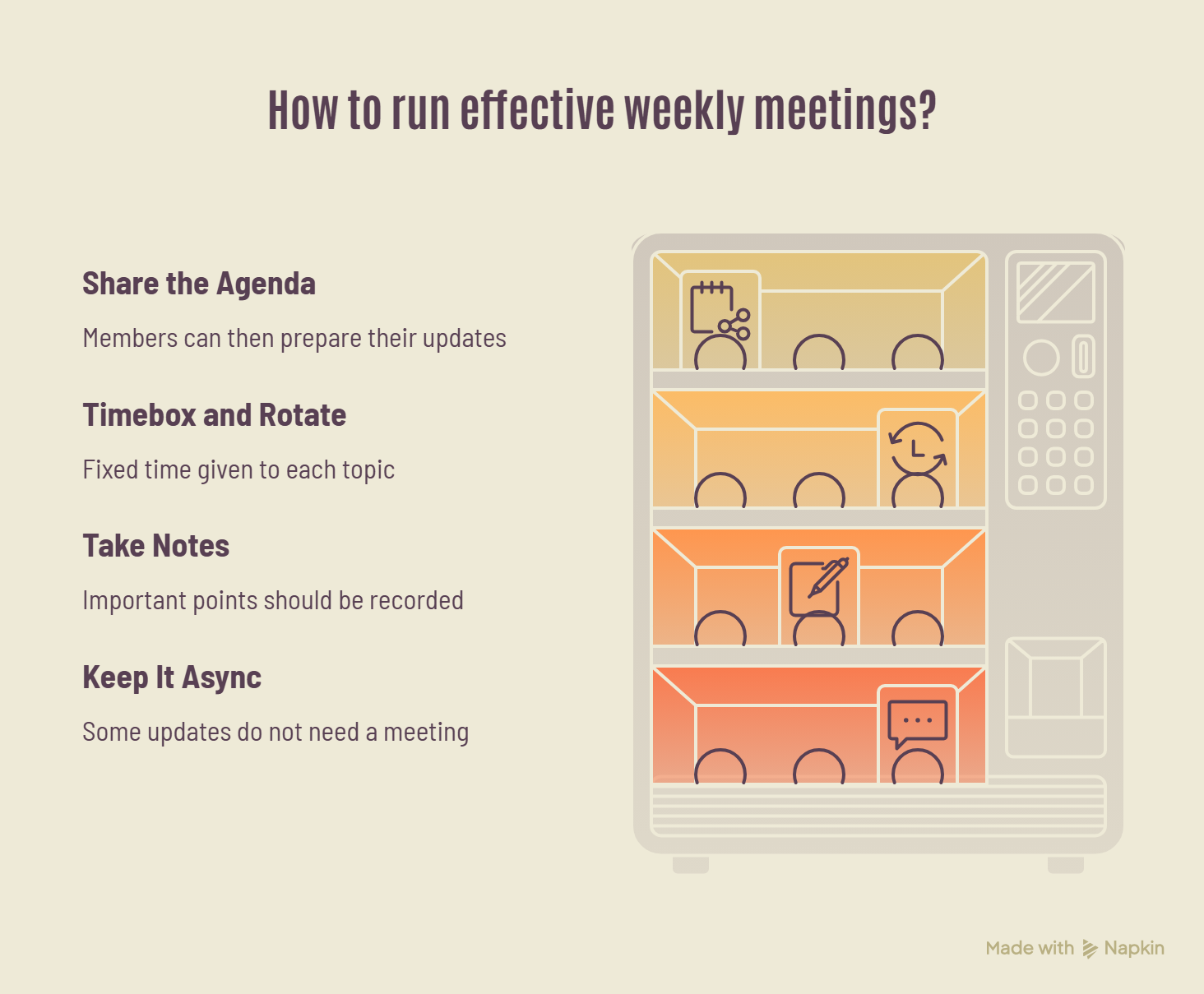
A few simple steps can improve meetings. Topics should be planned in advance. Time should also be managed carefully. Meeting notes should be maintained.
Share the Agenda in Advance
The agenda should be shared before the meeting. Members can then prepare their updates. Important questions can also be listed.
- Early Sharing. Topics are sent beforehand.
- Clear Details. Each topic is listed.
- Member Preparation. Updates are prepared in advance.
- Question List. Important questions are noted.
- Better Planning. Meeting time is used properly.
Timebox and Rotate the Facilitator
A fixed time should be given to each topic. Long discussions should be kept limited. The meeting leader can also be changed weekly.
- Time Limits. A time is set for each topic.
- Short Updates. Main details are shared briefly.
- Shared Duties. Meeting roles are rotated.
- Team Participation. More members are involved.
- Extra Discussion. Complex issues are handled separately.
Take Notes and Track Action Items
Important points should be recorded during meetings. Tasks should also be listed clearly. This helps future work get tracked.
- Meeting Notes. Main points are written down.
- Task Owners. Each task is assigned.
- Due Dates. Completion dates are recorded.
- Task Status. Progress is updated regularly.
- Follow-Ups. Pending work is checked later.
Keep It Async When a Meeting Isn’t Needed
Some updates do not need a meeting. Simple information can be shared through messages. Meeting time can then be used for important discussions.
- Written Updates. Routine details are shared beforehand.
- Quick Messages. Small changes are communicated.
- Shared Documents. Important information is stored.
- Task Updates. Progress is recorded online.
- Meeting Time. Only useful discussions are included.
Adapting the Agenda by Team Type
The meeting agenda may differ across teams. Each department has different work needs. More time should be given to relevant topics.
| Team | Emphasis | Example focus |
| Sales | Targets and clients | Sales figures, leads, client updates |
| Engineering | Projects and technical work | Development, testing, technical issues |
| Marketing | Campaigns and content | Campaign results, content plans, deadlines |
| HR and operations | People and daily work | Hiring, staff updates, work processes |
| Remote teams | Communication and coordination | Online updates, task progress, team support |
Sales teams may need more time for targets. Engineering teams may need technical updates. Marketing teams may review campaign results. HR and operations teams may discuss staff matters. Remote teams may need regular communication updates.
Common Weekly Meeting Mistakes
Some mistakes can make meetings less useful. These problems should be checked regularly.
- No Preparation. Topics are not planned.
- Long Meetings. Too much time is used.
- Unclear Purpose. Meeting goals are not explained.
- Repeated Topics. The same matters are discussed.
- Low Participation. Team members remain silent.
- Missing Notes. Important details are not recorded.
- No Task Owners. Responsibilities are not assigned.
- No Follow-Ups. Earlier tasks are not reviewed.
- Unrelated Discussions. The agenda is not followed.
- No Time Limits. Meetings continue for too long.
- Missed Deadlines. Upcoming dates are not reviewed.
- Unclear Decisions. Final decisions are not recorded.
A clear agenda can prevent many mistakes. Meeting notes should also be maintained. Tasks should be assigned before the meeting ends. Pending work should be checked regularly.
Tools That Help
Simple tools can support weekly meetings. Important details can be shared and stored. Tasks can also be tracked.
- Shared Docs. Agendas and meeting notes can be stored.
- Task Trackers. Tasks and deadlines can be followed.
- Note Templates. Meeting details can be recorded.
The tools should suit the team’s needs. Simple tools are often enough. Records should be updated after each meeting. Members should be given access when required.
Conclusion
Weekly team meetings help work stay organised. Important updates are shared during these meetings. Tasks and deadlines are also reviewed. Problems can be discussed before delays increase. Good work can also be recognised. A simple agenda should be followed. Meeting notes should be maintained regularly. Action items should be assigned clearly. With these steps, weekly meetings can remain useful and focused.
| Related Links | |
| Top Human Resource Blogs to Follow | How to build a remote HR career |
| HR Certification vs HR Degree | Which one to choose? | 15 HR Intern Interview Questions and Sample Answers |
Become an HR Expert – Enroll in Our HR Management Course Today!
Unlock the secrets to effective Human Resource Management with our expert-led course! Learn recruitment, employee relations, performance management, and more to build a thriving workplace. Start your journey toward a successful HR career today!
Know MoreFrequently Asked Questions
What Should Be Covered in a Weekly Team Meeting?
A weekly team meeting should cover team achievements, previous tasks, and current work progress. Weekly priorities, upcoming deadlines, challenges, cross-team updates, feedback, and new action items should also be discussed.
How Long Should a Weekly Team Meeting Be?
Most weekly team meetings can last between 30 and 45 minutes, depending on the team size and workload. A clear agenda and time limit for each topic can help keep the meeting focused.
What Is a Good Weekly Team Meeting Agenda?
A good weekly team meeting agenda should include team achievements, previous tasks, current priorities, and project updates. Problems, deadlines, feedback, recognition, and action items should also be included.
How Do You Make Weekly Meetings Less Boring?
Weekly meetings can be made more interesting through short discussions, useful updates, and team activities. Team achievements can be recognised, meeting duties can be rotated, and every member can be encouraged to participate.
Should Weekly Meetings Be Held in Person or Remotely?
Weekly meetings can be held in person or remotely, depending on the team’s location and work needs. A shared agenda should be provided, and meeting notes should be distributed afterward to keep everyone informed.
How Often Should Team Meetings Happen?
Weekly meetings are useful for reviewing tasks, tracking progress, and discussing upcoming priorities. Daily check-ins or less frequent meetings may also be arranged based on the team’s workload, project needs, and communication requirements.