
Table of Contents
Kanchipuram silk sarees – also called Kancheepuram or Kanjivaram – are handwoven mulberry-silk sarees from Kanchipuram, Tamil Nadu, prized for their rich zari, contrast borders and structured drape.
Once shaped by temple and royal patronage, they now remain a living South Indian handloom tradition across bridal, festive and designer fashion.
“Kancheepuram Silk” is a registered Geographical Indication (GI No. 15) with India’s GI Registry, with the application filed by the Department of Handlooms and Textiles.
Learn Advanced Designing & Boutique Skills with Experts. Join Now!
Key Takeaways
- Kanchipuram silk sarees are GI-registered mulberry-silk handloom sarees from Kanchipuram, Tamil Nadu.
- Their signature look comes from korvai borders and petni-joined pallus.
- Traditional zari uses silver wire over a silk core, coated with gold.
- The Saliyar and Devanga communities shaped the craft. Saliyar weaving records date to the Chola period.
- Designs now range from classic temple borders to pastels and lighter weaves.
- Silk Mark confirms pure silk, but not zari quality or origin.
- Price depends on zari, motif density and weaving time.
What are Kanchipuram Silk Sarees?
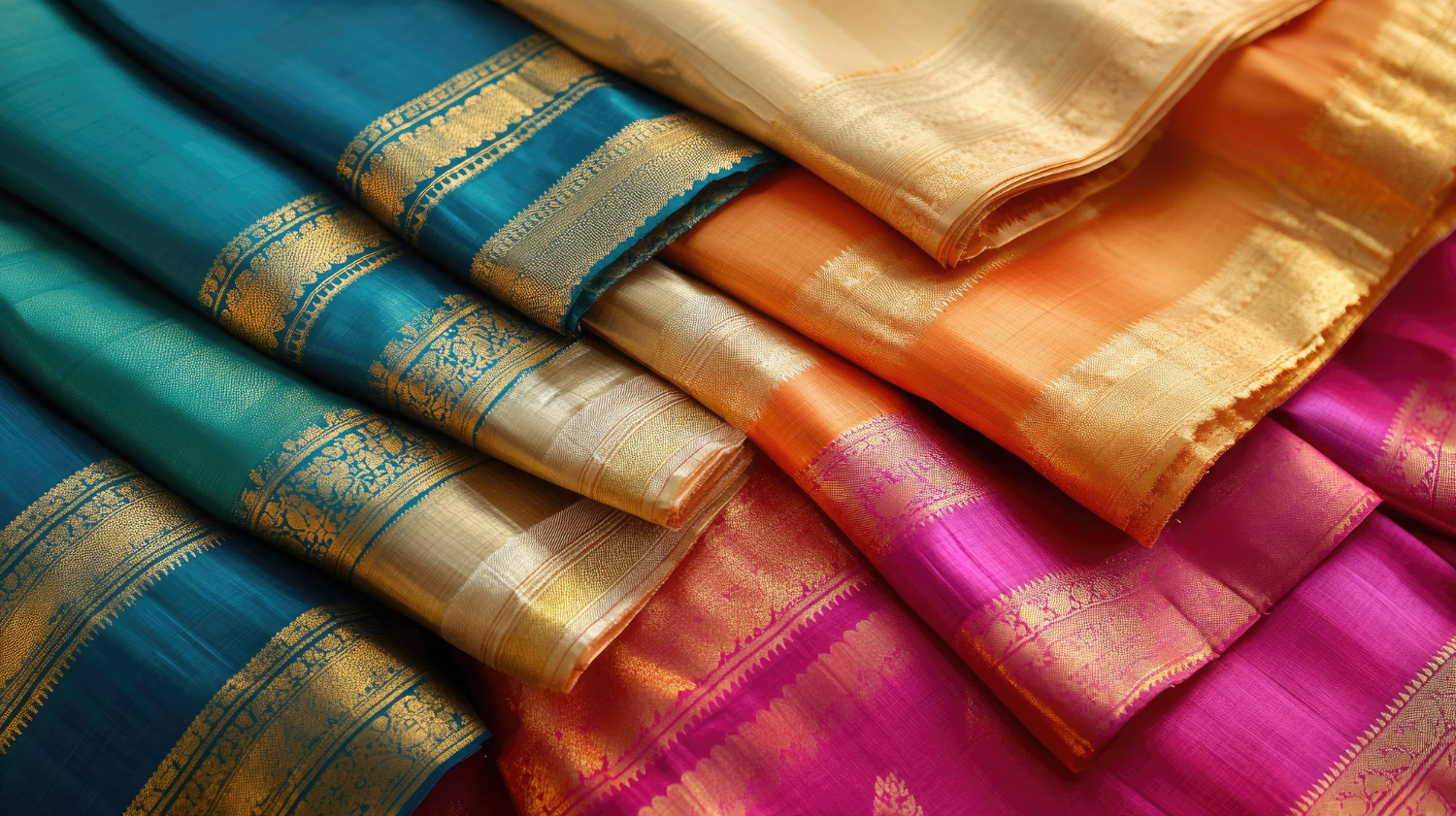
Kanchipuram silk sarees are handwoven silk sarees made in and around Kanchipuram, about 70 km from Chennai.
India’s handloom portal (Vikaspedia, citing the India Handloom Brand) lists mulberry silk yarn and gold zari as the materials and names contrast borders with korvai and contrast pallus with petni as the speciality.
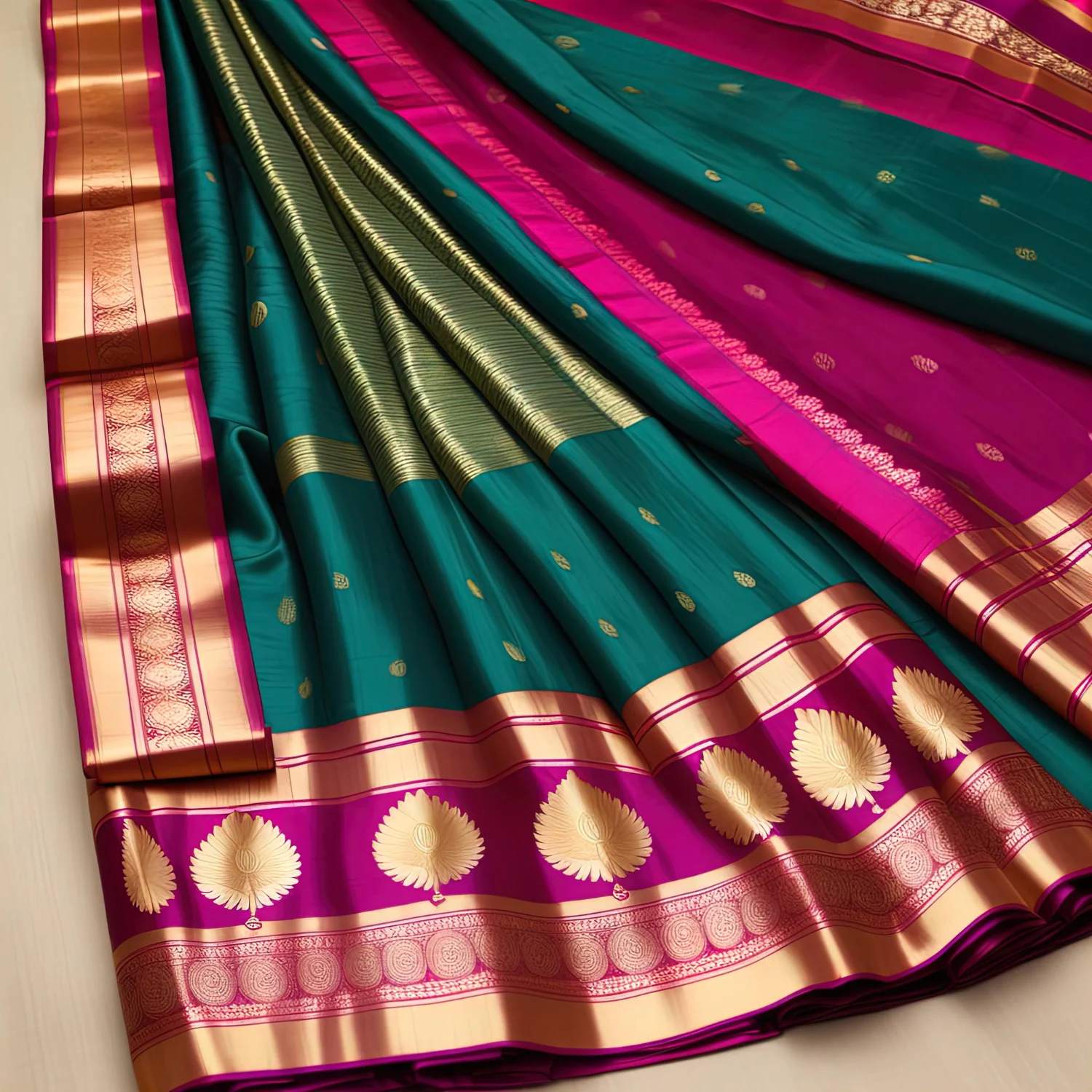
Unlike a saree woven as one continuous piece, the border and pallu are woven in separate colours and joined. That is why a red body can sit beside a green border with a sharp line between them.
Quick Identity Guide
| Feature | What Defines it |
| Origin | Kanchipuram, Tamil Nadu. GI-registered (GI No. 15) |
| Base fabric | Mulberry silk. 2-ply warp and 3-ply weft are typical |
| Border | Contrast border joined by korvai (interlocking) |
| Pallu | Contrast pallu joined by petni |
| Zari | Silver wire over silk core, gold-coated (composition varies) |
| Typical motifs | Temple-inspired designs, peacocks, parrots, coins, rudraksha beads |
| Common use | Weddings, festivals, temple ceremonies, gifting |
Master Fashion Designing and Create Your Signature Style
Unlock your creative potential with our expert-led Fashion Designing course. Build in-demand skills and step confidently into the world of fashion!
Begin Your Fashion Career Today!What is the GI Tag for Kanchipuram Silk?
The GI tag legally links the name “Kancheepuram Silk” to its place of origin. The GI Registry lists the application number as 15, with registration valid to 6 October 2034. Government sources describe the recognition as dating from 2005–06, and one legal summary gives the registration date as 17 March 2005.
A 2023 university field report found that only one authorised user had registered for the tag at the time, so a GI mention alone does not guarantee a specific seller’s saree is authentic. Ask for the seller’s GI authorisation or certification details.
What is the History of Kanchipuram Silk Sarees?
Kanchipuram’s textile history reaches back many centuries, shaped by temple culture, royal patronage and migrating weaving communities. Accounts differ on exact dates, so the safest reading is a layered one rather than a single origin story.
-
Early Records:
Patanjali’s Mahabhasya (2nd century BCE) mentions Kanchipuram as a city, though not its silk. Tenth-century Chola copper plates refer to Saliyar weavers and the taxes on looms.
-
Migration:
One popular account says Devanga and Saliyar weavers settled under Vijayanagara patronage in the reign of Krishnadevaraya (1509–1529 CE). Craft sources also note that the Saliyar link may be much older, so treat any single date as one tradition among several.
-
Silk and Zari:
Historians note there was never a hard line between cotton and silk weavers here. Over time, weavers moved mainly to silk with silver zari.
-
Twentieth Century:
Dancer Rukmini Devi Arundale is credited in some accounts with helping raise the saree’s elite status, including relocating weavers to Kalakshetra. Treat this as a reported claim rather than settled fact.
Official district material estimated about 5,000 families were involved in saree production as of 2008. Current figures are not yet available in the sources checked.
How is a Kanchipuram Silk Saree Made?
A Kanchipuram saree is woven on a pit loom (often with a throw or fly shuttle) after yarn dyeing, warp preparation and zari work. The body, border and pallu are woven separately and then joined. Jacquard systems with punch cards now automate patterning in many workshops.
Yarn and Dyeing:
Mulberry silk is degummed and dyed in the yarn stage. Retail sources commonly say the silk comes from Karnataka and zari from Gujarat (Surat), but this is not confirmed by an official source.
Warp and Weft:
Official handloom material describes 2-ply silk in the warp and 3-ply in the weft. A warp of about 18 metres can yield three sarees of 6 metres each, according to a craft documentation source.
Zari:
Flattened silver wire is coiled around a silk core and gilded. Reported compositions differ. One craft source cites about 57% silver and 0.6% gold. Vikaspedia cites about 40% silver and 0.5% gold, so there is no single universal figure.
Border (Korvai):
The border is woven with separate shuttles and interlocked with the body. The border-to-body join is often done with a second weaver’s help.
Pallu (Petni):
A separate warp in the pallu colour is joined to the body warp, leaving a narrow double-thickness strip where the colours blend.
Finishing:
The saree is inspected, trimmed and tagged.A traditional saree has been described as taking about a month, while simpler designs take less. Exact timing depends on motif density and zari, and no official average is available.
Master Fashion Designing and Create Your Signature Style
Unlock your creative potential with our expert-led Fashion Designing course. Build in-demand skills and step confidently into the world of fashion!
Begin Your Fashion Career Today!Korvai and Petni: Why they Matter
Korvai is the interlocking technique that attaches a contrast border to the body. Because the border is woven in its own colour, designers can pair bold colours without blending them. Kanchipuram sarees are sometimes called “korvai pattu” for this reason.Petni joins the pallu.
The weaver weaves the pallu weft through both warps for a few inches before cutting the body warp, which leaves a visible trimmed join. Authentic sources treat these joins as the weave’s “birthmarks”.
How has Kanchipuram Silk Fashion Evolved?
The weave has stayed constant while the styling has changed. Government and craft sources note lighter weights, softer colours and added embroidery or crystal work on some designer pieces.
| Direction | Typical expression | What stays the same |
| Traditional | Temple borders, deep reds, heavy gold zari | Korvai and petni construction |
| Bridal mainstream | Heavy zari pallus, structured drape | Silk base and contrast border |
| Contemporary | Pastels, lighter weaves, quieter bodies with rich pallus | Three-part build |
| Designer-led | Borders used as graphic elements, heritage motifs in new palettes | Regional weave identity |
One Industry Caution:
Some producers blend silk with cotton or polyester in the body or border and reduce the gold and silver in zari to cut cost. That is a real market trend, and it is why verification matters.
How to Identify an Original Kanchipuram Silk Saree
No single test is conclusive. Use several checks together.
Silk Mark:
The Silk Mark Organisation of India’s label certifies pure natural silk. It does not by itself prove zari quality or Kanchipuram origin.
GI Documentation:
Ask whether the seller is a registered authorised user and request supporting paperwork.
Join Lines:
Look for korvai interlocking at the border and trimmed edges at the petni join.
Weight and Drape:
Handloom sources describe Kanchipuram as the heaviest of silk sarees. Retail sources cite roughly 700 g to 1 kg, but there is no official weight standard.
Zari Questions:
Ask whether the zari is “pure” or “tested” (a base metal core, usually silver-plated and gold-coated). Home scratch tests are popular but not reliable. A lab test is the only firm answer.
Price Sense:
Pure silk, real zari and weeks of labour rarely fit a very low price. One undated journalism report cited a broad range of roughly Rs 5,000 to Rs 1,50,000, but current prices are to be confirmed.
Care Tips & Expert Recommendations
- Store in breathable cotton or muslin, not plastic.
- Keep away from direct sunlight, damp and perfume.
- Refold along different lines from time to time to avoid zari creasing.
- Use a professional dry cleaner for heavy zari work.
For fashion students and buyers, three habits help most:
- learn the three-part construction
- ask for zari and certification details in writing
- choose weight and zari to suit the occasion
For high-value or heirloom purchases, consider independent testing and consult a qualified textile professional.
Learn Advanced Designing & Boutique Skills with Experts. Join Now!
Conclusion
Kanchipuram silk sarees endure because they combine real craft knowledge with a design language that keeps adapting. The core of the weave is stable – mulberry silk, contrast borders joined by korvai, pallus joined by petni and gilded silver zari. What changes is how it is worn, from temple-red bridal looks to pastel receptions and designer reinterpretations.
For buyers, the practical lesson is to treat the name as a starting point and to verify silk content, zari and the seller’s GI authorisation before paying for a heritage piece. For designers, the saree is both a protected tradition and a flexible canvas.
Master Fashion Designing and Create Your Signature Style
Unlock your creative potential with our expert-led Fashion Designing course. Build in-demand skills and step confidently into the world of fashion!
Begin Your Fashion Career Today!Frequently Asked Questions
Does the GI tag guarantee authenticity?
No, the GI protects the name and origin, but only registered authorised users may use it. Ask the seller for authorisation details and check the saree itself.
What is zari made of?
Traditional zari is flattened silver wire coiled around a silk core and coated with gold. Metal content varies, so reported silver percentages differ between sources.
What is the difference between pure and tested zari?
Pure zari uses silver wire with a gold coat, while tested zari generally uses a base-metal core with silver and gold plating. Tested zari is cheaper and can tarnish more easily.
Does the Silk Mark prove a saree is Kanchipuram?
No, the Silk Mark certifies pure natural silk and not the weave’s origin or zari quality. Use it alongside GI documentation and a close look at the construction.
Why are Kanchipuram sarees expensive?
Costs reflect silk quality, zari content, motif complexity and skilled labour. Prices vary widely, so compare like with like rather than relying on a single benchmark.
How heavy is a Kanchipuram saree?
Retail sources commonly cite about 700 g to 1 kg, though no official standard is available. Handloom sources describe it as the heaviest among silk sarees.
Can I wear a Kanchipuram saree beyond weddings?
Yes, lighter weaves and pastel shades suit festivals, family functions and formal events. Changing the blouse and jewellery can alter the look considerably.
How should I store a Kanchipuram saree?
Wrap it in breathable cotton or muslin and keep it away from sunlight and moisture. Refold it along different lines now and then to protect the zari.
Are all sarees sold as "Kanchipuram" authentic?
No, blended fabrics and imitation zari are sold under similar names. Check certification, construction and zari details before buying.
Where can I verify a seller's GI authorisation?
Ask the seller for registration details and consult the GI Registry’s public records at ipindia.gov.in. Authorized-user lists may not be complete. So confirm with the registry if needed.