Table of Contents
Choose Montessori if you want to teach children aged 2 to 6 and start working within a year. You can go with B.Ed if you want to teach Classes 6 to 12 and aim for government school jobs.
The former is a specialist early-years certificate and the latter, the professional degree that opens India’s mainstream school system. The gap shows in the numbers.
Montessori training takes about 6 to 12 months after Class 12, a B.Ed takes two years after graduation. A government TGT starts at ₹44,900 basic pay on the 7th Pay Commission matrix.
Start your journey to becoming a certified Montessori teacher! Get free Demo Here!
Key Takeaways
- Montessori – ages 2 to 6, needs Class 12.
- B.Ed – Classes 6 to 12, needs bachelor’s (≥50%).
- B.Ed → government/aided schools (TET). Montessori → private preschools/international/own centre.
- Montessori isn’t statutory – pick credible trainers with solid practicum.
- Two-year B.Ed still standard (Sept 2026). One-year B.Ed for PG/4-year UG from 2026–27.
- Classes 1 to 5 (govt) – D.El.Ed required (SC, Aug 2023).
- Montessori freshers pay – ~₹1 to 2.4 LPA; govt B.Ed pays more but is competitive.
- You can combine both paths.
Montessori vs B.Ed: A Quick Comparison
1: What is the primary focus of the first plane of development in the Montessori method?
| Parameter | Montessori Teacher Training | B.Ed (Bachelor of Education) |
| Age group | 2–6 years (early childhood) | Classes 6–12 (subject teaching) |
| Minimum qualification | Class 12 (some diplomas ask for a degree) | Bachelor’s degree, 50% marks (relaxation for reserved categories) |
| Duration | 6–12 months (AMI 3–6 diploma: about 8 months full-time) | 2 years (1-year route pending final NCTE approval) |
| Entrance test | Usually none | State CETs, university tests or CUET-PG |
| Regulation | No single statutory regulator; provider or AMI standards | NCTE-regulated |
| Typical cost | Under ₹30,000 (some online diplomas) to ₹1.3–2.5 lakh (AMI centres) | ₹10,000–₹60,000 (government) to ₹50,000–₹2.5 lakh+ (private) |
| Government jobs | Not a standard route | Yes, with TET/CTET |
| Fresher pay | About ₹8,000–₹20,000 a month | Wide range: ₹15,000 a month in small private schools to ₹44,900+ basic in government TGT posts |
| Starting your own venture | Common (preschool, daycare) | Uncommon |
Get Certified & Start Your Montessori Career
Montessori Teacher Training Course by Entri App: Gain expert skills, earn certification, and kickstart your teaching career.
Join Now!What is the Montessori Teaching Method?
Montessori’s a total gem for teaching kids, usually ages 2 to 6. It’s all about letting them learn at their own speed, like choosing their favorite book to read. Picture a classroom where kids pick tasks, like sorting beads to count numbers. Teachers guide gently, sparking excitement.
What’s Covered
Fun tools, like wooden blocks or sandpaper letters, make math and words hands-on. Kids might stack cubes to learn sizes or trace letters for spelling, you know what? Classrooms are set up so kids grab stuff themselves, building confidence. It’s like a snack bar where they pick their learning treats.
Key Skills
The curriculum dives into child psychology to get what young learners need. Lesson planning feels like a treasure hunt for knowledge. Need to ensure a cozy, kid-friendly space. It’s about making learning a blast, honestly.
Why It’s Awesome
Montessori builds independence and creativity with self-directed tasks. Kids learn by doing, not just listening. It’s like planting a tiny seed and watching it grow into a happy plant. The child-centered approach is perfect for early education, no kidding.
What is a B.Ed (Bachelor of Education) Course?
B.Ed’s a classic path for teaching in structured classrooms, usually for grades 1 to 12. It trains educators to teach subjects like math or history with clear plans. Imagine leading a class through a science experiment with a textbook.
What’s Covered
The course teaches classroom management, lesson planning, and school rules. For example, educators might teach a history class with timelines and quizzes. It’s like following a recipe to bake a perfect cake, pretty neat, right? Practice teaching in real schools is included.
Key Skills
B.Ed covers educational psychology and handling big classes. Practice in schools is like test-driving a bike before a big ride. It prepares for government or private school roles with a focus on structure. Skills include managing parent meetings and school events.
Why It’s Great
B.Ed offers a big toolkit for classrooms with lots of students. It’s like coaching a sports team, keeping everyone on track. The degree ensures readiness for all sorts of schools, from small local ones to big institutions.
What are the Key Differences Between Montessori and B.Ed?
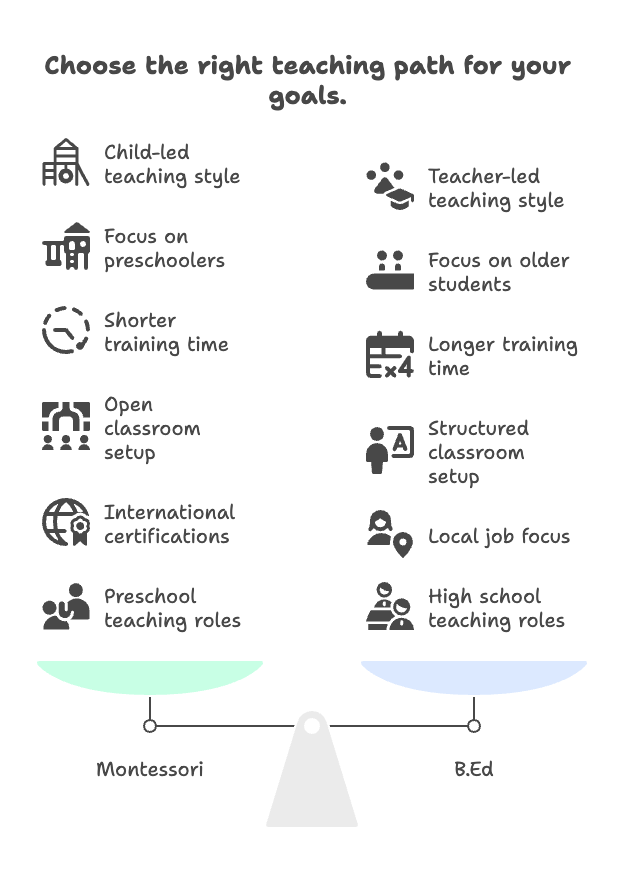
Montessori and B.Ed are like juice and toast, both great but different feels. Here’s the scoop:
Teaching Style
Montessori’s child-led, like letting kids pick their games at playtime. B.Ed’s teacher-led, with set lessons like a guided zoo tour. One’s free and fun, the other’s clear and organized.
Age Group
Montessori targets preschoolers, ages 2 to 6, with hands-on learning. B.Ed focuses on grades 1 to 12, teaching subjects like science. It’s like guiding tiny adventurers versus older students.
Training Time
Montessori TTC takes 6 to 9 months, like a quick baking class. Entri App’s Montessori Teachers Training Course offers a 6-month diploma. B.Ed takes 2 years, like a full chef’s training.
Classroom Setup
Montessori rooms are open, with kids moving freely, like a playground. B.Ed classrooms have desks and a teacher up front, like a classic school scene. One’s all about freedom, the other’s about structure.
Certification
Montessori offers international certifications, like CEED, USA, or UK credentials. B.Ed provides a degree for school jobs, especially government ones. It’s like a world travel pass versus a local bus ticket.
Job Focus
Montessori leads to preschool or international teaching roles. B.Ed targets primary or high school jobs. One’s for young learners, the other’s for older kids.
These differences help pick the path that matches teaching goals.
Get Certified & Start Your Montessori Career
Montessori Teacher Training Course by Entri App: Gain expert skills, earn certification, and kickstart your teaching career.
Join Now!Which Course Has Better Career Opportunities: Montessori or B.Ed?
Both Montessori and B.Ed offer fantastic job paths, but it depends on goals. Here’s the breakdown:
Montessori Careers
Become a Montessori teacher, guiding preschoolers in hands-on learning. Salaries in India range from ₹2.5 to 10 lakhs per year, higher abroad. Starting a preschool is an option, like opening a cozy café. International certifications, like CEED or UK credentials, open global roles in the US or UK. Entri’s Montessori vs. B.Ed video shows Montessori’s global appeal.
B.Ed Careers
B.Ed leads to primary or high school teaching, especially in government schools. Salaries range from ₹3 to 12 lakhs with benefits like pensions. Roles like school principal or private school teacher are possible. It’s like climbing a steady career ladder with TET qualifications.
Job Demand
Montessori’s demand is soaring, with a 25% rise in early education jobs in Kerala in 2026, based on industry trends. B.Ed’s in demand for government and private schools, especially for grades 5 to 12. Both are hot, but Montessori’s quicker to start, while B.Ed’s more stable long-term.
Flexibility
Montessori’s great for fast starts and international roles, like teaching in a fancy school in Dubai. B.Ed’s better for local, structured jobs with security. It’s like choosing a freelance gig versus a full-time office role.
Entrepreneurship
Montessori lets educators open a preschool, like starting a small bakery. B.Ed focuses on teaching jobs, not business ventures. For those wanting to be their own boss, Montessori’s the pick.
Both paths shine, Montessori for creative, global roles, B.Ed for stable, local teaching.
Who should Choose Montessori?
Montessori suits you if you:
- Love working with children aged 2–6 and play-based learning
- Want to start working quickly after Class 12
- Dream of running your own preschool or play school
- Prefer small groups over large classes
Who should Choose B.Ed?
B.Ed suits you if you:
- Want to teach a subject such as maths, science or a language to older students
- Are aiming for government or aided school jobs
- Can commit one to two years of full-time study after graduation
- Like structured curricula and clear promotion ladders
How to Decide: Five Questions
- Which age group excites you more, 2 to 6 or 11 to 18?
- Do you want to start earning within a year, or are you fine with a longer degree route?
- Is a government job your main goal? If yes, B.Ed with TET is the clearer path.
- Do you see yourself running a preschool one day? If yes, Montessori gives you a head start.
- Are you considering teaching abroad? Research the exact licensing rules of your target country first.
Start your journey to becoming a certified Montessori teacher! Get free Demo Here!
Conclusion
Montessori and B.Ed answer different questions. Montessori is the faster, specialised route for people who love early childhood and may want their own preschool. Whereas B.Ed is the longer, regulated route for subject teachers and government job seekers.
Neither is universally better, and neither locks you in. Let your preferred age group, timeline and long-term goal guide the decision, and verify current rules with NCTE and your state education department before applying.
Get Certified & Start Your Montessori Career
Montessori Teacher Training Course by Entri App: Gain expert skills, earn certification, and kickstart your teaching career.
Join Now!Frequently Asked Questions
What’s the biggest difference between Montessori and B.Ed?
Montessori’s all about kids leading their learning, like picking their favorite toy at playtime. B.Ed focuses on structured lessons, like guiding a class through a textbook. Montessori’s for preschoolers, ages 2 to 6, while B.Ed’s for older kids, grades 1 to 12. It’s like choosing between a free-play park or a school tour.
How long does it take to complete Montessori TTC?
Montessori TTC takes 6 months for a diploma or 9 months for a PG diploma with Entri App’s Montessori Teachers Training Course. B.Ed takes 2 years. It’s like learning a quick recipe versus a full cooking school program.
Is teaching experience needed for Montessori TTC?
No way! Montessori only needs a high school diploma, perfect for beginners. B.Ed requires a bachelor’s degree. It’s like starting a new hobby without any prior skills, super easy to jump in.
Can Montessori training lead to jobs abroad?
Totally! Montessori’s international certifications, like those from Entri App’s Montessori Teachers Training Course, open teaching roles in places like Dubai or London. B.Ed’s better for local schools. It’s like a global ticket versus a hometown pass.
Which is better for government teaching jobs?
B.Ed’s the go-to for government school jobs in India, qualifying for exams like TET. Montessori’s awesome for private preschools or international gigs. It’s like picking a steady job versus a creative adventure, you know what?
How much can Montessori teachers earn?
Montessori teachers earn ₹2.5 to 10 lakhs per year in India, higher abroad. B.Ed teachers make ₹3 to 12 lakhs with benefits like pensions. Both are solid picks, like choosing chocolate or strawberry candy.
Can Montessori training help start a preschool?
For sure! Montessori equips educators to open their own preschool, like starting a cozy little shop. B.Ed focuses on teaching jobs, not business ventures. It’s a neat way to be the boss, honestly.
How to decide between Montessori and B.Ed?
Love young kids and creative teaching? Go for Montessori. Prefer structured classrooms and government jobs? Choose B.Ed. Watch Entri’s Montessori vs. B.Ed video to pick the right path. It’s like choosing a favorite game, pretty neat, right?