Table of Contents
Key Takeaways:
- Learn all the TX topics.
- Practice tax questions every day.
- Revise your notes often.
- Read every question carefully.
- Regular practice helps you pass.
ACCA TX at a Glance
What is ACCA Taxation (TX)?
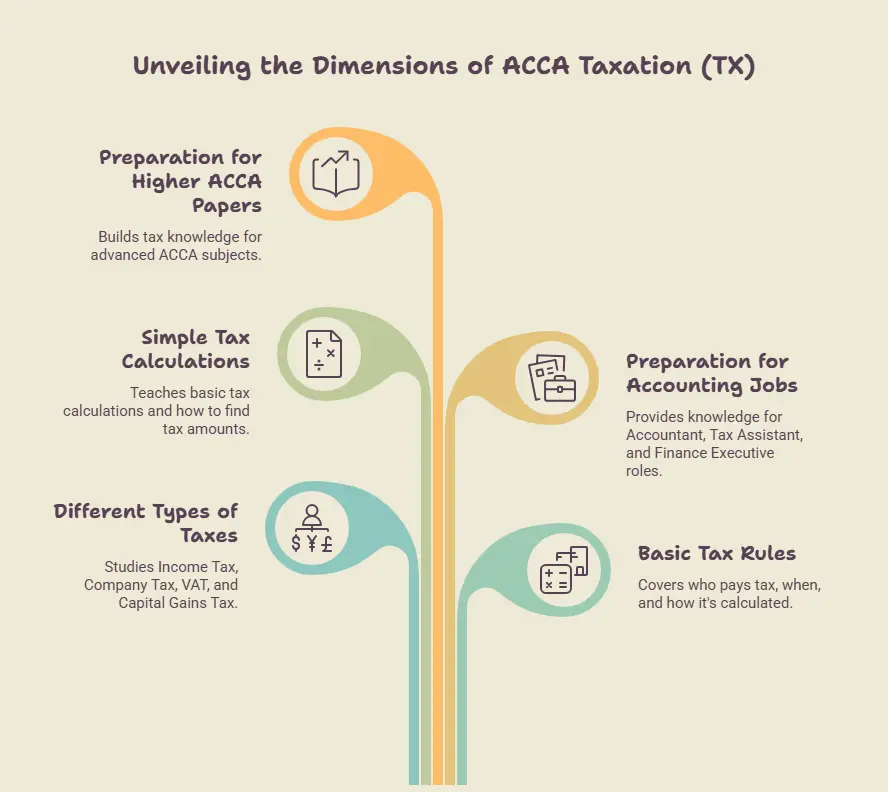
The ACCA Taxation (TX) paper teaches you the basics of taxes. It helps you understand how taxes are calculated and paid.
👉 This paper is important for students who want to work in accounting, finance, or taxation.
What Do You Learn in the TX Paper?
In this paper, you learn:
- Different types of taxes.
- Basic tax rules.
- How tax is calculated.
- How people and businesses pay tax.
👉 These are useful skills for accounting jobs.
Learn About Different Taxes
You study taxes such as:
- Income Tax.
- Company Tax.
- Value Added Tax (VAT).
- Capital Gains Tax.
👉 Each tax has its own rules.
Understand Tax Rules
You learn:
- Who should pay tax.
- When tax should be paid.
- How tax is calculated.
👉 This helps you understand the tax system.
Learn Simple Tax Calculations
The TX paper also teaches you:
- Basic tax calculations.
- How to find the tax amount.
- How to answer tax questions.
👉 Practice helps you improve these skills.
Prepare for Accounting Jobs
The TX paper gives you knowledge that is useful in jobs like:
- Accountant.
- Tax Assistant.
- Finance Executive.
- Accounts Executive.
👉 Many companies need people who understand taxes.
Prepare for Higher ACCA Papers
The TX paper builds your tax knowledge.
👉 It also helps you study higher ACCA subjects more easily.
Why Is the TX Paper Important?
The TX paper helps you:
- Learn tax basics.
- Improve calculation skills.
- Understand tax rules.
- Build confidence in taxation.
👉 It is an important step in your ACCA journey.
ACCA Taxation (TX) Syllabus
ACCA TX Exam Pattern
Understanding the exam pattern makes your preparation easier. It also helps you manage your time during the exam.
Exam Type
The ACCA TX exam is:
- Computer-based (CBE).
- Taken on a computer.
👉 All questions are answered on the computer.
Exam Time
The exam lasts for:
- 3 hours
👉 Use your time carefully to answer every question.
Total Marks
The exam carries:
- 100 marks
👉 You need 50 marks to pass.
Question Types
The exam has different types of questions.
You may get:
- Multiple-choice questions.
- Short questions.
- Calculation questions.
- Scenario-based questions.
👉 Read every question carefully before answering.
Topics in the Exam
Questions can come from any topic in the syllabus, such as:
- Income Tax.
- Company Tax.
- VAT.
- Capital Gains Tax.
- Tax administration.
👉 Study every topic because any topic can appear in the exam.
Calculation Questions
Many questions need simple tax calculations.
You should know how to:
- Use tax rates.
- Calculate tax amounts.
- Solve simple tax problems.
👉 Practice calculations regularly.
Time Management
During the exam:
- Answer easy questions first.
- If one question takes too much time, answer the next one.
- Return to difficult questions later.
👉 Good time management helps you answer more questions.
How to Score Well
To get good marks:
- Learn all the syllabus topics.
- Practice many questions.
- Revise regularly.
- Take mock tests.
- Read every question slowly.
👉 Regular study and practice can help you pass the ACCA TX exam with confidence.
How ACCA TX is Different from Other ACCA Applied Skills Papers
Best Preparation Strategy for ACCA TX
Good preparation helps you pass the ACCA TX exam. Study regularly instead of studying everything at the last minute.
Know the Full Syllabus
Start by reading the complete syllabus. Learn all the topics.
👉 This helps you know what to study.
Make a Simple Study Plan
Create a daily study timetable.
For example:
- Learn one topic.
- Practice questions.
- Revise old topics.
👉 Studying a little every day is better.
Understand the Tax Rules
Do not only memorize.
Try to understand:
- Tax rules.
- Tax terms.
- How taxes work.
👉 Understanding makes questions easier.
Practice Tax Calculations
The TX paper has many calculations.
Practice:
- Income tax.
- Company tax.
- VAT.
- Capital gains tax.
👉 The more you practice, the faster you become.
Solve Practice Questions
Answer many practice questions.
This helps you:
- Understand the exam style.
- Improve your speed.
- Build confidence.
👉 Practice every day.
Revise Regularly
Do not study a topic only once. Read your notes again.
Revise:
- Important rules.
- Tax rates.
- Calculations.
👉 Revision helps you remember better.
Take Mock Tests
Write mock exams before the real exam.
They help you:
- Improve your speed.
- Manage your time.
- Find weak topics.
👉 Mock tests prepare you for the real exam.
Manage Your Exam Time
During the exam:
- Answer easy questions first.
- Do not spend too much time on one question.
- Return to difficult questions later.
👉 Good time management helps you score more marks.
Stay Calm
Before the exam:
- Sleep well.
- Stay relaxed.
- Read every question carefully.
👉 A calm mind helps you perform better.
Common Challenges Students Face
Many students find the ACCA TX paper difficult at first. Most of these problems can be solved with regular study and practice.
Remembering Tax Rules
There are many tax rules to learn. Some students forget them easily.
👉 Revise the rules often.
Learning Tax Calculations
The TX paper has many calculations. Some students make mistakes while calculating tax.
👉 Practice calculations every day.
Understanding Different Taxes
There are different types of taxes.
For example:
- Income Tax.
- Company Tax.
- VAT.
- Capital Gains Tax.
👉 Learn one tax at a time.
Reading Long Questions
Some exam questions are long. Students may miss important details.
👉 Read every question slowly before answering.
Managing Time
Some students spend too much time on one question. Then they cannot finish the paper.
👉 Answer easy questions first.
Not Practicing Enough
Some students only read the study material. They do not solve questions.
👉 Practice helps you understand the exam better.
Forgetting to Revise
Some students study once and stop. Later, they forget important topics.
👉 Revise your notes regularly.
Feeling Nervous
Many students become worried before the exam. This can make it harder to think clearly.
👉 Stay calm and answer one question at a time.
Studying at the Last Minute
Some students begin studying only a few days before the exam.
👉 Start your preparation early and study a little every day.
Study Resources for ACCA TX
Preparation Tips to Score Well in ACCA TX
Good preparation can help you get better marks in the ACCA TX exam. Study regularly and practice every day.
Learn Every Topic
Read all the topics in the syllabus.
Do not leave any topic.
👉 Questions can come from any part of the syllabus.
Understand the Tax Rules
First, understand how each tax works.
Learn:
- Tax rules.
- Tax terms.
- Tax rates.
👉 Understanding is better than memorizing.
Practice Calculations
The TX paper has many calculations.
Practice:
- Income Tax.
- Company Tax.
- VAT.
- Capital Gains Tax.
👉 Daily practice improves your speed.
Solve Lots of Questions
Answer many practice questions.
This helps you:
- Learn the exam pattern.
- Improve your confidence.
- Find your weak topics.
👉 Practice every day.
Revise Regularly
Read your notes again and again.
Revise:
- Tax rules.
- Important topics.
- Calculations.
- Formulas.
👉 Regular revision helps you remember more.
Take Mock Tests
Write mock exams before the real exam.
They help you:
- Improve your speed.
- Manage your time.
- Get ready for the real exam.
👉 Mock tests build confidence.
Manage Your Time
During the exam:
- Start with easy questions.
- Do not spend too much time on one question.
- Return to difficult questions later.
👉 Good time management helps you answer more questions.
Check Your Answers
If you have time, check your work.
Look for:
- Calculation mistakes.
- Wrong answers.
- Missed questions.
👉 A quick check can help you avoid simple mistakes.
Stay Calm
Before the exam:
- Sleep well.
- Stay relaxed.
- Read every question carefully.
👉 A calm mind helps you think clearly and perform better.
Benefits of Passing ACCA TX
Conclusion
The ACCA Taxation (TX) paper helps you learn the basics of taxes and tax calculations. It also helps you understand how taxes work for both people and businesses.
Study every topic, practice questions regularly, and revise often. 👉 With regular study and daily practice, you can pass the ACCA TX exam and continue your ACCA journey with confidence.
Also Read |
|
| ACCA Management Accounting (MA) | ACCA Performance Management (PM) |
| ACCA Business and Technology (BT) | Is Accounting a good career choice for the future? |
Placement Oriented PWC Business Accounting Course
PWC Certified Business Accounting Course by Entri App: Master in-demand skills, ace interviews, and secure top-tier jobs.
Join Now!Frequently Asked Questions
What is the ACCA Taxation (TX) paper?
The ACCA Taxation (TX) paper teaches the basics of taxes. It helps you learn how different taxes work, how tax is calculated, and how people and businesses pay tax.
Who should study the ACCA TX paper?
The TX paper is for ACCA students who want to learn about taxation. It is one of the Applied Skills papers in the ACCA course.
What topics are covered in the ACCA TX syllabus?
The syllabus includes Income Tax, Company Tax, Value Added Tax (VAT), Capital Gains Tax, tax rules, and tax calculations
What is the ACCA TX exam pattern?
The TX exam is computer-based. It lasts for 3 hours, carries 100 marks, and you need 50 marks to pass.
Is the ACCA TX paper difficult?
Some students find it difficult because it has many tax rules and calculations. Regular study, practice, and revision can make it much easier.
How can I prepare for the ACCA TX exam?
Study every topic, make a simple study plan, practice tax questions every day, revise regularly, and take mock tests before the exam.
Why is the ACCA TX paper important?
The TX paper helps you understand taxation, improve your calculation skills, and prepare for accounting and tax-related jobs. It also helps you in higher ACCA papers.
What jobs can I apply for after passing the ACCA TX paper?
Passing the TX paper helps you prepare for roles such as Accountant, Tax Assistant, Accounts Executive, Finance Executive, and other accounting or taxation-related jobs.