Table of Contents
Answer First: Will AI Replace Airport Ground Staff?
Airport ground staff jobs are changing. Some duties may be automated. Complete job replacement is unlikely.
- Routine tasks: Check-in and boarding work may be reduced.
- Physical work: Baggage and safety duties will still need people.
- New roles: Technology-related jobs may be created.
Check-in and customer service roles may change more. Physical and support roles may remain safer. Digital skills should be developed for future jobs.
Introduction
Airport work is becoming more digital. Self-service kiosks are being introduced. Biometric boarding is also being used. Passenger questions are being answered through AI.
These changes have raised concerns. Many ground staff members are worried. Will their jobs be replaced by machines?
Some duties can be automated. Other duties still need people. Physical work must also be completed. Passenger problems must be handled carefully.
In this guide, these changes are explained. Affected jobs are also discussed. New career options are included. Ways to prepare are also covered.
✈️ Start Your Aviation Career Today
Explore career-focused insights on airport jobs, ground staff roles, and aviation training. Learn about salaries, skills, certifications, and hiring trends to start and grow your career in the aviation industry.
Join NowHow AI Is Already Used in Airports
Several airport tasks are now automated. Some work is completed through machines. Other work is supported by AI tools.
Check-in Kiosks, Self Bag Drop and Biometric Boarding
Passenger processing is becoming more automated. Several routine tasks are handled digitally.
- Check-in kiosks. Boarding passes can be printed.
- Self bag drop. Bags can be tagged and deposited.
- Biometric boarding. Faces can be used for identity checks.
- Automated gates. Boarding passes can be scanned.
- Digital checks. Some travel details can be checked.
These systems are already used at airports.
Delhi Airport has introduced self-service bag drop units. Around 50 units have been reported across terminals. Biometric services have also been introduced at Hamad International Airport. Facial recognition is used during passenger processing.
Waiting time can be reduced through these systems. Manual work can also be reduced. However, help may still be needed. Passengers may need guidance at these machines.
AI in Airport Operations
AI is also used behind the scenes. Airport activities can be tracked. Updates can be shared with different teams.
- Turnaround tracking. Aircraft service work is monitored.
- Delay prediction. Possible delays can be identified.
- Resource planning. Staff and equipment can be assigned.
- Queue management. Passenger waiting times are monitored.
- Gate planning. Aircraft movements are coordinated.
- Baggage tracking. Baggage movement can be followed.
For example, aircraft service work can be tracked. Refuelling and baggage loading can be monitored. Possible delays can also be identified. Ground teams can then be informed.
Daily work can be planned more easily. However, physical tasks still need people. Human checks are also required.
Chatbots and Virtual Assistants for Passenger Queries
Passenger questions are increasingly answered online. AI assistants are used for common questions.
- Flight status can be checked.
- Baggage details can be provided.
- Booking questions can be answered.
- Check-in steps can be explained.
- Airport directions can be shared.
- Common travel questions can be handled.
Several airlines have introduced these services.
IndiGo uses an AI assistant called 6Eskai. Booking and travel questions can be answered. Air India uses an assistant called Maharaja. Common passenger questions can be handled. Rome Fiumicino Airport also has an AI assistant. Airport and flight details can be provided.
Repeated questions can be handled automatically. Staff time can also be saved. Difficult cases may still need human help. Personal support cannot always be provided online.
Which Ground Staff Roles Are Most Affected?
AI exposure differs across airport jobs. Some duties can be automated easily. Other duties need physical work.
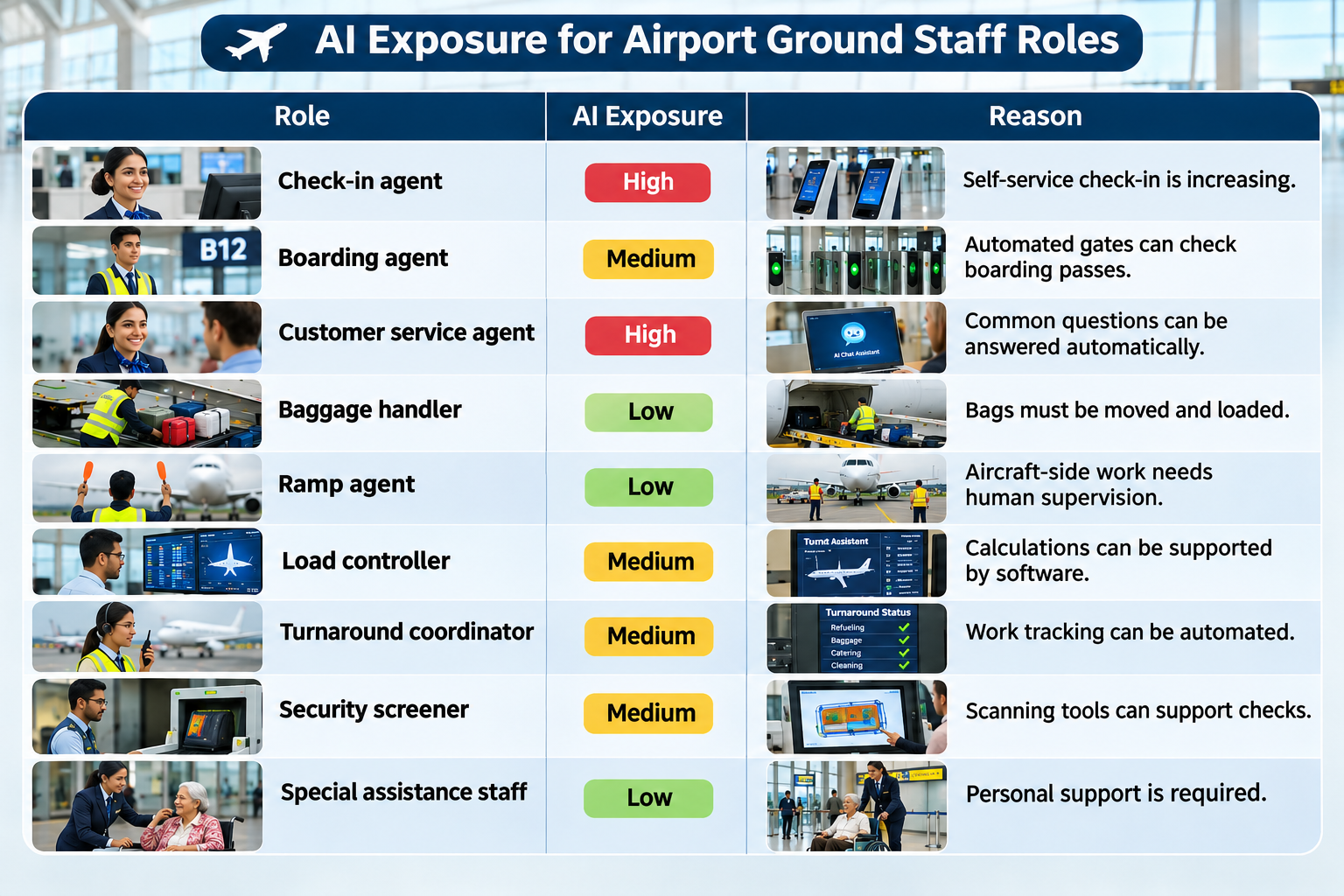
| Role | AI exposure | Reason |
| Check-in agent | High | Self-service check-in is increasing. |
| Boarding agent | Medium | Automated gates can check boarding passes. |
| Customer service agent | High | Common questions can be answered automatically. |
| Baggage handler | Low | Bags must be moved and loaded. |
| Ramp agent | Low | Aircraft-side work needs human supervision. |
| Load controller | Medium | Calculations can be supported by software. |
| Turnaround coordinator | Medium | Work tracking can be automated. |
| Security screener | Medium | Scanning tools can support checks. |
| Special assistance staff | Low | Personal support is required. |
These levels are general estimates. Actual changes may differ between airports. Employer investment will also matter. Local rules and passenger needs will affect adoption.
Why Are Some Roles More Affected?
Routine duties can be automated more easily. Repeated tasks can be handled by machines. Simple questions can be answered through software. Passenger details can also be checked digitally.
Check-in duties may become smaller. Some customer questions may be answered automatically. More difficult cases may be handled by staff. Different duties may also be assigned.
Physical work needs direct human involvement. Passenger assistance also needs personal care.
Roles Least Likely to Be Replaced
Some airport duties involve physical work. Other duties need human judgement. These tasks are harder to automate fully.
Physical and Safety-Critical Work
Several airport tasks need direct human support.
- Ramp work. Aircraft-side activities must be monitored.
- Baggage handling. Bags must be moved and loaded.
- Aircraft marshalling. Aircraft movement must be guided safely.
- Equipment handling. Ground equipment must be operated.
- Safety checks. Unsafe conditions must be identified.
- Physical assistance. Passengers may need direct support.
Machines may be used for some activities. However, human supervision is still needed. Equipment may fail during work. Unexpected problems may also occur. Safety rules must always be followed.
Human-Judgement Roles
Some situations cannot follow fixed instructions. Passenger needs may also change suddenly.
- Flight disruptions. New travel options must be explained.
- Passenger complaints. Concerns must be heard carefully.
- Special assistance. Individual needs must be understood.
- Medical situations. Immediate help may be needed.
- Team supervision. Staff must be guided.
- Unusual situations. Suitable decisions must be made.
A passenger may need extra support. A child may be travelling alone. An elderly passenger may feel confused. A cancelled flight may cause problems.
These situations need patience and care. AI may provide useful information. Human support may still be required.
✈️ Start Your Aviation Career Today
Explore career-focused insights on airport jobs, ground staff roles, and aviation training. Learn about salaries, skills, certifications, and hiring trends to start and grow your career in the aviation industry.
Join NowTasks AI Will Take Over vs Tasks Humans Will Keep
Some tasks can be automated. Other tasks need direct human support.
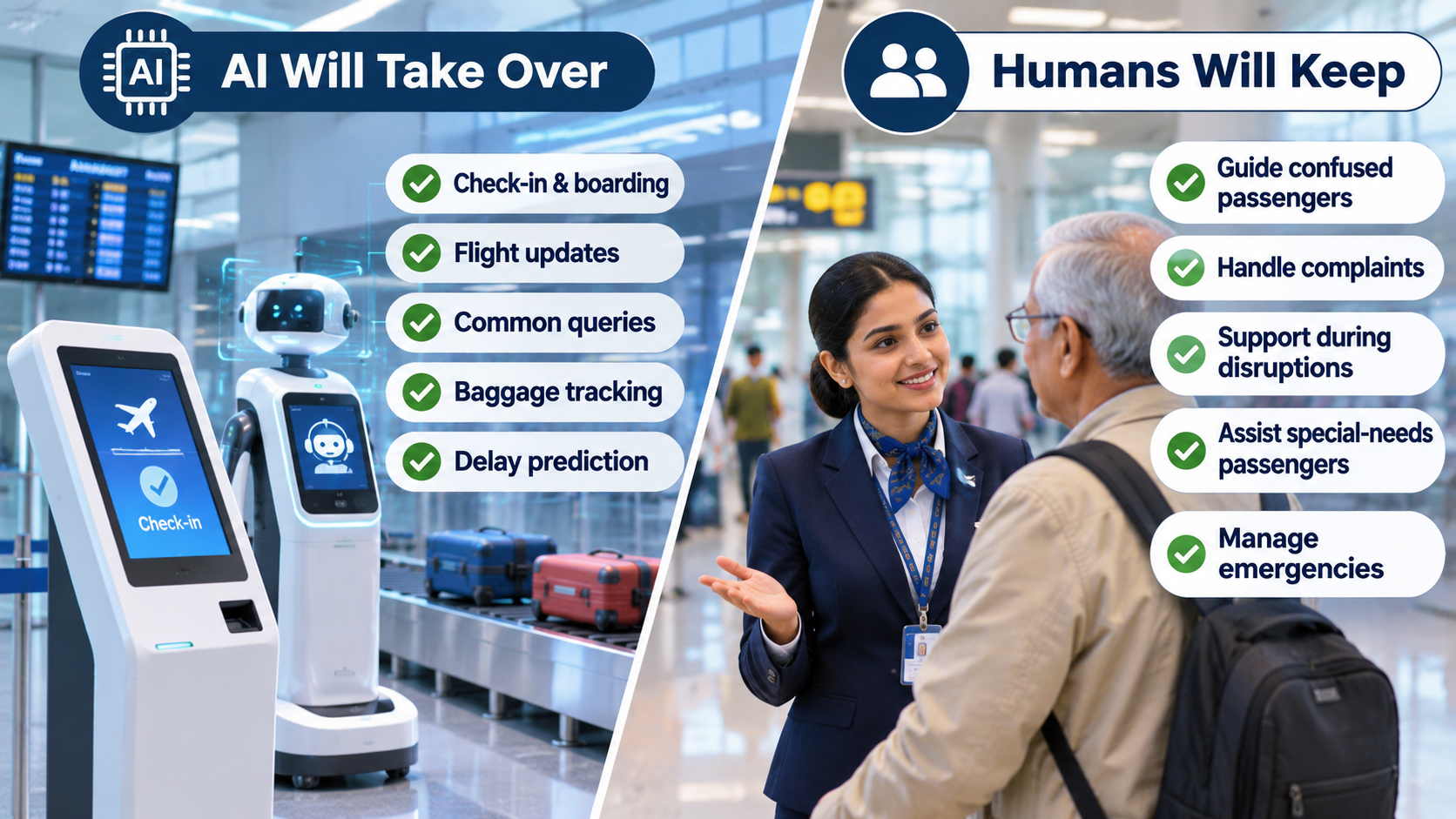
| AI-handled tasks | Human-handled tasks |
| Boarding passes can be printed. | Confused passengers can be guided. |
| Flight status can be checked. | Serious complaints can be handled. |
| Common questions can be answered. | Anxious passengers can be supported. |
| Delay updates can be sent. | Difficult disruptions can be managed. |
| Baggage details can be tracked. | Unusual baggage cases can be handled. |
| Delays can be predicted. | Ground activities can be supervised. |
| Staff needs can be estimated. | Emergencies can be handled. |
| Simple requests can be processed. | Personal assistance can be provided. |
This division may change over time. More tasks may be automated. Some duties may be shared. Human support will still be needed.
New Jobs and Roles AI Is Creating
New jobs may be created through technology. Digital systems need regular support. Airport data must also be managed.
Automation Technicians
Automated airport machines need regular checks.
- Machines must be inspected.
- Technical problems must be identified.
- Repairs must be arranged.
- System performance must be checked.
- Equipment records must be maintained.
Airport Data Analysts
Airport information can be studied. Reports can be prepared using this data.
- Passenger movement can be analysed.
- Flight delays can be reviewed.
- Staff needs can be estimated.
- Work patterns can be identified.
- Performance reports can be prepared.
Digital Operations Coordinators
Digital systems must be connected with airport teams. Daily work must be coordinated.
- Automated systems are monitored.
- Updates are shared with teams.
- System problems are reported.
- Staff activities are coordinated.
- Digital work processes are checked.
AI-Assisted Customer Experience Roles
AI tools can answer common questions. Difficult cases can be handled by staff.
- Complex questions are handled.
- AI responses are checked.
- Passenger complaints are managed.
- Digital support is monitored.
- Personal help is provided.
These roles may differ between employers. Job titles may also be different. Some duties may be added to existing jobs.
Why Full Automation Is Hard in Aviation
Airport work involves many activities. Safety must always be maintained. Passenger needs must also be considered. Full automation can also be costly.
Safety, Regulation and Accountability
Safety is very important in aviation. All airport activities must follow rules.
- Equipment must meet safety standards.
- Systems must be tested before use.
- Errors must be reported.
- Human supervision must be maintained.
- Responsibilities must be clearly assigned.
- Emergency steps must be followed.
Automated systems can also make mistakes. Technical problems may also occur. Human support must remain available. Safety decisions need proper supervision.
Cost, Infrastructure and Unpredictable Situations
Automation requires suitable airport systems. Older airports may need upgrades. New technology can also be expensive.
- Equipment installation can be costly.
- Software must be maintained.
- Staff must be trained.
- Data systems must be connected.
- Cybersecurity must be protected.
- Technical problems must be managed.
Unexpected situations are also common.
Bad weather can affect flights. Equipment may stop working. Large crowds may cause delays. These problems need quick action.
Passenger Preference for Human Help
Some passengers prefer personal assistance. This is especially important during problems.
- Elderly passengers may need guidance.
- First-time flyers may feel confused.
- Children may need extra support.
- Passengers with disabilities may need help.
- Language problems may create confusion.
- Serious complaints need personal attention.
Digital services can make travel easier. However, human help remains important. Passenger needs cannot always be predicted.
How Ground Staff Can Future-Proof Their Careers
New skills should be learned regularly. Existing airport knowledge should also be improved. Both can support career growth.
Skills to Build
The following skills can be developed.
- Digital literacy. Airport software should be understood.
- Data awareness. Basic reports should be understood.
- Problem-solving. Passenger problems should be handled calmly.
- Customer empathy. Passenger needs should be understood.
- Communication. Clear instructions should be given.
- Teamwork. Work should be shared properly.
- Adaptability. New systems should be learned.
- Safety awareness. Rules should be followed carefully.
Basic computer skills should be learned first. Spreadsheet skills can also be useful. Booking systems should be understood. Digital tools should be practised regularly.
Courses and Certifications Worth Considering
Useful training can be completed. Course choices should match career plans.
- Airport Operations Training
Basic airport work can be studied. Passenger handling may also be covered. Terminal activities can be included.
- Ground Operations Training
Ramp and baggage work can be learned. Safety rules may also be covered.
- Safety Management Training
Airport risks can be understood. Safety reporting can also be studied.
- Digital Skills Training
Computer skills can be improved. Spreadsheet and data skills can also be learned.
- Customer Service Training
Passenger communication can be improved. Complaint handling can also be practised.
IATA offers ground operations courses. Human factors and airside safety are covered. Baggage handling is also included. Station management may also be studied. A Ground Operations Diploma is available. Course details and entry rules should be checked.
Moving into Supervisory and Operations Roles
Career growth can be planned through experience. New skills can also be developed.
- Team leader. Daily staff work is supervised.
- Shift supervisor. Work schedules are managed.
- Ramp supervisor. Airside activities are monitored.
- Operations coordinator. Different teams are connected.
- Station manager. Station work is managed.
- Safety officer. Safety rules are monitored.
More responsibility is given in these roles. Communication skills are important. Decision-making skills are also needed. Airport experience is useful. Digital systems should also be understood.
What This Means for Freshers Entering Aviation
Airport jobs are still available. However, some duties may change. Basic computer skills should be learned. Customer service skills should also be developed.
Airport operations should be studied. Check-in and boarding steps should be understood. Safety rules should also be learned. Digital systems should be explored during training.
Entry-level experience can be useful. Further training can support career growth. Ground staff experience may lead to supervisory roles. Digital skills may also create new options.
Related aviation courses can also be explored. Airport operations training may be considered. Ground staff job requirements should be checked. Suitable roles can then be selected.
Timeline: What to Expect in the Next 5-10 Years
Airport automation may increase. However, changes will differ between airports. The following timeline is an estimate.
| Timeframe | Likely change |
| Next 1-2 years | More kiosks and digital passenger services. |
| Next 3-5 years | More AI support in airport work. |
| Next 5-7 years | More connected airport systems. |
| Next 8-10 years | More routine tasks may be automated. |
These are possible future changes. They are not fixed predictions. Investment and rules will affect progress. Passenger needs will also matter.
Conclusion
AI is changing airport work. Routine passenger tasks are becoming automated. Some ground staff duties may be reduced. Physical work will still be needed. Personal assistance will also remain important. New technology-related jobs may be created. Digital skills should be developed early. Airport knowledge should also be improved. Regular training can support future career growth.
✈️ Start Your Aviation Career Today
Explore career-focused insights on airport jobs, ground staff roles, and aviation training. Learn about salaries, skills, certifications, and hiring trends to start and grow your career in the aviation industry.
Join NowFrequently Asked Questions
Will AI replace airport ground staff?
AI may change many ground staff duties. Routine tasks may be handled by machines. Check-in and common passenger questions may be automated. Physical work and personal assistance will still be needed. Complete replacement of all ground staff jobs is unlikely.
Which airport jobs are safest from AI?
Physical and safety-related jobs may be less affected. Ramp agents and baggage handlers perform practical work. Special assistance staff provide personal support. Supervisors also handle unexpected problems. AI may be used in these roles. Human supervision will still be required.
Which ground staff roles are most at risk?
Check-in and basic customer service roles may be affected more. Kiosks can handle routine check-in tasks. Chatbots can answer common questions. Automated gates can support boarding checks. Some duties may be reduced. Difficult passenger problems will still need human help.
Is aviation still a good career in the AI era?
Aviation can still offer career opportunities. Airport operations will continue to need staff. Digital skills are becoming more useful. Customer service and safety knowledge are also important. Further training can support career growth. New technology-related jobs may also be available.
What skills should ground staff learn?
Basic computer skills should be developed first. Spreadsheet skills can also be useful. Airport software should be understood. Communication and problem-solving should be improved. Safety rules must be followed. Teamwork and customer care should also be practised.
Are self-check-in kiosks reducing airport jobs?
Self-check-in kiosks can reduce manual work. Some counter duties may become smaller. However, passengers may still need help. Booking and document problems may require staff support. Other duties may also be assigned. The effect will differ between airports.
Will airport ground staff need to learn AI tools?
Basic digital skills will become useful. Automated systems may be used during daily work. Booking and passenger systems should be understood. AI tools may also support common tasks. Regular training can help staff learn these systems.
Can freshers get airport jobs without technical skills?
Yes, many entry-level jobs are open to freshers. Basic computer knowledge is useful. Communication and customer service skills are also needed. Technical skills can be learned through training. Employer requirements should be checked before applying.
Will airport salaries decrease because of AI?
AI does not automatically reduce salaries. Pay depends on the employer and job role. Experience and special skills can affect earnings. Technology-related duties may also create new opportunities. Salary changes may differ between airports and employers.
Can airport ground staff move into technology-related roles?
Yes, this career change may be possible. Digital operations and automation roles can be explored. Basic computer and data skills should be learned. Suitable training can also be completed. Airport experience may support this move.