
Table of Contents
Answer First: Can EA Help Build an Investment Banking Career?
The Enrolled Agent (EA) qualification support finance careers. However, it does not directly prepare candidates for investment banking.
- Suitable roles: US tax, compliance, reporting, and tax advisory.
- Investment banking skills: Financial modelling, valuation, and deal analysis.
- Additional qualifications: CFA, MBA, and practical modelling experience strengthen an investment banking profile.
Become an Accounting Pro – Learn from Industry Experts!
Introduction
1: Accounting provides information on
Finance students explore professional qualifications. Investment banking is a popular career choice. High salaries attract many young professionals. This leads to questions about suitable courses.
The Enrolled Agent qualification is considered. However, its focus is US taxation. Investment banking requires a different skill set. Both careers involve financial knowledge. Their daily responsibilities are quite different.
This guide explains the value of EA. Investment banking requirements are also discussed. Suitable career options are covered. Additional qualifications and salary prospects are explained.

Placement Oriented PWC Business Accounting Course
PWC Certified Business Accounting Course by Entri App: Master in-demand skills, ace interviews, and secure top-tier jobs.
Join Now!What Is an Enrolled Agent (EA)?
An Enrolled Agent is a tax professional. The qualification is issued by the IRS. It is recognised across the United States. EAs specialise in federal tax matters.
Their work mainly involves tax preparation. Tax planning and representation are also included. Individuals and businesses can receive support. Complex tax matters may also be handled.
IRS Credential and Representation Rights
The EA credential is issued by the Internal Revenue Service (IRS). It allows qualified professionals to represent taxpayers.
This authority covers several tax matters.
- Tax Returns: Individual and business returns can be prepared.
- Audits: Clients can receive support during IRS audits.
- Appeals: Tax disputes can be represented before the IRS.
- Collections: Payment and collection matters can be handled.
- Tax Advice: Federal tax guidance can be provided.
EAs receive unlimited representation rights before the IRS. These rights cover federal tax matters. They do not provide investment banking authority. They also do not replace local work permits.
Exam Structure and Focus
The EA qualification requires three exam parts. Each part covers a different tax area.
- Part 1: Individuals.
- Part 2: Businesses.
- Part 3: Representation, Practices, and Procedures.
The exams focus on US federal taxation. Tax rules and regulations are tested. Practical tax situations are also covered.
Candidates must pass all three parts. They must also meet IRS suitability requirements. Continuing education is required after qualification.
The syllabus does not cover investment banking topics. Financial modelling is not a main subject. Valuation and M&A are also excluded.
What Do Investment Banks Look For?
Investment banks hire professionals for financial transactions. Their teams support companies and investors. Mergers and acquisitions are common assignments. Capital raising and valuation work are also handled.
Hiring requirements depend on the position. Analyst and associate differ in roles.
Typical Analyst and Associate Hiring Profile
Investment banking candidates have finance backgrounds. Relevant degrees and practical skills valued.
Analyst Positions.
- Finance/Commerce graduates.
- Accounting/economics graduates.
- Excel knowledge.
- Financial statement understanding.
- Financial modelling experience.
- Valuation knowledge.
- Good communication skills.
Associate Positions.
- Finance experience.
- MBA from a recognised institution.
- Strong financial modelling skills.
- Deal execution experience.
- Client management.
- M&A transaction knowledge.
- Team leadership skills.
Graduates can enter analyst positions. Associates often have prior experience. MBA graduates may also enter at associate level. However, hiring practices vary between banks.
Skills That Matter
Investment banking requires practical financial skills. These skills support business and investment decisions.
Financial Modelling.
- Three-statement models.
- Discounted cash flow models.
- Merger models.
- Leveraged buyout models.
- Financial forecasting.
Business Valuation.
- Comparable company analysis.
- Precedent transaction analysis.
- Discounted cash flow valuation.
- Enterprise value calculations.
- Equity calculations.
M&A Knowledge.
- Merger transactions.
- Acquisition structures.
- Due diligence.
- Deal documentation.
- Transaction analysis.
Technical Skills.
- Advanced Microsoft Excel.
- PowerPoint presentations.
- Financial data analysis.
- Financial statement interpretation.
- Research and reporting.
Soft Skills.
- Clear communication.
- Attention to detail.
- Time management.
- Team coordination.
- Problem-solving.
These skills are central to deal-related work. EA training does not cover most of them. Additional practical learning is therefore important.
Front Office vs Middle Office vs Back Office
Investment banks operate through different departments. Each department handles specific responsibilities. Their hiring requirements also differ.
| Area | Role Examples | Typical Background |
| Front Office | M&A analyst, equity research, capital markets analyst | Finance, CFA, MBA, modelling |
| Middle Office | Risk analyst, compliance analyst, control specialist | Finance, accounting, law, compliance |
| Back Office | Tax analyst, reporting associate, operations analyst | EA, accounting, finance, taxation |
EA knowledge may support middle-office roles. Tax and reporting teams may also value it. Front-office investment banking needs stronger deal skills.
Where EA Helps (and Where It Falls Short)
The EA qualification provides useful financial knowledge. Its strongest value lies in taxation. Some skills can transfer into banking roles. However, important investment banking gaps remain.
Strengths: US Tax Law, Compliance and Accuracy
EA training develops specialised tax knowledge. This can support several financial institution functions.
US Tax Knowledge.
- Federal tax rules understood.
- Individual taxation studied.
- Business taxation covered.
- Tax filing requirements learned.
Compliance Knowledge.
- Regulatory requirements understood.
- Tax records reviewed.
- Reporting accuracy maintained.
- Documentation standards followed.
Attention to Detail.
- Financial information checked.
- Tax calculations reviewed.
- Errors identified.
- Confidential records handled carefully.
Client Representation.
- IRS notices handled.
- Tax disputes supported.
- Client tax questions addressed.
- Representation procedures understood.
These skills are useful in financial institutions. Banks manage tax and reporting. Global teams also support US tax operations.
Gaps: Valuation, Capital Markets and Deal Structuring
Investment banking involves specialised transaction work. The EA syllabus does not cover these areas.
Valuation.
- Company valuation methods.
- Cash flow forecasting.
- Comparable company analysis.
- Financial performance assessment.
Capital Markets.
- Equity markets.
- Debt instruments.
- Initial public offerings.
- Capital raising strategies.
Deal Structuring.
- Mergers and acquisitions.
- Acquisition financing.
- Transaction structuring.
- Due diligence processes.
Financial Modelling.
- Three-statement modelling.
- DCF modelling.
- LBO modelling.
- Merger modelling.
An EA certificate alone cannot demonstrate these abilities. Practical projects can help close the gaps. Relevant internships can also build experience.
Placement Oriented PWC Business Accounting Course
PWC Certified Business Accounting Course by Entri App: Master in-demand skills, ace interviews, and secure top-tier jobs.
Join Now!Roles Around Investment Banking an EA Can Target
EA holders can explore several banking-related positions. Some roles are closer to investment banking. Others belong to supporting departments.
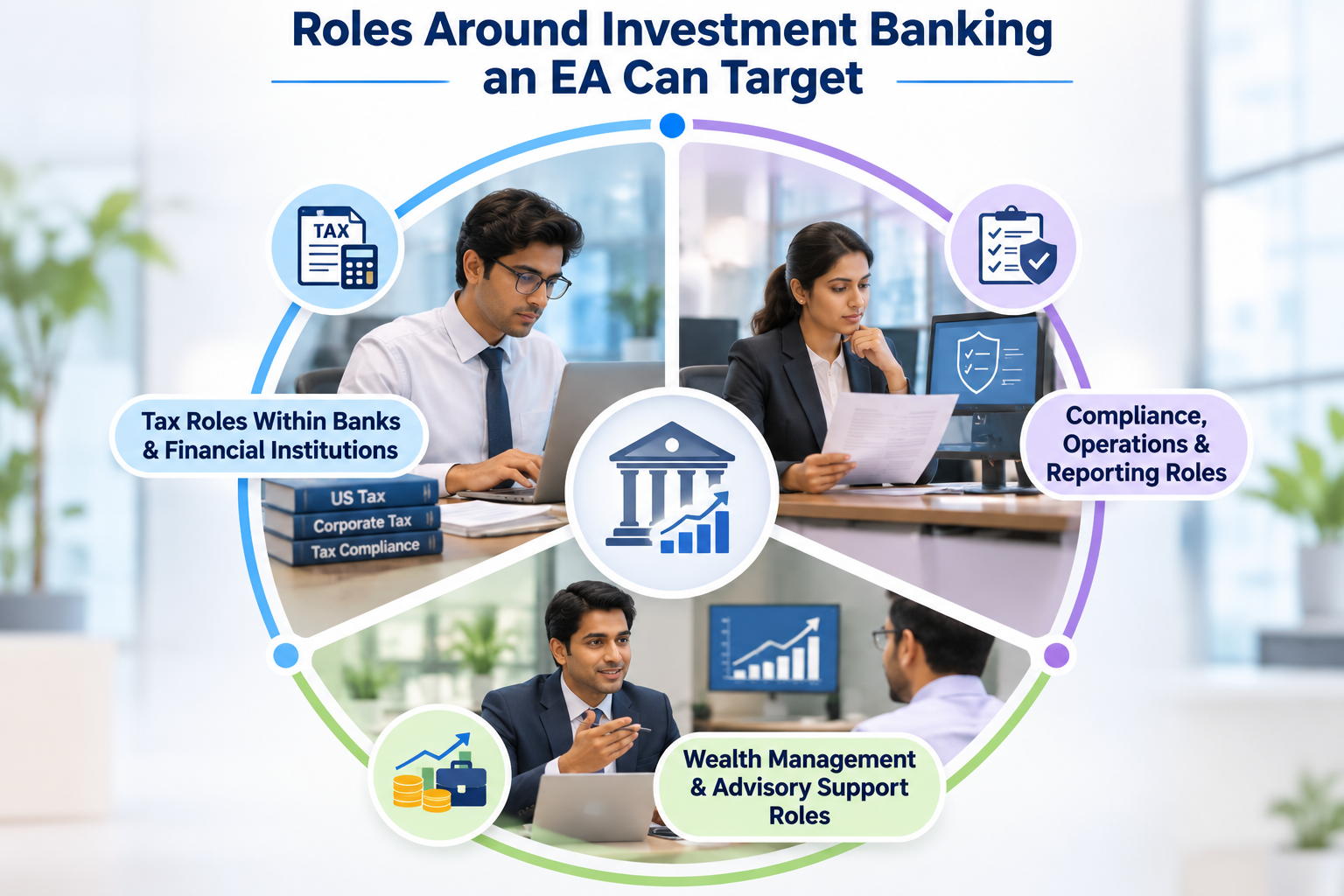
Tax Roles Within Banks and Financial Institutions
Banks maintain dedicated tax departments. These teams handle different tax responsibilities.
Possible positions include:
- US Tax Associate.
- Tax Analyst.
- International Tax Analyst.
- Corporate Tax Associate.
- Tax Compliance Specialist.
- Tax Reporting Analyst.
- Tax Advisory Associate.
EA knowledge support these positions. US taxation experience is especially useful. Some employers require accounting qualifications.
Compliance, Operations and Reporting Roles
Financial institutions follow strict reporting rules. Compliance teams help maintain these standards.
Possible positions include:
- Compliance Analyst.
- Regulatory Reporting Analyst.
- Financial Operations Associate.
- Transaction Monitoring Analyst.
- Risk and Controls Analyst.
- Tax Operations Associate.
- Financial Reporting Analyst.
EA training supports accuracy and documentation. However, additional regulatory knowledge may be required. AML and KYC knowledge can also help.
Wealth Management and Advisory Support Roles
Wealth management teams support individual investors. Tax knowledge can improve client service. This creates some opportunities for EA holders.
Possible positions include:
- Wealth Management Associate.
- Tax Planning Associate.
- Private Client Tax Analyst.
- Financial Advisory Support.
- Investment Operations Associate.
- Client Reporting Analyst.
EA knowledge support tax-related client discussions. Investment recommendations require wider financial knowledge. Securities and portfolio concepts should be studied.
Become an Accounting Pro – Learn from Industry Experts!
EA vs CFA vs CMA vs MBA for Investment Banking
Different qualifications support different finance careers. The right choice depends on career goals. Some qualifications focus on taxation. Others develop investment and management knowledge.
| Option | Focus | Duration | Cost | IB Relevance |
| EA | US federal taxation | Often 6–12 months of preparation | $951 exam fees, plus $140 enrolment | Low |
| CFA | Investment analysis and valuation | Around 3–4 years | 3,520–4,570 | High |
| CMA (US) | Management accounting and financial planning | Often 6–18 months | Varies by membership and exam fees | Moderate |
| MBA | Finance, business and management | Usually 2 years in India | Varies widely by institution | High |
Costs are indicative. Preparation, membership and other charges may apply.
1. Enrolled Agent (EA)
EA is suitable for tax-focused careers.
- US federal taxation.
- Tax compliance.
- IRS representation.
- International tax support.
- Tax advisory services.
Its investment banking relevance remains limited. It can support tax-related banking positions.
2. Chartered Financial Analyst (CFA)
CFA covers several investment-related subjects.
- Financial statement analysis.
- Equity valuation.
- Portfolio management.
- Fixed income.
- Corporate finance.
- Investment decision-making.
CFA is more relevant to investment banking. It can strengthen financial knowledge. However, it does not guarantee employment.
The complete programme has three levels. Candidates generally need three to four years. Relevant work experience is also required.
CFA Institute+1
3. Certified Management Accountant (CMA)
US CMA focuses on management accounting. It develops business finance knowledge.
- Financial planning.
- Cost management.
- Performance analysis.
- Risk management.
- Internal controls.
- Business decision-making.
CMA supports corporate finance careers. Its investment banking relevance is moderate. It does not replace valuation training.
The programme has two examination parts. IMA also specifies education and experience requirements.
IMA+1
4. Master of Business Administration (MBA)
An MBA can support investment banking entry. Finance specialisation is particularly relevant.
- Corporate finance.
- Investment management.
- Business strategy.
- Mergers and acquisitions.
- Financial analysis.
- Leadership skills.
College reputation can affect recruitment opportunities. Placement access also matters significantly. A strong finance internship can help.
Which Qualification Should Be Chosen?
The decision should follow career interests.
- US Taxation: EA is a suitable choice.
- Investment Banking: CFA or a relevant MBA.
- Corporate Finance: CMA or an MBA.
- Tax and Finance: EA with additional finance training.
For aspiring investment bankers, EA should not be the main qualification. CFA, MBA and modelling skills deserve greater attention.
How to Move from EA Toward Investment Banking
An EA holder can explore investment banking. However, additional preparation will be necessary. A planned career transition can help.
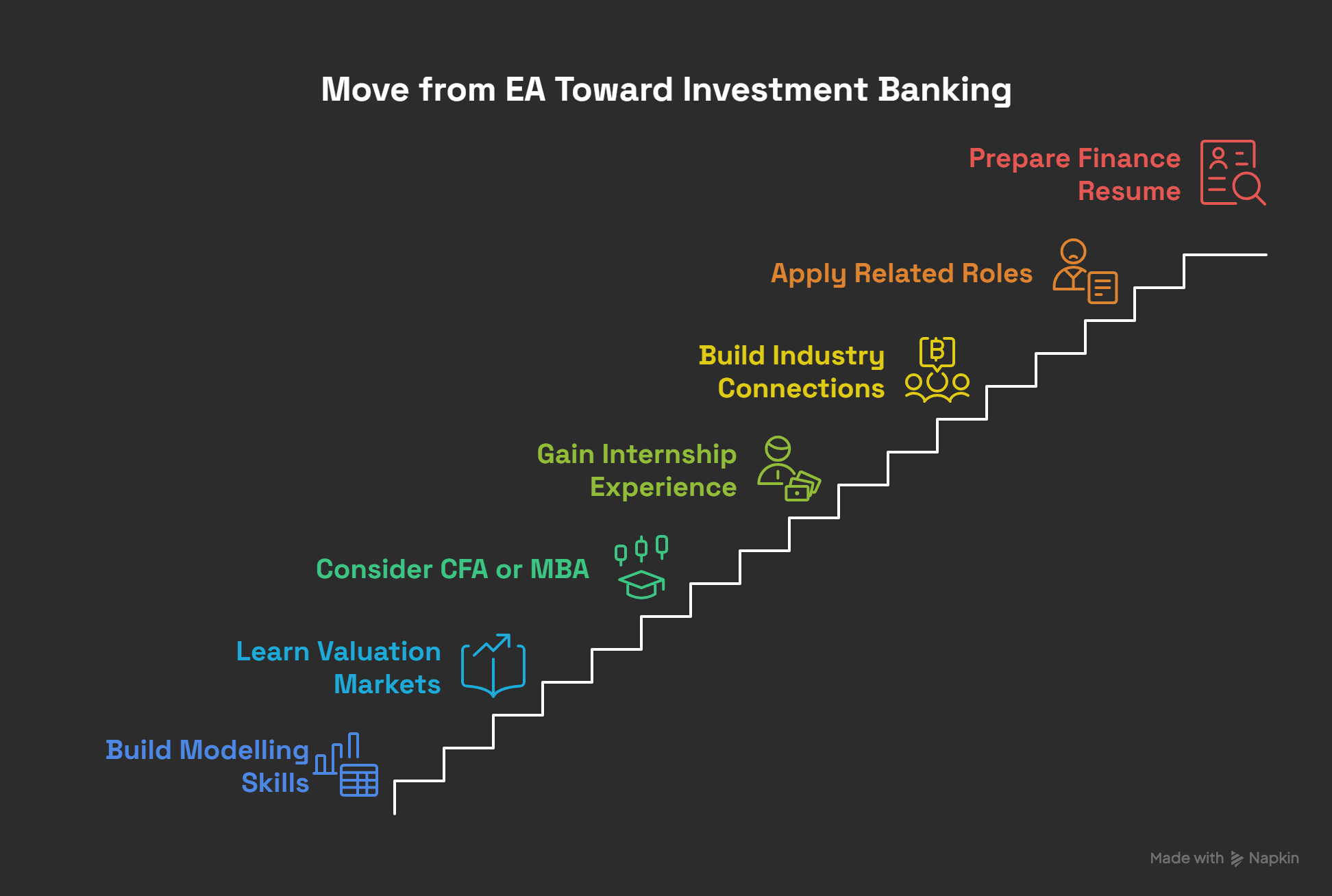
Step 1: Build Financial Modelling Skills
Financial modelling is essential for deal-related roles. It helps analyse business performance.
Important models include:
- Three-statement financial models.
- Discounted cash flow models.
- Comparable company analysis.
- Precedent transaction analysis.
- Merger and acquisition models.
- Leveraged buyout models.
Start with financial statements and Excel. Then practise complete valuation models. Sample company data can be used.
Step 2: Learn Valuation and Capital Markets
Investment bankers assess companies and transactions. Valuation knowledge supports these responsibilities.
Study the following topics:
- Equity valuation.
- Enterprise value.
- Discounted cash flow.
- Stock market basics.
- Debt and equity instruments.
- Initial public offerings.
- Mergers and acquisitions.
Financial news can also improve market knowledge. Company annual reports provide useful practice material.
Step 3: Consider CFA or MBA
An additional qualification can strengthen the profile. The choice depends on the desired role.
CFA Route.
- Investment analysis can be studied.
- Valuation knowledge can be developed.
- Financial markets can be understood.
- Investment-related roles can be explored.
MBA Route.
- Finance specialisation can be selected.
- Industry connections can be developed.
- Internship opportunities can be explored.
- Campus recruitment can provide access.
An MBA from a strong institution helps. However, the programme can involve significant costs. College selection requires careful research.
Step 4: Gain Relevant Internship Experience
Practical experience is important for entry-level hiring. Internships can provide useful industry exposure.
Consider internships in:
- Investment banking.
- Equity research.
- Corporate finance.
- Financial analysis.
- Transaction advisory.
- M&A support.
Even smaller firms can provide valuable exposure. Live projects can improve practical understanding. Relevant experience also strengthens job applications.
Step 5: Build Industry Connections
Networking can help discover suitable opportunities. Professionals can also share career guidance.
Useful activities include:
- Connecting with investment banking analysts.
- Attending finance-related events.
- Joining professional finance groups.
- Participating in industry discussions.
- Speaking with alumni.
- Following investment banking firms.
LinkedIn can support professional networking. Career events can provide useful contacts. Consistent communication can build industry relationships.
Step 6: Apply Through Related Finance Roles
Direct investment banking entry can be difficult. Related positions can provide a starting point.
Consider applying for:
- Financial Analyst.
- Transaction Advisory Associate.
- Valuation Analyst.
- Investment Operations Analyst.
- Corporate Finance Associate.
- Financial Due Diligence Analyst.
These positions can develop relevant experience. Some roles provide exposure to transactions. Internal transfers may become possible later.
Step 7: Prepare a Finance-Focused Resume
An EA resume usually highlights taxation skills. An investment banking resume needs broader finance evidence.
Include relevant details:
- Financial modelling projects.
- Valuation assignments.
- Excel proficiency.
- Financial statement analysis.
- Internship experience.
- Transaction research.
- Relevant qualifications.
Tax experience can remain part of the profile. However, investment banking skills should receive attention.
Career Paths Where EA Shines
EA offers a stronger advantage in taxation. Several career paths match its syllabus.
1. US Tax Consulting
Tax consulting firms hire trained professionals.
- Individual tax advice.
- Business tax consulting.
- Tax planning support.
- Client tax assistance.
2. Tax Compliance
Companies need accurate tax reporting.
- Federal tax returns.
- Business tax returns.
- Tax documentation.
- Regulatory reporting.
- Tax record reviews.
3. IRS Representation
EAs receive representation rights before the IRS.
- Audit representation.
- Tax dispute support.
- Collection matters.
- Appeals assistance.
- IRS notice resolution.
4. Tax Advisory in MNCs
Multinational companies manage different tax requirements.
- International tax support.
- US tax reporting.
- Corporate tax compliance.
- Cross-border tax assistance.
- Global tax operations.
These paths offer stronger EA alignment. Experience can support senior tax positions. Specialist knowledge can also improve career growth.
Salary and Growth Outlook
Investment banking and tax careers follow different salary structures. Earnings depend on skills and experience. Employer type and location also matter.
The following figures provide an indicative Indian market comparison.
| Role | Entry Range | Growth Path |
| US Tax Associate / EA | ₹4–8 LPA | Senior Tax Associate, Tax Manager |
| Tax Compliance Analyst | ₹3–7 LPA | Senior Analyst, Compliance Manager |
| Tax Advisory Associate | ₹4–8 LPA | Tax Consultant, Advisory Manager |
| Financial Analyst | ₹4–8 LPA | Senior Analyst, Finance Manager |
| Investment Banking Analyst | ₹11–25 LPA | Associate, Vice President |
| Valuation Analyst | ₹4–10 LPA | Senior Analyst, Valuation Manager |
Salary ranges are indicative estimates for India in 2026. Actual offers vary by employer, location, experience and role.
EA-related salary estimates are based on Indian US-tax market figures. Investment banking figures differ across firms. Indeed reported an average analyst base salary of approximately ₹15.6 lakh annually. Its estimate used 17 reported salaries.
Indeed+2
Investment banking compensation may include bonuses. Global banks can offer higher packages. Smaller firms may offer different salary structures.
FPA+1
What Influences Salary Growth?
Several factors influence career earnings.
- Experience: More experience can support senior positions.
- Employer: Large financial firms may offer higher packages.
- Skills: Specialised skills can improve job opportunities.
- Location: Salary levels differ across cities.
- Performance: Strong work can support promotions.
- Qualifications: Relevant credentials can strengthen applications.
An EA qualification alone cannot secure investment banking salaries. The job role determines the relevant salary range.
Who Should Choose EA, and Who Shouldn’t?
EA suits candidates interested in US taxation. It can also support international tax careers.
EA May Suit Candidates Who:
- Want to specialise in US taxation.
- Prefer tax compliance and advisory.
- Want to work with US clients.
- Plan to join global tax teams.
- Want IRS representation rights.
EA May Not Suit Candidates Who:
- Want direct M&A deal experience.
- Prefer company valuation work.
- Want capital markets careers.
- Aim for front-office banking.
- Want investment research as their main career.
Students targeting investment banking should compare qualifications carefully. CFA and MBA routes may fit better. Practical modelling skills remain essential.
Conclusion
EA can support a finance career. Its strongest value lies in US taxation. Tax and compliance roles offer suitable opportunities. Investment banking requires additional preparation.
CFA, MBA and modelling skills can help. Relevant internships can also improve job prospects. Candidates should select qualifications carefully. Career goals should guide the final decision.
Placement Oriented PWC Business Accounting Course
PWC Certified Business Accounting Course by Entri App: Master in-demand skills, ace interviews, and secure top-tier jobs.
Join Now!Frequently Asked Questions
Can an Enrolled Agent Work in Investment Banking?
Yes, an EA holder can work within an investment bank. Suitable opportunities may include tax, compliance, reporting and operations. However, front-office investment banking requires additional skills. Financial modelling, company valuation and transaction experience are important for these positions.
Is EA Better Than CFA for Investment Banking?
CFA is more relevant to investment banking. Its syllabus covers investment analysis, valuation and financial markets. EA focuses on US taxation and IRS representation. Candidates targeting investment banking should consider CFA. Those interested in US tax careers can choose EA.
Which Finance Roles Can an EA Do?
EA holders can explore several finance-related positions. Common options include US Tax Associate, Tax Analyst and Tax Compliance Specialist. Opportunities may also exist in international taxation, reporting and tax advisory. Additional qualifications can support wider finance career options.
Do I Need an MBA After EA to Enter Investment Banking?
An MBA is not compulsory for every investment banking position. However, a relevant MBA can improve recruitment opportunities. A strong institution may provide better placement access. Financial modelling, valuation and internship experience remain important. CFA is another qualification worth considering.
What Is the Salary After EA in India?
Freshers with EA qualifications may earn ₹4–8 LPA. Experienced professionals can earn ₹10–18 LPA or more. Senior specialists may receive higher packages. Actual salaries depend on experience, employer, location and US tax knowledge. These figures are indicative estimates.
What Is the Best Course for Investment Banking?
CFA and MBA are popular investment banking qualifications. Both can develop relevant financial knowledge. Financial modelling courses can provide practical skills. The best combination depends on educational background and career goals. Relevant internships and transaction experience can further strengthen applications.