Table of Contents
Three-year-olds learn many new things every day. They start to understand simple numbers, words, shapes, colours, and daily tasks.
Some children may learn a new skill quickly. Others may need more time. Both are normal. What matters is giving them simple things to try each day.
Parents and teachers can notice what the child likes. They can help when the child needs it. Talking, playing, reading, and doing daily tasks can all help children learn.
Key Takeaways:
- 3-year-olds learn through play and daily activities.
- Children can learn simple words, numbers, shapes, and colours.
- Daily tasks can teach children useful life skills.
- Parents can give children simple tasks to try.
- Reading, talking, and playing support early learning.
- Children need time and practice to learn new skills.
Register for the Entri Elevate Montessori Teacher Training Program! Join Now!
Language and Communication Skills
At 3, children start talking more. They may ask many questions. They may also tell you what they want or talk about what they see.
Talk to your child during normal daily activities. You can talk while eating, playing, bathing, or going outside. Reading books and singing simple songs can also help children hear and use new words.
Learning New Words
Children can learn new words from the people around them. You can name the things they see and use.
For example:
- “This is a red ball.”
- “Here is your spoon.”
- “The dog is running.”
- “Let’s put the cup on the table.”
Using the same words again can help the child remember them. Children also learn by hearing how words are used in simple sentences.
Talking in Simple Sentences
Children can start putting words together to say what they want. They may say things like, “I want water” or “Give me the ball.” Talk to the child in short and clear sentences. Give them time to answer.
Listening to Others
Children also need to learn how to listen. Ask small questions during the day.
You can ask:
- “Where is your shoe?”
- “What is this?”
- “Who is that?”
- “Do you want milk?”
Wait for the child to answer. Do not rush them.
Learning through Books
Picture books are useful for language learning. Point to a picture and name it. You can ask, “What is this?” or “Where is the cat?” Let the child answer in their own words.
Singing and Rhymes
Songs and rhymes make language fun. Children can listen to the words and join in.
Simple songs can also introduce new words. Repeating the same song is fine. Children often enjoy hearing their favourite songs again.
Learning to Express Feelings
Three-year-olds have many feelings. They may feel happy, sad, angry, or scared.
Sometimes, they may not know how to say it. You can use simple words with them.
- “Are you sad?”
- “Are you tired?”
- “Are you angry?”
Use these words when you talk to your child. Slowly, the child can learn to tell you how they feel.
Basic Numbers and Early Math Concepts
Children see numbers in many places. They may count toys or ask for two things. You can teach numbers during daily activities.
- Count the toys.
- Count the steps.
- Compare big and small things.
- Ask, “How many?”
These small activities make numbers easy and fun for a child.
 Learning to Count
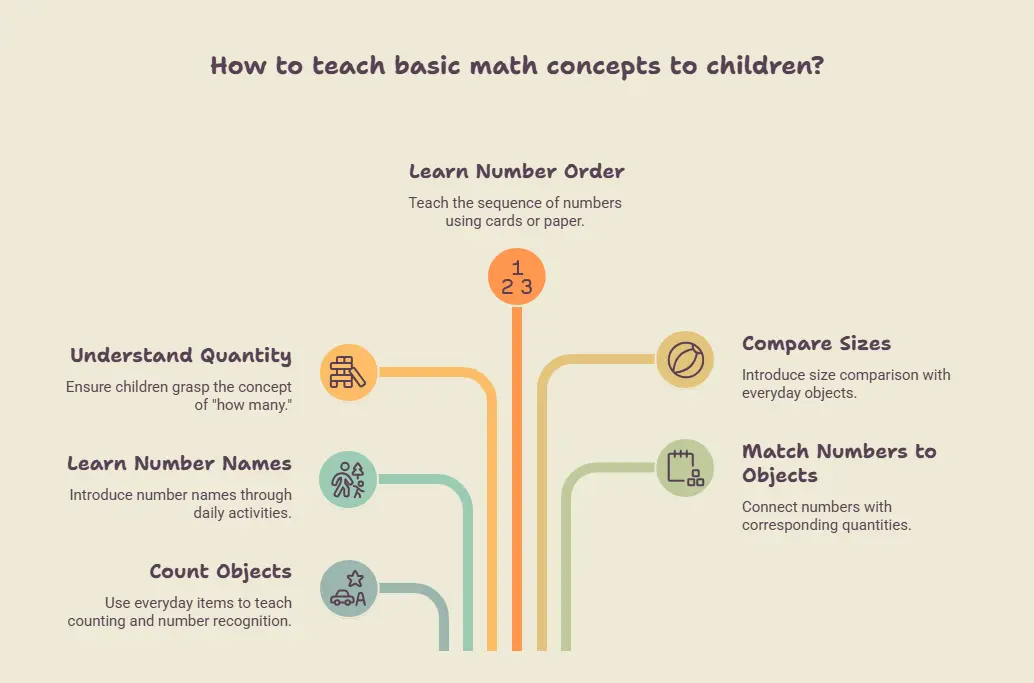
A 3-year-old can start counting small groups of things. Use objects that the child can see and touch.
You can count:
- Toys
- Blocks
- Fruits
- Spoons
- Balls
Count slowly with the child. Let the child touch each object while saying the number.
Learning Number Names
Children can learn the names of small numbers. Start with numbers they hear often.
You can say: One, two, three, four, five.
Say the numbers while doing something. For instance, count the steps while walking or count the toys while putting them away.
Knowing How Many
Counting is not only about saying numbers. Children also need to understand how many things they see.
Put three blocks on the table. Count them together.
“One, two, three. We have three blocks.”
Do the same with other objects during the day.
Learning Number Order
Children can learn that numbers come in an order.
You can use number cards or write numbers on paper.
1 → 2 → 3 → 4 → 5
Ask the child to put them in the right order. Keep the activity small and easy at first.
Big and Small
Size is also part of early maths. Children can compare objects around them.
Ask the child to find:
- A big ball
- A small ball
- A big box
- A small box
The child can look at two things and say which one is bigger or smaller.
Matching Numbers with Objects
Children can learn that a number stands for a certain amount.
Write the number 3 on a card. Place three blocks next to it.
Then say: “This is three. We have three blocks.”
This connects the number with the amount the child can see.
Colours, Shapes and Sizes
Children see different colours and shapes around them every day. They may notice a red ball, a big box, or a round plate. You can talk about these things while playing or doing simple work at home.
Learning Colours
Start with common colours like red, blue, yellow, and green.
You can point to things around the house and name the colour. You can also ask, “Can you find something red?”. There is no need to teach many colours at once. Give the child time to learn them.
Some easy colours are:
- Red
- Blue
- Yellow
- Green
- Pink
- Orange
- Black
- White
Parents can teach colours during normal play. For example, point to a red ball and say, “This is red.”
Matching Colours
Matching is an easy way to teach colours. Give the child a few objects and ask them to find things with the same colour.
For example, the child can:
- Put red blocks together
- Match blue toys
- Sort crayons by colour
- Find yellow things in the room
This can be done as a small game.
Learning Shapes
Children can also learn some simple shapes. Start with shapes they see often.
They can learn:
- Circle
- Square
- Triangle
- Rectangle
- Oval
Use things that are already around the child. A plate can show a circle. A window can show a rectangle.
Finding Shapes
Children can look for shapes at home or outside. This makes the idea easier to understand.
Ask simple questions like:
- “Can you find a circle?”
- “Where is the square?”
- “Can you find a triangle?”
Let the child look and answer. There is no need to rush.
Learning Big and Small
Children can also learn about size. Start with simple words like big and small. Show the child two things. For example, use a big ball and a small ball.
Ask: “Which ball is big?”
Then ask: “Which ball is small?”
Doing this with real objects can make the idea easier.
Learning Long and Short
Children can also compare the length of things.
For example:
- A long pencil
- A short pencil
- A long stick
- A short stick
Put two things next to each other. Let the child see which one is longer or shorter.
Basic Social and Emotional Skills
Fine Motor Skills and Hand-Eye Coordination
1: What is the primary focus of the first plane of development in the Montessori method?
Montessori materials give children many ways to use their hands. They pick up, move, hold, and place things. These simple actions help children use their fingers and hands better.
Children may:
- Stack blocks
- Move beads
- Pour water
- Open and close things
- Put puzzle pieces in place
- Thread beads
- Turn small knobs
These activities need hand control. The child has to look at the object and move the hand in the right way.
Helps Children Use Their Fingers
Small activities help children move their fingers with care. They learn how to hold and move things without dropping them.
For example, a child can move beads from one bowl to another. The child picks up each bead and puts it in the other bowl. This gives the fingers simple practice.
Helps Hands and Eyes Work Together
Children use their eyes and hands at the same time. They look at an object and then move their hands towards it.
For example, when a child puts a block in the right place, the eyes find the place first. The hand then moves the block there.
This simple practice helps children control their movements.
Helps with Daily Tasks
Good hand control is useful in daily life. Montessori activities give children practice for these tasks.
Children can learn to:
- Hold a spoon
- Turn a page
- Button clothes
- Open a box
- Use a pencil
- Pick up small things
Everyday Life Skills for 3-Year-Olds
A 3-year-old can start doing many small things alone. These are simple things they do every day. Montessori activities give children time to learn these skills.
Eating and Drinking
Children can learn to eat and drink with less help. They can use a spoon, drink from a cup, and carry light things to the table.
They may spill food or water at first. This is okay. They can try again and learn with practice.
Getting Dressed
A 3-year-old can try some simple dressing tasks. They may need help with some parts.
They can try to:
- Put on socks
- Wear shoes
- Pull up trousers
- Put on a simple shirt
- Open and close easy buttons
Let the child take time to try. Do not rush to do it for them.
Keeping Things in Place
Children can learn where their things belong. This can be part of their daily routine.
They can:
- Put toys in a box
- Keep books on a shelf
- Put shoes in their place
- Put dirty clothes in a basket
This helps children learn to take care of their things.
Helping at Home
Children often like to help with small jobs. Give them safe and easy work.
They can:
- Wipe a table
- Water a plant
- Put spoons on the table
- Carry light things
- Help put away groceries
- Put toys back after play
These small jobs make children feel useful.
Personal Care
Children can also learn simple self-care habits. They can slowly learn to do some of these tasks without help.
They can practise:
- Washing their hands
- Brushing their teeth
- Wiping their face
- Using a tissue
- Throwing waste in the bin
- Washing their hands after using the toilet
Parents can show the child first. Then, let the child try.
Cleaning Up
Children can learn to clean small messes. If they spill a little water, give them a cloth and let them wipe it.
They can also put away their toys after playing.
Simple habits like these teach children to take care of their space.
Doing Small Tasks Alone
A 3-year-old may want to say, “I can do it!” Give them safe chances to try.
For example, let the child:
- Choose between two shirts
- Carry their own small bag
- Put on their shoes
- Pour a little water
- Put away their toys
The child may need help at times. That is normal.
Everyday tasks are a simple way to teach children. They do not need special toys for every lesson. Simple work at home can help a 3-year-old learn useful skills and become more independent.
How Parents can Support Early Learning at Home
Home is the first place where children learn. Parents can help children learn through simple daily activities. There is no need to make every activity a lesson.
Give the child time to try things alone. Let them make small mistakes and try again.
Parents can:
- Read simple books
- Talk to the child often
- Let the child help with small tasks
- Give simple choices
- Play with blocks and puzzles
- Ask simple questions
- Let the child draw and colour
- Teach simple daily habits
Register for the Entri Elevate Montessori Teacher Training Program! Join Now!
Let Children Try
Children learn by doing things. Give them time to try a task before helping.
For example, let the child put on their shoes or put toys away. They may take more time. That is okay.
Use Daily Activities
Learning can happen during normal home activities.
A child can learn while:
- Counting fruits
- Sorting clothes
- Pouring water
- Setting the table
- Watering plants
- Putting toys in a box
These simple tasks make learning easy and fun.
Talk and Read Together
Talk to the child during the day. Ask about what they see and do.
Reading simple books is also a good way to learn. Ask questions such as, “What is this?” or “Where is the cat?”
Let the child answer in their own words.
Give Simple Choices
Give the child two simple choices. For example, ask, “Do you want the red shirt or the blue shirt?”
This lets the child make small decisions.
Parents do not need to plan many activities every day. Simple play, talk, reading, and daily tasks can give a 3-year-old many chances to learn.
Get Certified & Start Your Montessori Career
Montessori Teacher Training Course by Entri App: Gain expert skills, earn certification, and kickstart your teaching career.
Join Now!Conclusion
The age of 3 is an important time for learning. Children learn many new things through play and daily activities. They can learn simple words, numbers, colours, shapes, and daily habits.
Parents can make learning easy at home. Reading books, talking, drawing, counting, and helping with small tasks can give children good practice.
Children do not need to learn everything at once. Give them enough time to try, play, and learn. Small mistakes are also part of learning.
With simple support and regular practice, children can slowly learn new skills. Most importantly, learning should be simple, fun, and comfortable for the child.
Get Certified & Start Your Montessori Career
Montessori Teacher Training Course by Entri App: Gain expert skills, earn certification, and kickstart your teaching career.
Join Now!Frequently Asked Questions
What should a 3-year-old learn?
A 3-year-old can learn many simple things through daily life. This includes colours, shapes, numbers, new words, simple patterns, and basic daily tasks. Sharing, taking turns, and talking about feelings are also useful at this age.
How can I teach a 3-year-old at home?
You do not need special lessons every day. Talk to the child, read books, count things at home, and let them help with small tasks. Play is also a good time to learn.
How many colours should a 3-year-old know?
A 3-year-old can start with common colours such as red, blue, yellow, and green. Some children learn more colours quickly, while others need more time. There is no need to teach many colours at once.
Should a 3-year-old know numbers?
A 3-year-old can start learning to count small groups of things. For example, they can count toys, spoons, or blocks. At this age, knowing a few numbers is more important than doing difficult maths.
What shapes can a 3-year-old learn?
Start with simple shapes such as a circle, square, triangle, and rectangle. Point out these shapes in things the child sees every day. A plate, window, or book can become a simple example.
What daily tasks can a 3-year-old do alone?
A 3-year-old can try small tasks such as putting toys away, washing their hands, eating with a spoon, or putting clothes in the right place. They may still need some help with certain tasks.
How can I help my 3-year-old learn new words?
Talk to the child during normal activities. Read short books and name things around the house. When the child asks a question or tells you something, give them time to talk.
Is it important for a 3-year-old to learn sharing and taking turns?
Yes. These skills become part of everyday play with other children. A child may still find sharing or waiting difficult. Small games and regular practice can give them more chances to try.
What should I do if my 3-year-old learns slowly?
Children do not all learn at the same speed. Some may know colours or numbers early, while others may take longer. Give the child time and keep learning part of normal play.
When should I be concerned about my 3-year-old's learning?
Talk to a paediatrician if you have concerns about the child’s speech, movement, play, behaviour, or other development. It is better to ask when something does not seem right than to wait and worry.