Table of Contents
What Does an ELV and Low-Current Systems Engineer Do?
An ELV Engineer designs low-voltage building systems. These systems support security and communication. Building safety and automation are also supported.
ELV means Extra-Low Voltage. CCTV, fire alarms, and access control included. Network and communication systems are also covered.
Different responsibilities are handled during projects.
Main responsibilities include:
- Project requirements are studied.
- ELV systems are designed.
- Technical drawings are prepared.
- Cable routes are planned.
- Equipment is selected.
- Material schedules are prepared.
- Installation work is supervised.
- MEP teams are coordinated.
- Installed systems are tested.
- Handover documents are prepared.
Typical salary ranges:
| Location | Experience | Monthly / Annual Salary |
| India | Fresher | ₹2.5–4.5 LPA |
| India | Experienced | ₹5–9 LPA |
| UAE | Fresher | AED 3,000–5,000 monthly |
| UAE | Experienced | AED 7,000–12,000 monthly |
These figures are indicative estimates. Actual salaries depend on experience and location.
| Career detail | Overview |
| Main role | Designing ELV systems |
| Fresher salary in India | Around ₹2.5–4.5 LPA |
| Experienced salary in India | Around ₹5–9 LPA |
| Gulf opportunities | UAE, Saudi Arabia, Qatar |
| Career growth | Junior to Senior Engineer |
| Higher roles | Project Manager or Design Manager |
Salary figures are estimates. Actual pay depends on experience, location, and employer.
Get Career oriented MEP training with Expert Mentors! Get Free Demo Here!

Introduction: Why Does Every Modern Building Need ELV Systems?
Modern buildings depend on connected systems. These systems support daily building operations. Security and communication are also improved.
ELV systems are used in different buildings.
Commercial Buildings
- Office buildings.
- Shopping malls.
- Business centres.
- IT parks.
- Hotels.
Residential Buildings
- Apartments.
- Gated communities.
- Smart homes.
- Residential towers.
- Housing complexes.
Public Infrastructure
- Airports.
- Railway stations.
- Hospitals.
- Educational institutions.
- Metro stations.
Different systems are required in each building. CCTV used for security. Fire alarms for fire detection. Access control manages entry.
Communication systems are installed. Network support data transfer. PA systems are used for announcements.
ELV engineers handle these systems. Their designs are prepared according to requirements. Installation activities are also supervised.
Different engineering teams work on these projects. Electrical engineers on power distribution. Mechanical engineers on HVAC systems. ELV engineers on low-current services.
Coordination between them is important. It prevents installation problems. It supports smooth building operations.
Master MEP Design with Industry-Leading Training!
Gain in-depth knowledge of Mechanical, Electrical, and Plumbing (MEP) Design with expert-led courses. Learn HVAC, fire safety, sustainable building strategies, and BIM applications to excel in the construction industry.
Know MoreWhat Are ELV and Low-Current Systems?
ELV stands for Extra-Low Voltage. These systems operate at extra-low voltage levels.
Low-current systems support building communication. Security and monitoring functions are also included.
Different devices are connected through these systems.
Common applications include:
- Security monitoring.
- Fire detection.
- Emergency communication.
- Building automation.
- Data transmission.
- Access management.
- Network connectivity.
These systems use cables or wireless connections. Some systems are connected through networks. Their design depends on project requirements.
What Are ELV and Low-Current Systems?
ELV stands for Extra-Low Voltage. These systems operate at extra-low voltage levels.
Low-current systems support building communication. Security and monitoring functions are also included.
Different devices are connected through these systems.
Common applications include:
- Security monitoring.
- Fire detection.
- Emergency communication.
- Building automation.
- Data transmission.
- Access management.
- Network connectivity.
These systems use cables or wireless connections. Some systems are connected through networks. Their design depends on project requirements.
Systems Covered Under ELV Engineering
Different systems are included in ELV projects. Each system performs a specific function.
Common ELV Systems and Their Purposes
| System | Main purpose |
| CCTV | Building activities are monitored. |
| Access Control | Entry and exit are controlled. |
| Fire Alarm | Fire incidents are detected. |
| PA System | Announcements are shared. |
| Structured Cabling | Network connections are provided. |
| BMS | Building services are monitored. |
CCTV Systems
CCTV means Closed-Circuit Television. Building activities are monitored through cameras.
Common components include:
- Security cameras.
- Network video recorders.
- Storage devices.
- Monitoring screens.
- Network switches.
- Recording software.
Camera locations planned carefully. Suitable coverage areas dentified. Cable routes prepared.
Access Control Systems
Access control manages entry. It is provided to authorised people.
Common components include:
- Card readers.
- Biometric scanners.
- Access cards.
- Door controllers.
- Electronic locks.
- Exit buttons.
These systems are used in offices. Restricted areas are also protected.
Fire Alarm Systems
Fire alarm systems detect possible fires. Occupants are alerted through alarm devices.
Common components include:
- Smoke detectors.
- Heat detectors.
- Manual call points.
- Alarm sounders.
- Control panels.
- Notification devices.
Detector locations are planned carefully. Alarm layouts are also prepared. Safety requirements must be followed.
Public Address Systems
Public Address systems are called PA systems. They distribute announcements across buildings.
Main components include:
- Speakers.
- Microphones.
- Amplifiers.
- Control panels.
- Audio cables.
- Emergency announcement equipment.
They support daily announcements. They can also support emergency evacuation.
Structured Cabling Systems
Structured cabling connects building network devices. It supports communication and data transfer.
Common components include:
- Ethernet cables.
- Fibre optic cables.
- Patch panels.
- Network racks.
- Data outlets.
- Cable trays.
These systems support internet connectivity. They also support telephone and data networks.
Building Management Systems
BMS means Building Management System. Different building services are monitored centrally.
Common functions include:
- HVAC equipment monitoring.
- Lighting system control.
- Equipment status monitoring.
- Energy usage tracking.
- System alert monitoring.
- Centralised building control.
Different building systems can be connected. Integration depends on project requirements.
Master MEP Design with Industry-Leading Training!
Gain in-depth knowledge of Mechanical, Electrical, and Plumbing (MEP) Design with expert-led courses. Learn HVAC, fire safety, sustainable building strategies, and BIM applications to excel in the construction industry.
Know MoreWhat Does an ELV Engineer Do?
Several tasks are handled during ELV projects. Work usually begins with system design. It then moves towards installation and handover.
ELV System Design
Project requirements are studied first. Suitable equipment and layouts are selected.
Main activities include:
- Study project specifications.
- Understand building requirements.
- Select suitable devices.
- Plan camera locations.
- Design network layouts.
- Plan cable routes.
- Calculate equipment requiremen
Designs must match project requirements. Applicable standards must also be followed.
Preparing Shop Drawings
Shop drawings are prepared for installation. These drawings are followed by site teams.
Common drawings include:
- CCTV layouts.
- Fire alarm layouts.
- Access control layouts.
- PA system layouts.
- Network layouts.
- Cable routing drawings.
- Equipment room layouts.
- Riser diagrams.
Dimensions are checked . Device locations marked. Drawing details match approved designs.
Installation Supervision
It is monitored by engineers. Approved drawings are followed.
Main responsibilities include:
- Equipment deliveries checked.
- Installation locations reviewed.
- Cable routes inspected.
- Devices are installed.
- Cable terminations are checked.
- Electrical teams are coordinated.
- Site problems resolved.
- Installation quality inspected.
Regular inspections help reduce mistakes. Project quality is also maintained.
Testing and Commissioning
Installed systems are tested before handover. They must work correctly.
Common testing activities include:
- Test CCTV cameras.
- Check recording functions.
- Test access card readers.
- Check fire alarm devices.
- Test speaker coverage.
- Check network connections.
- Verify system integration.
- Record test results.
Commissioning confirms system readiness. Identified problems are corrected. Final system performance is also checked.
Project Handover
Completed systems are handed over. Required documents are also submitted.
Common handover documents include:
- As-built drawings.
- Equipment schedules.
- Test reports.
- Commissioning reports.
- Product manuals.
- Warranty documents.
- Maintenance instructions.
- System operating details.
These documents support future maintenance. Facility management teams use them regularly.
ELV Engineer vs MEP Electrical Engineer
Both engineers work on building services. However, their work areas are different.
Main Responsibilities
ELV Engineer
- Low-current systems are designed.
- Security systems are handled.
- Communication networks are planned.
- Fire alarm layouts are prepared.
- ELV drawings are created.
- Connected devices are tested.
- System integration is supported.
MEP Electrical Engineer
- Power distribution is designed.
- Electrical circuits are planned.
- Building loads are calculated.
- Electrical cables are selected.
- Lighting systems are designed.
- Earthing systems are planned.
- Electrical drawings are prepared.
Work Areas
| Comparison | ELV Engineer | MEP Electrical Engineer |
| Main Focus | Security and communication | Electrical power |
| Systems | CCTV, alarms, networking | Lighting, panels, power |
| Equipment | Cameras, sensors, readers | Transformers, breakers, cables |
| Drawings | ELV layouts and schematics | Power and lighting layouts |
| Testing | Device and network testing | Electrical system testing |
| Coordination | ICT and security teams | Electrical and MEP teams |
Both roles need technical knowledge. Both require drawing and coordination skills. Their work also overlaps in buildings.
Standards and Codes Used by ELV Engineers
Standards provide important design guidelines. Safe installation practices are supported. System performance is also maintained.
Different projects follow different standards. Location and authority requirements are considered. Client specifications must also be checked.
NFPA 72
NFPA 72 is the National Fire Alarm and Signaling Code.
Fire alarm system requirements are covered. Emergency communication systems are also included.
Important areas include:
- Fire alarm design.
- Detection devices.
- Alarm notification.
- Emergency communication.
- Inspection requirements.
- Testing procedures.
- System maintenance.
The 2025 edition is a published edition. Applicable local regulations must also be checked.
BICSI Standards
BICSI supports telecommunications infrastructure practices. Its standards guide ICT system design.
Important areas include:
- Structured cabling.
- Telecommunications rooms.
- Cable pathways.
- Network infrastructure.
- Installation practices.
- System documentation.
These standards support reliable installations. They are useful for ICT design professionals.
Get Career oriented MEP training with Expert Mentors! Get Free Demo Here!
TIA Standards
TIA standards cover telecommunications cabling. TIA-568 is an important reference.
Important areas include:
- Structured cabling requirements.
- Cable performance.
- Installation methods.
- Network components.
- Telecommunications connections.
These standards support organised cabling systems.
Local Building Codes
Local regulations must always be followed.
In India, the following references are used:
- National Building Code 2016.
- Applicable BIS standards.
- Local fire department requirements.
- Project specifications.
- State and municipal regulations.
In the Gulf, different regulations are followed.
- UAE Fire and Life Safety Code.
- Dubai Civil Defence requirements.
- Saudi Building Code.
- Qatar Civil Defence requirements.
- Local authority regulations.
Requirements differ between countries. Relevant authority approvals must be obtained.
Skills and Software Required for ELV Engineers
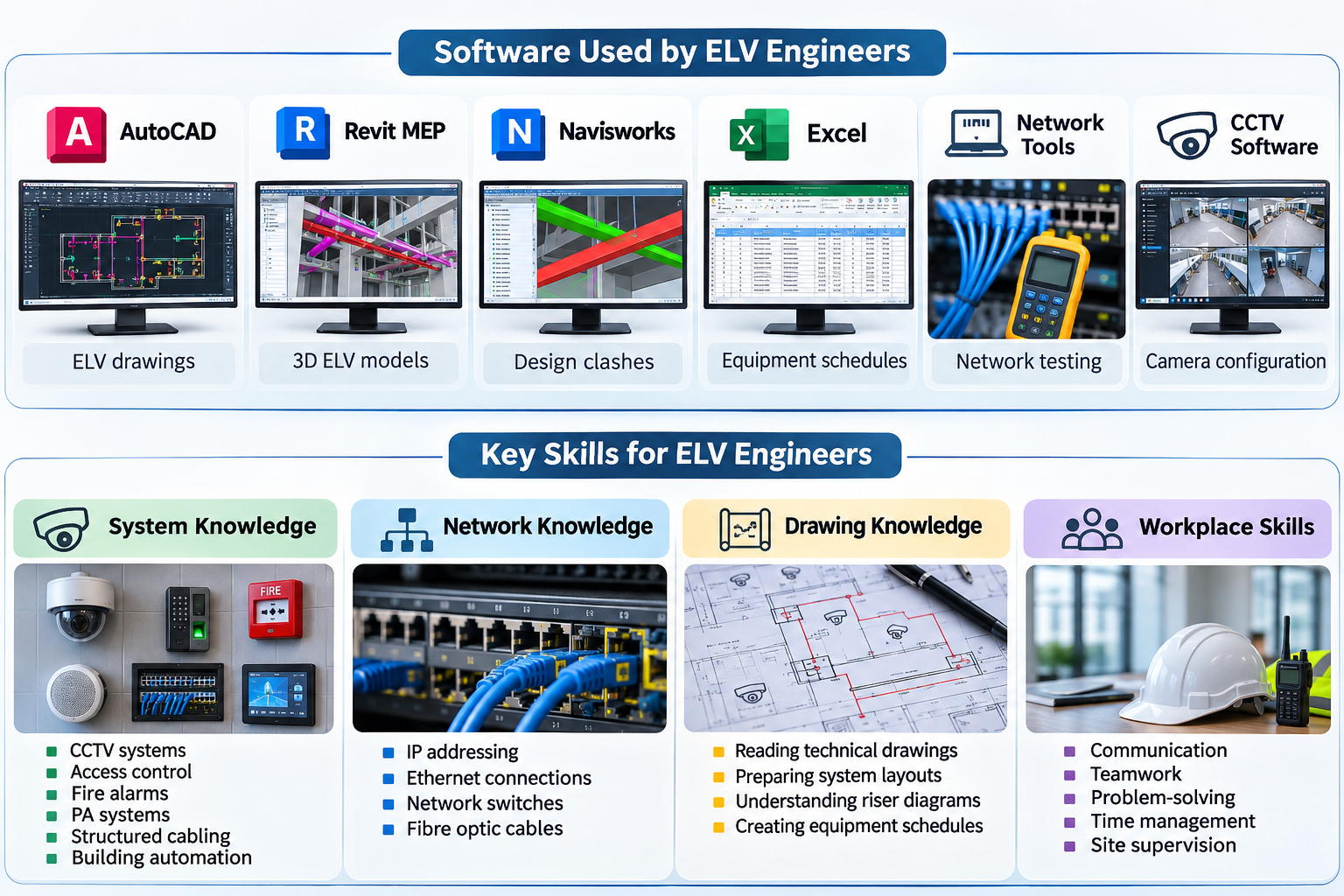
Technical and practical skills are needed. Different software tools are also used. The required tools depend on projects.
Software Used by ELV Engineers
| Software / Skill | Main application |
| AutoCAD | ELV drawings are prepared. |
| Revit MEP | 3D ELV models are created. |
| Navisworks | Design clashes are checked. |
| Microsoft Excel | Equipment schedules are prepared. |
| Network Tools | Network connections are tested. |
| CCTV Software | Camera systems are configured. |
AutoCAD
AutoCAD is used for technical drawings.
Main uses:
- CCTV layouts are prepared.
- Fire alarm drawings are created.
- Cable routes are marked.
- Equipment layouts are prepared.
- Shop drawings are edited.
- As-built drawings are updated.
Revit MEP
Revit supports building information modelling. Three-dimensional ELV models are created.
Main uses:
- ELV models are developed.
- System devices are placed.
- Cable trays are modelled.
- Building services are coordinated.
- Equipment locations are reviewed.
- Model-based drawings are prepared.
Navisworks
Navisworks supports project coordination. Design clashes are identified through models.
Main uses:
- 3D models are reviewed.
- Cable tray clashes are checked.
- MEP services are coordinated.
- Building layouts are examined.
- Design coordination is supported.
Technical Skills
System Knowledge
- CCTV systems.
- Access control.
- Fire alarms.
- PA systems.
- Structured cabling.
- Building automation.
Network Knowledge
- IP addressing.
- Ethernet connections.
- Network switches.
- Fibre optic cables.
Drawing Knowledge
- Reading technical drawings.
- Preparing system layouts.
- Understanding riser diagrams.
- Creating equipment schedules.
Workplace Skills
- Communication.
- Teamwork.
- Problem-solving.
- Time management.
- Site supervision.
Qualifications and Certifications for ELV Engineers
A suitable engineering qualification is useful. Technical training can also be completed.
Educational Qualifications
The following qualifications support entry:
- B.Tech in Electrical Engineering.
- B.E. in Electrical Engineering.
- B.Tech in Electronics Engineering.
- B.E. in Electronics and Communication.
- Diploma in Electrical Engineering.
- Diploma in Electronics Engineering.
- Instrumentation Engineering qualifications.
Some employers accept related qualifications. Requirements depend on the job role.
A design engineer needs drawing knowledge. A commissioning engineer needs testing skills. Networking knowledge is useful for ICT roles.
Professional Certifications
Certifications can support career growth.
BICSI RCDD
This certification covers ICT infrastructure design.
- Structured cabling.
- Network room planning.
- Cable pathways.
- Telecommunications systems.
Experience requirements must be met.
BICSI ICT Training
Important topics include:
- Cable installation.
- Network planning.
- ICT infrastructure.
- Structured cabling.
Manufacturer Training
Equipment-specific training is also available.
- CCTV configuration.
- Fire alarm systems.
- Access control.
- Network equipment.
- BMS systems.
Practical experience remains essential.
ELV Engineer Salary in India and the Gulf
ELV engineer salaries vary across locations. Experience and technical skills affect earnings. Company size also matters.
Salary in India
Several building projects are developed in India. Different ELV systems are required.
Common job locations include:
- Bengaluru.
- Chennai.
- Hyderabad.
- Mumbai.
- Pune.
- Delhi.
- Gurugram.
- Kochi.
- Ahmedabad.
Reported salaries vary between companies. Entry-level offers are usually lower. Experienced professionals may receive higher salaries.
Salary in the Gulf
Gulf countries offer ELV engineering opportunities. Commercial and infrastructure projects need these systems.
Common job locations include:
- Dubai.
- Abu Dhabi.
- Riyadh.
- Jeddah.
- Doha.
- Muscat.
- Kuwait City.
Salary packages vary between countries. Project experience can affect salary offers.
Salary by Experience
The following figures are indicative estimates. They are not guaranteed salary offers.
| Experience | Career level | India (Annual) | UAE (Monthly) |
| 0–2 years | Junior ELV Engineer | ₹2.5–4.5 LPA | AED 3,000–5,000 |
| 2–5 years | ELV Engineer | ₹4–7 LPA | AED 4,500–6,000 |
| 5–8 years | Senior ELV Engineer | ₹7–11 LPA | AED 5,500–8,000 |
| 8+ years | Lead / Project Engineer | ₹10–15+ LPA | AED 7,000–12,000+ |
Actual salaries may fall outside these ranges. Specialist skills can improve earning opportunities. International project experience can also help.
Factors That Affect Salary
Several factors can influence earnings.
- Years of experience.
- ELV system knowledge.
- AutoCAD and Revit skills.
- Networking knowledge.
- International project experience.
- Design standards knowledge.
- Testing and commissioning skills.
- Project management experience.
Career Path of an ELV Engineer
Career growth is supported through experience. Higher responsibilities are gained over time.
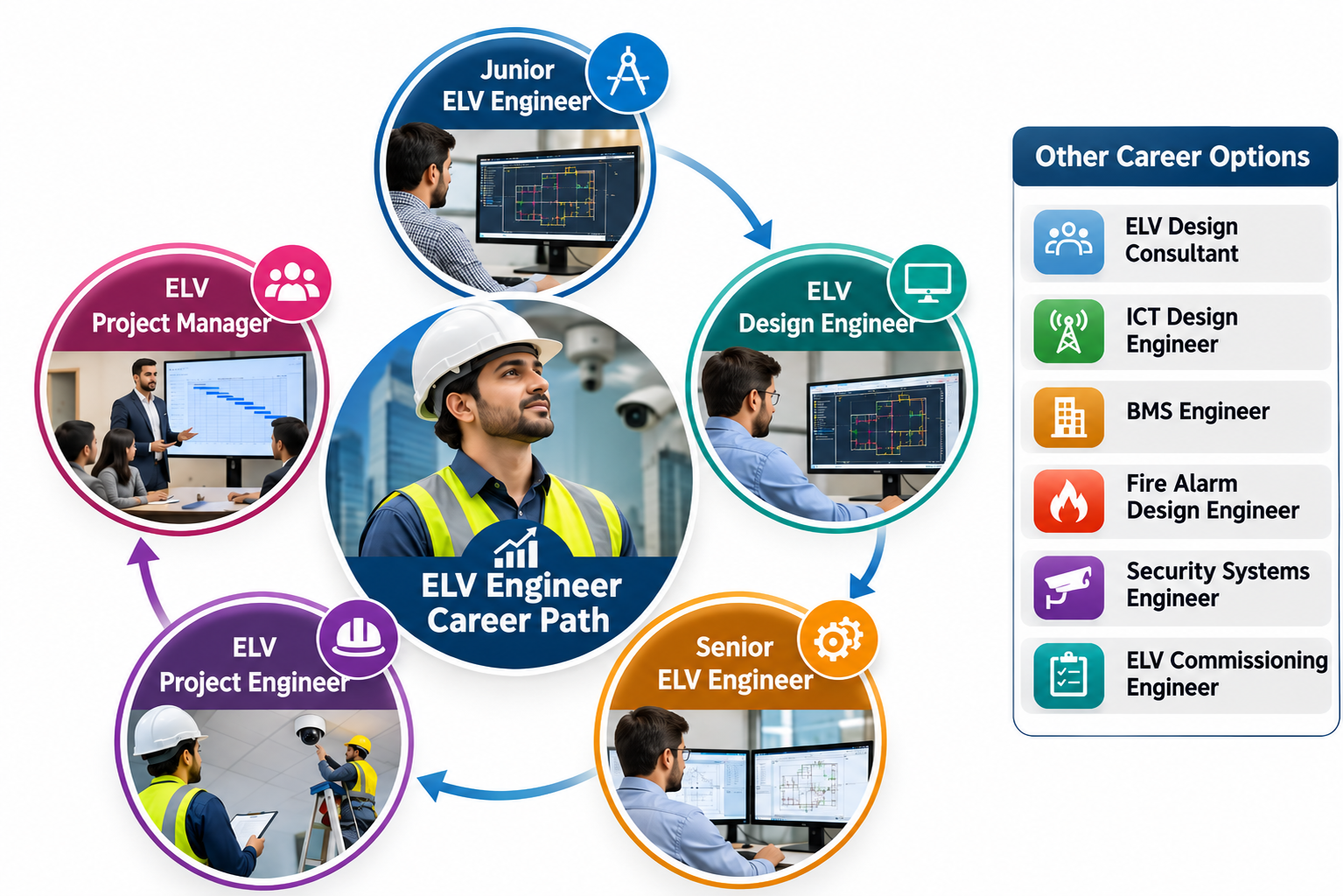
| Career stage | Main responsibility |
| Junior ELV Engineer | Supporting design work |
| ELV Design Engineer | Preparing system designs |
| Senior ELV Engineer | Reviewing complex designs |
| ELV Project Engineer | Supervising installations |
| ELV Project Manager | Managing projects |
Junior ELV Engineer
Basic tasks are completed under guidance.
- Drawings are updated.
- Equipment schedules are checked.
- Senior engineers are supported.
ELV Design Engineer
Design activities are handled independently.
- ELV systems are designed.
- Shop drawings are prepared.
- Equipment is selected.
- Cable routes are planned.
Senior ELV Engineer
Complex design activities are handled.
- Designs are reviewed.
- Technical problems are resolved.
- Junior engineers are guided.
- Teams are coordinated.
ELV Project Engineer
Site activities are supervised.
- Installation schedules are prepared.
- Contractors are coordinated.
- Progress is monitored.
- Commissioning is supported.
ELV Project Manager
Overall project activities are managed.
- Teams are managed.
- Budgets are monitored.
- Client meetings are conducted.
- Project delivery is supervised.
Other career options:
- ELV Design Consultant.
- ICT Design Engineer.
- BMS Engineer.
- Fire Alarm Design Engineer.
- Security Systems Engineer.
- ELV Commissioning Engineer.
How to Become an ELV Engineer
Basic engineering knowledge and practical skills are needed.
Step 1: Complete a Relevant Qualification
A suitable engineering course should be completed.
Recommended qualifications:
- Electrical Engineering.
- Electronics Engineering.
- Electronics and Communication.
- Instrumentation Engineering.
Step 2: Learn ELV System Basics
Common ELV systems should be understood.
Focus on:
- CCTV systems.
- Access control.
- Fire alarms.
- PA systems.
- Structured cabling.
- Building automation.
Step 3: Understand Design Standards
Important standards should be learned.
Start with:
- NFPA 72.
- BICSI standards.
- TIA-568.
- NBC 2016.
- Local fire safety codes.
Step 4: Learn ELV Design Software
Common design tools should be practised.
Recommended tools:
- AutoCAD.
- Revit MEP.
- Navisworks.
- Microsoft Excel.
Step 5: Complete Practical Projects
Practical skills should be developed through projects.
Suggested projects:
- Office CCTV design.
- Fire alarm layout.
- Apartment access control.
- Office structured cabling.
- Hotel BMS layout.
Practical activities:
- Devices are selected.
- Layouts are prepared.
- Cable routes are planned.
- Equipment schedules are created.
Step 6: Build a Professional Portfolio
Completed projects should be collected.
Include:
- CCTV layouts.
- Fire alarm drawings.
- Network diagrams.
- Equipment schedules.
- Software screenshots.
Confidential details must be removed.
Step 7: Apply for Suitable Jobs
Entry-level opportunities can be explored.
Possible job titles:
- Junior ELV Engineer.
- ELV Design Engineer.
- ELV Site Engineer.
- ELV Draftsman.
- ELV Commissioning Engineer.
Where to Apply:
- MEP consultancy companies.
- Construction companies.
- ELV contractors.
- Security system companies.
- Building automation companies.
A suitable resume and portfolio should be prepared.
Conclusion
ELV systems support modern building operations. Security, communication, and fire safety are improved. ELV engineers handle system designs and drawings. Installation, testing, and commissioning are also managed. AutoCAD, Revit, and networking skills are useful. Suitable qualifications and practical training build expertise.
An MEP design course can develop these skills. Building services and design software are covered. Practical training also supports career growth. Explore an MEP Design Course. Build skills for ELV engineering careers.
Master MEP Design with Industry-Leading Training!
Gain in-depth knowledge of Mechanical, Electrical, and Plumbing (MEP) Design with expert-led courses. Learn HVAC, fire safety, sustainable building strategies, and BIM applications to excel in the construction industry.
Know MoreFrequently Asked Questions
What Does an ELV Engineer Do?
Low-voltage building systems are designed by ELV engineers. CCTV, fire alarms, and access control are included. Technical drawings are also prepared. Installation and testing activities are supervised.
Which Software Is Used by ELV Engineers?
AutoCAD is used for technical drawings. Revit supports 3D modelling. Navisworks is used for coordination. Network tools support connectivity testing.
Is Electrical Engineering Required for ELV Jobs?
Electrical engineering is a common qualification. Electronics and instrumentation are also relevant. Some employers accept suitable diplomas. Requirements depend on the position.
What Is the Salary of an ELV Engineer?
Freshers may earn around ₹2.5–4.5 LPA. Experienced engineers may earn higher salaries. Gulf salaries depend on experience and location. Company and project requirements also matter.
Is ELV Engineering Different From Electrical Engineering?
Yes, their work areas are different. ELV engineers handle security and communication. Electrical engineers handle power distribution and lighting. Both work together on building projects.
Is ELV Engineering a Good Career Option?
Different career opportunities are available. Modern buildings require ELV systems. Jobs are available in several industries. Senior positions can be reached with experience.