Table of Contents
German A1 is the first step for people who are new to the language. At this stage, most of the words are short and easy.
You will come across words for family, food, home, shopping, time, and everyday things. These are words you can use in many simple situations.
It is better to start with words that you may hear or use often. There is no need to learn difficult words at the start.
These basic words are also useful for A1 reading, listening, writing, and speaking tasks. In this blog, you will find common German A1 words with their simple meanings.
Key Takeaways
- A1 starts with basic German words.
- Learn words used in daily life.
- Family and home words are useful.
- Numbers and time words are important.
- Food and shopping words are useful for simple daily conversations.
German A1 Vocabulary: Essential Words
German A1 starts with simple words. These are words you may hear and use in daily life.
You do not need to learn difficult words at this level. Start with words that you use often. Family, food, time, home, work, and travel are common A1 topics. These words also come up when you read, listen, write, and speak in German.
Greetings & Common Expressions
Greetings are usually some of the first German words you learn. You use them when you meet someone, begin talking, or leave.
Some common German greetings are:
- Hallo – Hello
- Guten Morgen – Good morning
- Guten Tag – Good day
- Guten Abend – Good evening
- Gute Nacht – Good night
- Tschüss – Bye
- Auf Wiedersehen – Goodbye
You will also hear some simple polite words.
- Danke – Thank you
- Bitte – Please / You are welcome
- Entschuldigung – Excuse me / Sorry
- Ja – Yes
- Nein – No
For example:
Hallo! Wie geht es dir? – Hello! How are you?
Danke, gut. – Thank you, I am good.
Tschüss! – Bye!
These small words are used often. So, they are useful words to learn first.
Learn German in your own language! Get free Demo Classes Here!
Family & People
Family is a common topic in German A1. You can use these words when talking about your parents, children, brothers, sisters, or other family members.
Here are some basic family words:
- die Mutter – mother
- der Vater – father
- die Eltern – parents
- der Bruder – brother
- die Schwester – sister
- der Sohn – son
- die Tochter – daughter
- das Kind – child
- die Familie – family
- der Mann – man / husband
- die Frau – woman / wife
- der Freund – male friend
- die Freundin – female friend
You can use these words in short sentences.
Das ist meine Mutter. – This is my mother.
Ich habe einen Bruder. – I have a brother.
Meine Familie ist klein. – My family is small.
You may also need simple words to talk about yourself.
Ich bin Studentin. – I am a female student.
Er ist mein Freund. – He is my friend.
Numbers, Dates & Time
Numbers are important at A1 level. When talking about your age, phone number, price, date, or time, you must need them.
Some basic numbers are:
- eins – one
- zwei – two
- drei – three
- vier – four
- fünf – five
- sechs – six
- sieben – seven
- acht – eight
- neun – nine
- zehn – ten
You may also come across these words when talking about days and dates:
- heute – today
- morgen – tomorrow
- gestern – yesterday
- Montag – Monday
- Dienstag – Tuesday
- Mittwoch – Wednesday
- Donnerstag – Thursday
- Freitag – Friday
- Samstag – Saturday
- Sonntag – Sunday
Some simple time words are:
- jetzt – now
- später – later
- früh – early
- spät – late
- die Uhr – clock / o’clock
- die Stunde – hour
For example:
Ich bin 25 Jahre alt. – I am 25 years old.
Heute ist Montag. – Today is Monday.
Der Kurs beginnt um neun Uhr. – The course starts at nine o’clock.
Numbers and time words are useful for age, dates, and time.
Food & Drinks
You may hear these words at home or when you eat outside.
Some basic food words are:
- das Brot – bread
- der Apfel – apple
- die Banane – banana
- das Ei – egg
- der Reis – rice
- das Fleisch – meat
- das Gemüse – vegetables
- das Obst – fruit
- das Essen – food
Some common drink words are:
- das Wasser – water
- die Milch – milk
- der Kaffee – coffee
- der Tee – tea
- der Saft – juice
You can make short sentences with these words.
Ich trinke Wasser. – I drink water.
Ich möchte einen Kaffee. – I would like a coffee.
Ich esse einen Apfel. – I eat an apple.
You may also hear simple words such as hungrig for hungry and durstig for thirsty.
Home & Daily Life
Home is another common A1 topic. You may need simple words for rooms and things around the house.
Some useful home words are:
- das Haus – house
- die Wohnung – apartment
- das Zimmer – room
- die Küche – kitchen
- das Bad – bathroom
- das Schlafzimmer – bedroom
- die Tür – door
- das Fenster – window
- der Tisch – table
- der Stuhl – chair
- das Bett – bed
Daily life also includes simple actions. Some common words are:
- essen – to eat
- trinken – to drink
- schlafen – to sleep
- arbeiten – to work
- lernen – to learn
- gehen – to go
- kommen – to come
- wohnen – to live
For example:
Ich wohne in Kochi. – I live in Kochi.
Ich lerne Deutsch. – I learn German.
Ich gehe nach Hause. – I go home.
These words can be used when talking about your home and your normal day.
Work, School & Education
Work and studies are also common topics at A1 level. You may need to say what you do or where you work or study.
Example:
- die Arbeit – work
- der Beruf – job / profession
- die Schule – school
- die Universität – university
- der Student / die Studentin – student
- der Lehrer / die Lehrerin – teacher
- der Arzt / die Ärztin – doctor
- der Mitarbeiter / die Mitarbeiterin – employee
- das Büro – office
- die Klasse – class
- der Kurs – course
You can use these words to give simple information about yourself.
Ich bin Studentin. – I am a student.
Ich arbeite in einem Büro. – I work in an office.
Ich lerne Deutsch. – I am learning German.
Meine Mutter ist Lehrerin. – My mother is a teacher.
Short sentences are enough at A1. You can talk about yourself and your day.
|
German A2 Exercises – Download Free PDF |
||
Travel & Places
These words are useful when you travel. You may need them for places and transport.
Some common place words are:
- die Stadt – city
- das Dorf – village
- der Bahnhof – train station
- der Flughafen – airport
- das Hotel – hotel
- der Supermarkt – supermarket
- die Bank – bank
- die Schule – school
- das Krankenhaus – hospital
- die Straße – street
Some common travel words are:
- der Bus – bus
- der Zug – train
- das Auto – car
- das Fahrrad – bicycle
- das Ticket – ticket
- die Reise – trip / journey
You may also need simple direction words:
- links – left
- rechts – right
- geradeaus – straight ahead
- hier – here
- dort – there
For example:
Wo ist der Bahnhof? – Where is the train station?
Gehen Sie geradeaus. – Go straight ahead.
Der Supermarkt ist dort. – The supermarket is there.
Common German Verbs
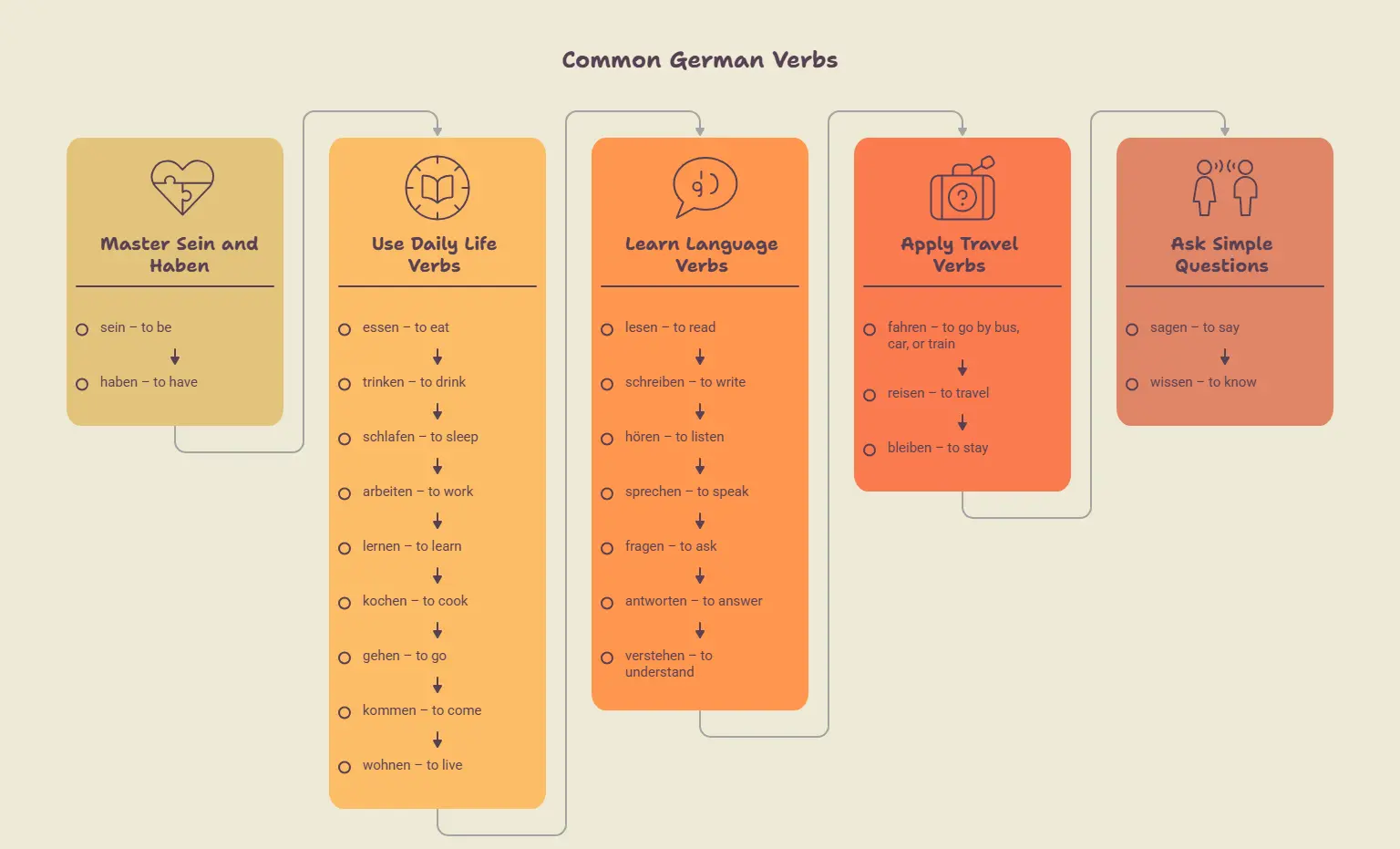
Verbs tell us what someone does. You will hear these verbs often. They come up when you talk about your family, work, home, food, or your day. Learn the ones you need most first.
Some common German verbs are:
- sein – to be
- haben – to have
- gehen – to go
- kommen – to come
- machen – to do
- lernen – to learn
- arbeiten – to work
- wohnen – to live
- essen – to eat
- trinken – to drink
- schlafen – to sleep
- sprechen – to speak
Sein and Haben
Sein means to be. It is one of the most common German verbs. You can use it when you talk about yourself or someone else.
For example:
Ich bin Anna. – I am Anna.
Ich bin Studentin. – I am a student.
Er ist mein Bruder. – He is my brother.
Haben means to have.
You can use it to talk about things you have.
Ich habe ein Auto. – I have a car.
Ich habe eine Schwester. – I have a sister.
Wir haben ein Haus. – We have a house.
These two verbs are used in many simple German sentences.
|
Goethe 2026 Exam Dates: Multiple Test Centers |
|
| Trivandrum Goethe Exam Dates | Kochi Goethe Exam Dates |
| Chennai Goethe Exam Dates | Coimbatore Goethe Exam Dates |
Verbs for Daily Life
Some German verbs are useful in your daily life.
- essen – to eat
- trinken – to drink
- schlafen – to sleep
- arbeiten – to work
- lernen – to learn
- kochen – to cook
- gehen – to go
- kommen – to come
- wohnen – to live
For example:
Ich esse Brot. – I eat bread.
Ich trinke Wasser. – I drink water.
Ich arbeite am Morgen. – I work in the morning.
Ich lerne Deutsch. – I learn German.
Ich schlafe um zehn Uhr. – I sleep at ten.
These verbs are easy to use when you talk about your day.
Verbs for Learning German
Some verbs are very useful when you are learning the language.
- lesen – to read
- schreiben – to write
- hören – to listen
- sprechen – to speak
- fragen – to ask
- antworten – to answer
- lernen – to learn
- verstehen – to understand
For example:
Ich lese ein Buch. – I read a book.
Ich schreibe einen Satz. – I write a sentence.
Ich spreche Deutsch. – I speak German.
Ich verstehe die Frage. – I understand the question.
These words are also useful in simple A1 exam tasks.
Verbs for Travel
Some verbs are useful when you talk about going to a place.
- gehen – to go
- kommen – to come
- fahren – to go by bus, car, or train
- reisen – to travel
- bleiben – to stay
For example:
Ich gehe nach Hause. – I go home.
Ich komme morgen. – I am coming tomorrow.
Ich fahre mit dem Bus. – I go by bus.
Wir reisen nach Deutschland. – We travel to Germany.
These verbs can help you talk about simple travel plans.
Verbs for Simple Questions
You also need some verbs when you talk to other people.
- fragen – to ask
- antworten – to answer
- sagen – to say
- sprechen – to speak
- machen – to do
- wissen – to know
For example:
Was machst du? – What are you doing?
Wo wohnst du? – Where do you live?
Wie heißt du? – What is your name?
Ich heiße Anna. – My name is Anna.
Ich weiß das nicht. – I do not know that.
Essential Adjectives
1: How do you say "Good Morning" in German?
Adjectives describe people and things. Some common German adjectives are:
- gut – good
- schlecht – bad
- groß – big / tall
- klein – small
- alt – old
- jung – young
- neu – new
- schön – nice
- schnell – fast
- langsam – slow
- leicht – easy
- schwer – difficult
Adjectives for People
You can use these words to describe people.
Er ist groß. – He is tall.
Sie ist klein. – She is short.
You can also talk about feelings.
- glücklich – happy
- traurig – sad
- müde – tired
- krank – sick
Ich bin müde. – I am tired.
Adjectives for Things
These words can describe things around you.
- sauber – clean
- schmutzig – dirty
- kaputt – broken
- teuer – expensive
- billig – cheap
Das Haus ist groß. – The house is big.
Das Auto ist neu. – The car is new.
Adjectives for Food
These words are useful when talking about food.
- lecker – tasty
- süß – sweet
- heiß – hot
- kalt – cold
- frisch – fresh
Das Essen ist lecker. – The food is tasty.
Der Kaffee ist heiß. – The coffee is hot.
Adjectives for Daily Life
Some simple words are:
- richtig – right
- falsch – wrong
- leicht – easy
- schwer – difficult
Das ist richtig. – That is right.
Das ist falsch. – That is wrong.
Learn a few adjectives first. Try using them in small sentences.
Free German A1 Mock Tests – Powered by AI!
Test your skills on our interactive platform. Get instant feedback from our AI to help you communicate better and track your progress. Start your free German mock test now.
Test Your German A1 for FreeA1 Vocabulary Practice Tips
You will not remember every German word at once. That is normal. Take a few words each day. Read them again later. Say them aloud and try using them when you can.
Learn a Few Words Each Day
Learn five or ten words at a time. You can choose words about:
- Family.
- Food.
- Home.
- Work.
- Time.
- Travel.
Learn a few words today and revise them tomorrow.
Use Short Sentences
Try to use each word in a simple sentence.
das Wasser – water
Ich trinke Wasser. – I drink water.
die Mutter – mother
Das ist meine Mutter. – This is my mother.
Short sentences are easy to remember.
Say the Words
Read the words aloud when you study. Say simple sentences like:
Guten Morgen.
Ich heiße Anna.
Ich lerne Deutsch.
A few minutes of speaking each day is enough to start.
Write the Words
Write new words in a small notebook.
For example:
- das Brot – bread
- der Tisch – table
- die Schule – school
- gehen – to go
- klein – small
Read these words again later.
Learn Words by Topic
Learn words that belong together. For example, food words:
- das Brot – bread
- der Apfel – apple
- das Ei – egg
- die Milch – milk
- das Wasser – water
You can do the same with family, home, work, and travel words.
Read and Listen
Read short German texts. Listen to simple German audio too. You may hear words that you already know. This helps you get used to the language.
You do not need to understand every word.
Revise Old Words
Keep checking the words you learned before. Read them again after a day or two. Try to make a short sentence with them.
This helps you remember them for longer.
Use German in Daily Life
Try to use German during simple daily tasks.
See a door? Think die Tür.
Drinking water? Think das Wasser.
Going to work? Think die Arbeit.
Small practice like this can help you learn A1 words little by little.
Learn German in your own language! Get free Demo Classes Here!
Conclusion
Learning German words takes some time. You may remember a few words quickly, while some may take more practice. That is okay. A1 words are mostly words you may hear in daily life. Family, food, home, work, time, shopping, and travel are common examples.
Try to use the words when you speak or write. You can make very short sentences with them. Reading old words again can also be useful. There is no need to learn a lot in one day. Just keep using the words when you get the chance. After some time, many of them will start to feel familiar.
|
Related Articles |
|||||
| TELC Kochi Exam Dates | TELC Exam Centre in Kerala | How to Book the TELC Exam? | |||
| Related Articles | |||||
| TELC A1 Exam Pattern | 5 Signs You’re Ready to Take the German A1 Exam | Which TELC Level is Required for Germany? | |||
| Goethe A1 vs telc A1: Which German Exam Is Better? | |||||
Free German A1 Mock Tests – Powered by AI!
Test your skills on our interactive platform. Get instant feedback from our AI to help you communicate better and track your progress. Start your free German mock test now.
Test Your German A1 for FreeFrequently Asked Questions
What is German A1 vocabulary?
German A1 vocabulary means the basic German words used by beginners. These include words for family, food, home, work, numbers, time, shopping, travel, and daily activities.
How many German words should I learn for A1?
There is no fixed number of words you must learn. Start with common words that are used in daily life. Words for family, food, time, home, work, and travel are a good place to start.
Which German words should I learn first?
Start with simple words that you may use every day. Greetings, numbers, family words, food words, common verbs, and time words are useful for beginners.
Are German verbs important at A1 level?
Yes. Verbs are used in many simple German sentences. Words such as sein, haben, gehen, kommen, lernen, and arbeiten are useful at A1 level.
Do I need to learn German adjectives for A1?
Yes. Simple adjectives can help you describe people and things. Words such as gut, klein, groß, alt, neu, and schön are common examples.
Why are numbers important in German A1?
Numbers are used for age, phone numbers, prices, dates, and time. You may also need them when talking about appointments or simple plans.
How can I remember German vocabulary easily?
Learn a few words at a time. Write them down and use them in small sentences. Reading and saying the words again can also make them easier to remember.
Should I learn German words with their articles?
Yes. It is useful to learn nouns with der, die, or das. For example, learn das Brot, die Mutter, and der Tisch instead of learning only the noun.
Are A1 vocabulary words useful for the German A1 exam?
Yes. Basic vocabulary is used in reading, listening, writing, and speaking tasks. You may see familiar words in questions, short texts, conversations, and simple writing tasks.
How can I practise German A1 vocabulary every day?
Pick a few words each day. Read them, say them, and make short sentences. You can also use German words while doing simple things at home, shopping, or talking about your day.