
Table of Contents
Are you planning to take the German A1 exam? You may be wondering if you are ready. You do not need to know difficult German for A1. But you should be able to use simple words and sentences in common situations.
Not sure if you are ready for the German A1 exam? Check a few simple things first. They can give you an idea of where you stand.
You Can Introduce Yourself in German
Talking about yourself is a useful part of learning German. You may need to do it in a class, while meeting someone, or during your A1 exam.
You do not need a long introduction. Just talk about a few things, such as your name, where you live, your work or studies, and what you like to do.
Say Your Name
Start with your name.
Ich heiße Anna.
My name is Anna.
You can also say:
Mein Name ist Anna.
To ask a person’s name:
Wie heißt du?
What is your name?
Say Your Age
You can say your age like this:
Ich bin 25 Jahre alt.
I am 25 years old.
To ask someone’s age:
Wie alt bist du?
|
German A2 Exercises – Download Free PDF |
||
Say Where You Are From
Tell the person where you are from.
Ich komme aus Indien.
I am from India.
You can also say your city.
Ich komme aus Kochi.
I am from Kochi.
Say Where You Live
Use this simple sentence:
Ich wohne in Kochi.
I live in Kochi.
To ask where someone lives:
Wo wohnst du?
Talk About Your Work or Studies
You can say what you do.
Ich bin Lehrerin.
I am a teacher.
Ich bin Studentin.
I am a student.
You can also say:
Ich studiere Informatik.
I study computer science.
If you are learning German:
Ich lerne Deutsch.
I am learning German.
Talk About Your Family
You can say a little about your family.
Ich habe einen Bruder.
I have a brother.
Ich habe eine Schwester.
I have a sister.
Ich habe zwei Kinder.
I have two children.
You can also say:
Ich bin verheiratet.
I am married.
One or two sentences are enough.
Talk About Your Hobbies
You can say what you like to do.
Ich lese gern.
I like reading.
Ich höre gern Musik.
I like listening to music.
Ich koche gern.
I like cooking.
Ich reise gern.
I like travelling.
Gern means that you like doing something.
Talk About Languages
You can also say which languages you speak.
Ich spreche Englisch.
I speak English.
Ich spreche Malayalam.
I speak Malayalam.
If you know a little German, say:
Ich spreche ein bisschen Deutsch.
I speak a little German.
A Simple Introduction
Here is a short way to introduce yourself:
Hallo! Ich heiße Anna. Ich bin 25 Jahre alt. Ich komme aus Indien. Ich wohne in Kochi. Ich bin Studentin. Ich lerne Deutsch. Ich lese gern.
In English:
Hello! My name is Anna. I am 25 years old. I am from India. I live in Kochi. I am a student. I am learning German. I like reading.
Change the name, age, place, and other details to match you.
Simple Questions
After your introduction, these questions can help you continue the conversation:
- Wie heißt du? – What is your name?
- Woher kommst du? – Where are you from?
- Wo wohnst du? – Where do you live?
- Wie alt bist du? – How old are you?
- Was machst du? – What do you do?
- Was sind deine Hobbys? – What are your hobbies?
Practise Your Introduction
Say your introduction out loud a few times. Try it without reading.
You can also practise with a friend. Making a few small mistakes is normal.
Keep using the same sentences until they feel easy to say.
|
Goethe 2026 Exam Dates: Multiple Test Centers |
|
| Trivandrum Goethe Exam Dates | Kochi Goethe Exam Dates |
| Chennai Goethe Exam Dates | Coimbatore Goethe Exam Dates |
You Understand Basic German Conversations
At A1 level, you start to understand simple German. You may not understand every word. But you can understand the main idea.
You may hear simple German at home, in shops, at work, in class, or while travelling.
You Can Understand Simple Questions
You can understand common questions such as:
Wie heißt du? – What is your name?
Wo wohnst du? – Where do you live?
Wie alt bist du? – How old are you?
Was machst du? – What do you do?
You can also learn simple answers to these questions.
You Can Understand Greetings
You will learn common greetings like:
- Hallo – Hello
- Guten Morgen – Good morning
- Guten Tag – Good day
- Guten Abend – Good evening
- Tschüss – Bye
- Auf Wiedersehen – Goodbye
These are useful in daily conversations.
You Can Understand Simple Requests
You may also understand short requests.
Bitte setzen Sie sich. – Please sit down.
Warten Sie bitte. – Please wait.
Kommen Sie bitte. – Please come.
The word bitte is often used in polite requests.
You Can Understand Simple Shopping Talk
You can understand some common shopping sentences.
Was kostet das? – How much is that?
Wie viel kostet das? – How much does that cost?
Ich möchte ein Brot. – I would like some bread.
You may also hear simple prices, numbers, and product names.
You Can Understand Time and Dates
You can learn simple words about time.
- Heute – Today
- Morgen – Tomorrow
- Montag – Monday
- Uhr – O’clock
For example:
Heute um zehn Uhr. – Today at ten o’clock.
You Can Understand Simple Directions
You may also understand basic directions.
Wo ist der Bahnhof? – Where is the train station?
Geradeaus. – Straight ahead.
Links. – Left.
Rechts. – Right.
These words can help when you travel.
You May Not Understand Every Word
It is normal to miss some words at first.
Try to listen for the words you know. For example, in:
Der Zug fährt um zehn Uhr.
You may understand Zug and zehn Uhr. That can help you understand what the sentence is about.
With regular listening, you will understand more.
Practise Short Conversations
Listen to short German conversations every day. Start with easy topics like family, food, shopping, work, and travel.
Listen to the same conversation more than once. First, try to understand the main idea. Then listen again and learn the new words.
Regular practice can make German conversations easier to understand.
Learn German language in your own language! Get free Demo Classes Here!
You Can Read & Write Simple German
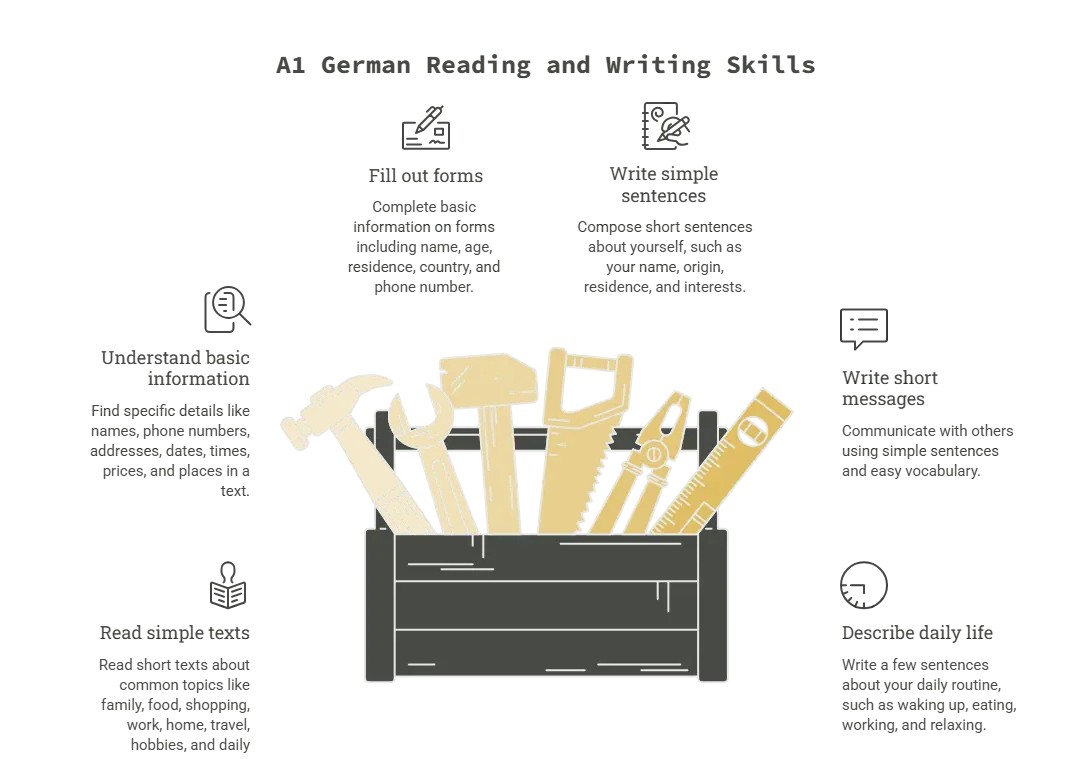
At the A1 level, you can read and write short German sentences. You can understand simple words, short messages, signs, forms, and basic information.
You do not need to write long paragraphs. You mainly use simple words and short sentences.
You Can Read Simple German Texts
You can read short texts about common topics.
For example:
- Family
- Food
- Shopping
- Work
- Home
- Travel
- Hobbies
- Daily activities
You may also read simple notices, messages, menus, and signs.
For example:
Heute geschlossen.
Closed today.
Der Kurs beginnt um 9 Uhr.
The course starts at 9 o’clock.
Bitte hier warten.
Please wait here.
You Can Understand Basic Information
You can find simple information in a German text.
For example, you may need to find:
- A person’s name.
- A phone number.
- An address.
- A date.
- A time.
- A price.
- A place.
You do not always need to understand every word. Look for the important information first.
You Can Fill Out Simple Forms
At A1 level, you can fill in basic information on a form.
You may need to write:
Name: Anna Müller
Alter: 25
Wohnort: Kochi
Land: Indien
Telefon: 123456789
These forms are common in everyday situations.
You Can Write Simple Sentences
You can write short sentences about yourself.
For example:
Ich heiße Anna.
My name is Anna.
Ich komme aus Indien.
I am from India.
Ich wohne in Kochi.
I live in Kochi.
Ich lerne Deutsch.
I am learning German.
Ich höre gern Musik.
I like listening to music.
You Can Write a Short Message
You can also write a short message to another person.
For example:
Hallo Maria,
ich komme heute um 5 Uhr. Wir sehen uns später.
Liebe Grüße
Anna
The message does not need difficult words. Simple sentences are enough.
You Can Write About Daily Life
You can write a few sentences about your day.
For example:
Ich stehe um 7 Uhr auf. Ich frühstücke. Danach gehe ich zur Arbeit. Am Abend sehe ich fern.
This means:
I get up at 7 o’clock. I have breakfast. Then I go to work. In the evening, I watch TV.
Practise Reading and Writing
Read short German texts every day. Write a few simple sentences about yourself, your family, or your daily life.
Start with small sentences. Learn new words as you read.
With regular practice, you can slowly read and write more German.
You Know Essential A1 Grammar & Vocabulary
At A1 level, you learn basic German words and grammar. These help you make simple sentences and have short conversations.
Common A1 Words
You learn words about everyday topics, such as:
- Family
- Food
- Work
- Home
- Shopping
- Time
- Numbers
- Hobbies
For example:
Familie – Family
Wasser – Water
Arbeit – Work
Haus – House
Basic Grammar
You learn simple grammar rules, such as:
- Personal pronouns.
- Common verbs.
- der, die, das.
- Singular and plural.
- Simple questions.
- Basic sentence order.
For example:
Ich lerne Deutsch.
I am learning German.
Wo wohnst du?
Where do you live?
Common Verbs
You also learn useful verbs like:
- sein – to be
- haben – to have
- gehen – to go
- kommen – to come
- wohnen – to live
- lernen – to learn
Try using new words in short sentences. This makes them easier to remember.
At A1 level, focus on common words, basic grammar, and simple sentences.
You Can Complete A1 Mock Tests Confidently
A1 mock tests help you practise before the German exam. They help you understand the questions and the exam pattern.
Try mock tests for all four parts:
- Reading
- Listening
- Writing
- Speaking
Practise the Full Test
Try to complete the full mock test from start to finish. This helps you get used to the real exam.
Use a timer while practising. Try to finish each section within the given time.
Check Your Mistakes
Check your answers after each test. Do not just look at your score.
Look at the questions you got wrong. Try to find out why your answer was wrong.
Then practise the same topic again.
Practise Different Questions
Do not practise only one type of question. Try different tasks.
You may need to:
- Read short texts.
- Listen to simple conversations.
- Fill in basic information.
- Write short sentences.
- Answer simple questions.
Practise Speaking
Do not forget the speaking part. Practise introducing yourself and answering simple questions.
You can talk about your:
- Name
- Age
- Family
- Work or studies
- Hobbies
- Where you live
Take Mock Tests Regularly
Try a mock test every few days as your exam gets closer. With regular practice, you can understand the exam better and feel more comfortable with the questions.
Focus on your mistakes each time. This can help you improve before the real A1 exam.

How to Check Your A1 Exam Readiness
Before taking the A1 German exam, check how well you can use basic German. You do not need to know difficult German.
You should be able to understand and use simple German in common situations.
Check Your Reading
Try reading short German texts without help.
You should be able to find simple information such as:
- Names
- Dates
- Times
- Prices
- Places
- Phone numbers
Try a few A1 reading questions. Check how many you can answer correctly.
Check Your Listening
Listen to short German conversations or announcements.
You should be able to understand simple information about:
- People
- Places
- Time
- Food
- Shopping
- Daily activities
If you miss some words, do not worry. Try to understand the main meaning.
Check Your Writing
Try writing a short message in German.
You should be able to write simple sentences about:
- Yourself
- Your family
- Your work
- Your hobbies
- Your daily life
Also practise filling out simple forms with your name, address, date, and other basic details.
Check Your Speaking
Try speaking German without reading from a book.
You should be able to:
- Introduce yourself.
- Say where you are from.
- Talk about your family.
- Talk about your work or studies.
- Talk about your hobbies.
- Ask simple questions.
- Answer simple questions.
Speak slowly and use short sentences.
Take an A1 Mock Test
A mock test is a simple way to check your preparation.
Take a full test and follow the real exam time. After the test, check your answers.
Look at the areas where you made mistakes.
For example:
- If reading is difficult, practise more short texts.
- If listening is difficult, listen to simple German every day.
- If writing is difficult, write a few sentences daily.
- If speaking is difficult, practise talking aloud.
Check Your Basic Grammar and Words
Make sure you know common A1 words and grammar.
You should know basic words for:
- Numbers
- Days and months
- Family
- Food
- Home
- Work
- Shopping
- Time
You should also be able to make simple sentences using common German verbs.
Check Your Exam Timing
Knowing the answers is not enough. You should also be able to finish the tasks on time.
Take a mock test with a timer. This will show you which sections take more time.
Practise those sections again.
Learn German language in your own language! Get free Demo Classes Here!
Conclusion
1: How do you say "Good Morning" in German?
The A1 German exam checks your basic German skills. You do not need to know hard words or grammar. You need to understand simple German and use it in daily life.
Before the exam, try some A1 mock tests. Check your answers and practise the parts that are difficult for you. Read short texts, listen to simple German, write a few sentences, and speak German every day.
Do not try to learn everything in one day. Learn a few words at a time and use them in simple sentences. Keep practising the same things until they become easy. Regular practice can help you feel more ready and relaxed on exam day.
|
Related Articles |
|||||
| TELC Kochi Exam Dates | TELC Exam Centre in Kerala | How to Book the TELC Exam? | |||
| Related Articles | |||||
| TELC A1 Exam Pattern | Goethe A1 vs telc A1: Which German Exam Is Better? | Best TELC Preparation Books | |||
| Top German A1 Vocabulary Words You Must Know | |||||
Free German A1 Mock Tests – Powered by AI!
Test your skills on our interactive platform. Get instant feedback from our AI to help you communicate better and track your progress. Start your free German mock test now.
Test Your German A1 for FreeFrequently Asked Questions
How do I know if I am ready for the German A1 exam?
You may be ready if you can understand simple German and use it in daily situations. You should be able to answer basic questions, write short sentences, understand simple texts, and talk about yourself.
What should I know before taking the A1 exam?
You should know common German words and simple sentences. You should also be able to talk about things like your name, family, home, work, studies, and hobbies.
Should I be able to introduce myself in German for the A1 exam?
Yes. Introducing yourself is an important part of the speaking test. You may need to give simple information about yourself and answer basic questions.
How much German do I need to speak at A1 level?
You do not need to speak German perfectly. You need basic German for simple situations. You should be able to use short sentences and understand simple questions.
Can I take a mock test before the A1 exam?
Yes. A mock test can help you see what you already know and which parts need more practice. It can also help you get used to the type of questions in the exam. The Goethe-Institut also provides practice material for A1 learners.
What are the main parts of the German A1 exam?
The Goethe-Zertifikat A1 exam has four parts: listening, reading, writing, and speaking. The tasks use simple German and common everyday situations.
Do I need to understand every German word in the exam?
No. You do not need to know every word. Focus on the words you know and try to understand what the question or text is about. A1 is about basic communication, not difficult German.
What should I do if I am not ready for the A1 exam yet?
Do not worry. Find the parts that are difficult for you and practise them more. Read short texts, listen to easy German, write a few sentences, and speak whenever you can. Try another practice test after some time and check your progress.