Table of Contents
Global HR means managing people across many countries. It covers hiring, pay, rules, and support for workers in different places. A cross-border HR manager makes sure all of this works smoothly.
A cross-border HR manager looks after employees who work in more than one country. They follow each country’s laws and keep the company’s culture strong.
The main areas they manage:
- International recruitment
- Employment compliance
- Payroll and compensation
- Employee mobility
- Cross-cultural workforce management
Is being an HR your dream? Enrol now for our course on Human Resource!
Key Takeaways:
- Every country has its own labour rules. Missing even one can mean a fine.
- Local HR knows one place well. Global HR has to juggle many at once.
- Pay is not just a number. Currency, tax and benefits change at every border.
- Good global HR managers listen first. Culture gaps cause more trouble than most people expect.
- Not sure where to begin? A local HR role is a solid first step.
- Learn one other country’s basic employment rules this month. It adds up fast.
What Is Global HR?
Global HR is the way a company manages its people around the world. It is not just HR in one office. It is HR for a team that sits in many countries.
Think of a company with offices in India, Germany, and the USA. Each office has its own rules. Global HR connects all of them.
- It sets common goals for all offices.
- It follows local laws in each country.
- It treats every employee fairly.
Why it exists: Companies are growing across borders. They hire talent from many places. Someone has to manage this well.
- Remote work has made teams more global.
- Companies want the best talent, not just local talent.
- Rules change from country to country.
What it includes: Global HR covers the full journey of an employee.
- Finding and hiring people
- Paying them on time
- Training and growing them
- Keeping them happy
- Handling exits properly
The goal is simple. Every worker should feel part of one company. It should not matter where they sit.
What Does a Cross-Border HR Manager Do?
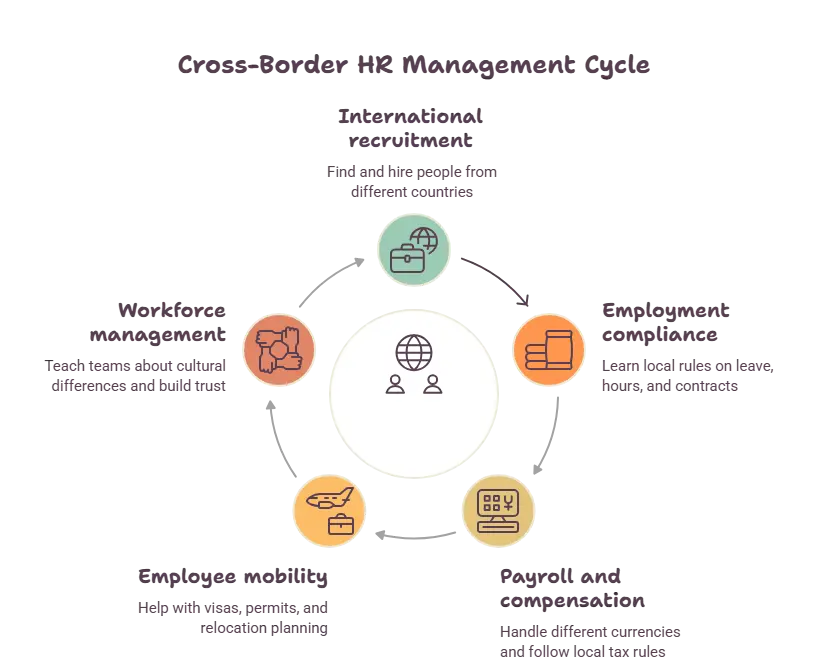
A cross-border HR manager handles people matters across countries. They are the bridge between the head office and local teams. Their work is wide, but it falls into five main areas.
1. International recruitment
They find and hire people from different countries.
- Write job posts that suit each country
- Use job sites popular in each place
- Check work permits and visa needs
- Run interviews across time zones
- Make offers that fit local pay levels
2. Employment compliance
Every country has its own labour laws. Breaking them can cost a lot.
- Learn local rules on leave, hours, and contracts
- Keep contracts up to date
- Follow tax and social security laws
- Keep records safe and ready for checks
- Work with local lawyers when needed
3. Payroll and compensation
People must be paid correctly and on time. This is harder across borders.
- Handle different currencies
- Follow local tax rules
- Set fair pay for each country
- Plan bonuses and benefits
- Work with payroll partners
4. Employee mobility
Some employees move from one country to another. The HR manager makes this easy.
- Help with visas and permits
- Plan relocation and travel
- Explain tax rules for movers
- Help families settle in
- Plan the return home after the job ends
5. Cross-cultural workforce management
People from different cultures work in different ways. HR helps them understand each other.
- Teach teams about cultural differences
- Reduce confusion in communication
- Build trust between teams
- Respect local festivals and customs
- Create a friendly work culture
A cross-border HR manager keeps the whole system running. They protect the company and care for its people.
Become an HR Expert – Enroll in Our HR Management Course Today!
Unlock the secrets to effective Human Resource Management with our expert-led course! Learn recruitment, employee relations, performance management, and more to build a thriving workplace. Start your journey toward a successful HR career today!
Know MoreWhat Does a Global HR Manager Do on a Typical Day?
No two days are the same. Still, there is a common pattern. Here is how a day may look.
Morning: Check in with teams
The day often starts early. Teams in some countries are just ending their day.
- Read emails from different time zones
- Reply to urgent questions
- Check any problems from overnight
- Plan the day’s tasks
Mid-morning: Hiring and talent work
Hiring is a big part of the job.
- Review new job applicants
- Talk to hiring managers
- Join interviews on video calls
- Prepare offer letters
- Check visa updates for new hires
Afternoon: Compliance and payroll
This is the time for rules and numbers.
- Check if contracts follow local laws
- Review payroll reports
- Talk to payroll partners
- Update policies when laws change
- Answer tax and leave questions
Late afternoon: People support
Employees often have questions or worries. The HR manager helps them.
- Talk to employees who are moving countries
- Solve conflicts between team members
- Share updates on company policies
- Help managers with team issues
Evening: Meetings across time zones
Late meetings are common in this job.
- Join calls with teams in other regions
- Plan training sessions
- Report to senior leaders
- Plan the next day
A flexible day
Things change fast. A new law, a visa delay, or a team issue can change the plan. Good HR managers stay calm and adjust.
Skills Required for a Global HR Manager
This job needs more than HR knowledge. It needs people skills, smart thinking, and an open mind. Here are the key skills.
Knowledge of labour laws
Every country has its own rules. A global HR manager must know the basics.
- Understand contracts, leave, and notice periods
- Know tax and social security rules
- Keep learning as laws change
Cultural awareness
This is one of the most important skills.
- Respect different ways of working
- Understand that greetings, feedback, and meetings differ
- Avoid judging people by your own culture
Communication skills
Clear communication avoids many problems.
- Use simple words
- Listen carefully
- Write clear emails
- Speak slowly on calls with non-native speakers
Language skills
Knowing more than one language is a big plus. It is not always needed, but it helps.
- English is often the common language
- A second language helps in local markets
- Even basic words show respect
Problem-solving
Problems come up often in global work.
- Stay calm under pressure
- Find fair solutions
- Think of the company and the employee
Tech skills
Global HR runs on digital tools.
- Use HR software and payroll systems
- Read data and reports
- Use video tools for remote work
Adaptability
Plans change often. A good manager changes with them.
- Work across time zones
- Handle sudden law changes
- Stay open to new ideas
Empathy
Moving to a new country is not easy. Employees need support.
- Understand their worries
- Be kind and patient
- Build trust over time
Global HR vs International HR vs Local HR
These three terms are often mixed up. They sound similar, but they are different. Here is a simple way to understand them.
Local HR
Local HR looks after employees in one country only.
- Follows one set of laws
- Knows the local culture well
- Handles hiring, pay, and support in one place
- Example: An HR manager in a Mumbai office
International HR
International HR manages employees across a few countries. It often works from a home country. It treats other countries as “outside” markets.
- Head office makes most decisions
- Local offices follow the main policy
- Handles staff sent abroad
- Example: An Indian company with small teams in two other countries
Global HR
Global HR treats the whole world as one workplace. It builds common rules but allows local changes.
- Works with many countries at the same time
- Balances global rules and local needs
- Builds one company culture everywhere
- Example: A large company with offices on every continent
A quick comparison
| Type | Focus | Scope |
|---|---|---|
| Local HR | One country | Small |
| International HR | Home country plus a few others | Medium |
| Global HR | Whole world as one team | Large |
The main difference
Local HR knows one place well. International HR connects a few places. Global HR joins all places into one system.
Become an HR Expert – Enroll in Our HR Management Course Today!
Unlock the secrets to effective Human Resource Management with our expert-led course! Learn recruitment, employee relations, performance management, and more to build a thriving workplace. Start your journey toward a successful HR career today!
Know MoreWhy Is Global HR Important for Multinational Companies?
A company that works in many countries needs strong HR. Without it, things can go wrong fast. Here is why it matters.
It keeps the company legal
Every country has its own laws. Mistakes can lead to fines or lawsuits.
- Follows labour laws everywhere
- Avoids tax problems
- Protects the company’s name
It helps hire the best talent
Good people live everywhere. Global HR helps companies reach them.
- Opens the door to a bigger talent pool
- Fills skill gaps faster
- Builds a diverse team
It keeps pay fair
Pay differs by country. But fairness matters everywhere.
- Sets pay by local market rates
- Avoids big unfair gaps
- Keeps employees happy
It builds one culture
Employees in different places should feel connected.
- Shares common values
- Builds trust across teams
- Makes people feel they belong
It helps teams work together
Global teams can do great things when they understand each other.
- Reduces confusion
- Improves teamwork
- Speeds up projects
It keeps employees longer
People stay where they feel cared for.
- Offers clear growth paths
- Supports people who move
- Lowers hiring costs over time
It helps the company grow
Strong HR makes it easier to enter new countries.
- Sets up teams faster
- Avoids early mistakes
- Builds a strong base in new markets
Advantages and Challenges of Global HR
Global HR brings many gains. But it also has real problems. Let us look at both sides.
Advantages:
1. Access to more talent
- You can hire from any country
- You can find rare skills
- You can build a diverse team
2. New ideas
- People from different places think differently
- Teams solve problems in fresh ways
- Products fit more markets
3. Round-the-clock work
- Teams in different time zones can pass work along
- Projects move faster
- Customers get quicker support
4. Stronger brand
- A global employer looks strong
- It attracts top talent
- It builds trust with partners
Challenges:
1. Different laws
- Every country has its own rules
- Laws change often
- Mistakes can be costly
2. Culture gaps
- People may misread each other
- Work styles can clash
- Feedback may land badly
3. Time zones
- Meetings are hard to plan
- Replies can be slow
- Some people must work odd hours
3. Payroll and tax issues
- Many currencies to handle
- Tax rules differ
- Errors can upset employees
4. Hard to build one culture
- Teams feel far apart
- Remote staff can feel left out
- Company values may not travel well
5. Moving employees is complex
- Visas take time
- Families need support
- Costs can be high
How to handle the challenges
- Use good HR software
- Work with local experts
- Train managers in cultural skills
- Keep communication simple and open
- Review policies often

Career Opportunities in Global HR
Global HR is a growing field. More companies are hiring across borders. This means more jobs for skilled people.
Common job roles
1. Global HR Manager
- Leads HR across many countries
- Builds policies that fit all regions
2. International Recruiter
- Finds talent in other countries
- Handles visas and offers
3. Global Mobility Specialist
- Manages employees who move abroad
- Handles relocation and tax matters
4. Global Compensation and Benefits Analyst
- Sets fair pay across countries
- Studies market pay data
5. Global Payroll Manager
- Makes sure everyone is paid correctly
- Works with payroll partners
6. HR Compliance Specialist
- Tracks labour laws in each country
- Keeps the company safe from legal risks
7. Diversity and Inclusion Manager
- Builds a fair and open workplace
- Runs programs for cultural understanding
How to start
You do not need to start at the top. Many people begin in local HR and grow from there.
- Study HR or business
- Start in a general HR role
- Learn about international laws
- Work with global teams
- Learn a new language
- Take short HR courses
Where the jobs are
- Multinational companies
- Consulting firms
- Staffing agencies
- Global payroll companies
- Remote-first companies
Growth path
- HR Executive
- HR Manager
- Senior HR Manager
- Head of Global HR
- Chief HR Officer
Why it is a good career
- Strong demand
- Good pay
- Chance to work with many cultures
- Chance to travel or work remotely
Is being an HR your dream? Enrol now for our course on Human Resource!
Conclusion
Managing people in one country is hard enough. Now add three tax systems, two time zones and a visa delay. That is a normal week for a global HR manager.
The work is not glamorous. Most of it is paperwork, checking rules and answering worried employees. But it matters. One missed rule can cost a company a lot, and one kind reply can make a new hire feel safe in a new country.
If this sounds like your kind of work, start small. Take a local HR role. Learn how contracts and payroll work. Then ask to join a project with a team abroad. That first step is often the hardest one.
| Related Links | |
| Top Human Resource Blogs to Follow | How to build a remote HR career |
| HR Certification vs HR Degree | Which one to choose? | 15 HR Intern Interview Questions and Sample Answers |
Become an HR Expert – Enroll in Our HR Management Course Today!
Unlock the secrets to effective Human Resource Management with our expert-led course! Learn recruitment, employee relations, performance management, and more to build a thriving workplace. Start your journey toward a successful HR career today!
Know MoreFrequently Asked Questions
What is global HR?
Global HR means managing employees who work in different countries. It includes hiring, training, salary management, and employee support across countries.
What does a global HR manager do?
A global HR manager looks after HR work in different countries. They help hire employees, manage company policies, support staff, and make sure the company follows local labour laws.
What are the main responsibilities of a global HR manager?
The main responsibilities include:
-
Hiring employees in different countries
-
Managing salaries and benefits
-
Supporting employee training
-
Handling workplace issues
-
Following local labour laws
-
Helping teams work together
What skills does a global HR manager need?
A global HR manager needs good communication, problem-solving, and planning skills. They should also understand different cultures and know how to work with people from different backgrounds.
What is the difference between global HR and local HR?
Local HR mainly manages employees in one country. Global HR works across different countries. Global HR must also understand different labour laws, cultures, and workplace practices.
What challenges do global HR managers face?
Global HR managers may face language barriers, cultural differences, different labour laws, and time zone issues. They need to plan carefully and communicate clearly to handle these challenges.
Why is global HR important for companies?
Global HR helps companies manage employees in different countries. It supports international hiring, keeps HR policies clear, and helps employees work together across locations.
How can someone become a global HR manager?
A degree in HR, business, or a related field can help. Experience in human resources is also useful. Learning about international labour laws, different cultures, and global hiring can improve career opportunities.