Table of Contents
Montessori materials help children learn through simple activities. They can teach numbers, letters, shapes, colours, and everyday skills. Each material has a different use and gives children a chance to learn by doing.
This guide explains what Montessori materials are, how they work, the skills they support, their benefits, and some common materials and their uses.
What are Montessori Materials?
Montessori materials are things children use to learn. They can be blocks, beads, cards, letters, or shapes. Children use these things in class. They can count, match, sort, build, or put things in order.
Different things teach different skills. Some help with numbers. Some help with letters, colours, and shapes. Children learn by doing. They can try the work again and again.
What do Montessori Materials Look Like?
Montessori materials are simple. Many are made of wood. Some have beads, cards, or blocks.
Some common materials are:
- Number Rods
- Sandpaper Letters
- Pink Tower
- Brown Stair
- Colour Tablets
- Geometric Shapes
- Bead Materials
- Practical Life Materials
Children can hold and move these things. They can also match, sort, and arrange them.
How do Children Use Montessori Materials?
The teacher first shows the child how to use the material. Then, the child tries it. The child can do the activity many times. This helps the child learn.
For example, the child can put the Pink Tower blocks from big to small. The child can also touch Sandpaper Letters to learn the letters. Children learn by using their hands. They can learn step by step.
Register for the Entri Elevate Montessori Teacher Training Program! Join Now!
Why are Montessori Materials Used?
Montessori materials help children learn by doing. Children can see and touch the materials. Children can use the same material many times. This gives them time to practise.
Some materials also help children find their mistakes. They can check their work and try again. This helps children learn to work on their own.
What Skills can Children Learn?
Different materials support different skills. Some focus on early maths, while others help with language or daily tasks.
Children may practise:
- Focus and attention
- Hand control
- Matching and sorting
- Counting
- Language skills
- Movement
- Problem-solving
- Independent work
The exact skill depends on the material being used.
Do All Montessori Materials Teach the Same Thing?
No. Each material has a different purpose.
One may help with numbers, while another may focus on language or movement. This gives children different ways to learn as they grow.
How do Montessori Materials Work?
Montessori materials help children learn by doing. Children can touch, move, match, and sort things. Each material helps children learn something. The teacher shows the work first. Then, the child tries it.
Children Learn with Their Hands
Children use their hands to learn. They can move blocks, match cards, or put things in order.
The Teacher Shows the Work
The teacher shows the child how to use the material. The child watches and then tries it.
Children Try the Work
The child does the work after watching the teacher. They can try again if they make a mistake.
Children can Do the Work Again
Children can repeat the same work. This helps them learn better. They can take their own time to finish the work.
The Materials Help Find Mistakes
Some materials help children find mistakes. A piece may not fit when it is in the wrong place. The child can see the mistake and fix it.
Different Materials Teach Different Skills
Different materials teach different skills. Some help with numbers. Others help with letters, shapes, and daily work.
Children Work at Their Own Pace
Children learn at different speeds. They can take their time and practise the work.
The Child Takes Part in Learning
Children use the materials by themselves. They also put them back after the activity.
Materials Become More Challenging
Young children start with easy activities like sorting and matching. As they learn more, they can try harder activities.
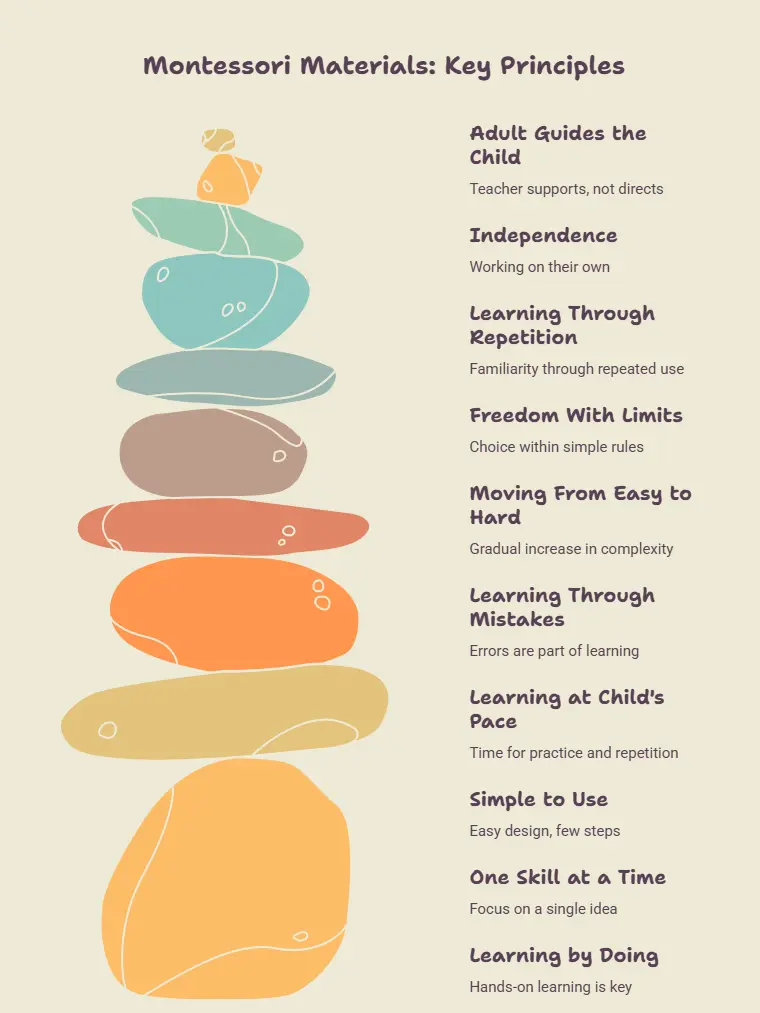
Key Principles Behind Montessori Materials
Montessori materials are made with simple learning ideas. They give children a chance to learn by doing.
The materials are not used only for play. Each one has a clear purpose. The child can touch, move, match, sort, or arrange the material while learning. Some important ideas guide the use of Montessori materials.
Learning by Doing
Children learn by using the materials with their hands. They do not only listen to the teacher.
For example, a child can use blocks to learn about size. They can move the blocks and put them in order. This makes the lesson easier to understand.
One Skill at a Time
Many Montessori materials focus on one main idea.
A material may teach:
- Counting
- Size
- Shape
- Colour
- Letters
- Sounds
- Sorting
This keeps the activity simple. The child can focus on the skill being taught.
Simple to Use
Montessori materials are usually simple in design. They do not have too many parts or steps.
The child can see what to do with the material. The teacher gives a short demonstration before the activity starts.
Learning at the Child’s Pace
Children do not all learn at the same speed. Some children may understand an activity quickly. Others may need more time.
Montessori work gives children time to practise. They can repeat the activity without being rushed.
Learning Through Mistakes
Mistakes are part of the activity. Children get a chance to notice what went wrong.
For example, a piece may not fit in the right place. The child can try another piece and check again. This gives the child a chance to learn from the activity.
Moving From Easy to Hard
Montessori materials are given based on the child’s age and level.
Children usually start with simple activities. Later, they can move to work that needs more steps and thinking. This allows learning to grow slowly.
Freedom With Limits
Children get some choice in Montessori learning. They can choose an activity that they are ready to do.
But there are simple rules. The child needs to use the material properly and return it after use. So, freedom does not mean doing anything they want.
Learning through Repetition
Children can repeat an activity many times. Repetition helps them become familiar with the material.
A child may use the same material today and again later. Each time, the work may become easier.
Independence
Montessori materials also give children a chance to work on their own. The teacher shows the activity and then gives the child space to try.
The child can complete the work and put the material back. This makes the child more involved in their own learning.
The Adult Guides the Child
The teacher does not do the work for the child. The teacher watches, gives a simple lesson, and helps when needed. The child gets enough time to explore and practise.
These principles make Montessori materials different from ordinary classroom tools. They focus on hands-on work, practice, simple steps, and independent learning.
Benefits of Montessori Learning Materials
Montessori materials help children learn by doing. Children can touch, move, match, and arrange the materials.
Each material has a simple use. Some help with numbers. Some help with letters, shapes, or daily work.
Helps Children Focus
Montessori activities need attention. The child looks at the material and works with it.
For example, the child may put blocks in the right order.
These activities help children:
- Pay attention
- Look carefully
- Finish a task
- Work for some time
Helps Hand Movement
Children use their hands a lot with Montessori materials. They pick up, move, and place different objects. This gives practice with small hand movements.
They may learn to:
- Hold things properly
- Move things carefully
- Use their fingers
- Place things correctly
These skills can also help with writing and drawing later.
Helps Children Work Alone
The teacher shows the activity first. Then the child gets time to try it alone. The child can take the material and use it without constant help.
They also learn to:
- Take the material
- Do the activity
- Finish the work
- Put it back
This helps children become more independent.
Helps Children Think
Some materials have a simple problem to solve. The child has to find the right piece or the right place. If something is wrong, they can try again.
For example, a puzzle piece may not fit. The child can look for another piece.
Helps With Matching and Sorting
Children often match and sort objects in Montessori activities.
They may sort things by:
- Colour
- Size
- Shape
- Type
This helps children notice how things are the same or different.
Helps with Numbers
Some Montessori materials are used for early maths. Children can count objects and put them in order. They can also match numbers with the right amount.
They may practise:
- Counting
- Number order
- Matching numbers
- Big and small
Using real objects can make numbers easier to understand.
Helps with Language
Montessori materials can also help children learn language. They may use letters, pictures, and sound activities.
These activities can help children learn:
- Letters
- Letter sounds
- New words
- Reading
- Writing
Gives More Practice
Children can use the same material again and again. They can practise until they understand the activity. They do not have to finish it quickly.
With practice, the work can become easier.
Builds Confidence
Children may feel happy when they finish an activity by themselves. They can see what they have done. This can make them feel ready to try another activity.
Montessori materials can support many simple skills. They help children learn, practise, think, and work on their own.
Examples of Montessori Materials and Their Uses
Montessori classrooms use many different materials. Each material has a simple purpose. Some materials help with numbers. Others help with letters, shapes, colours, or hand movement.
Pink Tower
The Pink Tower has ten pink blocks. The blocks are different in size. The child puts the blocks from the biggest to the smallest.
This activity helps children learn about:
- Size
- Order
- Hand control
- Focus
The child also learns to look at small differences between the blocks.
Brown Stair
The Brown Stair has blocks with different widths. The child arranges them from thin to thick. The child needs to look carefully at each block before placing it.
It helps with:
- Size
- Width
- Visual skills
- Hand control
Number Rods
Number Rods are long rods of different lengths. They help children learn basic numbers. The child can count the sections on each rod. They can also put the rods in order.
This gives simple practice in:
- Counting
- Number order
- Comparing lengths
- Understanding quantity
Sandpaper Letters
Sandpaper Letters help children learn letters. The child can look at the letter and trace it with a finger. The rough surface helps the child feel the shape of the letter.
This activity can help with:
- Letter shapes
- Letter sounds
- Hand movement
- Early writing
Colour Tablets
Colour Tablets are used to teach colours. Children match tablets that have the same colour. Later, they may arrange colours from light to dark.
The activity helps children notice:
- Different colours
- Light and dark shades
- Matching
- Visual differences
Geometric Shapes
Geometric materials include simple shapes such as circles, squares, and triangles. Children can touch the shapes and learn their names. They can also match or compare them.
These materials help children learn:
- Shapes
- Size
- Shape names
- Visual differences
Binomial Cube
The Binomial Cube has small blocks in different colours and sizes. The pieces fit together to make a cube. The child takes the pieces out and puts them back in the right place.
It helps children practise:
- Focus
- Hand control
- Size
- Colour
- Problem-solving
Bead Materials
Bead materials are used for early maths work. Children can count and arrange beads. They can use them to understand numbers and simple maths ideas.
These materials can help with:
- Counting
- Number order
- Quantity
- Basic maths
Practical Life Materials
These materials are used for simple daily tasks. They may include items for pouring, transferring, buttoning, or cleaning.
Children practise these activities with their hands.
They can learn:
- Hand control
- Careful movement
- Daily skills
- Working independently
Each Montessori material has its own use. Children learn by touching, moving, and using the materials.
How Montessori Materials Support Child Development
Montessori materials help children learn by doing. They use their hands and eyes to touch, move, match, count, and arrange things.. This helps them learn different skills.
Helps Hand Skills
Many Montessori activities use the hands and fingers. Children pick up, move, and place things.
For example, they may:
- Move beads
- Pour water
- Stack blocks
- Open and close things
- Tie and button
These activities help children use their hands better.
Helps Children Think
Montessori materials give children small tasks to solve. They need to look and find the right way to do the work.
For example, a child may put blocks in the right order or find the right shape.
This helps children:
- Think
- Choose
- Compare
- Find answers
Helps Children Focus
Some activities need care and attention. Children may need to match colours or put blocks in order. They may do the same activity many times. This gives them more time to focus on one task.
Helps With Language
Some materials help children learn letters and words.
For example, children can use Sandpaper Letters. They can touch the letters and learn their shapes and sounds.
They can also learn:
- Letter names
- Letter sounds
- New words
- Simple reading
Helps With Numbers
Some Montessori materials help children learn numbers. Children can count beads or use Number Rods. They can see which object is bigger, smaller, longer, or shorter. This makes early maths easier to understand.
Helps Children Work Alone
Montessori materials give children a chance to do things by themselves. A teacher shows the activity first. Then the child tries it.
The child can:
- Take the material
- Do the activity
- Finish the work
- Put it back
This helps children become more independent.
Register for the Entri Elevate Montessori Teacher Training Program! Join Now!
Builds Confidence
Children feel happy when they do the work by themselves and learn to try again when they make a mistake.
Teaches Care and Order
Children learn to use materials carefully. They also learn to keep things back after use.
This teaches simple habits like:
- Taking care of things
- Keeping things in place
- Working neatly
- Finishing a task
Montessori materials help children learn through simple activities. They support hand skills, thinking, language, numbers, focus, and independence.
Conclusion
1: What is the primary focus of the first plane of development in the Montessori method?
Montessori materials give children simple ways to learn. They help children build skills through touch, movement, and practice. Each material has a different purpose, such as learning numbers, letters, shapes, or daily tasks.
Using these materials can support focus, hand skills, thinking, and independence. Children also get time to practise and learn at their own pace.
Get Certified & Start Your Montessori Career
Montessori Teacher Training Course by Entri App: Gain expert skills, earn certification, and kickstart your teaching career.
Join Now!Frequently Asked Questions
What are Montessori materials?
Montessori materials are learning tools used in Montessori education. They include blocks, beads, cards, letters, numbers, shapes, and other simple materials.
How do Montessori materials help children learn?
Montessori materials help children learn by doing. Children can touch, move, count, match, sort, and arrange the materials while learning new ideas.
Why are Montessori materials important for children?
Montessori materials give children simple ways to learn and practise. They can also help improve focus, hand control, memory, and basic learning skills.
How are Montessori materials used in the classroom?
The teacher first shows the child how to use the material. The child then tries the activity. Children can repeat the work until they understand it.
What skills do Montessori materials develop?
Montessori materials can help children develop skills such as counting, matching, sorting, language, memory, focus, hand control, and problem-solving.
How do Montessori materials help children learn from mistakes?
Some Montessori materials allow children to see their own mistakes. If something does not fit or match, the child can check the work and try again.
Can children use Montessori materials independently?
Yes. Many Montessori activities are designed for children to do on their own. They can take the material, complete the work, check it, and put it back.
Are Montessori materials suitable for different age groups?
Yes. Montessori materials are available for different ages and learning levels. Young children may use simple materials for sorting, matching, and movement, while older children can use materials for numbers, reading, and language.
Can children repeat Montessori activities?
Yes. Children can repeat Montessori activities as many times as needed. Repeating the work gives them more practice and helps them improve their skills.
How do Montessori materials support independent learning?
Montessori materials give children a chance to do activities by themselves. They can choose the work, practise it, check their mistakes, and complete it with less help from adults.