Table of Contents
Introduction
The embedded systems that are used in modern technology are an essential component. These components are utilized in a wide variety of electrical products, including automobiles, washing machines, medical equipment, smart devices, industrial machinery, and many more. Embedded systems are systems that mix hardware and software in order to carry out a certain function. As a result of the ongoing development of technology, there is an increasing demand across all sectors for talented experts who specialize in embedded systems.
In the event that you are an experienced professional who is interested in entering the fields of electronics, automotive, robotics, or Internet of Things (IoT), you may find that switching your career to embedded systems is a smart alternative. Whether you have a background in software development, electronics, electrical engineering, or another technical profession, acquiring the appropriate skills can assist you in transitioning into this line of work.
Kickstart your embedded systems career and turn your tech passion into high-demand skills!
Key Takeaways
- The management of electronic devices is the responsibility of embedded systems, which are composed of both hardware and software.
- C and C++ are two programming languages that you need to be proficient in if you want to advance your career in embedded systems.
- Acquiring a substantial amount of knowledge regarding microcontrollers, communication protocols, and electronics is unavoidable.
- By participating in practical projects, prospective employers are able to see how you can put your technical skills to work.
- It is beneficial to gain knowledge regarding testing, debugging, and real-time running systems.
- You should select a field of expertise that not only piques your interest but also assists you in achieving your professional objectives.
- Not only should you make modifications to your portfolio and resume, but you should also submit applications for entry-level employment that are currently available.
Master Embedded Systems Programming!
Launch your tech career with our Embedded Systems Course, designed for hands-on learning and industry readiness.
Know MoreWhat Is an Embedded System?
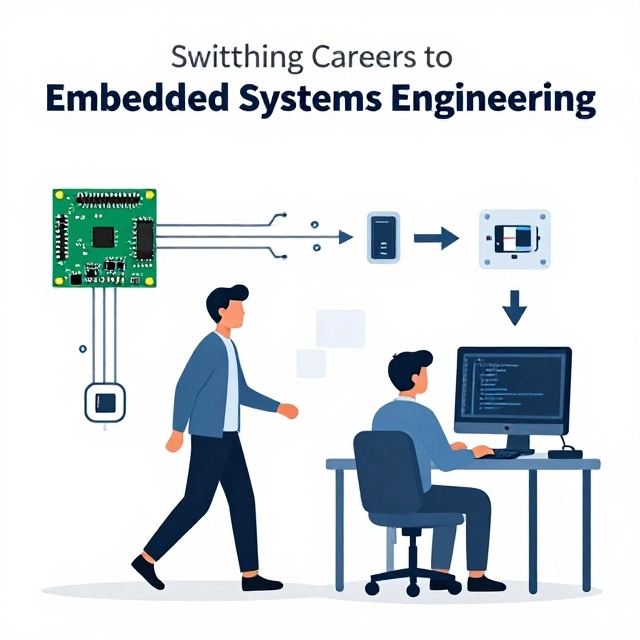
When it comes to computers, an embedded system is a mix of computer hardware and software that is designed to carry out a specific purpose. It is designed to operate or manage a particular device or process, as contrast to a computer that can be used for a variety of purposes.
As an illustration, an embedded system is responsible for controlling the temperature in an air conditioner, managing the safety features in a vehicle, and assisting a smartwatch in monitoring daily activities.
Professionals that work in embedded systems are responsible for the development, testing, and maintenance of the software and hardware that enables these devices to function properly.
Steps to Switch Your Career to Embedded Systems
1. Understand the Basics of Embedded Systems
Prior to making a move in your job, it is important to have an awareness of the functioning of embedded systems as well as the contexts in which they are applied. Acquaint yourself with the differences between microcontrollers, microprocessors, and software, in addition to the differences between hardware and software.
You also need to become familiar with essential aspects of electronics, such as resistors, digital circuits, voltage, and current. This is in addition to the previous point.
An excellent choice would be to start with tutorials and classes that are designed for people who are just starting out. You will be able to determine which subfield of embedded systems most piques your interest with the help of the answers to these questions.
2. Learn C and C++ Programming
One of the programming languages that is utilized the most frequently in embedded systems is C. This is due to the fact that it provides effective control over other hardware resources. However, C++ is also utilized in a great deal of embedded software.
Put your attention on learning:
- Data types, loops, variables, and functions are all included.
- A variety of structures, arrays, and pointers
- The administration of memory and bitwise operations
- Conventional data structures
- Debugging and developing code that is both efficient
It is possible that you are already employed as a software engineer. The fact that you already have experience in programming can make this shift simpler for you if you are currently employed as a software developer. It is necessary for you to get knowledge regarding the distinctions between embedded programming and the creation of standard applications.
3. Learn Microcontrollers and Hardware
Individual microcontrollers are little computers that are integrated into electronic devices. A processor, memory, and input/output peripherals are all features that are included in them.
First things first, educate yourself on well-known platforms like Arduino, ESP32, and STM32. The process of connecting sensors, LEDs, buttons, and other fundamental components should be practised.
Gain an understanding of the ways in which software and hardware communicate with one another through interfaces such as:
- Input/Output (General-Purpose) is abbreviated as GPIO.
- The acronym UART stands for “Universal Asynchronous Receiver-Transmitter.”
- Serial peripheral interface, abbreviated as SPI
- An analog-to-digital converter, often known as an I2C (Inter-Integrated Circuit) converter.
When it comes to the construction of embedded systems, having practical expertise with these concepts is absolutely necessary.
4. Understand Embedded Operating Systems
The use of a real-time operating system (RTOS) or embedded Linux is utilized by some embedded devices, while others function without the addition of an operating system.
Acquire knowledge regarding the scheduling of tasks, interruptions, task scheduling, memory management, and timing limitations. If you want to advance your career, you can start with FreeRTOS and then move on to embedded Linux if that is what your ambitions are.
These abilities are especially helpful when it comes to the development of complicated machines that are required to react to occasions within predetermined time constraints.
5. Build Practical Projects
You are able to exhibit your capabilities to potential employers and apply the knowledge you have gained through projects. To begin, begin with tasks that are straightforward, and then progressively progress to applications that are more complicated.
These are some examples:
- The temperature can be measured with the use of a sensor and a microprocessor inside of a temperature monitoring system.
- Lighting system that is intelligent allows for the control of lights through the use of sensors or wireless communication.
- Web of Things monitoring device: The data from the sensors should be collected and then sent to a dashboard.
- In a motor control system, a microcontroller is used to exert control over a relatively small motor.
- Real-time monitoring system: Make use of an RTOS in order to manage a number of different jobs.
Whenever it is feasible, you should submit your code to GitHub, document each project, and provide an explanation of the technologies that were utilized. You can strengthen your candidacy for entry-level or transitional employment by adding a good project portfolio to your application.
6. Learn Debugging and Testing
Due to the fact that software faults might have an effect on physical components, embedded systems need to function successfully. Because of this, the abilities of testing and debugging are particularly vital.
Become familiar with the use of debugging tools, the reading of error messages, the inspection of memory, and the identification of faults with either hardware or software. Experiment with various tools, such as oscilloscopes, logic analyzers, and hardware debuggers, become familiar with them.
Furthermore, you should have a fundamental understanding of hardware validation, as well as unit testing and integration testing.
7. Choose a Specialisation
One can pursue a variety of professional options in embedded systems. You can better focus your learning and job search by selecting a specialization to specialize in.
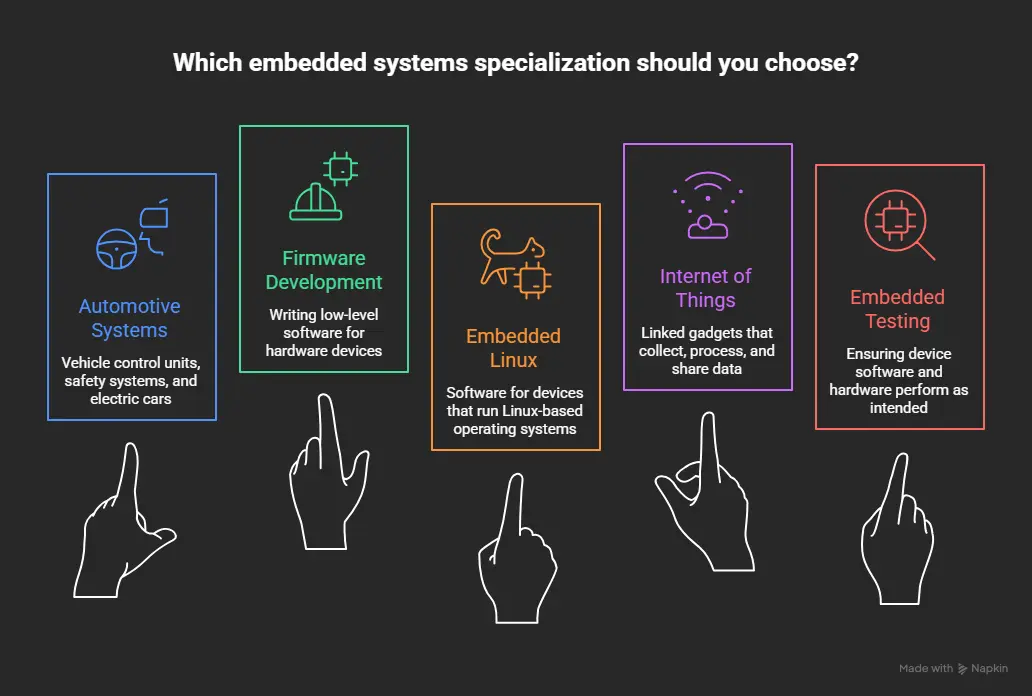
- The development of software for vehicle control units, driver assistance systems, and electric vehicles all fall under the category of automotive embedded systems.
- Development of the Internet of Things: Construct linked gadgets that can collect and share data.
- The job that you do with embedded Linux includes developing software for industrial systems, networking equipment, and smart gadgets.
- The development of firmware involves writing low-level software that possesses direct control over hardware.
- The field of robotics requires the development of embedded software for robot controls, actuators, and sensors.
Select a specialization that takes into account your present talents and interests, as well as the opportunities that are accessible in the industry that you are interested in.
8. Prepare Your Resume and Apply for Jobs
After you have acquired the relevant skills, you should proceed to update your curriculum vitae in order to highlight significant technical knowledge, projects, and experience that can be transferred. As soon as you have established the appropriate skills, you ought to put this into action.
Try to find people who are interested in filling positions such as:
- Embedded Test Engineer
- Internet of Things Developer
- Junior Embedded Software Engineer
- Firmware Engineer
- Embedded Systems Developer
- Embedded Test Engineer
In addition, if you do not have any direct experience working with embedded systems, you might want to think about opportunities such as internships, trainee positions, and junior roles. Consider these options. All of these are instances of choices that you want to think about taking into consideration.
Choosing the Right Embedded Systems Specialization
Automotive Embedded Systems
The development of software for vehicle control units, safety systems, and electric cars is the focus of this industry. The ability to communicate using CAN and to understand automotive software standards can be beneficial.
Firmware Development
Engineers that specialize in firmware are responsible for writing low-level software that ensures hardware devices function properly. C programming and direct hardware interface are two topics that are suited for anyone who are interested in this path.
Embedded Linux Development
Engineering professionals that specialize in embedded Linux create software for devices that run operating systems based on Linux. In order to successfully complete this specialization, you might need to be familiar with Linux commands, device drivers, operating system fundamentals, and either C or C++.
Internet of Things (IoT)
Professionals in the Internet of Things create linked gadgets that are able to collect, process, and share data. Microcontrollers, sensors, wireless communication, and fundamental networking are all abilities that are both useful and valuable.
Embedded Testing
Embedded test engineers are responsible for ensuring that the software and hardware of the device perform as intended. It is possible that people who have experience in software testing or quality assurance could find this to be an appropriate entry point.
Master Embedded Systems Programming!
Launch your tech career with our Embedded Systems Course, designed for hands-on learning and industry readiness.
Know MoreHow Long Does It Take to Switch to Embedded Systems?
You will need to determine the amount of time necessary based on your prior experience as well as the amount of time you are able to devote to learning.
- The time it takes software engineers to learn core embedded abilities can range anywhere from three to six months, depending on their prior programming experience.
- Approximately three to six months to increase programming and embedded development skills for engineers working in electronics or electrical engineering.
- Programming, electronics, and practical project abilities can be developed over a period of approximately six to twelve months or even longer for professionals from sectors that are not related.
These are estimates of the amount of time needed to study, and they are not guaranties of employment. Your starting knowledge, practice, previous project experience, and the function you intend to play all play a factor in determining the actual timeframe.
Common Challenges When Changing Careers
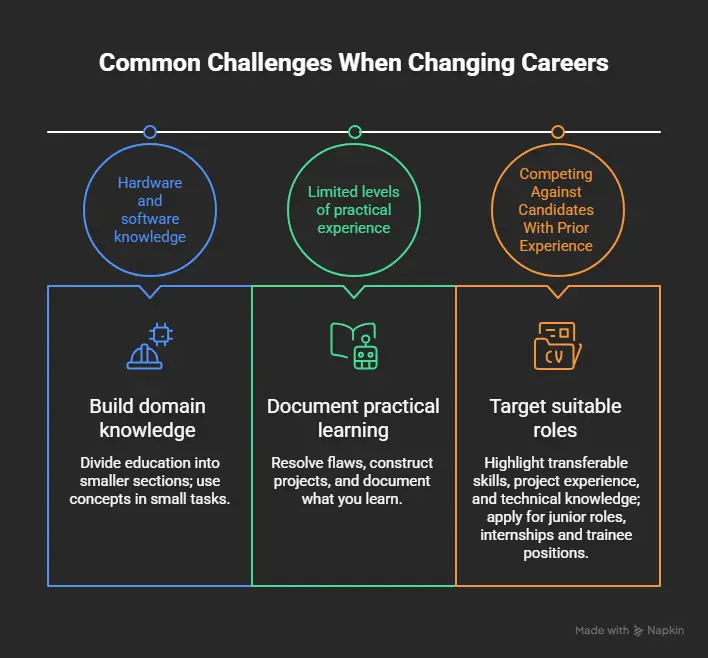
Hardware and software knowledge
When working with embedded systems, it is vital to have knowledge in two related domains. Your education should be divided into smaller sections and you should take each concept and put it to use in small tasks.
Limited levels of practical experience
Perhaps instructions in themselves will not suffice. In addition to resolving flaws and constructing projects you should document what you learn.
Competing Against Candidates With Prior Experience
In your CV you need to highlight transferable skills, practical project experience and technical knowledge related to the post. Search and apply for junior roles, internships and trainee positions that suit your current abilities and experience.
Career Opportunities in Embedded Systems
Once you have the abilities you might look at roles such as:
- Embedded Software Engineer (ESS)
- Firmware Engineer ·
- Embedded Systems Developer (Embedded Software Engineer)
- Junior Embedded Software Engineer
- Embedded Test Engineer Automotive Software Engineer
- IoT Developer
- Embedded Linux Developer
The required qualifications and experience vary depending on the job and the specialization.
Kickstart your embedded systems career and turn your tech passion into high-demand skills!
Conclusion
If you want to make the move from working with hardware to working with embedded systems as a profession, you will need a combination of your programming skills, your understanding of hardware, and your practical experience. It is recommended that you begin by being familiar with the programming language C, gaining an understanding of microcontrollers, and constructing some basic projects. It is recommended that you gradually expand your debugging skills, and that you concentrate in a field that relates to things that you find interesting. It is necessary to engage in consistent practice, have a project portfolio that is well-organized, and conduct a targeted job search in order to be able to work for a profession that is related to embedded systems.
Master Embedded Systems Programming!
Launch your tech career with our Embedded Systems Course, designed for hands-on learning and industry readiness.
Know MoreFrequently Asked Questions
Can I switch to embedded systems without an electronics background?
Yes. You can transition from software development or another technical field by learning basic electronics, microcontrollers, and hardware communication.
Which programming language is best for embedded systems?
C is an excellent starting point because it is widely used in firmware and low-level programming. C++ is also valuable for many embedded applications.
Do I need a degree to become an embedded systems engineer?
Many employers prefer degrees in electronics, electrical engineering, computer engineering, or computer science. Requirements vary, and some positions may accept candidates with strong practical skills and relevant experience.
Is embedded systems difficult to learn?
It can be challenging because it combines hardware and software. A structured learning plan and regular project practice can make the process easier.
Which embedded systems field is best for beginners?
Firmware development, embedded testing, and basic IoT development can be useful starting points. The best choice depends on your existing skills and interests.
Is embedded systems a good long-term career?
It can offer opportunities in automotive technology, healthcare, consumer electronics, robotics, and industrial automation. Continuing to learn new tools and technologies is important for long-term career growth.
What tools are required to learn embedded systems?
Beginners can start with a development board such as Arduino or ESP32, a code editor or IDE, and basic electronic components. As they progress, they can learn debugging tools, Git, and microcontroller-specific software.
Can software developers move into embedded systems?
Yes. Software developers can use their existing programming and problem-solving skills to transition into embedded systems. They should focus on C programming, hardware interaction, microcontrollers, and real-time operating systems.
Is Python useful for embedded systems?
Yes. Python is useful for testing, automation, data processing, and developing scripts for embedded projects. However, C and C++ are generally more important for low-level firmware development.
What is the difference between embedded software and firmware?
Embedded software is a broad term for software running on embedded devices. Firmware is a type of software closely associated with controlling hardware and managing device operations.