Table of Contents
This blog will cover the top SAP interview questions and answers that you are likely to face in 2026. These questions will help you show your understanding of using SAP modules, technical expertise, problem-solving skills and SAP solutions on landscape in the real world. Whether you focus on SAP FICO, SAP SD, SAP MM, SAP ABAP, or any other module, this guide will assist you navigate the interview process with self belief. Let’s dive into the maximum requested questions on SAP interview and give a detailed solution to help you be triumphant!
Join Entri’s SAP FICO Training Course today!!
Introduction
SAPS (products in system, application and products in products) Interviews are designed to test both your functional and technical expertise in different SAP modules, as well as understanding the ability to solve problems and how SAP supports business processes. Questions may vary from basic concepts to advanced technical and scenario -based questions, which may be based on your role and experience level.
SAP Interview Questions and Answers
Here are the 30 best SAP interview questions and answers for 2026, covering different SAP modules and concepts:
Beginner Level – Cross‑Module
1. What is SAP ERP, and why is it used?
Answer:
SAP ERP (Enterprise Resource Planning) is integrated software that supports core business processes like finance, procurement, sales, production, and HR on a single platform. It improves data accuracy, process automation, and reporting by eliminating isolated departmental systems.
2. What is the difference between SAP ECC and SAP S/4HANA?
Answer:
SAP ECC is the classic ERP on traditional databases, with complex data structures and batch‑heavy reporting. SAP S/4HANA is the next‑generation ERP built on SAP HANA (in‑memory database), using simplified data models, real‑time analytics, and Fiori‑based UI instead of heavy SAP GUI transactions.
3. What is a Company Code in SAP FICO?
Answer:
Company Code is the smallest legally independent organizational unit in FI for which financial statements (balance sheet, P&L) are prepared. Each company code has its own chart of accounts, fiscal year variant, and currency.
Check out Entri’s SAP MM course with Placement Assistance!
4. What is a Purchase Requisition (PR) in SAP MM?
Answer:
A Purchase Requisition is an internal request to purchase materials or services. It is created before a Purchase Order and contains details like material, quantity, required date, and purchasing group. It helps in planning and approval workflows.
5. What is a Sales Document in SAP SD?
Answer:
A Sales Document (like a Sales Order) is an electronic record that captures the customer’s requirement. It contains partner data, items, pricing, delivery, and billing information, and drives the entire order‑to‑cash process.
FICO – Beginner
6. What is GL (General Ledger) in SAP FI?
Answer:
GL accounts are the core accounts in SAP FI that record all financial transactions. Each GL account is maintained in the Chart of Accounts and is used for preparing balance sheet and P&L. Posting examples are journal entries, bank postings, and intercompany transactions.
7. What is a Posting Key in SAP FI?
Answer:
A Posting Key controls how line items are posted (debit/credit, account type, tax indicators, and field status). For example, posting key 40 is used for “debit to GL account” and 50 for “credit to GL account”.
FICO – Intermediate
8. What is the difference between Account Assignment and Account Determination in FI-MM?
Answer:
Account Assignment means the user manually enters the GL account (for example, in a cost center or internal order). Account Determination is an automatic mechanism where the system derives the correct GL account based on material, valuation class, movement type, and other configuration.
9. How is automatic payment program (APP) configured in SAP FI?
Answer:
APP is configured using:
- Payment methods (e.g., NEFT, ACH, checks).
- Company codes, house banks, and payment programs.
- Payment proposals are generated, reviewed, and finally executed to create outgoing payments and update vendor accounts.
10. What is Cost Element in SAP CO?
Answer:
A Cost Element is a GL account that is also used in Controlling. It represents the nature of a cost (primary like material cost, or secondary like internal allocations). CO uses cost elements to track cost centers, internal orders, and profitability segments.
FICO – Advanced
11. How has the Universal Journal changed FI–CO integration in S/4HANA compared to ECC?
Answer:
In ECC, FI and CO used separate sets of tables; integration required reconciliations. In S/4HANA, the Universal Journal (ACDOCA) stores all FI and CO data in one table, enabling real‑time integration, simplified reporting, and elimination of many reconciliation steps.
12. What are key considerations for a FICO consultant during S/4HANA migration?
Answer:
Key considerations include:
- Data cleanup (master data, open items, special GL).
- Mapping of legacy GL/cost structures to Universal Journal.
- Ensuring legal and tax‑specific reporting requirements are met in the new data model.
MM – Beginner
13. What is the difference between Purchase Requisition (PR) and Purchase Order (PO)?
Answer:
A PR is an internal request for procurement; it is not a legal contract. A PO is a formal, legally binding document sent to the vendor containing quantities, prices, delivery dates, and terms.
Check out Entri’s SAP SD course with Placement Assistance!
14. What is a Vendor Master in SAP MM?
Answer:
Vendor Master stores all information about a supplier (address, payment terms, bank details, tax data, etc.). It is maintained at client, company code, and purchasing organization levels to support procurement and invoicing.
MM – Intermediate
15. How do you handle a blocked purchase order in SAP MM?
Answer:
A PO can be blocked due to incomplete data, approval workflow, or credit limits. To resolve, check the blocking reason in the PO details, update missing fields, release approval, or adjust credit limits; then re‑check the status and release the PO.
16. What is Inventory Management vs Warehouse Management in SAP?
Answer:
Inventory Management (within MM) tracks material stock and movements at plant/warehouse level. Warehouse Management (WM / EWM) focuses on internal warehouse operations like storage types, picking, and putaway.
MM – Advanced
17. How does S/4HANA change MM procurement processes?
Answer:
S/4HANA uses embedded EWM (or EWM integration), Fiori‑based procurement apps, and simplified data models. It supports real‑time stock visibility, better analytics for procurement KPIs, and digital workflows for approvals and supplier collaboration.
SD – Beginner
18. What is SAP SD?
Answer:
SAP SD (Sales and Distribution) manages the order‑to‑cash process, including sales document processing, pricing, shipping, and billing. It integrates closely with MM (warehouse) and FI (revenue recognition).
19. What are Sales Document Types in SAP SD?
Answer:
Sales document types (e.g., OR – standard order, RE – return) define the sales process, item categories, copying rules, and status management. Each document type controls how the order behaves throughout the sales flow.
SD – Intermediate
20. How does Pricing Procedure work in SAP SD?
Answer:
Pricing Procedure is a sequence of condition types (e.g., PR00 – price, K004 – discount, MWST – tax) that the system evaluates to calculate the net value. It is tied to sales document type, customer, and material via pricing condition records.
21. What is the difference between Sales Order and Delivery?
Answer:
A Sales Order captures the customer’s requirement and pricing. A Delivery document is created from the order to execute physical or service delivery; it triggers goods movement (GI) and later billing.
SD – Advanced
22. How does S/4HANA impact SD order‑to‑cash?
Answer:
S/4HANA simplifies structures (e.g., reduced document tables), enables real‑time analytics for order fulfilment KPIs, and promotes Fiori‑based Sales apps for faster order entry and tracking, reducing reliance on SAP GUI.
ABAP / BASIS / Technical – Beginner
23. What is SAP ABAP?
Answer:
ABAP (Advanced Business Application Programming) is SAP’s proprietary language used to customize or extend SAP standard functionality (reports, forms, interfaces, enhancements). It runs on the SAP application server.
24. What is a T‑code in SAP?
Answer:
A T‑code (Transaction Code) is a short command that executes a specific SAP screen or process (e.g., “MM01” for material creation, “FB60” for vendor invoice posting). It is assigned to a target transaction in the menu or role.
ABAP / BASIS / Technical – Intermediate
25. What is LSMW in SAP?
Answer:
LSMW (Legacy System Migration Workbench) is a tool to migrate data from legacy systems into SAP (e.g., master data, transaction data). It supports batch input, direct input, and BAPI‑based methods.
26. What is a Workflow in SAP?
Answer:
A Workflow is an automated business process that routes tasks (e.g., release approvals, PO approvals) to appropriate users, tracks status, and sends reminders. It improves process compliance and reduces manual follow‑ups.
ABAP / BASIS / Technical – Advanced
27. How has S/4HANA changed common ABAP development patterns?
Answer:
S/4HANA pushes developers toward:
- CDS‑based data models instead of low‑level table reads.
- Fiori apps and OData‑based UIs instead of SAP GUI‑only developments.
- Use of embedded analytics and ready‑made SAP Fiori apps to reduce custom development.
S/4HANA / Cross‑Module Advanced
28. What is the difference between SAP GUI and SAP Fiori?
Answer:
SAP GUI is the traditional desktop client with transaction‑based screens. SAP Fiori is a responsive, role‑based UI suite with tiles and apps that provide simple, guided transactions and analytics, especially in S/4HANA.
29. What are deployment options for SAP S/4HANA?
Answer:
Main options are:
- On‑Premise: Full control, self‑managed infrastructure.
- Managed Cloud: SAP or partner manages infrastructure.
- Public Cloud: SAP-hosted S/4HANA Cloud (standardized, rapid deployment).
30. How do you prepare for S/4HANA‑focused interviews today?
Answer:
Focus on:
- Basic S/4HANA concepts (Universal Journal, Fiori, simplified data model).
- Module‑specific changes (FI–CO, MM, SD, EWM).
- Real‑world scenarios like “How would you handle a migration‑related data issue?”
Join Entri’s SAP FICO Training Course today!!
Tips to Ace Your SAP Interview
1. Understand SAP Modules
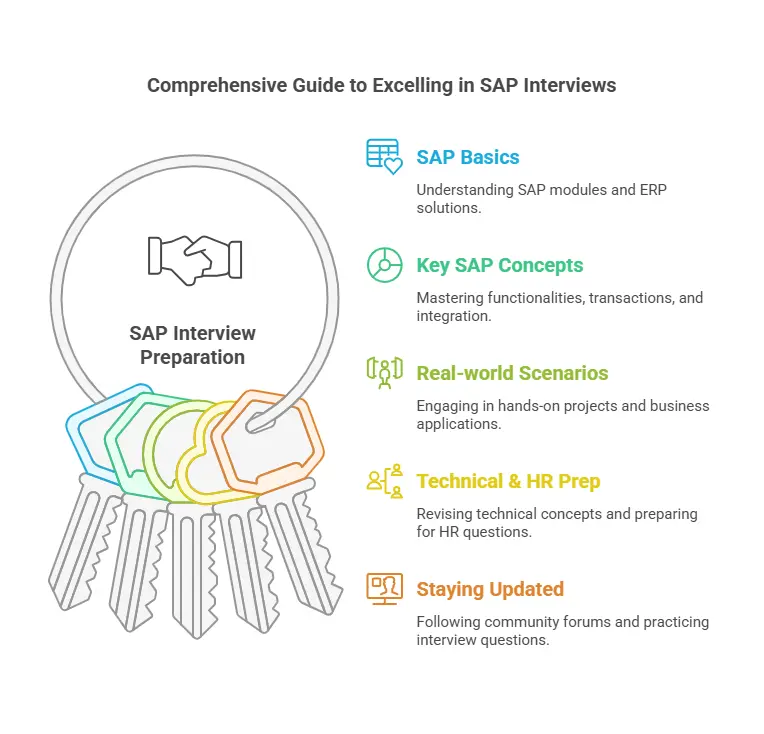
A knowledge of various SAP modules such as SAP FI (Financial Accounting), SAP CO (Control), SAP etc. (Material Management), SAP SD (Sales and Distribution), SAP PP (Production Scheme) and others relevant to your domain. Knowing how these modules are connected.
2. Review SAP Best Practices
SAP follows the best practice specific to use and configure your module. Make sure you are well aware of your knowledge of SAP function and their impact on business efficiency.
3. Master Core SAP Concepts
Understand core concepts as:
-
ERP (Enterprise Resource Planning) and how SAP fits into it.
-
Client-server architecture used by SAP.
-
T-codes (transaction codes) for various operations.
-
ABAP (Advanced Business Application Programming) if relevant to the role.
4. Prepare for Real-world Scenarios
Be prepared to discuss real -world scenarios, such as how to solve problems or better processes using SAP. The interviewer can present a position and ask how you want to solve it using the SAP module.
5. Know Implementation Methodologies
ASAP (Accelerated SAP) and SAP Active should familiarize yourself with the SAP implementation feature and be able to explain how you used them in previous projects
6. Practice SAP Interview Questions
Work on specific SAP interview questions based on your module. General technical and behavioral questions can be included:
- How do you handle a module from adapting a module to accommodate business needs?
- Can you explain the integration points between SAP mm and SAP SD?
- What challenges have you faced during the SAP implementation?
Join Entri’s SAP FICO Training Course today!!
Conclusion
SAP (system, applications and products) are still an important part of commercial business for companies worldwide. SAP Skill Mastering opens many career opportunities in different industries, making it a valuable property for professionals. In this blog we covered the best SAP interview questions and answers for 2026, and provided insight into modules such as SAP Hana, Fico, MM, SD, ABAP and more.
By making ready the technical, useful and behavioral problems mentioned right here, SAP can meet self assurance interviews and secure roles in top groups, who need SAP advisors. Staying updated with the present day SAP developments, undergoing continuous training and gaining practical revel in is important for a a success SAP career in 2026. Whether you are a new or an experienced candidate, this guide equates you to demonstrate your knowledge and understanding in SAP, offers you with an area for success inside the competing job market.
| SAP Courses Offered | ||
| SAP FICO Course | SAP MM Course | SAP SD Course |
Master SAP with Expert-Led Courses
Unlock your potential with our comprehensive SAP courses! Learn essential modules like SAP MM (Materials Management), SAP SD (Sales and Distribution), and SAP FICO (Financial Accounting and Controlling) from industry experts.
Know MoreFrequently Asked Questions
What is SAP and why is it widely used in enterprises?
SAP (Product in System, Application and Data Processing) is a software program for Enterprise Resource Planning (ERP) that integrates special commercial approaches. It is extensively used, as it allows agencies to control their enterprise in finance, logistics, human sources and other crucial regions thru an incorporated gadget, which enables to improve performance, productiveness and decision.
What are the key components of SAP's R/3 architecture?
SAP R/3 architecture has three teams:
- Presentation layer: User interface that connects the latest user to the system.
- Application layer: Business management logic and data processing.
- Database team: Responsible for data storage and management. It ensures smooth communication between three-level architectural clients and servers and supports scalability.
What is the difference between SAP ECC and SAP S/4HANA?
SAP ECC (ERP Central Component) is the old version of SAPS ERP software, while SAP S/4hana is the latest version, built on the Hana database in Mememory. S/4hana provides better speed, real -time analysis, simplified data models and extended user experience through the Fiii interface, making it a more powerful and efficient ERP solution.
What is a 'transport request' in SAP?
A transport request in SAP is a package used to transfer configuration settings, development objects or from one SAP system to another (eg from development to production). It ensures stability and integrity in different systems during SAP implementation or upgrading.