Table of Contents
This guide covers 20 common interview questions. Simple sample answers are also included. The selection process and preparation steps are explained. Each section is designed for freshers. It can also help career switchers. Communication and attitude are often assessed. Practical knowledge and confidence are also expected.
Key Takeaways
- Common interview questions covered here.
- Sample answers are given for practice.
- Selection stages differ with employers.
- Customer service skills are assessed.
- Basic airport terms should be understood.
- Grooming and communication should be practised.
- A seven-day preparation plan is included.
Airport Ground Staff Selection Process
The selection process depends on the employer. Different stages may be included. Candidates should check the official job notice. The instructions shared by recruiters should be followed.
Typical Stages
- Written Test or Initial Screening
Basic knowledge may be tested first. English and reasoning questions may be included. General awareness may also be checked. Some employers may use online screening.
- Group Discussion
A topic may be given to candidates. Communication and teamwork are observed. Clear points should be shared. Other candidates should also be heard.
- HR Interview
Personal and job-related questions are asked. Education and work experience may be discussed. Interest in aviation is usually checked. Shift flexibility may also be discussed.
- Grooming and Fitness Check
Personal presentation are reviewed. Basic fitness requirements are checked. Few employers have specific standards.
- Document Verification
Educational certificates may be checked. Identity documents may also be requested. Experience certificates may be required. The employer’s document list should be followed.
What Recruiters Assess at Each Stage
Different skills are checked during selection.
- Communication: Clear speaking and listening.
- Confidence: Calm and clear answers.
- Teamwork: Respectful behaviour with others.
- Customer service: Patient and helpful responses.
- Problem-solving: Practical solutions to common issues.
- Grooming: Neat and professional appearance.
- Flexibility: Willingness to work assigned shifts.
- Basic knowledge: Understanding of airport operations.
Selection stages are not the same everywhere. They may vary by airline and employer.

Top 20 Airport Ground Staff Interview Questions and Answers
Different questions may be asked during interviews. Customer situations may also be discussed. Basic airport procedures may be checked. The following answers can be used for practice.
Introductory and HR Questions
- Tell me about yourself.
A short introduction should be prepared. Education and skills should be mentioned. Relevant experience may also be included.
Sample Answer:
“My name is [Name]. I have completed [Qualification]. I have good communication skills. I enjoy helping people. I can work well with others. I would like to build my career in aviation.”
- Why do you want to work in aviation?
Interest in the aviation field should be explained. Customer service can also be mentioned. A clear reason should be provided.
Sample Answer:
“Aviation is an interesting field. Passengers from different places are served here. I enjoy communicating with people. I would like to support passengers. This role would also help me gain experience.”
- Why do you want to join this airline or company?
Some basic company knowledge should be shown. Its services and work can be mentioned. The reason for applying should be clear.
Sample Answer:
“Your company is known for its services. I would like to work with your team. My communication skills can be used here. More knowledge about airport operations can also be gained.”
- What are your strengths and weaknesses?
A few useful strengths should be selected. One genuine weakness can be mentioned. Steps taken to improve should also be explained.
Sample Answer:
“My strengths are patience and communication. I can also work well in teams. I sometimes take extra time to check my work. I am working on managing my time better.”
- Are you willing to work rotational shifts?
Airport operations run at different times. Early and late shifts may be assigned. Weekend duties may also be required.
Sample Answer:
“Yes, I am comfortable with rotational shifts. I understand that airport duties follow different schedules. I can follow the assigned timings. My responsibilities will be completed properly.”
Customer Service Questions
Passenger support is an important part of ground staff work. Difficult situations may be discussed. Calm and clear answers are expected.
- How would you handle an angry passenger?
The passenger should first be heard. The problem should be understood carefully. A suitable response should then be provided.
Sample Answer:
“The passenger would be allowed to explain. Their concern would be heard patiently. A calm response would be given. The issue would be checked. A suitable solution would be explained. Help would be requested when needed.”
- How would you handle a delayed or cancelled flight?
The latest flight information should be checked. Clear updates should be shared. Available options should also be explained.
Sample Answer:
“The flight status would be checked first. The passenger would be informed politely. The latest updates would be shared. Available options would be checked. Rebooking assistance would be provided when available.”
- What would you do if a passenger missed a flight?
The passenger’s booking should be reviewed. The reason for missing the flight should be checked. Available options should then be explained.
Sample Answer:
“The passenger’s ticket would be checked. The missed flight would be reviewed. Available flights would be checked. Rebooking options would be explained. Further assistance would be arranged when needed.”
- What would you do if baggage was lost?
The baggage details should be checked first. The passenger’s complaint should be recorded. The baggage team should be informed.
Sample Answer:
“The passenger would be heard patiently. The baggage tag would be checked. A missing baggage report would be prepared. The relevant team would be informed. The passenger would be guided through the claim process.”
- How would you help a passenger with special needs?
The passenger’s needs should be understood. Suitable assistance should be arranged. Respectful communication should be maintained.
Sample Answer:
“The passenger’s needs would be asked about politely. Wheelchair assistance would be arranged when requested. Boarding support would also be coordinated. Clear instructions would be provided. The passenger’s comfort would be respected.”
Situational and Behavioural Questions
Past experiences may be discussed during interviews. Real examples should be selected. The STAR method can be used.
- How would you work under pressure?
Busy periods are common at airports. Tasks should be arranged by priority. Calm behaviour should be maintained.
Sample Answer:
“During busy periods, tasks would be arranged by priority. Important duties would be handled first. Clear communication would be maintained. Help would be requested when required. Work would be completed carefully.”
- How would you handle a disagreement with a colleague?
Teamwork is important in airport operations. Disagreements should be handled respectfully. Work instructions should also be followed.
Sample Answer:
“The issue would be discussed calmly. Both views would be heard. The work instructions would be reviewed. A suitable solution would be agreed upon. Teamwork would be maintained.”
- What would you do if you made a mistake?
Mistakes should be reported honestly. The issue should be corrected quickly. Steps should be taken to prevent repetition.
Sample Answer:
“The mistake would be reported immediately. The correct details would be checked. The issue would be corrected. Guidance would be requested if needed. More care would be taken next time.”
- How would you manage several tasks during peak hours?
Several duties may need attention together. Tasks should be prioritised carefully. Team support may also be required.
Sample Answer:
“Tasks would be arranged by importance. Urgent passenger needs would be handled first. Team members would be informed. Instructions would be followed carefully. Each task would be completed in order.”
- What would you do if a passenger request went against company rules?
Company rules must be followed. The passenger should still be treated politely. Suitable alternatives may be explained.
Sample Answer:
“The request would be heard carefully. The relevant rule would be checked. The reason would be explained politely. Available alternatives would be shared. A supervisor would be contacted if required.”
Role and Technical Questions
Basic airport knowledge may be checked. Simple procedures should be understood. Answers should be kept clear and accurate.
- What are the basic steps in check-in?
The passenger’s booking is checked first. Travel documents are reviewed. Baggage is weighed and tagged. A boarding pass is issued. The passenger is guided towards security.
Sample Answer:
“The booking details would be checked first. Required documents would be verified. Baggage would be weighed and tagged. The boarding pass would be issued. The passenger would be guided to the next step.”
- What is the boarding process?
Passengers are called to the boarding gate. Boarding passes and required documents are checked. Passengers are guided towards the aircraft. The process is completed according to airline procedures.
Sample Answer:
“Passengers would be guided to the correct gate. Boarding passes would be checked. Required documents would be verified. Passengers would be called for boarding. The airline’s instructions would be followed.”
- What are airline and airport codes?
Codes are used to identify airlines and locations. IATA airline codes usually contain two characters. IATA airport codes usually contain three letters. ICAO location codes usually contain four letters.
Sample Answer:
“Codes are used in airline operations. They help identify airlines and airports. IATA airport codes have three letters. ICAO location codes have four letters. These codes are used in different aviation systems.”
- What documents are required for air travel?
Required documents depend on the journey. Domestic travel usually requires valid identification. International travel generally requires a passport. A visa may also be needed.
Sample Answer:
“Travel documents depend on the destination. Domestic passengers need accepted identification. International passengers need valid passports. Visas may also be required. The applicable travel rules would be checked.”
- Why are safety and security important at airports?
Safety and security protect passengers and staff. Airport rules must be followed. Unusual activities should be reported. Restricted areas must be protected.
Sample Answer:
“Safety is important in airport operations. All procedures must be followed. Restricted areas should be protected. Unusual activities must be reported. Passenger and staff safety should always be maintained.”

✈️ Start Your Aviation Career Today
Explore career-focused insights on airport jobs, ground staff roles, and aviation training. Learn about salaries, skills, certifications, and hiring trends to start and grow your career in the aviation industry.
Join NowQuestions at a Glance
The main interview topics are listed below. Each question checks a different skill.
| Category | Example question | What the interviewer wants to see |
| Introduction | Tell me about yourself. | Confidence and clear speaking. |
| Motivation | Why do you want aviation? | Interest in the field. |
| Customer service | How would an angry passenger be handled? | Patience and empathy. |
| Flight issues | How would a delay be handled? | Calm behaviour and clear updates. |
| Teamwork | How would a disagreement be handled? | Cooperation and respect. |
| Technical | What happens during check-in? | Basic airport knowledge. |
| Safety | Why are airport rules important? | Care and responsibility. |
How to Answer Using the STAR Method
The STAR method can be used for experience-based questions. It helps answers stay clear and organised. Four simple steps are followed.
- Situation
The background should be explained briefly. A real example can be selected.
- Task
The responsibility should be mentioned. The main problem should be identified.
- Action
The steps taken should be explained. Personal involvement should be made clear.
- Result
The final outcome should be shared. Any lesson learned may also be mentioned.
Mini Example: Working Under Pressure
Situation: Several tasks were assigned together.
Task: All tasks had to be completed on time.
Action: Tasks were arranged by priority. Team members were informed. Important duties were completed first.
Result: The work was completed on time. Better time management was also learned.
Questions to Ask the Interviewer
A few questions may be asked at the end. They can show interest in the role.
- What training is provided to new staff?
- What are the main daily duties?
- How are work shifts assigned?
- Which skills are most important?
- How is staff performance reviewed?
- What are the next selection stages?
✈️ Start Your Aviation Career Today
Explore career-focused insights on airport jobs, ground staff roles, and aviation training. Learn about salaries, skills, certifications, and hiring trends to start and grow your career in the aviation industry.
Join NowGrooming, Body Language and Communication Tips
Professional presentation is important during interviews. Clear communication should also be maintained. A few simple habits can help.
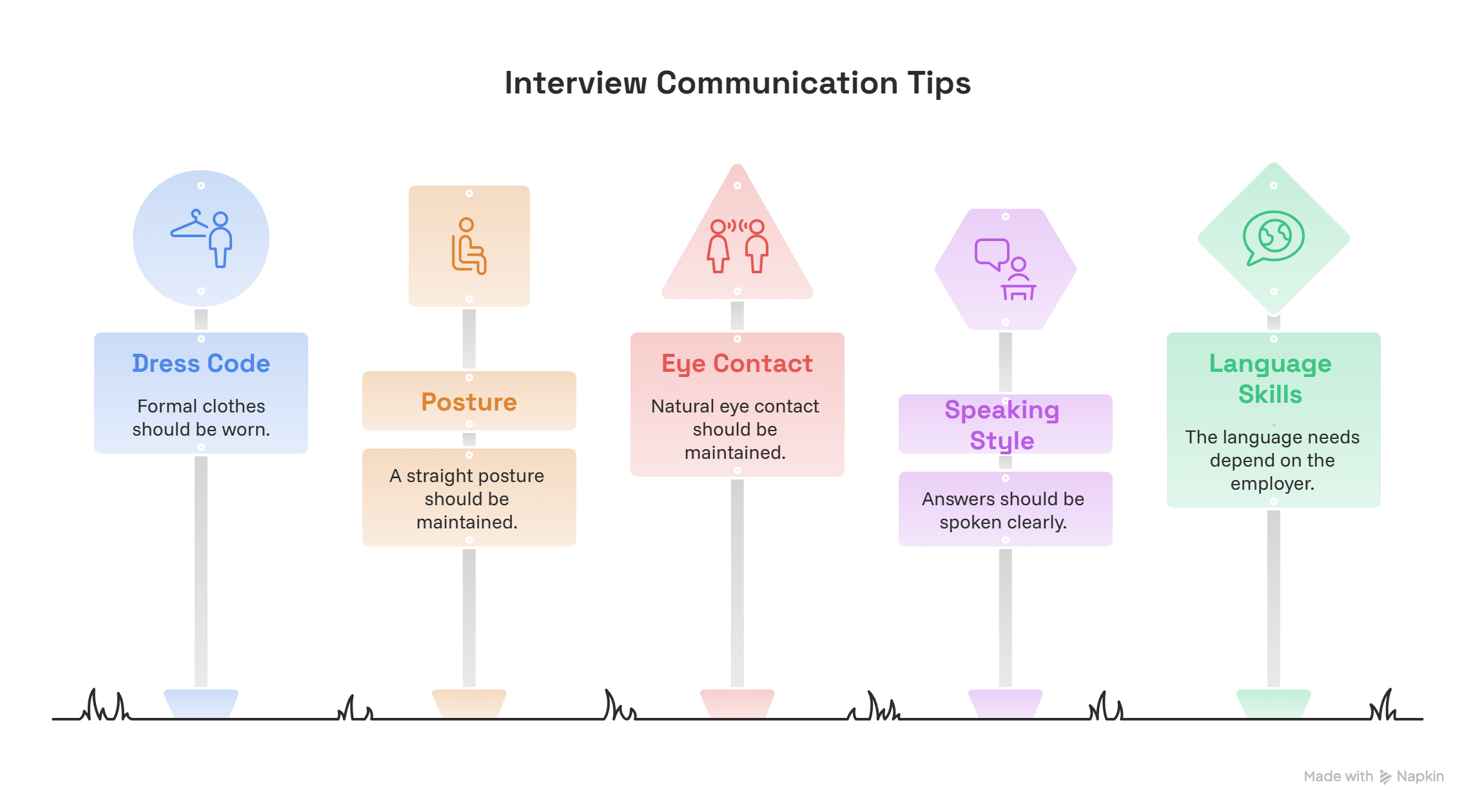
Dress Code
- Formal clothes should be worn.
- Clothes should be clean and well-fitted.
- Shoes should be neat and polished.
- Strong perfumes should be avoided.
Posture
- A straight posture should be maintained.
- Hands should be kept relaxed.
- Unnecessary movements should be avoided.
- A calm appearance should be maintained.
Eye Contact
- Natural eye contact should be maintained.
- The interviewer should be heard carefully.
- Attention should be shown while listening.
Speaking Style
- Answers should be spoken clearly.
- A polite tone should be used.
- Very fast speaking should be avoided.
- Simple words should be preferred.
Language Skills
English may be used during interviews. Regional languages can also be useful. The language needs depend on the employer. Clear communication is important in every language.
Common Mistakes to Avoid
Some mistakes can affect interview performance. These should be avoided during preparation.
- Giving very long answers.
- Speaking without understanding the question.
- Sharing incorrect airport information.
- Showing poor listening habits.
- Speaking negatively about previous employers.
- Giving memorised answers without understanding.
- Ignoring grooming standards.
- Showing unwillingness towards shift work.
- Guessing answers about safety procedures.
- Arriving late for the interview.
How to Prepare in 7 Days
A simple preparation plan can be followed. Each day can be used for one task.
| Day | Task |
| Day 1 | Learn about the airline and role. |
| Day 2 | Practise introductory and HR questions. |
| Day 3 | Practise customer service situations. |
| Day 4 | Revise airport terms and procedures. |
| Day 5 | Practise STAR-based answers. |
| Day 6 | Prepare grooming and communication. |
| Day 7 | Complete a mock interview and revise. |
Quick Revision: Aviation Basics Freshers Should Know
Some basic terms may be asked during interviews. Their meanings should be understood before attending.
Codes
- IATA: International Air Transport Association.
- ICAO: International Civil Aviation Organization.
- IATA airport code: Usually three letters.
- ICAO location code: Usually four letters.
- Airline designator: A code used to identify an airline.
Common Airport Terms
- PNR: Passenger Name Record.
- Boarding pass: Document used for boarding.
- Check-in: Passenger and baggage processing.
- Gate: Area used for boarding.
- Baggage tag: Label attached to checked baggage.
- ETA: Estimated Time of Arrival.
- ETD: Estimated Time of Departure.
- PRM: Passenger with Reduced Mobility.
Baggage Basics
Baggage rules depend on the airline. Weight limits should be checked before travel. Cabin and checked baggage have different rules. Restricted items must be handled according to safety rules.
Travel Documents
- Domestic identification.
- Passport for international travel.
- Visa, when required.
- Boarding pass.
- Other documents required by the destination.
Safety Awareness
Airport safety rules must be followed. Restricted areas should not be entered without permission. Unusual activities should be reported. Passenger safety should remain a priority.
Important Aviation Codes and Terms
| Term | Meaning |
| IATA | International Air Transport Association. |
| ICAO | International Civil Aviation Organization. |
| PNR | Passenger Name Record. |
| PRM | Passenger with Reduced Mobility. |
| ETA | Estimated Time of Arrival. |
| ETD | Estimated Time of Departure. |
Conclusion
Airport ground staff interviews cover several areas. Communication and customer service are often assessed. Basic airport knowledge may also be checked. Each question should be answered clearly. Practical examples can also be included. Interview stages may differ between employers. The official job notice should be reviewed. Regular practice can improve interview confidence.
✈️ Start Your Aviation Career Today
Explore career-focused insights on airport jobs, ground staff roles, and aviation training. Learn about salaries, skills, certifications, and hiring trends to start and grow your career in the aviation industry.
Join NowFrequently Asked Questions
How do I prepare for an airport ground staff interview?
The company and job role should be researched first. Common interview questions should be practised. Basic airport terms should also be revised. Communication and grooming should be checked. A mock interview can help improve confidence.
What is asked in an airport ground staff HR round?
Personal details and educational background may be discussed. Interest in aviation may also be checked. Questions about strengths and weaknesses are common. Shift flexibility may be discussed. Previous work experience may also be reviewed.
Is English fluency mandatory for ground staff jobs?
English is useful in airport operations. Passengers from different places may need assistance. Regional languages can also be helpful. Language requirements depend on the employer and role. Clear speaking and listening skills are important.
What qualifications do ground staff need?
Requirements depend on the employer. Many entry-level roles accept candidates with higher secondary education or graduation. Some positions may require specific qualifications. Communication skills and basic computer knowledge are useful. The official job notice should always be checked.
Is there a written test for airport ground staff?
Some employers conduct written tests. Basic English and reasoning may be included. General awareness may also be checked. Other employers may use direct interviews. The selection process should be checked in the job notification.
What should I wear to a ground staff interview?
Formal and well-fitted clothes should be worn. Shoes should be clean and polished. Hair should be neatly arranged. Heavy accessories should be avoided. A clean and professional appearance should be maintained throughout the interview.