
Table of Contents
Introduction: What Are Darts in Garment Construction?
Darts are small folds sewn into fabric. They are used to give clothes a proper shape. Extra fabric is folded and stitched together. This helps the garment fit the body.
Darts are commonly used in clothing. They are often found around the bust and waist. They may also be added near shoulders. Different types are used for different areas. Each dart helps create a particular shape.
Darts are important in garment construction. They help clothes fit the body’s curves. They also improve the overall appearance. Without darts, some garments may look loose. Proper darts help create a neat finish.
Darts are used in dresses, blouses, and skirts. They are also found in trousers and jackets. Their size and position depend on the design. They are usually marked before stitching.
Key Takeaways
- Darts are used to shape garments.
- Extra fabric is folded and stitched.
- Different darts suit different body areas.
- Bust and waist darts are commonly used.
- Darts help improve garment fitting.
- Correct marking is important before sewing.
- Fabric should be handled carefully.
- Proper stitching gives a smooth finish.
Learn Advanced Designing & Boutique Skills with Experts. Join Now!
Why Are Darts Important in Clothing Design?
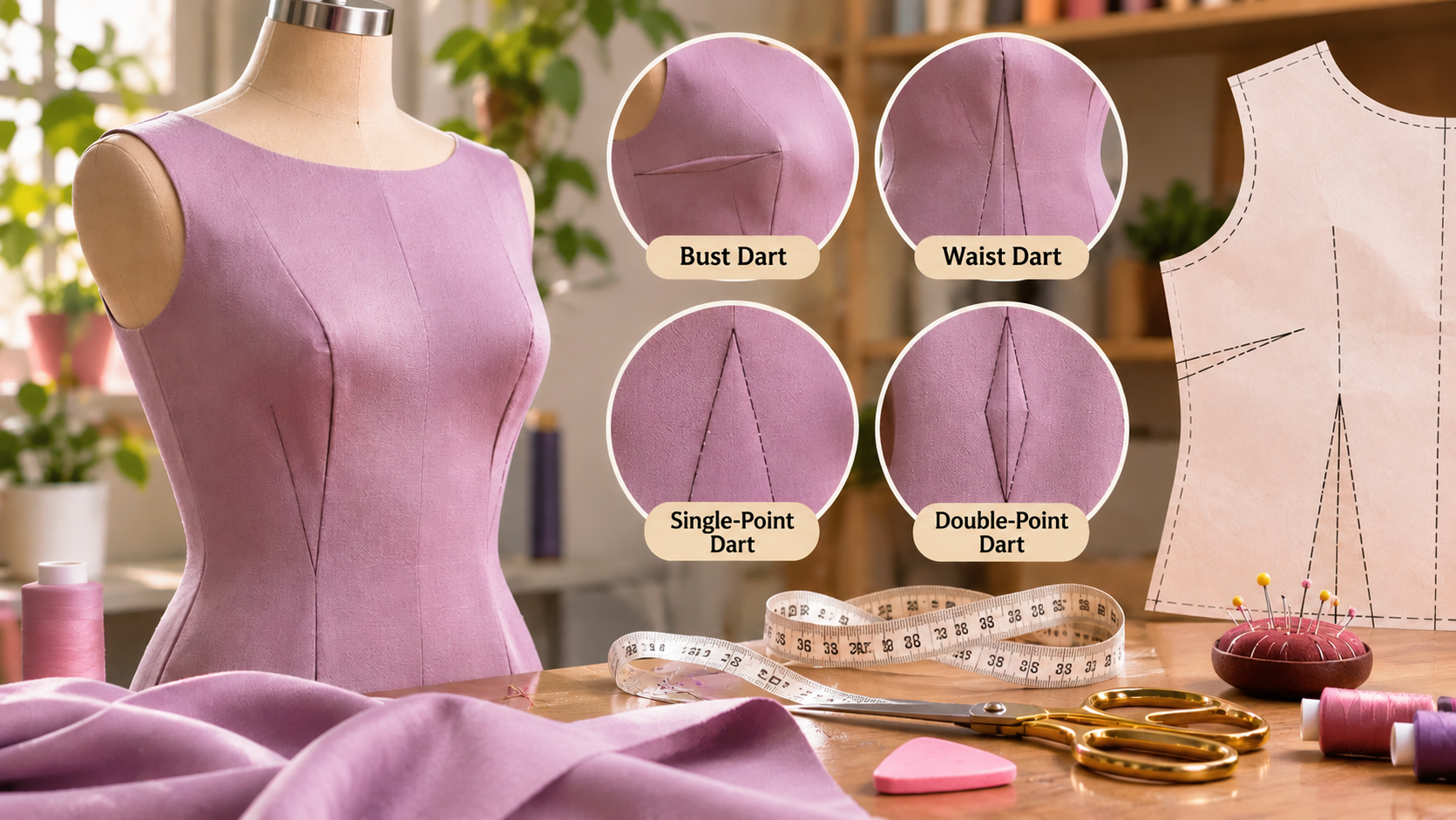
Darts are used to give clothes a better fit. They help fabric follow the body’s shape. Extra fabric is removed through stitching. This creates a neat garment shape.
Without darts, some clothes may appear loose. They may also form unwanted folds. Darts help control the extra fabric. A better fit can then be achieved.
Better Fitting
Darts help clothes fit different body shapes.
- Extra fabric is reduced.
- The garment follows body curves.
- Loose areas are controlled.
- A closer fit is created.
- The garment looks neater.
Improved Shape
Darts help create the required garment shape.
- Bust areas are shaped.
- Waist areas are fitted.
- Shoulders are adjusted.
- Sleeves can be shaped.
- Curved areas are supported.
Better Appearance
Darts also improve how clothes look.
- Fabric is kept in place.
- Unwanted folds are reduced.
- The garment looks balanced.
- The shape appears more natural.
- The finish looks cleaner.
Design Support
Darts are also used in fashion design.
- Different garment shapes can be created.
- Fitted styles can be developed.
- Waistlines can be shaped.
- Design details can be added.
- Pattern adjustments can be made.
Darts are useful in many garments. Their placement depends on the pattern. The correct position should be marked carefully.
Master Fashion Designing and Create Your Signature Style
Unlock your creative potential with our expert-led Fashion Designing course. Build in-demand skills and step confidently into the world of fashion!
Begin Your Fashion Career Today!Different Types of Darts Used in Sewing
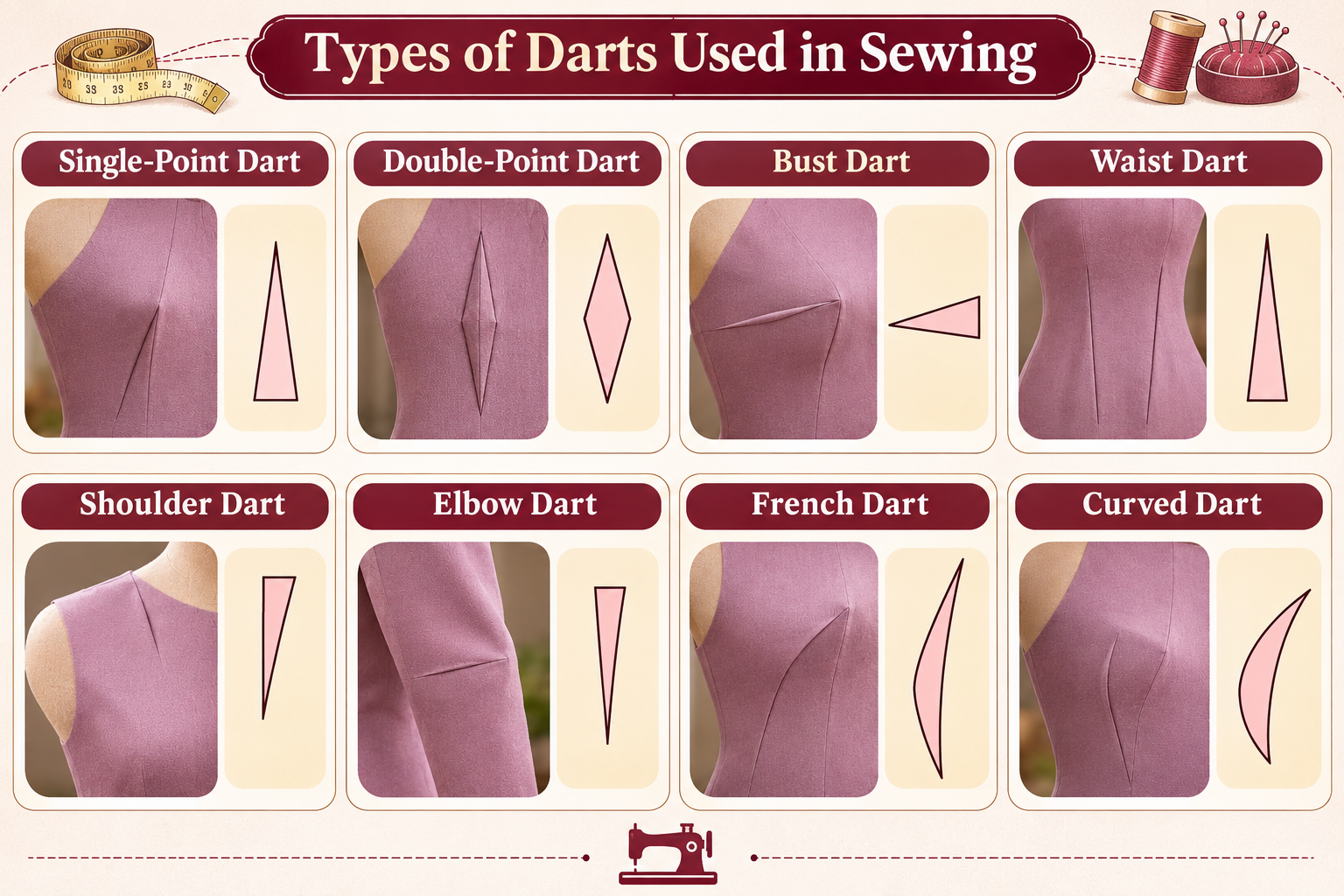
Several types of darts are used in garment construction. Each type has a different purpose. Their positions also depend on the garment. Some are used for body shaping. Others are used for better movement and fit.
Single-Point Darts
A single-point dart has one pointed end. It is one of the common dart types. It is usually used for shaping fabric.
The wider part is placed near the body area. The dart becomes narrower towards its point. The folded fabric is stitched along this line.
Main Features
- One pointed end.
- A wider base.
- A narrow stitching point.
- Simple construction.
- Commonly used in fitted garments.
Common Uses
- Blouses.
- Skirts.
- Dresses.
- Shirts.
- Bodices.
Single-point darts are often used around the bust. They may also be placed near the waist. Their length depends on the garment pattern.
Double-Point Darts
Double-point darts have two pointed ends. They are also called fisheye darts. The centre section is wider. Both ends become narrow.
This dart is used to shape the waist. It helps remove extra fabric around the middle. A fitted shape is created on both sides.
Main Features
- Two pointed ends.
- A wider centre section.
- Narrow ends on both sides.
- Curved or straight stitching lines.
- Used for waist shaping.
Common Uses
- Fitted dresses.
- Blouses.
- Jackets.
- Bodices.
- Tunics.
Double-point darts help create a closer fit. They are often placed vertically. Their position is selected according to the pattern.
Bust Darts
Bust darts are used to shape the chest area. Extra fabric is removed around the bust. This helps the garment follow the body’s curves.
These darts are often placed below the bust. They may also start from the side seam. Their pointed ends are directed towards the bust point.
Main Features
- Used around the bust area.
- Helps create chest shaping.
- Usually has one pointed end.
- Commonly found in fitted tops.
- Supports a better garment fit.
Common Uses
- Blouses.
- Shirts.
- Dresses.
- Bodices.
- Jackets.
The dart point should not end directly at the bust point. A small distance is usually maintained. This helps prevent a pointed appearance.
Waist Darts
Waist darts are used to shape the waistline. Extra fabric is removed from the waist area. A closer fit is created around the body.
These darts are usually placed vertically. They may be found at the front or back. Their size depends on the garment design.
Main Features
- Used around the waist.
- Usually placed vertically.
- Helps reduce extra fabric.
- Creates a fitted shape.
- May be used in pairs.
Common Uses
- Skirts.
- Dresses.
- Trousers.
- Blouses.
- Jackets.
Waist darts help create a neat outline. They are commonly used in fitted clothing.
Shoulder Darts
Shoulder darts are used near the shoulders. They help shape the upper part of garments. Extra fabric is removed from this area.
These darts may be placed near the shoulder seam. They help the fabric follow the body. A smoother shoulder fit is created.
Main Features
- Placed near the shoulder.
- Helps shape the upper body.
- Reduces extra fabric.
- Improves shoulder fitting.
- Usually kept small.
Common Uses
- Blouses.
- Shirts.
- Dresses.
- Jackets.
- Bodices.
Shoulder darts are used when needed. Their position depends on the garment pattern. They may be adjusted during fitting.
Elbow Darts
Elbow darts are used in sleeves. They help shape the elbow area. Extra fabric is controlled around the joint.
These darts allow sleeves to follow the arm’s shape. They are often used in fitted sleeves. A better sleeve fit can be achieved.
Main Features
- Placed near the elbow.
- Used in sleeve construction.
- Helps shape the arm area.
- Controls extra fabric.
- Supports comfortable movement.
Common Uses
- Fitted jackets.
- Formal shirts.
- Tailored coats.
- Long-sleeved garments.
- Structured sleeves.
Elbow darts are useful in tailored clothing. Their position should match the elbow area. Proper marking helps maintain comfort.
French Darts
French darts are long shaping darts. They usually begin near the waist. They extend diagonally towards the bust area.
This dart combines waist and bust shaping. It is often used in fitted tops. A smooth and shaped appearance is created.
Main Features
- Long diagonal shape.
- Starts near the waist or side area.
- Extends towards the bust.
- Helps shape the upper body.
- Creates a fitted appearance.
Common Uses
- Dresses.
- Blouses.
- Bodices.
- Fitted tops.
- Formal garments.
French darts are useful in garment design. They can create a smooth body shape. Their length and angle depend on the pattern.
Curved Darts
Curved darts are stitched along curved lines. They are used when a straight dart is unsuitable. A softer shape can be created.
These darts are often used for special designs. They help shape areas with natural curves. Careful stitching is required.
Main Features
- Curved stitching line.
- Used for body shaping.
- Helps follow natural curves.
- Needs careful marking.
- Requires smooth stitching.
Common Uses
- Fitted dresses.
- Blouses.
- Bodices.
- Special garment designs.
- Tailored clothing.
The curve should be marked clearly. The fabric should be stitched slowly. This helps prevent uneven shapes.
Comparison of Different Dart Types
| Dart Type | Main Position | Main Purpose |
| Single-Point Dart | Bust or waist | Basic shaping |
| Double-Point Dart | Waist | Shaping the middle section |
| Bust Dart | Bust area | Chest shaping |
| Waist Dart | Waistline | Creating a fitted waist |
| Shoulder Dart | Shoulder area | Improving shoulder fit |
| Elbow Dart | Sleeve | Shaping the elbow |
| French Dart | Waist to bust | Combined body shaping |
| Curved Dart | Different body areas | Following body curves |
Learn Advanced Designing & Boutique Skills with Experts. Join Now!
How to Sew Darts in Garment Construction
Darts should be sewn carefully. Correct stitching helps create a smooth shape. The fabric must be marked before sewing. The marked lines should be followed properly.
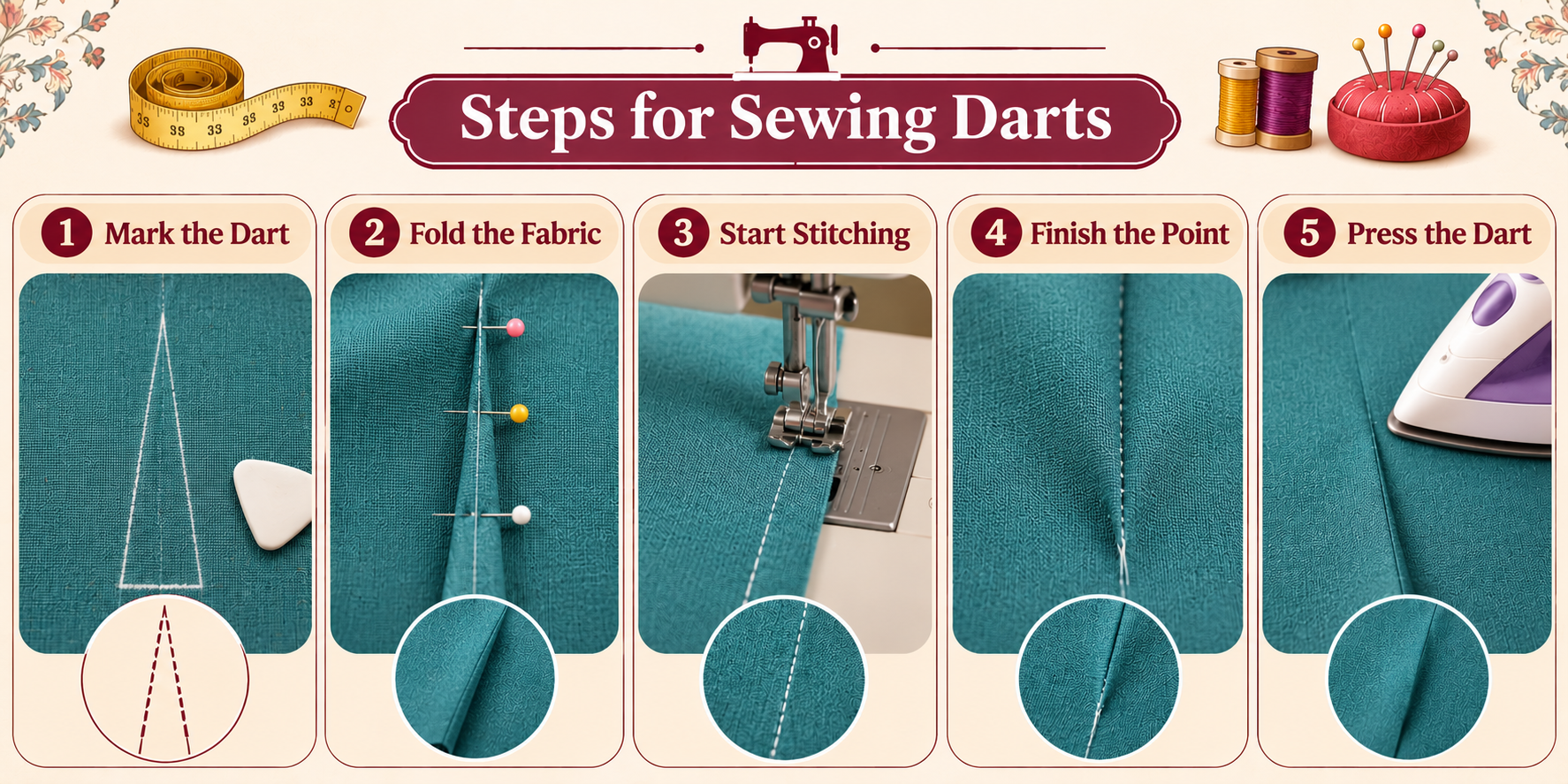
Steps for Sewing Darts
Step 1: Mark the Dart
- Place the pattern on the fabric.
- Mark the dart points.
- Mark the dart legs.
- Check the marked lines.
- Remove the pattern carefully.
Step 2: Fold the Fabric
- Bring the dart legs together.
- Match both marked lines.
- Keep the fabric edges aligned.
- Place pins along the fold.
- Check the dart point.
Step 3: Start Stitching
- Begin at the wider end.
- Follow the marked stitching line.
- Keep the stitches even.
- Sew towards the pointed end.
- Maintain a straight line.
Step 4: Finish the Point
- Reduce the stitch length near the point.
- Sew carefully towards the tip.
- Leave a short thread tail.
- Tie the threads securely.
- Avoid making a thick knot.
Step 5: Press the Dart
- Remove the pins.
- Check the stitching.
- Press the dart with an iron.
- Follow the correct pressing direction.
- Allow the fabric to cool.
Important Sewing Tips
A few simple steps can improve results.
- Use matching thread.
- Choose a suitable needle.
- Keep the fabric flat.
- Avoid pulling the fabric.
- Follow the marked lines.
- Check the dart before pressing.
The dart should look smooth. No unwanted folds should remain.
How to Transfer Darts from a Pattern to Fabric
Darts are usually marked using a paper pattern. Correct marking is important. It helps keep the dart in the right position. Different marking tools can be used.
Tools Needed
The following tools may be used.
- Paper pattern.
- Measuring tape.
- Fabric chalk.
- Tailor’s pencil.
- Pins.
- Tracing wheel.
- Carbon tracing paper.
- Fabric scissors.
Steps to Transfer Darts
Step 1: Place the Pattern
- Spread the fabric on a flat surface.
- Place the pattern on the fabric.
- Match the grainline.
- Secure the pattern with pins.
Step 2: Mark the Dart Points
- Find the dart markings.
- Mark the dart tip.
- Mark both dart legs.
- Check their positions.
Step 3: Transfer the Lines
- Use fabric chalk or a pencil.
- Draw both dart legs.
- Mark the centre fold.
- Keep the lines clear.
Step 4: Remove the Pattern
- Remove the pins carefully.
- Lift the paper pattern.
- Check all markings.
- Make corrections when needed.
Step 5: Check the Markings
- Match both dart legs.
- Check the dart length.
- Confirm the dart position.
- Prepare the fabric for stitching.
Common Dart Marking Methods
| Marking Method | How It Is Used | Suitable For |
| Fabric Chalk | Lines are drawn on fabric | Most common fabrics |
| Tailor’s Pencil | Markings are made directly | Light and medium fabrics |
| Tracing Wheel | Pattern lines are transferred | Suitable fabric types |
| Carbon Paper | Marks are copied onto fabric | Pattern transfer |
| Pins | Dart points and lines are marked | Temporary marking |
The marking method depends on the fabric. Delicate fabrics need extra care. Marks should be tested first.
Master Fashion Designing and Create Your Signature Style
Unlock your creative potential with our expert-led Fashion Designing course. Build in-demand skills and step confidently into the world of fashion!
Begin Your Fashion Career Today!Common Dart Sewing Mistakes and How to Avoid Them
Small mistakes can affect dart fitting. They may also change the garment shape. Care should be taken during marking and sewing.
Incorrect Dart Placement
Darts must be placed correctly.
- Wrong positions can affect fitting.
- The garment may look uneven.
- Extra folds may appear.
- The pattern markings should be checked.
- Body measurements should be reviewed.
Uneven Stitching
Uneven stitches can affect the dart shape.
- Stitch length should remain consistent.
- The fabric should be guided slowly.
- The stitching line should be followed.
- The machine speed should be controlled.
Sewing Beyond the Dart Point
The dart point should be finished carefully.
- Extra stitching may create a visible point.
- A thick end may form.
- The fabric may look uneven.
- Stitching should end at the marked tip.
- Thread tails should be tied securely.
Incorrect Folding
Both dart legs should be matched.
- Uneven folding can change the shape.
- The dart may become twisted.
- Pins should be placed carefully.
- Marked lines should be matched.
Poor Pressing
Pressing helps set the dart shape.
- Incorrect pressing can create folds.
- Excessive heat can damage fabric.
- A suitable iron setting should be used.
- The correct pressing direction should be followed.
Common Mistakes and Their Solutions
| Common Mistake | Possible Result | How to Avoid It |
| Wrong placement | Poor garment fitting | Check pattern markings |
| Uneven stitching | Uneven dart shape | Sew slowly and carefully |
| Sewing beyond the point | Visible fabric tip | Stop at the marked point |
| Incorrect folding | Twisted dart | Match both dart legs |
| Poor pressing | Unwanted folds | Press in the correct direction |
How Darts Improve Garment Fitting and Shape
Darts play an important role in garment fitting. They help fabric follow the body. Extra fabric is removed through stitching. A better shape is created.
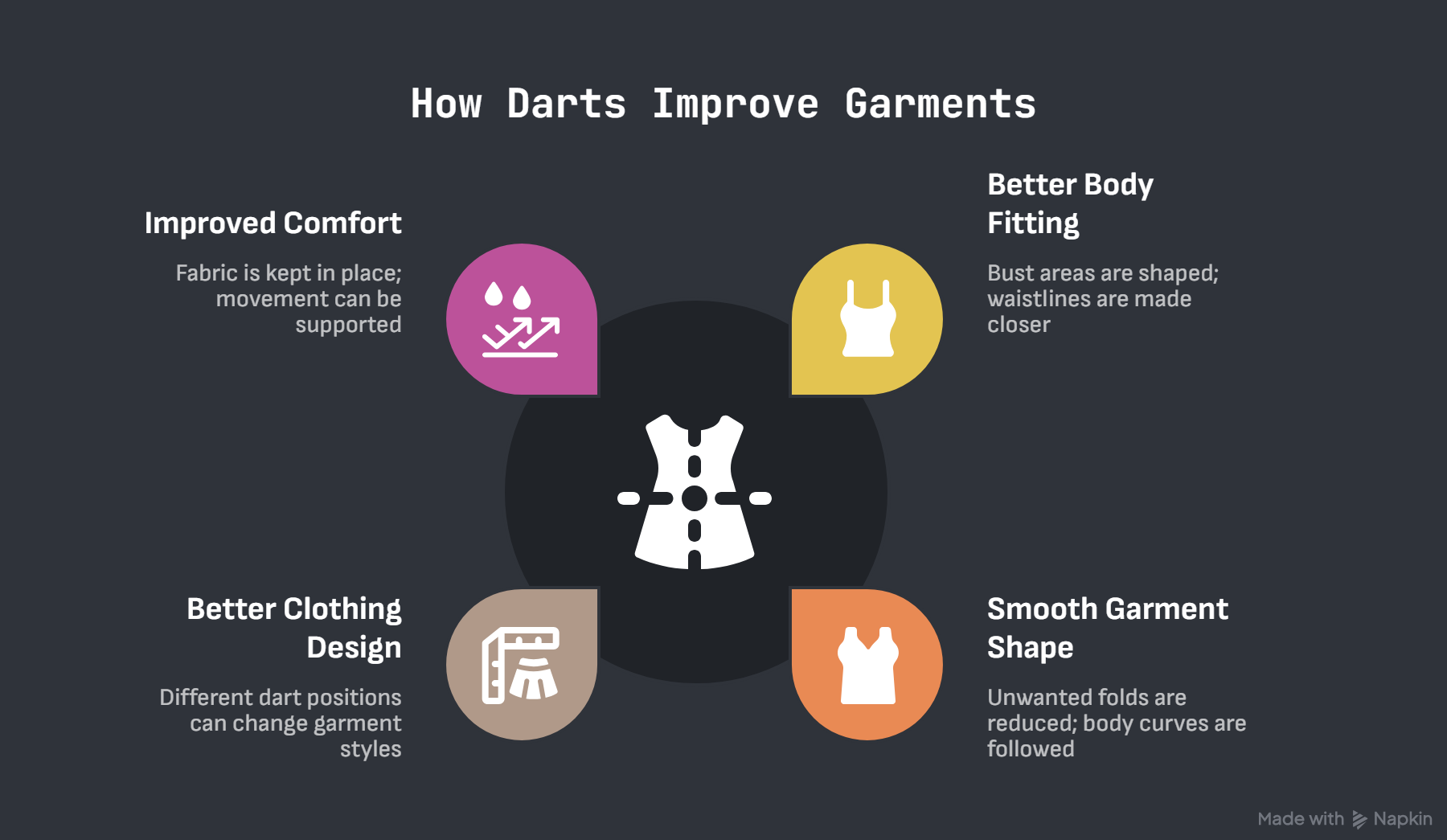
Better Body Fitting
Darts help garments fit different body areas.
- Bust areas are shaped.
- Waistlines are made closer.
- Shoulder fitting is improved.
- Sleeves are shaped around elbows.
- Extra fabric is controlled.
Smooth Garment Shape
A smooth appearance can be created.
- Unwanted folds are reduced.
- Loose fabric is controlled.
- Body curves are followed.
- The garment looks more balanced.
- The finished shape looks neat.
Better Clothing Design
Different dart positions can change garment styles.
- Fitted dresses can be created.
- Shaped blouses can be made.
- Tailored jackets can be designed.
- Structured skirts can be developed.
- Different body shapes can be fitted.
Improved Comfort
Correctly placed darts can improve comfort.
- Fabric is kept in place.
- Extra material is controlled.
- Garments can fit more naturally.
- Movement can be supported.
- Tight areas can be reduced.
The dart size should be suitable. Its position should match the pattern. Proper fitting should be checked before finishing.
Conclusion
Darts are important in garment construction. They are used to shape fabric. Different types are used for different areas. Bust, waist, and shoulder darts are common examples.
Correct marking and stitching are important. Each dart should be placed carefully. Proper pressing helps create a smooth finish. These steps improve garment fitting and shape.
Dart construction is an important sewing skill. It is useful in fashion designing. It is also helpful in pattern making. With practice, neat darts can be created.
Master Fashion Designing and Create Your Signature Style
Unlock your creative potential with our expert-led Fashion Designing course. Build in-demand skills and step confidently into the world of fashion!
Begin Your Fashion Career Today!Frequently Asked Questions
What are darts in garment construction?
Darts are small folds sewn into fabric. They are used to shape garments. They help clothes fit the body.
Why are darts used in sewing?
Darts are used to remove extra fabric. They help create a fitted shape. They also improve the garment’s appearance.
Which dart is commonly used for bust shaping?
Bust darts are commonly used for this purpose. They help shape the chest area. They are often placed below the bust.
What is a double-point dart?
A double-point dart has two pointed ends. Its centre section is wider. It is commonly used for waist shaping.
What is the difference between bust darts and waist darts?
Bust darts are used around the chest. Waist darts are used around the waist. Both help improve garment fitting.
What is a French dart?
A French dart is a long diagonal dart. It usually starts near the waist. It extends towards the bust area.
How are darts marked on fabric?
Darts are marked using fabric chalk. A tracing wheel may also be used. Both dart legs and the point are marked.
How should a dart be finished?
The stitching should end at the dart point. The thread ends should be tied. The dart should then be pressed.
Why should darts be pressed after sewing?
Pressing helps the dart lie flat. It also improves the garment shape. The correct iron setting should be used.
Can darts be used in all garments?
Darts are used in many fitted garments. They are common in dresses and blouses. Loose garments may not need them.