Table of Contents
Artificial intelligence has overpowered the entire system and the perspective with which we traditionally operate. The process of developing and testing the software is now undergoing rapid change due to artificial intelligence.
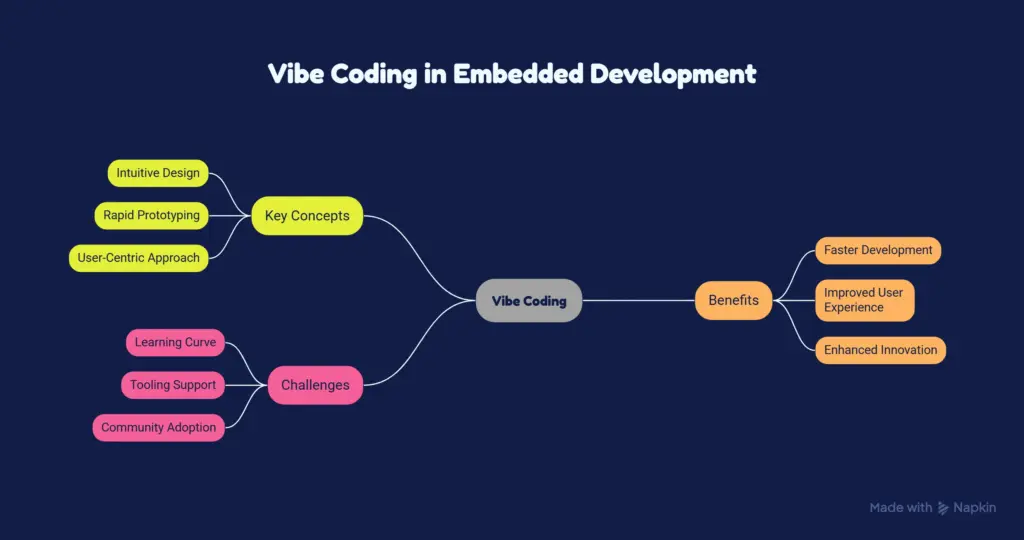
Vibe coding is one such emerging approach which enhances the process of code development. Vibe coding is the process where developers make use of prompts to ask AI tools to generate the code.
-Embedded development is accelerated by AI through the creation, debugging, analysis, and testing of the codes
-Vibe coding makes use of natural language as the prompt
-Human validation is essential for the real-world behaviour of AI
The developers provide natural language prompts to generate the code. Along with the generation of the code, modifications and debugging also happen alongside. Traditional software development largely relied upon normal code development; the vibe of coding is creating new currents across the globe.
The role of vibe coding in embedded development is complex in nature. Among the traditional code development methodologies, vibe coding has become one of the popular approaches.
The embedded system is known for interacting directly with the sensors, memory, hardware, etc. Can AI develop the embedded system? This question may confuse many. AI can accelerate the development of the embedded system. AI cannot fully replace the expertise of embedded engineering.
Kickstart your embedded systems career and turn your tech passion into high-demand skills!
What Is Vibe Coding in Embedded Development?
Through natural language instructions, Vibe Coding in embedded systems uses AI tools and generates, modifies, tests and debugs the embedded code. The developers provide the prompt to troubleshoot errors and create peripherals and functions.
The AI-generated code still requires human review and testing. The final validation shall be given after the human evaluation and analysis. The code that seemingly feels correct can still have the potential to fail in embedded systems. The hardware configuration and electrical concerns can affect the code. Reviewing the code and testing it before the final run is thus really important.
Why Embedded Development Is Different from Traditional Software
With abundant memory and processing resources, traditional software runs on powerful hardware systems. Strict constraints are provided for the operation of embedded systems. Embedded developers should consider the following aspects:
- Communication protocols
- Behaviour of actuators
- Working of sensor
- Limited flash memory
- Limited RAM
- Limitation in CPU and processing
- Overconsumption
- Reliability
- Safety
- Interrupts
- Registers of hardware
The malfunctioning of a device is often caused by small software mistakes. The developers must be really careful while handling the tools before the system goes unresponsive.
Master Embedded Systems Programming!
Launch your tech career with our Embedded Systems Course, designed for hands-on learning and industry readiness.
Know MoreWhat Does “Vibe Coding” Look Like in Embedded Projects?
Throughout the different stages of development, an embedded developer can use AI technology.
The AI assistant can help the developer in the following stages:
- Generation of SPI, I2C, and UART communication code
- Expanding the knowledge on unfamiliar configurations of registers
- Generation of C++ code for sensors and microcontrollers
- Basic sensor drivers creation
- Unit tests writing
- Potential bug identification
- Compiler error detection and reporting
- Embedded C code conversion from pseudocode
The code will be given to the target boards, and the actual behaviour will be tested by the developer.
Rather than being an autonomous embedded engineer, the AI can act as an assistant in development procedures, and it can work alongside the developers.
Kickstart your embedded systems career and turn your tech passion into high-demand skills!
Where AI Works Well—and Where It Doesn’t
Well-defined and repetitive programming tasks will be handled well by AI. AI carries out actions such as code documentation and code explanations.
Project scaffolding initially, conversion of syntax, suggestions for debugging, generating tests, boilerplating of code and so on.
AI struggles in areas such as electrical faults, precise requirements of time, specific hardware problems, critical system safety debugging in the real world, hardware behaviour being undocumented, and so on. The AI can detect why a particular sensor is not working well or responding but can never check the connections and components involved in the system failure. That requires human intervention.
| AI Works Well | Where AI Doesn’t Work |
| Code documentation | Specific hardware problems |
| Debugging | Timing requirement specifications |
| Test generation | Faults in electricals |
| Code analysis | Safety of critical systems |
| Conversion of Syntax | Real-world debugging |
| Boilerplate code | Hardware behaviour undocumented |
| Scaffolding of initial project | Physical hardware inspection |
| Peripheral examples | Interruptions in complex interactions |
Traditional Embedded Development vs Vibe Coding
Here are the core differences between traditional embedded development and vibe coding.
Vibe coding may define the ways by which the code is produced. But it can never replace the role of an engineer who gives the ultimate validation.
| Features | Traditional Embedded Development | Vibe Coding |
| Development speed | Slower | Faster |
| Coding Approach | Manual coding | AI-assisted coding |
| Debugging | Manual | AI-assisted |
| Code writing | Developer | AI-generated |
| Documentation | Manually written | AI-generated |
| Best use | Production firmware | Rapid prototyping |
| Human oversight | Required throughout | Required reviewing |
| Learning curve | Less beginner-friendly | Beginner-friendly |
Master Embedded Systems Programming!
Launch your tech career with our Embedded Systems Course, designed for hands-on learning and industry readiness.
Know MoreBenefits of Vibe Coding for Embedded Engineers
Here are the benefits of using AI for assisted development.
- Rapid prototyping – experimentation with ideas will happen rapidly.
- Documentation – the documentation process will be improved with the AI-generated comments and explanations
- Debugging – the AI detects software errors much faster, and debugging will be done easily
- Faster code development – the initial code generation will be more rapid.
- Repetitive work reduction – boilerplate programming will be handled effortlessly by AI
- Learning – better learning opportunities will be provided as new and unfamiliar concepts will be explained with the aid of AI
| Features | Traditional Programming | Vibe coding |
| Prototyping | Slower | Faster |
| Code generation | Manual | AI |
| Debugging | Developer | AI |
| Testing | Required | Required |
| Validation | Required | Required |
Kickstart your embedded systems career and turn your tech passion into high-demand skills!
Risks and Limitations
Challenges are part of code development in embedded systems. An important risk is raised by the vibe coding in embedded development. This includes
- Timing problems
- Vulnerable security
- Hardware assumption’s inaccuracy
- Race condition
- Code inefficiency

The AI-generated code will only be accepted if you know its real nature. If you are unaware of how this works, the AI-generated code can turn itself into a safety hazard when this application is particularly used in industrial controllers, automotive systems and other medical devices.
Kickstart your embedded systems career and turn your tech passion into high-demand skills!
Best Practices for Using AI in Embedded Development
In the process of embedded system development, engineers can make use of AI effectively.
- You can understand the working of the generated code before applying it.
- You can verify the documentation of the hardware rather than simply relying on AI. I
- When it’s the appropriate time, you can make use of hardware-in-the-loop testing.
- You can compile the code and run required tests frequently
- Review the timing and the memory usage of the same
- You have to check the safety and security requirements
- Track the AI-assisted changes with the aid of version control
You have to look forward to AI-assisted engineering rather than completely relying on AI.
Popular AI Tools Embedded Developers Are Using
Here is the list of popular tools used by developers:
- Cursor
- Claude
- Chatgpt
- Google gemini
- Github copilot
These tools are essential to generate code, assist with the appropriate workflow, explain the documentation and troubleshoot errors.
| AI Tool | Useage | Features |
| ChatGPT | Code generation, debugging, analysis | Problem-solving |
| GitHub Copilot | AI code completion and analysis | Quick embedded coding |
| Claude | research | Physical system errors |
| Cursor | AI-powered code editor | Embedded software development |
| Amazon Q Developer | AWS integrated code assistant | Embedded projects with cloud connection |
| Tabnine | AI code autocompletion | Productivity boosting |
| Codeium | Free AI coding assistant | Own developers |
Is Vibe Coding the Future of Embedded Engineering?
Vibe coding is one of the most essential parts of embedded development. Vibe coding plays a crucial role in documentation, rapid prototyping, testing and other repetitive programming. Embedded engineering codes contain more than writing code.
The real-time behaviour of the code should be thoroughly understood. You have to learn about the system architecture as well, along with the requirements meant for safety. In the near future, embedded alongside. Engineers can work with AI to create a better outcome.
Final Thoughts
Embedded development will move at a faster pace with the advent of vibe coding. AI will not be able to replace developers but can only work alongside them. AI tools are really powerful in debugging, prototype acceleration, and concept clarification.
But human intervention is essential, as final validation should be given before the actual testing of the code. Developers must understand the relationship between the AI-generated code and the working nature of the embedded system.
Developers who wish to accelerate their career prospects should learn the fundamentals of embedded systems and use AI as an assistant for better performance!
Master Embedded Systems Programming!
Launch your tech career with our Embedded Systems Course, designed for hands-on learning and industry readiness.
Know MoreFrequently Asked Questions
What is the significance of vibe coding in embedded system development?
Vibe coding is one such emerging approach which enhances the process of code development. Vibe coding is the process where developers make use of prompts to ask AI tools to generate code.
What are the popular tools used by the developers?
The popular tools used by the developers include, Cursor, Claude, Chatgpt, Google gemini and Github copilot
How is vibe coding connected to embedded engineering?
Vibe coding plays a crucial role in documentation, rapid prototyping, testing and other repetitive programming. Embedded engineering codes contain more than just writing code.
What is the major threat of AI code generation?
If you are unaware of how this works, the AI-generated code can turn itself into a safety hazard when this application is particularly used in industrial controllers, automotive systems and other medical devices.
Can vibe coding shape the future of the embedded system developers?
Yes. Vibe coding can aid the embedded system developers to use the AI assistants to work more progressively. But, it requires human validation before the real world introduction of the physical system.