Table of Contents
Your blood circulation has to be sufficient to ensure that each cell in the body gets the right amount of oxygen and nutrients. If you sit for long periods of time or don’t move around much, or both, the body might become stiff and sluggish.
Yoga is a subtle and powerful kind of exercise, and one of the most basic strategies to encourage good blood flow is to get regular physical activity.
While doing yoga, you get to focus on several poses that will improve your lower, middle, and upper body. Doing so can help you stretch out your muscles better and release stress from the muscles more easily. This means that regularly integrating yoga into your active lifestyle can have positive benefits on your circulation and general health.
Want to Step Up? Join our Yoga Instructor Course Online!
Key Takeaways:
- Yoga is a discipline that incorporates both breathing and movement techniques, both of which are good to the circulation of blood thanks to its incorporation.
- Your legs that are feeling tired will benefit greatly from the Legs-Up-the-Wall Pose, which is a fantastic strategy for offering rest to your legs.
- You will notice that your legs, arms, and back all appear to be stronger once you have finished practising Adho Mukha Svanasana (Downward-Facing Dog). This occurs as a result of the fact that you have performed this pose various times.
- Strength in your chest and back can be developed through the practice of Cobra Pose, which can help you develop your strength.
- The Triangle Pose will not only help you become more flexible and mobile, but it will also assist you in maintaining your balance.
- Regular yoga practice is helpful to your health and helps to quiet your thoughts. Yoga is a discipline that can be done by anyone.
- There are a number of things you can do to improve your health, including going on walks and doing yoga. Exercise, and make sure you consume enough water throughout the day.
Yoga for Better Blood Circulation: Poses and Benefits
The circulation of blood is of utmost significance. In addition, it assists in delivering oxygen and nutrients to all parts of the body. A healthy blood flow can be encouraged by maintaining a physically active lifestyle. However, sitting or standing in the same position for extended periods of time can cause the body to become stiff and painful.
The practice of yoga is an excellent addition to an active lifestyle that includes stretching, moderate exercise, and breathing that is under control. The practice of yoga is therefore an excellent addition to an active way of life.
While performing various yoga positions, you have the opportunity to engage a wide variety of muscle groups, which in turn produces movement throughout the body. The following is a list of poses that are typically performed in a mild yoga program and that can be added to the routine:
Best Yoga Positions for Optimal Blood Circulation
1: Which of these is the primary goal of yoga practice?
It is possible to incorporate a number of different yoga poses into a regimen that is intended to promote healthy blood flow. Those who are just starting out should take their time with each pose and avoid forcing their bodies into positions that are uncomfortable.
Below given are the best yoga postures for optimal blood circulation.
Become a Certified Yoga Instructor
Yoga Teacher Training Course by Entri App: Master authentic yoga techniques, earn certification, and build a successful career as a professional yoga instructor.
Join Now!Legs-Up-the-Wall Pose

The Legs-Up-the-Wall pose is also known as Viparita Karani . In this pose , you lie on your back and place your legs in a vertical posture against a wall . This yoga pose is known for its therapeutic and relaxing properties.
The form of yoga that is employed for this purpose is generally called “Viparita Karani. This is one of the easier yoga poses and can be quite soothing if you have been sitting, standing or walking for a long period.
You will also be able to take this posture as one of the poses during your time spent practicing yoga. This causes a shift in the lower body position, which in turn allows the legs to rest in a way which is not only natural but also enjoyable. The higher stance of the legs brings about this alteration.
How to do the Legs-up-the-wall Posture:
- Lie down on your back, one hip against the wall.
- Slowly lower yourself again, softly lifting your legs up onto the wall.
- You should lie down in a comfortable position with your legs up the wall.
- Lie on your back with your head, neck and back on the floor.
- Let your arms hang loosely by your sides, palms facing up or down.
- If you wish you can close your eyes and breathe short and easy.
- Hold for a few minutes or for as long as is comfortable for you.
- If you want to go out do the knees thing. Slide away from the wall. Roll over on to your side and come up to a sitting position.
How it can Help Circulation
You can also raise your legs so that they are above your heart, which can be a pleasant feeling after standing or sitting for a long time. This position also allows the leg muscles to relax and provides a mild stretch through the backs of the legs.
It is not meant as a remedy for a disease of the circulation, but can be a comfortable supplement to a movement and relaxation program.
Downward-Facing Dog Posture
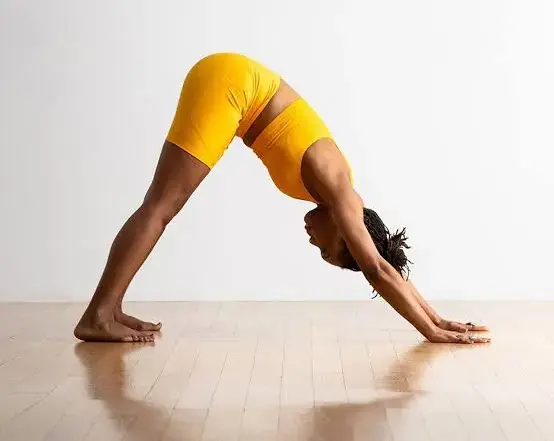
Adho Mukha Svanasana or Downward-Facing Dog is a yoga pose that is often performed to combine flexibility with a moderate amount of strength. This stance is also sometimes called the “Downward-Facing Dog.”
This exercise works the entire body, including the arms, shoulders, back, hips, and legs, and eventually leads to a position that is like an inverted V.
How to do the downward-facing dog posture:
- First, go down on your hands and knees.
- Hands should be somewhat in front of the shoulders.
- Tuck your toes beneath and slowly raise your knees.
- Raise hips straight back and up.
- Try to keep your spine long, rather than trying to get your legs into a perfectly straight position.
- So you can get your heels lifted even if your hamstrings or calves are stiff.
- Keep your head between your arms and stay there.
- Now breathe deeply and pleasantly a few times and gently return to your starting posture.
How it can Help Circulation
This posture works several of the larger muscular groups, especially those in the legs and upper torso. Getting into and holding the pose actively involves and stretches the muscles.
The pose also changes the posture of the body from a straight standing stance during a yoga session.
Cobra posture
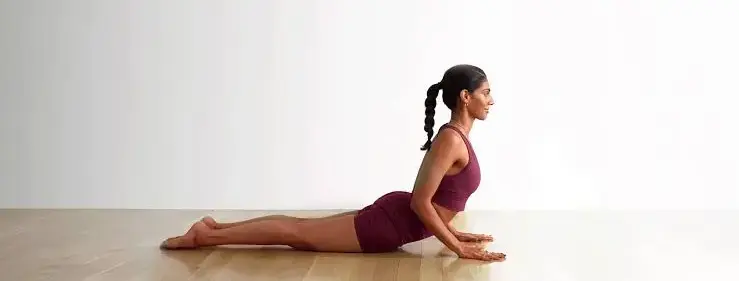
The Cobra Pose or Bhujangasana is a moderate backbend exercise performed by a person lying on his stomach. This position is also called Bhujangasana. This exercise opens the front of the body, stretches the chest and shoulders and actively uses the muscles in the back. These are just some of the many benefits that are linked with this exercise.
How to do the Cobra Posture:
- Lie on your back, with your legs straight behind you.
- Put your palms on the ground in a level position close to your shoulders and remain flat.
- Keep your elbows close to your body.
- During this time, progressively lift your chest and press lightly onto your hands. Do this while you’re doing it.
- Make sure that your shoulders are relaxed and not touching your ears at all times. This is a safety feature of importance.
- Keep your weight at a level that you are comfortable with in what you are wearing.
- You have to avoid pushing yourself into a deep backbend, but you have to also make sure your pelvis and lower ribs are being supported in a secure way.
- Start by holding your breath for a few seconds and then slowly lower yourself down.
How it can Help Circulation
Gaining mobility in the chest, shoulders, back, and abdominal region can be accomplished by performing the Cobra Pose.
One can experience a gentle opening of the front of the body, which is a nice sensation, particularly after sitting at a desk for an extended period of time or working.
As part of an overall active program, the combination of movement and muscular engagement is the most important factor that contributes to circulation.
Become a Certified Yoga Instructor
Yoga Teacher Training Course by Entri App: Master authentic yoga techniques, earn certification, and build a successful career as a professional yoga instructor.
Join Now!Triangle Posture

By incorporating both stretching and controlled movement, the Triangle Pose, often referred to as Trikonasana, is a standing yoga pose that places an emphasis on maintaining balance.
During this yoga pose, the legs, hips, chest, shoulders, and sides of the torso are some of the areas that are concurrently targeted. Other places that are targeted include the shoulders.
How to do the Triangle Posture:
- Your feet should be spaced apart in a comfortable manner.
- The first foot should be turned outside, while the other foot should be kept slightly inside the box.
- Both arms should be raised to the level of the shoulders.
- Move your upper body toward the leg in a slow and deliberate manner, keeping your foot to the outside of your body.
- Your bottom hand should be resting on your shinbone, ankle, or a yoga block, depending on how flexible you are that particular hand.
- Bring the opposing arm up to its fullest extent.
- Maintain an open chest at all times and refrain from bringing your body forward in a forward-curving manner.
- While maintaining the position, make sure to maintain a steady breathing pattern.
- Make a slow and gentle transition back to the standing position, and then repeat the method on the opposite side.
How it can Help Circulation
Triangle Pose is a yoga pose that encourages movement through the hips, torso, and upper body while also keeping the legs active.
Due to the fact that it is a standing pose, it also requires the muscles to work in order to keep the stability and posture of the body.
Performing motions such as these on a regular basis can help to maintain the body’s mobility and activity levels.
Benefits of Yoga for Blood Circulation
Yoga has numerous benefits for the circulatory system. Regular practice of yoga may bring several benefits that contribute to overall physical well-being. Some of them are mentioned below:
- Stimulates frequent exercise and helps to cut down long periods of inactivity.
- Promotes flexibility by stretching the muscles and joints in a gentle manner.
- Supports muscle action, particularly in the upper body, legs and hips and the back.
- It may help relieve stiffness that develops after lengthy durations of sitting or standing.
- This approach induces relaxation through moderate movements and controlled breathing.
- You will have greater awareness in your body and be able to be more conscious of your posture and movement.
- It increases overall fitness when combined with other excellent habits like walking, eating a well-rounded diet and other healthy habits.
Tips for Improving Circulation with Yoga
For the purpose of promoting healthy mobility and circulation, there is no requirement for a yoga regimen that is followed by a trained professional.
Assisting you in practicing in a manner that is more comfortable and consistent can be accomplished via the use of a few straightforward routines.
Begin slowly
When you are just beginning to practice yoga, you should begin with simple poses and have a limited amount of time to devote to your practice.
You ought to focus on learning the appropriate movement rather than attempting to maintain positions that are difficult to maintain.
Make sure that you are concentrating on your breathing
It is important that you make an effort to breathe in a way that is not just soft but also natural when you are practicing.
It is of the utmost importance that you do not hold your breath when you are entering or holding a position that provides a hard challenge.
Maintaining a single position for an extended period of time is not good for your health
Yoga is a form of physical activity that can be a wonderful complement to other forms of physical expression. If you are sitting for extended periods of time, you should be sure to give yourself regular breaks to get up, move about, stretch your legs, or exercise your legs.
Always stay hydrated
When it comes to maintaining regular biological processes, drinking sufficient amounts of water throughout the day is beneficial.
When you are doing out or practicing yoga in a warm atmosphere, it is extremely vital to have water on hand. You should always have water on hand, but this is especially important.
Regular practice is essential
There are occasions when a lengthy and intense workout could end up being more of a disadvantage than a gain. This is something that is feasible.
One of the most useful things that can be done is to perform a little yoga session on a daily basis. Find a routine that you will be able to stick to and stick to it.
Pay attention to your body whenever necessary
The discomfort that is experienced as a result of stretching should not be severe or piercing. While in a certain posture, you should quit the pose and rest if you are experiencing any of the following symptoms:
- pain
- dizziness
- unexpected shortness of breath
- substantial discomfort
Consider Including Yoga Among Your Other Healthy Habits
The conclusion is that numerous forms of physical exercise, including walking, any form of physical activity, gaining sufficient amounts of sleep, eating a diet that is balanced, and avoiding lengthy periods of inactivity, can all contribute to enhanced cardiovascular health.
Want to Step Up? Join our Yoga Instructor Course Online!
Conclusion
Adding gentle movement, stretching, and conscious breathing to your daily practice is one of the simplest ways to promote blood circulation in yoga practice. Different poses include different parts of the body, such as the Legs-Up-the-Wall, Downward-Facing Dog, Cobra Pose, and Triangle Pose.
These positions also promote flexibility and movement. These benefits can aid with stiffness, promote mobility, assist relaxation and contribute to general physical well-being with frequent practice.
The highest results have been shown when yoga is practiced regularly and incorporated into an active lifestyle. “Remember, yoga is not a substitute for health care. If you experience unexplained or ongoing problems with your circulation, you should see a medical specialist to help discover the underlying source of your ailment.
Become a Certified Yoga Instructor
Yoga Teacher Training Course by Entri App: Master authentic yoga techniques, earn certification, and build a successful career as a professional yoga instructor.
Join Now!Frequently Asked Questions
Which yoga pose is best for blood circulation?
Legs-Up-the-Wall Pose is a gentle option that many people find relaxing, while poses such as Downward-Facing Dog and Triangle Pose provide more active movement and stretching.
Can I do yoga every day?
For most healthy people, gentle yoga can be practiced regularly. However, allow your body to recover after more physically demanding sessions and modify poses when necessary.
Does breathing affect circulation during yoga?
Breathing is an important part of yoga. Slow, controlled breathing can promote relaxation and help you stay comfortable while performing different poses.
Can beginners practice yoga for better circulation?
Yes. Beginners can start with simple poses and gentle stretching. There is no need to perform advanced poses to benefit from regular movement.
Is yoga better than walking for circulation?
Both can be useful forms of physical activity. Yoga emphasizes stretching, mobility, balance, and controlled breathing, while walking provides continuous aerobic movement. Including both can create a well-rounded activity routine.
How long should I practice yoga for circulation?
Beginners can start with around 10 to 15 minutes of gentle yoga and gradually increase the duration as they become more comfortable.
When should I avoid yoga for circulation problems?
If you have unexplained swelling, severe pain, significant numbness, sudden changes in skin color, chest pain, or difficulty breathing, seek medical advice rather than trying to manage the symptoms with yoga alone.