Table of Contents
Answer First: What Does an Aircraft Turnaround Coordinator Do?
An Aircraft Turnaround Coordinator manages ground work between flights. Different airport teams are coordinated. The aircraft is prepared for the upcoming flight.
- Main duties.
- Ground teams are coordinated.
- Flight activities are checked.
- Delays are reported.
- Safety rules followed.
- Salary in India (2026).
- Entry-level: ₹2.4–3.6 LPA.
- Experienced: ₹3–5.5 LPA.
- Senior: ₹5–8 LPA.
- Qualifications.
- One may need a degree.
- An aviation diploma can be useful.
- Airport experience may be preferred.
- Difference from passenger handling.
- Passengers are assisted by passenger agents.
- Wider ground work is coordinated by turnaround coordinators.

Introduction
Every flight needs ground preparation. Several teams are involved. Baggage must be loaded. Fuel must be supplied. The cabin must be cleaned. Passengers must be boarded.
All tasks must be completed before departure. Their progress is checked by a coordinator. Delays are reported to concerned teams. The aircraft is then prepared for its next flight.
This guide explains the role and salary. Required skills and qualifications are covered. Courses and career options are also included. Aviation graduates can consider this job. Airport staff can also apply.
✈️ Start Your Aviation Career Today
Explore career-focused insights on airport jobs, ground staff roles, and aviation training. Learn about salaries, skills, certifications, and hiring trends to start and grow your career in the aviation industry.
Join NowWhat Is Aircraft Turnaround?
Aircraft turnaround means preparing an aircraft for its next flight. It starts after landing. It ends when the aircraft leaves its parking area.
Several tasks are completed during this time.
- Passengers are guided out.
- Baggage is unloaded.
- The cabin is cleaned.
- Fuel is supplied.
- Food and drinks are loaded.
- New baggage is loaded.
- Passengers are boarded.
- Final checks are completed.
- The aircraft is prepared for departure.
All tasks are planned around flight times. Some tasks are completed together.
The Turnaround Process From Landing to Pushback
The process is completed through these steps.
- Aircraft arrival.
- The aircraft is guided to its parking area.
- The parking space is checked.
- Wheel blocks are placed.
- Safety rules are followed.
- Passenger deboarding.
- Passengers are guided out.
- Stairs or boarding bridges are used.
- Passengers are guided towards the terminal.
- The cabin is checked.
- Baggage unloading.
- Bags are removed from aircraft.
- They are taken to baggage area.
- Baggage details are checked.
- Missing bags are reported.
- Aircraft servicing.
- Fuel is supplied.
- Water services are arranged.
- Ground equipment is positioned.
- Safety rules followed.
- Cabin cleaning.
- Seats and floors are cleaned.
- Waste is removed.
- Toilets are checked.
- Cabin supplies arranged.
- Catering services.
- Food supplies delivered.
- Drinks and other items loaded.
- Required quantities are checked.
- Catering work is completed.
- Baggage loading.
- New bags are brought to aircraft.
- Bags are placed in cargo area.
- Loading instruction is followed.
- Final details checked.
- Passenger boarding.
- Passengers are boarded.
- Boarding is checked.
- Passenger number is confirmed.
- Special help provided if needed.
- Final checks.
- Remaining tasks are looked into.
- Important details are confirmed.
- Team updates collected.
- Departure readiness checked.
- Pushback.
- The aircraft cleared for pushback.
- Safety instructions followed.
- The aircraft moved from parking area.
- Turnaround work completed.
The exact steps may differ between airlines. Safety checks are followed throughout.
Why Does Turnaround Time Matter?
Turnaround time affects schedules. Delays happen when tasks take longer. Other airport activities also get affected.
- Flight schedules.
- Later flights may be delayed.
- Connecting flights may be missed.
- Other flight plans may be affected.
- Aircraft use.
- More time may be spent on the ground.
- Aircraft availability may be reduced.
- Daily schedules get affected.
- Operating costs.
- Extra ground time increase costs.
- More staff are needed.
- Airline resources get affected.
- Airport activities.
- Parking spaces may remain occupied.
- Other aircraft may have to wait.
- Staff schedules may need changes.
Well-managed turnarounds help flights leave on time.
What Does an Aircraft Turnaround Coordinator Do?
Ground activities are managed by this coordinator. Different teams are guided during the process. Work progress is checked regularly. Delays are also reported.
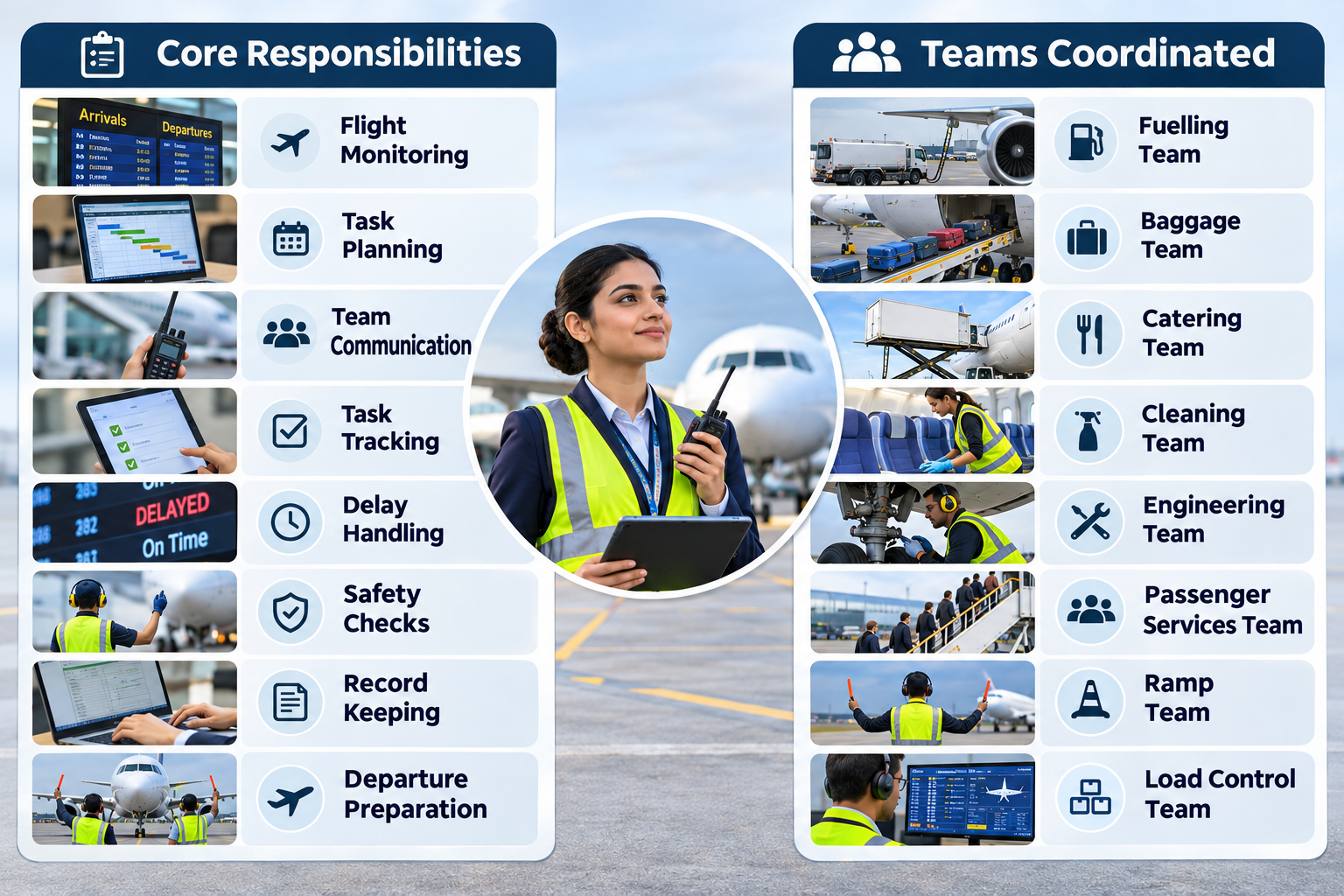
Core Responsibilities
The main duties are listed below.
- Flight monitoring.
- Arrival times are checked.
- Departure times are monitored.
- Flight updates are followed.
- Task planning.
- Ground activities are planned.
- Duties are assigned to teams.
- Work progress is checked.
- Team communication.
- Updates are shared with teams.
- Instructions are passed on.
- Problems are reported.
- Task tracking.
- Important tasks checked.
- Completion times are recorded.
- Pending work is followed up.
- Delay handling.
- Delays are identified.
- Their causes are reported.
- Help is arranged where possible.
- Safety checks.
- Ground safety rules are followed.
- Unsafe activities get reported.
- Required checks get completed.
- Record keeping.
- Work details recorded.
- Task update is saved.
- Reports prepared when needed.
- Departure preparation.
- Remaining tasks checked.
- Team confirmations collected.
- Aircraft readiness checked.
Duties differ between employers. Airline rules must always be followed.
Teams Coordinated
Several teams are involved in each turnaround. Their work is checked and coordinated.
- Fuelling team.
- Fuel delivery is arranged.
- Fuel supply progress is checked.
- Safety rules are followed.
- Baggage team.
- Bags are unloaded.
- New bags are loaded.
- Baggage movement is checked.
- Catering team.
- Food supplies are delivered.
- Food and drinks are loaded.
- Completed work is checked.
- Cleaning team.
- Cabin cleaning is arranged.
- Waste is removed.
- The cabin is prepared.
- Engineering team.
- Technical problems are reported.
- Required checks are arranged.
- Aircraft problems are followed up.
- Passenger services team.
- Boarding is monitored.
- Passenger movement is supported.
- Special help is arranged.
- Ramp team.
- Ground equipment is positioned.
- Aircraft servicing is supported.
- Ramp safety is maintained.
- Load control team.
- Loading details are shared.
- Required information is checked.
- Loading instructions are followed.
Each team is given its own duties. Overall progress is checked by coordinator.
Turnaround Coordinator vs Related Roles
Several jobs are involved in airport work. Some duties may look similar. However, each role has a different main task.
| Role | Main work | Workplace |
| Turnaround Coordinator | Ground activities are coordinated | Ramp and operations areas |
| Ramp Agent | Ground tasks are completed | Airport apron |
| Passenger Handling Agent | Passengers are assisted | Airport terminal |
| Load Controller | Aircraft loading details are checked | Load control office |
| Duty Manager | Airport work is supervised | Operations areas |
Main Differences
Turnaround Coordinator.
- Ground teams are coordinated.
- Flight preparation is checked.
- Delays are reported.
- Departure progress is monitored.
Ramp Agent.
- Baggage is moved.
- Aircraft servicing is supported.
- Ground equipment is used.
- Safety rules are followed.
Passenger Handling Agent.
- Passengers are assisted.
- Check-in work is handled.
- Boarding is supported.
- Passenger questions are answered.
Load Controller.
- Loading information is prepared.
- Aircraft weight is checked.
- Weight and balance rules are followed.
- Loading instructions are shared.
Duty Manager.
- Airport work is supervised.
- Work problems are handled.
- Different teams are guided.
- Daily activities are monitored.
Passenger agents mainly handle passenger services. Wider ground activities are covered by turnaround coordinators.
✈️ Start Your Aviation Career Today
Explore career-focused insights on airport jobs, ground staff roles, and aviation training. Learn about salaries, skills, certifications, and hiring trends to start and grow your career in the aviation industry.
Join NowAircraft Turnaround Coordinator Salary in India
Salary depends on experience and employer. Airport location may also affect pay. Job duties may influence the salary offered.
The following figures are estimated ranges.
Salary by Experience Level
| Level | Estimated annual salary |
| Entry-level / Junior | ₹2.4–3.6 LPA |
| 2–5 years | ₹3–5.5 LPA |
| Senior / Supervisory | ₹5–8 LPA |
Entry-level.- Junior ground jobs may be offered.
- Training may be provided.
- Lower starting salaries may be expected.
- Experienced.
- More flights may be handled.
- Team duties may be coordinated.
- Higher salaries may be offered.
- Senior-level.
- Larger teams may be supervised.
- More duties may be assigned.
- Higher salaries may be provided.
Salary by Employer Type
| Employer type | Estimated annual salary |
| Airline or airline handling unit | ₹3–5.5 LPA |
| Ground handling company | ₹2.4–5 LPA |
| Airport operator | ₹3–6 LPA |
Airlines.- Ground operations jobs may be offered.
- Pay depends on the job.
- Extra benefits may be included.
- Ground handling companies.
- Entry-level jobs may be available.
- Salary may depend on experience.
- Different airport jobs may be offered.
- Airport operators.
- Airport operations jobs may be offered.
- Salary depends on job level.
- Benefits may differ between employers.
These figures are general estimates. Actual salaries may be different.
Allowances and Shift Pay
Airport work continues throughout the day. Different working hours may be assigned. Extra payments may also be provided.
- Night allowance.
- Extra pay may be provided.
- Company rules will apply.
- Shift allowance.
- Rotating shifts may be covered.
- Payment differs between employers.
- Overtime pay.
- Extra working hours may be paid.
- Company rules usually apply.
- Transport.
- Pick-up or drop services may be provided.
- Availability depends on location.
- Medical benefits.
- Medical cover may be included.
- Family cover may differ.
- Insurance.
- Employee insurance may be provided.
- Coverage depends on company rules.
Benefits should be checked before joining. Details should also be checked in the offer letter.
Eligibility and Qualifications
Requirements may differ between employers. Aviation graduates may be preferred. General graduates may also be accepted.
Common requirements include:
- Education.
- A bachelor’s degree may be preferred.
- A recognised degree may be accepted.
- Technical courses may help with some jobs.
- Aviation diploma.
- Airport operations courses are useful.
- Ground handling basics are taught.
- Aviation diplomas can support applications.
- Work experience.
- Airport experience is useful.
- Ramp work may be preferred.
- Ground handling experience can help.
- Language skills.
- English communication is important.
- Local languages can be useful.
- Clear instructions must be given.
- Computer knowledge.
- Basic computer skills are needed.
- Email and office tools are useful.
- Airport software can be learned at work.
- Safety training.
- Airside safety training may be required.
- Ramp safety rules must be understood.
- Training may be provided by employers.
- Airport access pass.
- Airport entry is controlled.
- An approved pass may be required.
- The process is usually guided by employers.
- Medical fitness.
- Medical checks may be required.
- Airport health rules must be followed.
A DGCA licence is not needed for every role. Requirements differ between employers and airports.
Skills Needed
Several useful skills are needed for this job. Most can be improved through practice.
| Skill type | Examples |
| Time management | Tasks and deadlines are tracked |
| Communication | Clear updates are shared |
| Decision-making | Delays and changes are handled |
| Safety awareness | Ramp safety rules are followed |
| Aircraft knowledge | Common aircraft types are recognised |
| Equipment knowledge | Ground equipment is understood |
| Team coordination | Different teams are connected |
| Computer skills | Airport systems are used |
| Problem-solving | Unexpected problems are handled |
| Leadership | Teams are guided during busy hours |
Courses and Certifications
Aviation courses can help with airport work. Ground handling courses are also useful. Practical experience is equally important.
Aviation Operations and Ground Handling Courses
Some useful courses are listed below.
| Course | Duration | Best for |
| IATA Airport Operations Fundamentals | Around 45 hours | Beginners |
| IATA Station Operations Control | 4 days | Ground operations staff |
| IATA Ground Operations Management with AHM | Around 60–70 hours | Supervisors and managers |
| IATA Ground Operations Diploma | Four courses within 3 years | Experienced professionals |
Safety and Regulatory Training
Safety training is important for airport work. Requirements depend on employer and airport rules.
Useful training areas include:
- Airside safety.
- Safe movement near aircraft is taught.
- Restricted area rules are explained.
- Ramp safety steps are covered.
- Human factors.
- Common work mistakes are studied.
- Tiredness and attention are covered.
- Safe work habits are explained.
- Safety Management Systems.
- Possible risks are identified.
- Safety problems are reported.
- Required rules are followed.
- Dangerous goods.
- Dangerous items are identified.
- Safe handling rules are explained.
- Required steps are followed.
- Emergency response.
- Airport emergency rules are studied.
- Emergency communication is covered.
- Basic response steps are explained.
- Aircraft ground handling.
- Ground equipment use is taught.
- Aircraft servicing is explained.
- Ramp activities are covered.
IATA training is available for ground operations. Employers may also provide required training. A course certificate does not replace an airport access pass.
Career Path
Several career options are available in airport work. Higher positions can be reached through experience. Other airport departments can also be explored.
| Level | Role | Typical experience |
| Entry | Ground Operations Assistant | 0–1 year |
| Junior | Ramp Agent / Operations Assistant | 1–2 years |
| Mid-level | Turnaround Coordinator | 2–5 years |
| Senior | Senior Coordinator / Ramp Supervisor | 5–8 years |
| Management | Station Manager / Operations Manager | 8+ years |
These experience ranges are general estimates. Promotions depend on performance and available jobs.
Growth to Supervisory and Operations Roles
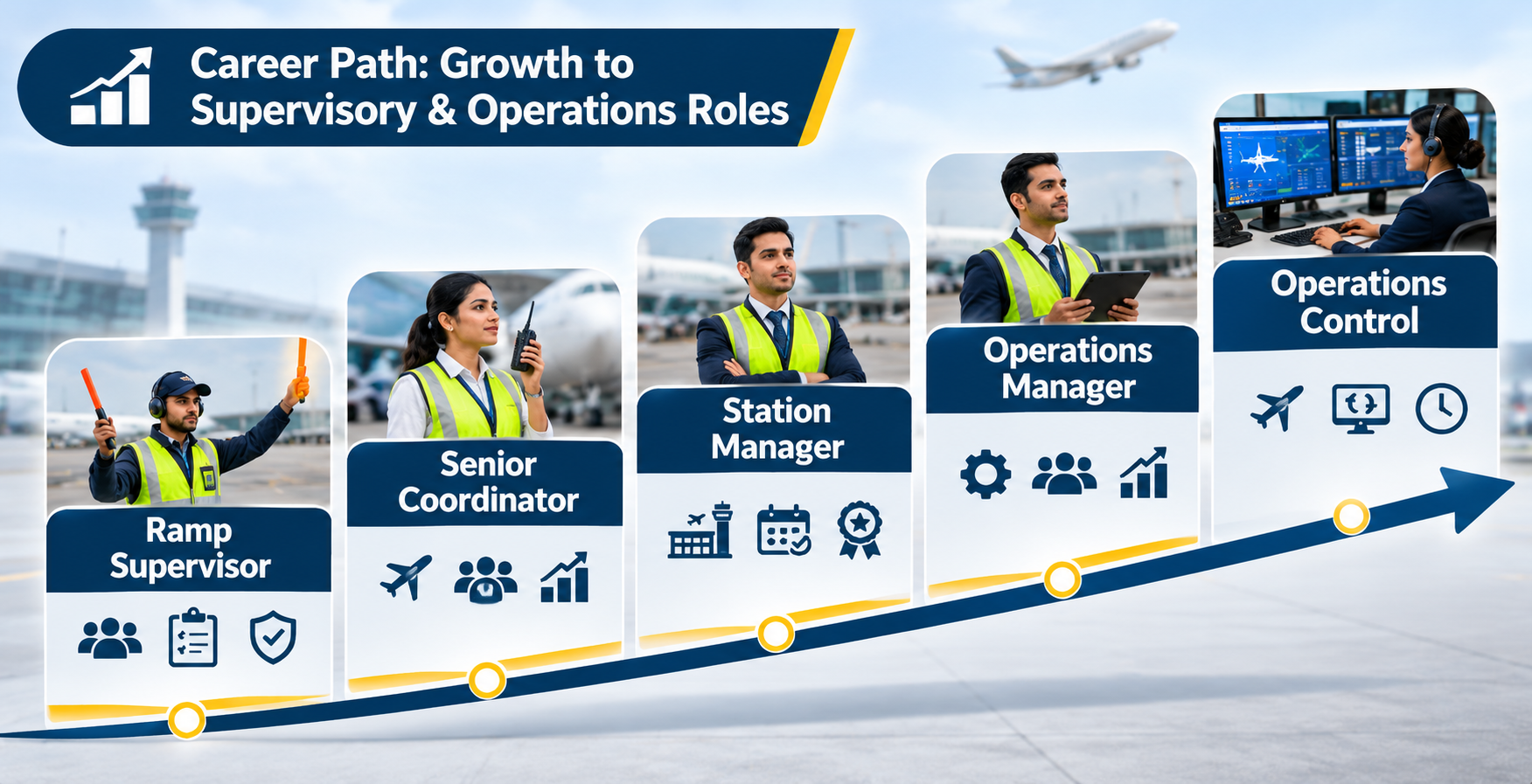
The following positions may be reached with experience.
- Ramp Supervisor.
- Ramp teams are supervised.
- Daily duties are assigned.
- Safety checks are monitored.
- Senior Coordinator.
- More flights may be handled.
- Larger teams may be coordinated.
- Work reports may be prepared.
- Station Manager.
- Airport station work is managed.
- Staff schedules are checked.
- Service quality is monitored.
- Operations Manager.
- Wider airport activities are managed.
- Work problems are handled.
- Team performance is checked.
- Operations Control.
- Flight movements are monitored.
- Work updates are shared.
- Delays are followed up.
How to Become an Aircraft Turnaround Coordinator
This job can be entered through ground operations. Previous airport experience can be useful.
The following steps can be followed.
- Complete a qualification.
- A recognised degree can be completed.
- An aviation diploma can be considered.
- Basic airport work can be studied.
- Learn ground handling.
- Ramp work can be studied.
- Baggage handling can be understood.
- Turnaround steps can be learned.
- Apply for entry-level jobs.
- Ramp agent jobs can be checked.
- Ground operations jobs can be explored.
- Airport assistant jobs can be considered.
- Gain airport experience.
- Daily ground work can be learned.
- Different teams can be observed.
- Flight schedules can be understood.
- Learn airport systems.
- Computer systems can be practised.
- Flight information tools can be learned.
- Turnaround screens can be understood.
- Complete safety training.
- Approved training can be attended.
- Airside safety rules can be learned.
- Airport entry rules can be followed.
- Improve coordination skills.
- Clear communication can be practised.
- Several tasks can be tracked.
- Work pressure can be handled.
- Apply for coordinator jobs.
- Airline vacancies can be checked.
- Ground handling companies can be contacted.
- Job requirements must be reviewed.
Freshers may begin in junior jobs. Previous experience may be needed for coordinator positions.
Pros and Challenges
Useful airport experience can be gained through this job. However, daily work can be demanding.
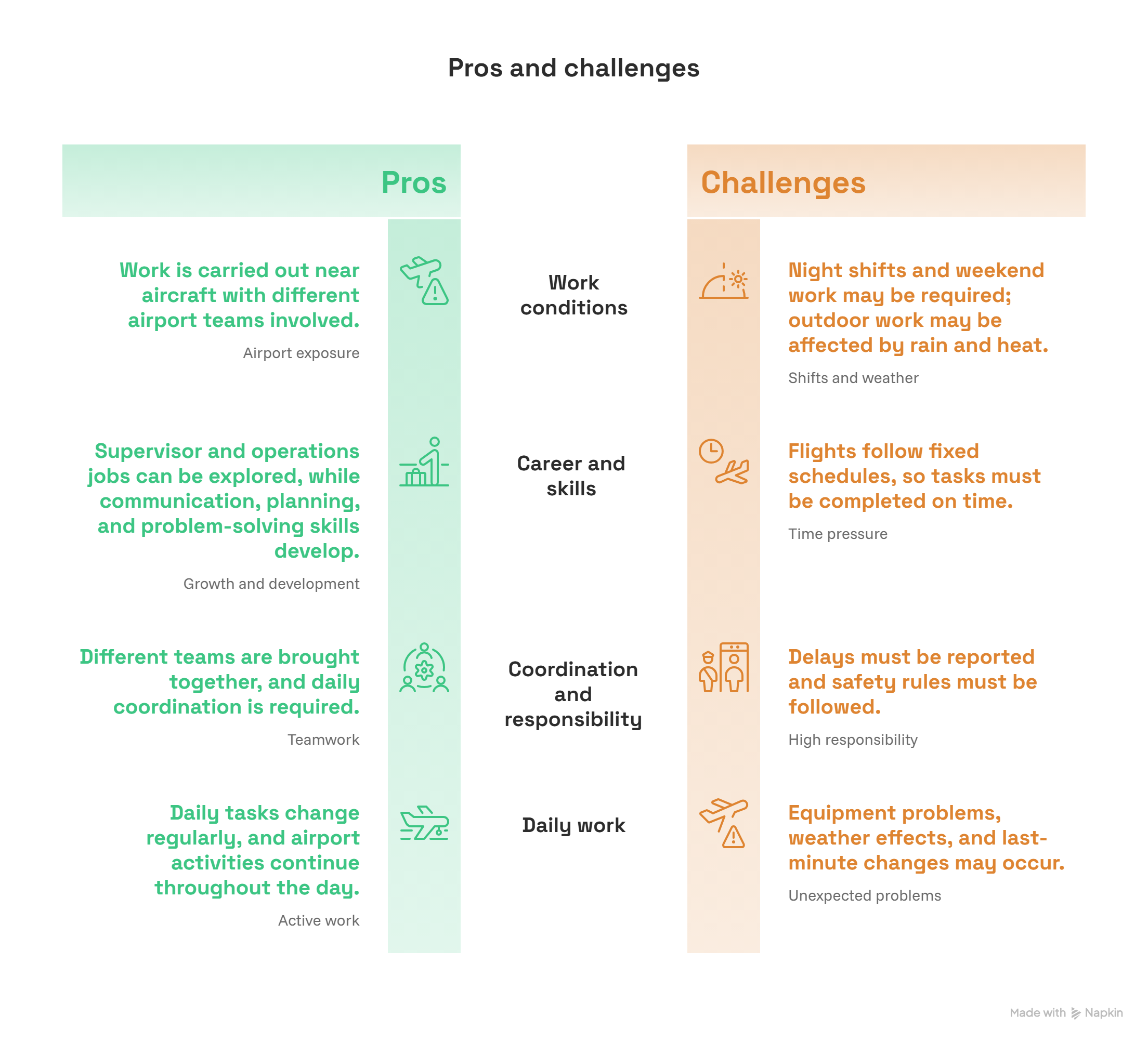
Pros
- Airport exposure.
- Work is carried out near aircraft.
- Different airport teams are involved.
- Career growth.
- Supervisor jobs can be explored.
- Operations jobs may be available.
- Skill development.
- Communication skills are improved.
- Planning skills are developed.
- Problem-solving experience is gained.
- Teamwork.
- Different teams are brought together.
- Daily coordination is required.
- Active work.
- Daily tasks are changed regularly.
- Airport activities continue throughout the day.
Challenges
- Shift duties.
- Night shifts may be assigned.
- Weekend work may be required.
- Weather conditions.
- Outdoor work may be needed.
- Rain and heat can affect work.
- Time pressure.
- Flights follow fixed schedules.
- Tasks must be completed on time.
- High responsibility.
- Delays must be reported.
- Safety rules must be followed.
- Unexpected problems.
- Equipment problems may occur.
- Weather may affect flights.
- Last-minute changes may happen.
Ground work is coordinated by an Aircraft Turnaround Coordinator. Different teams are guided during this process. Flight progress and delays are checked. A degree and airport experience can be useful. Safety training is also important. Higher positions can be reached through experience. This job can suit people interested in airport work.
✈️ Start Your Aviation Career Today
Explore career-focused insights on airport jobs, ground staff roles, and aviation training. Learn about salaries, skills, certifications, and hiring trends to start and grow your career in the aviation industry.
Join NowFrequently Asked Questions
What does an aircraft turnaround coordinator do?
An aircraft turnaround coordinator manages ground activities between flights. Baggage, fuelling, cleaning, catering, and other tasks are coordinated.
What is the salary of a turnaround coordinator in India?
The estimated salary ranges from ₹2.4–5.5 LPA. Pay depends on experience, employer, airport, and shift allowances.
What qualification is needed for the role?
A bachelor’s degree or aviation diploma may be accepted. Airport experience and safety training can also be useful.
Is a turnaround coordinator the same as a ramp agent?
Both roles support airport ground operations. Ramp agents handle ground tasks, while coordinators manage wider flight preparation.
How long does an aircraft turnaround take?
A medium aircraft may need around 45 minutes. Larger aircraft may require around 90 minutes, depending on services and airport conditions.
What is the career growth in airport operations?
Experienced coordinators can move into supervisory roles. Station management, operations control, and safety roles are also possible.
Is previous airport experience required?
Some employers prefer candidates with airport experience. Freshers may also qualify for entry-level roles with suitable training.
Do aircraft turnaround coordinators work night shifts?
Yes, night shifts may be part of the job. Weekend and holiday duties may also be assigned.
Where does an aircraft turnaround coordinator work?
The role is mainly based at airports. Work may take place near aircraft parking areas or in operations offices.
Is an aviation diploma enough for this job?
An aviation diploma can support a job application. Some employers may also require a degree, experience, or safety training.