Table of Contents
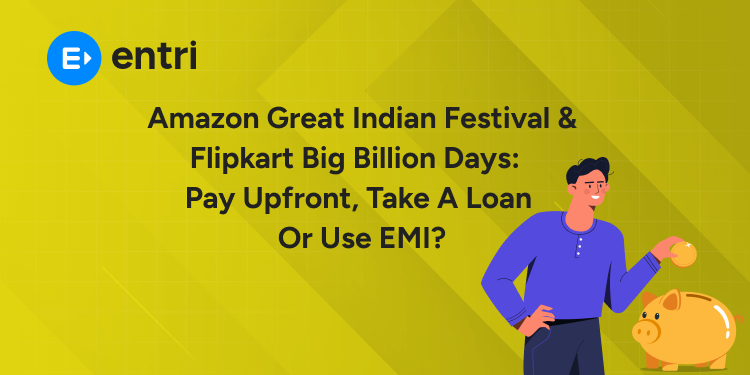
For most shoppers, paying upfront with an eligible bank card is the cheapest way to buy during the 2026 festive sales, as long as it does not eat into your emergency savings.
EMIs and loans do make big purchases easier to manage. But they add GST on interest, processing fees and often cost you card rewards.
On a ₹50,000 phone, the same device can cost about ₹45,000 upfront, roughly ₹47,600 on a credit card EMI and around ₹53,200 on a six-month personal loan.
Ace your personal finance journey with Entri’s Personal Finance Online Course. Join Now!
Key Takeaways
- Upfront wins on pure cost. Full payment avoids interest, fees and future liability.
- “No Cost EMI” is not free. 18% GST on interest and processing fees can still apply,
- EMI can quietly cost you rewards. Many cards exclude EMI from cashback and points.
- Personal loans are the costliest route – interest, processing fees and GST add up fast.
- Check your card’s cap before checkout. SBI Cashback’s 5% online cashback stops at ₹2,000 per cycle (₹40,000 spend).
- Protect your safety net. Keep a 3 to 6 month emergency fund and total EMIs within ~35% to 40% of take-home pay.
Amazon Great Indian Festival vs Flipkart Big Billion Days 2026: Dates and Offers
1: What is a stock?
Amazon’s Great Indian Festival begins on October 8, 2026, and Flipkart’s Big Billion Days opens to everyone on October 9.
Amazon’s Early Deals have been live since September 25, and Prime members are widely reported to get 24-hour early access from October 7. However, that detail is not part of Amazon’s official announcement.
Flipkart gives early access on October 8 to Plus, VIP and Black members and Flipkart credit card holders.
| Feature | Amazon Great Indian Festival | Flipkart Big Billion Days |
| Main sale date | October 8, 2026 | October 9, 2026 |
| Early access | Prime early access reported from Oct 7 | Oct 8 for Plus, VIP, Black and Flipkart credit card holders |
| Headline bank offer | 10% instant discount on SBI credit and debit cards, including credit card EMI | Up to 10% instant discount on select Axis Bank and ICICI Bank cards |
| Other payment perks | Amazon Pay ICICI card: 5% cashback for Prime members, 3% for others; Amazon Pay Later: pay in 3 interest-free EMIs on carts of ₹1,500 and above | Flipkart Pay Later: credit up to ₹1 lakh with No Cost EMI and flat ₹500 off |
One Amazon offer page has also listed a 10% instant discount on eligible HDFC Bank credit cards. So confirm your card on the product page.
Discount caps and minimum order values were not fully published at the time of writing. So read the offer terms before you add anything to the cart.
The Three Ways to Pay, Explained Simply
Upfront payment means paying the net price after the bank discount in one go: no debt, and the full instant discount.
Credit Card EMI (including No Cost EMI) splits the price into monthly installments, typically over 3 to 12 months. Standard card EMIs carry interest of roughly 13% to 18% a year.
A personal or consumer durable loan gives you a lump sum to spend anywhere. Banks currently quote rates from about 10.8% to 24% a year depending on your profile. There is an additional processing fee and GST on it.
Here is what the same phone costs under each payment mode. The figures are illustrative. So swap in your own price, card and tenure. Assumptions: Card EMI at 15% a year with a ₹199 + GST processing fee. No Cost EMI where the merchant discount equals the interest, with the instant bank discount not applied. It often cannot be combined. So check at checkout. Personal loan at 14% a year with a 2% processing fee plus GST. The ₹45,000 net price assumes the discount cap is not reached. Rewards you lose on EMI are extra. If you pay for the product with an eligible debit card using borrowed money, the instant discount can still apply. Also, the loan route drops to about ₹47,900. Even then, it stays costlier than paying upfront. No Cost EMI means the seller or bank absorbs the interest through an upfront discount. However, the bank still books that interest in the background. Because of that, 18% GST is charged on the interest portion. You will have to pay it out of your own pocket. Many banks also add a one-time processing fee. This is often a few hundred rupees plus GST. The result is a small but real cost. Roughly ₹400 to ₹650 on a ₹50,000 purchase over six months. The bigger leak is usually lost rewards. This is since many card issuers exclude EMI transactions from cashback and points. Your credit limit is also blocked for the whole tenure. This can push up your credit utilisation. Trusted, concepts to help you grow with confidence. Enroll now and learn to start investing the right way.
A card’s headline cashback rate matters less than its monthly cap. From April 1, 2026, the SBI Cashback Card replaced its old ₹5,000 combined cap with two limits: Both for a ₹4,000 maximum per statement cycle. In practice, 5% online cashback now stops at ₹40,000 of eligible online spend. For festive shoppers, three habits follow from this: Amazon advertises the Amazon Pay ICICI card’s 5% (Prime) or 3% (non-Prime) cashback as unlimited, a useful fallback when no bank instant discount applies. Ace your personal finance journey with Entri’s Personal Finance Online Course. Join Now! The smartest festive purchase is the one that keeps your total outflow lowest. That too without straining your monthly budget. If you can afford it comfortably, the obvious choice is paying upfront with the right bank card. Simply let the instant discount do the work. If you need some breathing room, then you should go for a short, genuinely low-cost EMI. This would be a fair compromise. A personal loan should be your last resort. Before the sales begin, shortlist your products. Pick your card and run the numbers once. A few minutes of calculations can save thousands of rupees. Trusted, concepts to help you grow with confidence. Enroll now and learn to start investing the right way.
Upfront payment is usually cheaper because it avoids interest, GST on interest and processing fees. EMI makes sense only when cash flow is tight and the total cost still fits your budget. Amazon says the 10% instant discount covers eligible credit card EMI transactions. Always confirm the terms and cap on the product page. The interest is offset by a discount, so the product price effectively stays the same. You can still pay 18% GST on the interest and a processing fee. Often not, because many issuers exclude EMI transactions from cashback and reward points. Check your card’s terms before choosing EMI. Only as a last resort, since interest, processing fees and GST make it the most expensive route. A loan can help if you must fund purchases across several sites. Major banks quote roughly 10.8% to 24% a year depending on your credit profile, plus a processing fee. Your final rate depends on income, credit score and employer category. Flipkart lists Pay Later credit up to ₹1 lakh with No Cost EMI and a flat ₹500 off during the sale. Check for charges after the interest-free period before you commit. Add up price minus discounts, then add interest, GST, processing fees and any lost cashback. The lowest total, not the lowest monthly instalment, is your best option.Total Cost Comparison: ₹50,000 Smartphone
Payment mode
Net price
Interest and fees (approx.)
Total outflow (approx.)
Upfront, 10% instant discount
₹45,000
₹0
₹45,000
Credit card EMI, 6 months, with 10% discount
₹45,000
₹1,990 interest + ₹358 GST + ₹235 fee
₹47,580
No Cost EMI, 6 months, no instant discount
₹50,000
₹398 GST on interest + ₹235 fee
₹50,630
Personal loan, 6 months
₹50,000
₹2,060 interest + ₹1,180 fee with GST
₹53,240
Personal loan, 12 months
₹50,000
₹3,870 interest + ₹1,180 fee with GST
₹55,050
What does “No Cost EMI” Really Cost You?
Stock Market Training Reviewed & Monitored by SEBI Registered Investment Advisor
Reward Caps in 2026: The Check Most Shoppers Skip
When Upfront Wins and When EMI Makes Sense
Pay upfront if:
Choose EMI or a loan if:
Step-by-Step: Pick Your Payment Mode in Five Minutes
Conclusion
Stock Market Training Reviewed & Monitored by SEBI Registered Investment Advisor
Frequently Asked Questions
Which is better during the festive sale: upfront payment or EMI?
Does the SBI 10% discount work on EMI?
Is No Cost EMI really interest-free?
Do I earn cashback on EMI purchases?
Should I take a personal loan for festive shopping?
How much does a personal loan cost in 2026?
Is Flipkart Pay Later worth using?
How do I compare the true cost of each payment mode?