
Table of Contents
Can Average Students Pass CMA US?
Yes, it can be passed by average students. Proper study and regular practice needed.
- Consistency: Study daily.
- Practice: Solve questionsregularly.
- Preparation: Give six to nine months.
Introduction
Many students worry about their academic performance. Average marks may create doubts. Accounting knowledge may also seem weak. The examination syllabus may appear difficult.
However, CMA US can be prepared systematically. Each subject can be studied step by step. Regular practice improves understanding and confidence.
In this blog, the exam difficulty is explained. Pass rates and preparation methods are also covered. A simple study plan is provided. Career opportunities and salary prospects are discussed too.
Key Takeaways
- Average students can pass CMA US.
- College marks do not decide exam results.
- Accounting basics are strengthened first.
- Regular MCQ practice is important.
- Case-based questions must be practised.
- Both exam parts can be attempted separately.
- Six to nine months can be planned.
- Mock tests should be included regularly.
Enroll in Entri’s USA CMA course now!

Start Your CMA Journey Today
Kickstart your CMA preparation with expert mentorship, structured learning, and a clear roadmap from basics to exam readiness.
Know MoreHow Difficult Is the US CMA Really?
The US CMA is a professional finance qualification. Two examination parts are included. Different financial topics are covered. Practical business knowledge is also tested.
Some topics may appear difficult initially. More preparation may be needed by beginners. Better understanding can be developed gradually.
Exam Structure and What Is Tested
The CMA examination consists of two parts. Both parts cover different subject areas.
Part 1: Financial Planning, Performance, and Analytics.
Financial planning and business performance covered.
- Financial Reporting.
- Financial statements.
- Accounting concepts.
- Reporting methods.
- Planning and Budgeting.
- Budget preparation.
- Financial forecasting.
- Planning methods.
- Performance Management.
- Performance measurement.
- Variance analysis.
- Business evaluation.
- Cost Management.
- Cost behaviour.
- Cost calculations.
- Cost control.
- Internal Controls.
- Risk management.
- Control systems.
- Technology and Analytics.
-
- Data analysis.
- Information systems.
Part 2: Strategic Financial Management.
This part focuses on financial decisions. Business strategy is also covered.
- Financial Statement Analysis.
-
-
- Ratio analysis.
- Financial interpretation.
-
- Corporate Finance.
-
-
- Investment decisions.
- Capital structure.
-
- Business Decision Analysis.
-
-
- Business decisions.
- Risk evaluation.
- Cost analysis.
-
- Enterprise Risk Management.
-
-
- Risk identification.
- Risk assessment.
-
- Capital Investment Decisions.
-
-
- Project evaluation.
- Investment returns.
-
- Professional Ethics.
-
- Ethical practices.
- Professional conduct.
Each part has 100 MCQs. Two case-based question sets are also included. The examination lasts four hours. Three hours are allocated to MCQs. One hour is allocated to case-based questions.
Candidates need 50% in MCQs first. This allows access to case-based questions. The final score combines both sections. A score of 360 is required. The total score ranges from 0–500.
Examination Format
Each part contains 100 multiple-choice questions. Case-based questions are also included. Four hours are provided for each examination.
From September/October 2026, case-based questions became standard. The earlier English examination format included essay questions.
The current format includes:
- Three hours for multiple-choice questions.
- One hour for case-based questions.
- Two case-based question sets.
- A minimum 50% MCQ score for access.
The final result is based on the combined score. Both parts must be passed separately.
Pass Rates and What They Mean
The CMA examination requires proper preparation. This is also shown through its pass rates.
According to IMA, average pass rates are around 50%. This applies to both examination parts.
What does this pass rate mean?
- Half of candidates pass.
- The remaining candidates need preparation.
- Concepts must be understood.
- Regular practice is important.
- Time management to be improved.
A 50% pass rate appear challenging. However, proper preparation can improve performance. Academic marks are not used to decide success.
CMA vs CPA vs CFA: Which Is More Difficult?
All three qualifications are professionally recognised. Different subjects are covered in each qualification. Preparation requirements also vary.
| Factor | CMA US | CPA | CFA |
| Main focus | Management accounting | Accounting and auditing | Investment and finance |
| Exam structure | Two parts | Multiple sections | Three levels |
| Main skills | Financial decisions | Accounting knowledge | Investment analysis |
| Study approach | Concepts and practice | Technical preparation | Extensive study |
| Career area | Corporate finance | Accounting and audit | Investment management |
The CPA has a wider accounting focus. The CFA covers three examination levels. The CMA has two focused examination parts.
The difficulty depends on individual strengths. Career goals should also be considered.
What Does “Average Student” Really Mean Here?
An average student may have ordinary academic marks. Accounting knowledge may also be limited. Some students may struggle with calculations.
These factors do not decide CMA results. Preparation habits play an important role. Basic concepts can also be improved.
Academic Marks vs Exam Readiness
Academic marks show previous examination performance. Exam readiness is developed by preparation.
The following skills are important:
- Understanding:
- Understand basics.
- Practice:
- Question solving.
- Accuracy:
- Calculate correctly.
- Speed:
- Completed on time.
- Revision:
- Revise important topics.
- Confidence:
- Manage exam pressure.
Average marks do not prevent CMA preparation. Required skills can be developed gradually.
For example, consider two students.
- Student A scores 85% in college.
- Student B scores 60% in college.
- Student A studies irregularly.
- Student B practises questions every day.
Student B may become better prepared. Daily practice can improve exam performance.
What Actually Decides Success?
Three important factors are needed. These should be maintained throughout preparation.
- Discipline
- Daily study must be maintained.
- Weekly targets completed.
- Missed topics covered.
- Revision time fixed.
- Practice
- MCQs must be solved daily.
- Difficult questions must be reviewed.
- Case questions must be practised.
- Mistakes must be corrected.
- Time Management
- Study hours must be planned.
- Difficult topics must receive more time.
- Weekly progress checked.
- Mock tests must be completed.
These habits can support better preparation. High academic marks are not compulsory.
Why Average Students Can Succeed in CMA US
CMA preparation can be divided into smaller sections. Each subject can be studied separately. Difficult topics can also be revised repeatedly.
Several features can support average students.
Application-Based, Not Memory-Heavy Exam
The CMA exam tests practical understanding. Questions often involve business situations. Candidates must analyse the given information.
Simple memorisation is not sufficient.
Application skills.
- Financial analysis.
- Budget calculations.
- Cost evaluation.
- Business decisions.
- Performance measurement.
How practice helps.
- Concepts become easier to understand.
- Similar questions become easier to recognise.
- Calculation methods become familiar.
- Decision-making skills improve.
- Exam confidence gradually increases.
For example, a budgeting problem may be presented. The correct calculation must be identified. The result must also be interpreted.
Two-Part Structure Allows Focused Attempts
The CMA examination is divided into two parts. Each part can be attempted separately. Either examination part can be taken first.
Benefits of separate attempts.
- One subject area can be prioritised.
- Preparation pressure can be divided.
- Difficult topics receive more attention.
- Progress can be tracked separately.
- Each examination gets focused preparation.
For example, Part 1 can be attempted first. Part 2 can follow after preparation. Both parts must be passed eventually.
The examination programme has a three-year completion period. This starts from programme entry.
Flexible Timelines and Exam Windows
Three examination windows are provided each year.
These are:
- January and February.
- May and June.
- September and October.
Preparation can be planned around these windows. Suitable examination dates can also be selected.
Both parts must be completed within three years. This period begins after entering the certification programme.
A realistic study schedule can reduce pressure.
Start Your CMA Journey Today
Kickstart your CMA preparation with expert mentorship, structured learning, and a clear roadmap from basics to exam readiness.
Know MoreChallenges Average Students Face
Some difficulties may be faced during preparation. These problems can be managed through practice.
- Weak Accounting Basics
- Confusion in debit and credit.
- Financial statements look difficult.
- Calculations may take time.
- Inconsistent Study
- Skipping daily sessions.
- Delaying revision.
- Unfinished topics.
- Case-Based Questions.
Business situations are understood correctly.
- Important details identified.
- Financial information understood.
- Calculations completed.
- Suitable answers selected.
- Time Management.
The examination has time limits.
- Long calculation questions.
- Difficult MCQs.
- Slow reading speed.
- Poor question selection.
- Limited Revision
- Earlier topics may be forgotten.
- Weak areas may remain unnoticed.
- Examination confidence may decrease.
These problems can be reduced through planning. Regular progress checks should also be included.
Step-by-Step Plan to Crack CMA US as an Average Student
A simple preparation plan can be followed. Each step should be completed carefully. Regular progress should also be checked.
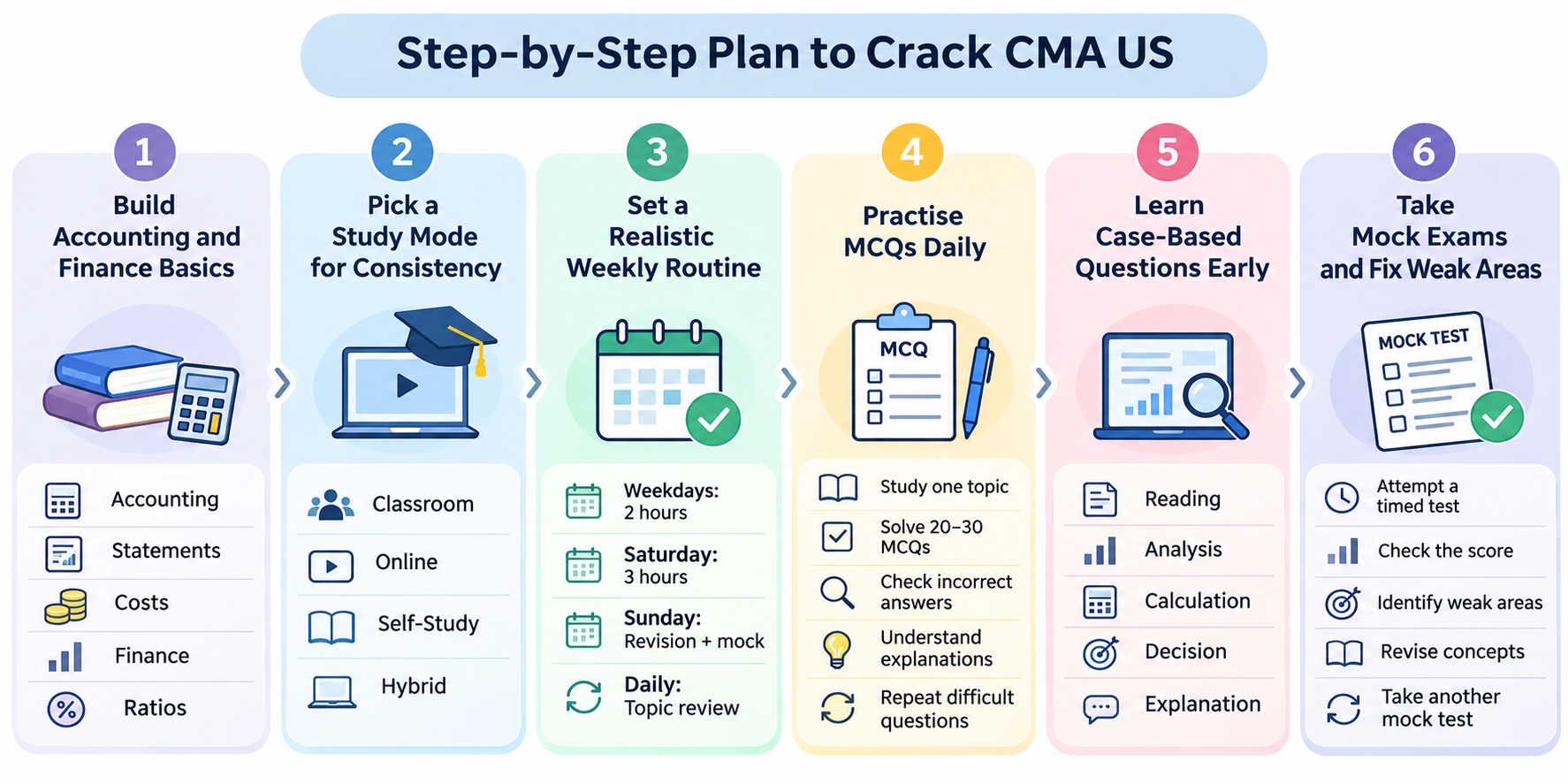
Step 1: Build Accounting and Finance Basics
Basic accounting knowledge is needed. Difficult concepts can then be understood more easily.
The following topics should be covered:
- Accounting:
- Debit entries
- Credit entries.
- Journal entries.
- Statements:
- Balance sheets.
- Income statements.
- Costs:
- Fixed.
- Variable.
- Finance:
- Interest
- Time value of money.
- Ratios:
- Basic calculations.
Extra time may be needed for these topics. Previous accounting concepts revised.
Step 2: Pick a Study Mode That Keeps You Consistent
Select a suitable learning method. Classes can also be combined with self-study.
Different study options are available.
Classroom Learning
- Topics are explained by teachers.
- Doubts can be discussed directly.
- Regular classes are provided.
Online Learning
- Recorded classes can be accessed.
- Live sessions may be attended.
- Study time can be adjusted.
Self-Study
- Learning materials are used independently.
- Study schedules are prepared personally.
- Practice questions are solved regularly.
Hybrid Learning
- Online and classroom sessions are combined.
- Recorded lessons revised.
- Teacher support provided.
One suitable method should be followed. Frequent changes affect preparation.
Step 3: Set a Realistic Weekly Routine
Daily study targets are kept manageable. Regular sessions improve learning.
A simple weekly routine is followed.
- Weekdays:
- Two hours of study.
- Saturday:
- Three hours of question practice.
- Sunday:
- Revision and mock tests.
- Daily:
- Reviews of previous topics.
Study hours are increased when needed. College and work schedules are considered.
Useful study habits.
- Keep a fixed study time.
- Set weekly learning targets.
- Maintain short revision notes.
- Completed topics should be tracked.
- Regular practice should be included.
- Long study breaks should be avoided.
Step 4: Practise MCQs Daily
MCQs form a major exam section. Regular practice is extremely important.
Students should solve questions every day.
The following routine can be followed:
- One topic should be studied carefully.
- 20–30 related MCQs should be solved.
- Incorrect answers should be checked.
- Correct explanations should be understood.
- Difficult questions should be repeated.
Accuracy improves through practice. Question-solving speed also increases.
Step 5: Learn Case-Based Questions Early
Case-based questions are included in the current format. Business situations are presented in these questions.
Earlier English examinations included essay questions. Older study materials contain essay practice.
Both formats require clear understanding. Important details must be identified correctly.
The following areas should be practised:
- Reading: Business situations must be understood.
- Analysis: Main financial problems must be identified.
- Calculation: Suitable formulas must be applied.
- Decision: Correct business solutions must be selected.
- Explanation: Answers must be supported with facts.
Practice method:
- Short business cases should be read.
- Main problems should be identified.
- Important details should be marked.
- Relevant concepts should be selected.
- Required calculations should be practised.
- Incorrect answers should be reviewed.
Case-based practice should begin early. Final-week preparation may create unnecessary pressure.
Step 6: Take Mock Exams and Fix Weak Areas
Mock examinations can be used to check preparation. Time management can also be improved.
A simple mock-test routine can be followed.
- One timed test should be completed.
- The final score should be checked.
- Weak subjects should be identified.
- Incorrect answers should be reviewed.
- Difficult concepts should be revised.
- Another mock test should be attempted.
Repeated mistakes must be corrected. More time should be given to weak areas.
Sample Study Timeline
A realistic timeline should be prepared before studying. Around six to nine months can be planned. More time may be needed by beginners.
| Phase | Duration | Focus |
| Basics | 3–4 weeks | Accounting and finance foundations |
| Part 1 | 8–10 weeks | Concepts, MCQs and case practice |
| Part 1 Revision | 2 weeks | Mock tests and weak topics |
| Part 2 | 8–10 weeks | Financial management concepts |
| Part 2 Revision | 2 weeks | Practice and final revision |
This timeline is a general study guide. Regular study hours must be maintained. Preparation time may vary between students.
Students with strong basics may progress faster. Beginners may require additional revision time.
Enroll in Entri’s USA CMA course now!
Mistakes That Make Average Students Fail
Some preparation mistakes can affect examination results. These habits should be avoided.
- Skipping Basics: Important concepts remain unclear.
- Irregular Study: Learning progress becomes slow.
- Only Memorising: Practical understanding remains limited.
- Avoiding MCQs: Question-solving speed remains low.
- Ignoring Case Practice: Business questions become difficult.
- Skipping Mock Tests: Time management remains untested.
- Poor Revision: Previously studied topics may be forgotten.
- Last-Minute Preparation: Important topics receive less attention.
- Ignoring Weak Areas: Repeated mistakes remain unresolved.
- Unrealistic Targets: Study routines become difficult to maintain.
A better preparation approach is needed. Regular revision can prevent many problems.
Do Marks or Background Matter?
Academic background can affect preparation time. However, CMA eligibility requirements must be fulfilled.
Students from different educational backgrounds can pursue CMA. Basic financial knowledge may need to be developed.
Commerce vs Non-Commerce Graduates
Commerce graduates may have some initial advantage. Accounting concepts may already be familiar.
Additional preparation may be needed by non-commerce graduates. Basic financial concepts should be studied first.
Commerce Graduates
- Accounting concepts may be familiar.
- Financial statements may be understood.
- Costing basics may already be known.
- Less time may be needed for basics.
Non-Commerce Graduates
- Accounting basics must be covered.
- Financial terms must be understood.
- Extra practice may be required.
- More revision time may be needed.
Both groups can prepare for CMA US. Learning speed may differ between students.
Experience and Age
Previous work experience can be useful. Business situations may become easier to understand.
However, work experience is not required before exams.
- Fresh graduates can begin CMA preparation.
- Working professionals can study alongside employment.
- Older candidates pursue certification.
- Practical knowledge support learning.
- Relevant work experience needed for certification.
IMA requires two years of experience. It must be in management accounting or financial management. It can be completed before or after exams. The requirement must be completed within seven years.
A recognised bachelor’s degree or eligible professional qualification is also required.
Is CMA US Worth It for Average Students?
CMA US can support corporate finance careers. Several opportunities are available after certification. Preparation and experience are also important.
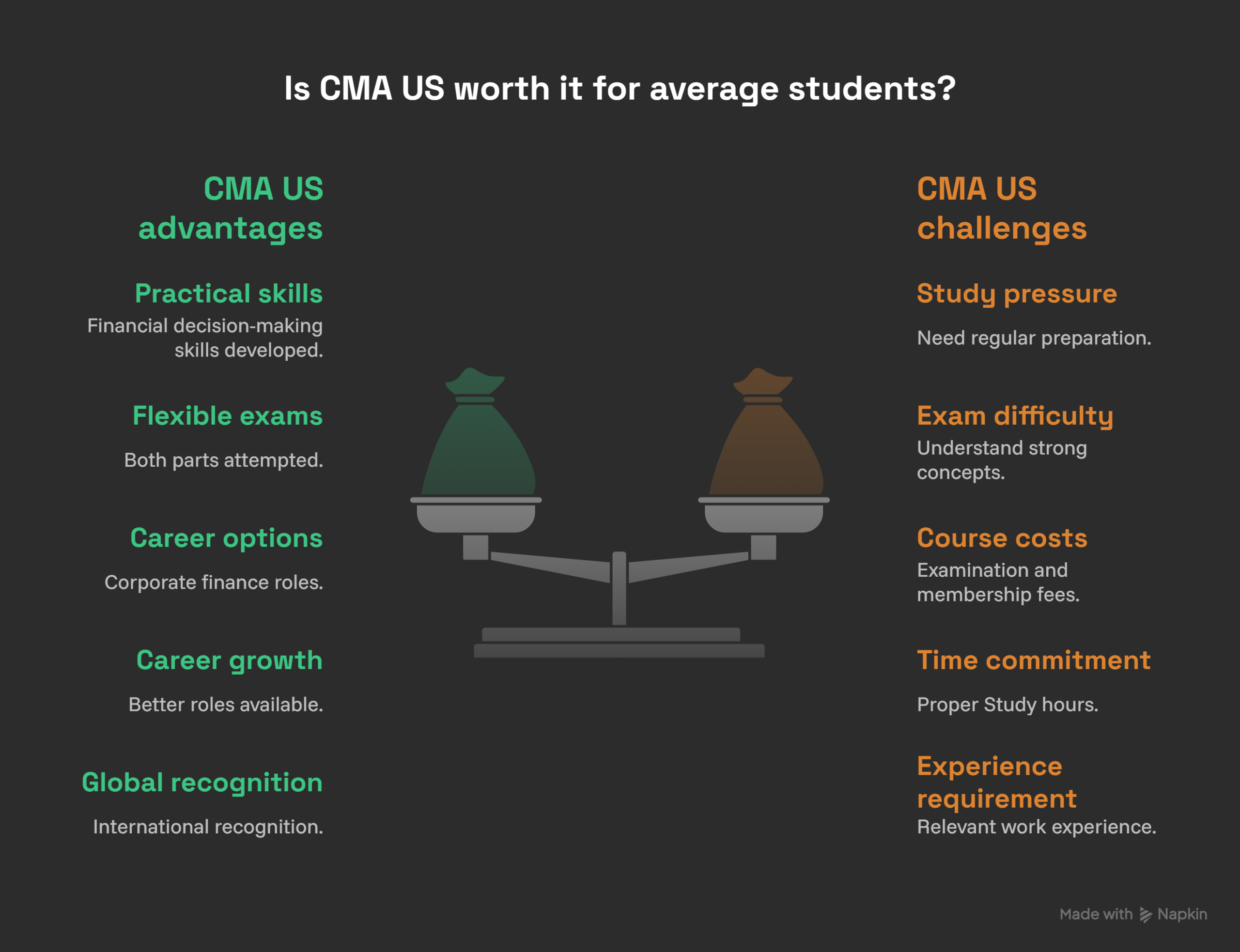
Advantages
- Global Recognition: International recognition.
- Career Options: Corporate finance roles.
- Practical Skills: Financial decision-making skills developed.
- Career Growth: Better roles available.
- Flexible Exams: Both parts attempted.
Challenges
- Study Pressure: Need regular preparation.
- Exam Difficulty: Understand strong concepts.
- Course Costs: Examination and membership fees.
- Time Commitment: Proper Study hours.
- Experience Requirement: Relevant work experience.
Career Scope and Salary Outlook
CMA holders work in four things. FP&A, budgeting, cost management, & financial analysis. IMA’s 2023 salary survey reported 21% higher median compensation for CMAs.
Actual salaries can vary by country. Experience and employer also affect earnings.
Conclusion
CMA US can be cleared by average students. Academic marks do not decide examination success. Basic concepts can be developed through study. Regular practice improves understanding. Mock tests identify weak areas.
A suitable study routine is followed. Difficult topics receive extra attention. With proper preparation, both parts get cleared. A professional finance career is pursued finally.
Start Your CMA Journey Today
Kickstart your CMA preparation with expert mentorship, structured learning, and a clear roadmap from basics to exam readiness.
Know MoreFrequently Asked Questions
Can an average student pass CMA US?
Yes, CMA US can be cleared by average students. Academic marks do not decide examination results. Regular study and practice are required. Accounting basics should be strengthened first. Mock tests can also improve confidence. A realistic preparation schedule should be followed.
Is CMA US very hard?
CMA US requires proper preparation. Financial calculations and business concepts are tested. Some topics may appear difficult initially. Regular practice can improve understanding. The two-part structure also supports focused learning. The difficulty can vary between students.
What is the pass rate of CMA US?
According to IMA, average pass rates are around 50%. This applies to both examination parts. Actual pass rates may vary. The figure shows the examination’s difficulty. Proper preparation and regular practice are important.
How many attempts do people usually need?
There is no fixed number of attempts. Some candidates pass both parts initially. Others may require additional attempts. Preparation quality can affect results. Weak topics should be revised after every attempt. A better study plan can then be followed.
Can I pass CMA US with six months of preparation?
Six months may be sufficient for some students. Strong accounting basics can reduce preparation time. Regular study hours must also be maintained. Beginners may require more time. Both parts must receive proper attention. Mock tests should be completed before examinations.
Is CMA US easier than CPA or CFA?
The difficulty depends on individual strengths. CMA US has two examination parts. CPA covers accounting and auditing subjects. CFA includes three examination levels. All three require proper preparation. Career goals should guide the choice.