

Table of Contents
A CMA US by itself will not get you a front office investment banking job. It offers a good base in accounting and financial analysis but more skills and experience is necessary. CMA holders can seek opportunities in financial analysis, credit, risk, FP&A and corporate finance. To break into investment banking you can look at doing courses in financial modeling, valuation training, CFA, an MBA and appropriate internships.
Key Takeaways
- To be a front-office investment banker you need more than just CMA US.
- Strong financial modeling and valuation skills are important.
- CMA holders can consider employment in finance, risk and FP&A.
- An MBA or CFA can help you in your IB career.
- CMA US is more suitable for corporate finance and financial management.
Enroll in Entri’s USA CMA course now!
Introduction
Many students of accounting and commerce think of CMA US as the gold standard for a future in finance. One common issue that occurs before the selection of the certification is: Is it true that CMA US can open doors to investment banking? That depends on the type of job you are looking for and the skills you develop along with the degree. The Certified Management Accountant (CMA) US designation is not usually linked to investment banking, but it can nevertheless offer a solid financial foundation and may open doors to jobs in the industry. Let’s see what its usefulness, limitations, possible earnings and the qualifications to enter the investment banking field are.
What Is the CMA US, and What Does It Cover?
The Certified Management Accountant (CMA US) is a professional certification offered by the Institute of Management Accountants (IMA), a US professional association. It includes managerial accounting, financial planning, corporate performance and strategic financial management.
CMA US does not train people to get certificates regarding auditing or taxation, but rather to evaluate financial information and help in making key company decisions.
Certifying body and exam structure (two parts)
The CMA US certification involves 2 phases of examination:
- Part 1 – Financial Planning, Performance and Analytics: Deals with external financial reporting, planning, forecasting, performance management, cost management, internal controls, technology and analytics.
- Part 2 – Strategic Financial Management: Encompasses financial statement analysis, corporate finance, business decision analysis, risk management, investment decisions and professional ethics.
Candidates may take the two portions in either sequence. Passing both exams is not the only criteria for certification. You also must meet IMA’s education, experience and membership standards.
Core focus: Management accounting and financial decision-making
CMA US focuses on helping businesses understand their financial performance and make better decisions. Students learn how to manage costs, prepare budgets, evaluate investments, analyse financial statements and assess business risks.
This knowledge is valuable in corporate finance and financial management. However, investment banking requires additional expertise in company valuation, capital markets, mergers and acquisitions (M&A) and transaction execution.
Start Your CMA Journey Today
Kickstart your CMA preparation with expert mentorship, structured learning, and a clear roadmap from basics to exam readiness.
Know MoreWhat Do Investment Banks Actually Look For?
Investment banks assist corporations raise money, buy other companies, sell assets and execute financial transactions. They expect their staff to be strong analysts with a good awareness of the practicalities of financial markets.
A professional certification adds weight to a candidate’s profile, but employers also look at academic qualifications, internships, technical skills and past work experience.
Typical hiring profile for analyst and associate roles
Investment banks commonly hire for the following entry-level roles:
- Investment Banking Analyst : Usually a degree in finance, accounting, economics or comparable. Analysts construct financial models, conduct corporate research and appraisal and provide presentation materials.
- Investment Banking Associate: Investment Banking Usually an MBA graduate or with the right investment banking or M&A experience. Associates manage analysts, examine financial models, and assist with client transactions.
Investment banks sometimes hire from engineering, math and other quantitative disciplines. So a finance degree is useful but practical skills and recruitment possibilities are just as important.
Skills that matter in investment banking
Investor banking is an area that deals with technology. The ideal candidate would be well-versed in financial transactions and corporate value.
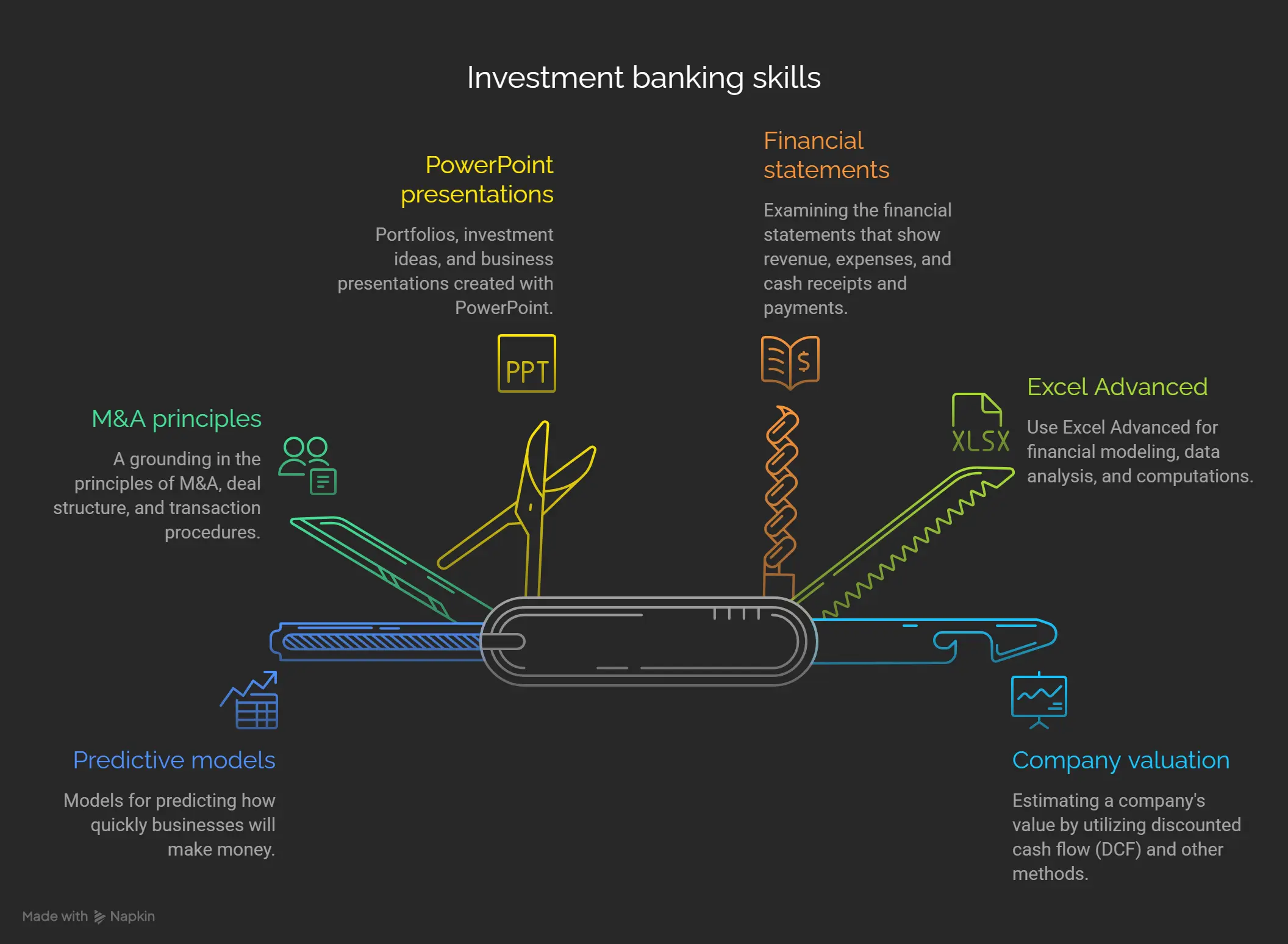
Important skills include:
- Models for predicting how quickly businesses will make money.
- The process of estimating a company’s value by utilizing discounted cash flow (DCF) and other methods.
- A grounding in the principles of M&A, deal structure, and transaction procedures.
- Use Excel Advanced for financial modeling, data analysis, and computations.
- Portfolios, investment ideas, and business presentations created with PowerPoint
- Examining the financial statements that show revenue, expenses, and cash receipts and payments.
Front office vs middle office vs back office
Investment banks have different departments, and not every position involves directly working on deals. Understanding these differences helps CMA candidates identify suitable opportunities.
| Area | Role examples | Typical background |
|---|---|---|
| Front office | M&A analyst, investment banking analyst, equity capital markets analyst, debt capital markets analyst | Finance, accounting, economics, MBA, CFA and strong modelling skills |
| Middle office | Risk analyst, compliance analyst, financial control, treasury risk | Accounting, CMA, finance, risk management |
| Back office | Finance operations, settlements, reporting, reconciliation and transaction support | Accounting, CMA, finance and operations |
Where CMA US Helps (and Where It Falls Short)
Investment banks are comprised of a variety of departments, and not every position involves working directly on commercial transactions. CMA candidates can more easily identify opportunities that are suitable for them if they understand these differences.
Strengths of CMA US
The qualification includes a lot of skills that investment banks and other financial firms want.” These are:
- Cost management: Teaching professionals how much a business costs and how efficient its finances are.
- Budgeting and forecasting: Teaching professionals how to guess how well its finances will do in the future.
- Financial planning: Teaching professionals how to allocate their money and plan their operations.
- Performance analysis: Teaching professionals how to spot financial trends and judge business results.
- Financial statement analysis: Teaching professionals how to understand how healthy a company’s finances are.
Where CMA US falls short
CMA US is about corporate finance and investment decision making, but not specialist transaction training typical of investment banking.
Some of the prominent gaps are:
- Company Valuation: CMA does not offer practical training on company valuation which is essential in investment banking.
- Capital Markets: candidates should have a better understanding of equity, debt and securities markets.
- Deal structure: M&A transactions require a certain skill set in terms of deal structure and financing solutions.
- Financial Modeling: Investment banking demands strong practical modeling skills (e.g. DCF and related corporate research).
- Execution of Transaction: Candidates should be experienced with due diligence, transaction document drafting and the M&A process in general.
Investment Banking Roles a CMA Can Realistically Target
CMA US qualified applicants can apply for several finance-related roles. But eligibility for a job relies on the employer, academic background, work experience and technical skills.
Middle and back-office, finance and operations roles
They tend to be more closely related to the CMA syllabus.
- Financial Controller: Responsible for financial reporting, accounting processes and internal controls.
- Financial reporting analyst: Prepares financial reports and analyzes the operation of the corporation.
- Finance Operations Analyst: Assists with financial transactions, reporting and reconciliation.
- Management Accountant: Analyze budgets, spending and financial performance.
- Treasury Analyst: Supports cash flow, liquidity and financial risk management activities.
You get experience working at financial institutions like investment banks, but you don’t often close M&A deals in these jobs.
Credit, risk and financial analysis roles
Jobs involving the analysis of financial data and the assessment of business risks may potentially be of interest to CMA applicants.
- Credit Analyst: A credit analyst determines whether a business is financially stable enough to repay its loans.
- Risk Analyst: Perform risk assessments and analyzes in the areas of finance and operations.
- Financial Analyst: The role of the financial analyst is to help in decision-making by reviewing financial statements, making estimates, and analyzing trends.
- Portfolio Operations Analyst: Assist in investing and reporting on the portfolio as an analyst.
- Financial Planning Analyst: Assist in the preparation of financial performance reports, budgets, and projections as a financial planning analyst.
You can improve your odds in the financial markets, with an understanding of credit analysis, and with an understanding of investment goods.
Corporate finance, FP&A and corporate development roles
Here are some of the most important employment opportunities for CMA professionals who want to approach strategic finance.
- FP&A Analyst: Prepares budgets, projections and performance reports.
- Corporate Finance Analyst: Assists in funding, financial planning and company investment decisions.
- Corporate Development Analyst: Supports business acquisitions, strategic investments and growth prospects.
- Business Finance Analyst: Analyzes financial performance and aids management with decision making.
- Investment Analysis Support: Provides investment teams with financial research, reporting and analysis.
Corporate development is great for individuals interested in M&A, since they are exposed to acquisitions and business valuation. But the particular duties differ from firm to company.
Unlock your USA CMA career now with Entri’s comprehensive course!
Start Your CMA Journey Today
Kickstart your CMA preparation with expert mentorship, structured learning, and a clear roadmap from basics to exam readiness.
Know MoreCMA US vs CFA vs MBA for Investment Banking
There is a distinction between the CMA US, CFA, and MBA qualifications. Your career objectives and the kind of investment banking position you are looking for will determine which option is the best one for you to proceed with.
| Option | Main focus | Duration | Cost | Investment banking relevance |
|---|---|---|---|---|
| CMA US | Management accounting, budgeting and corporate finance | Often completed in 6–12 months of exam preparation | Exam, membership and entrance fees; preparation costs extra | Moderate for related finance roles; limited as a direct IB credential |
| CFA | Investment analysis, valuation, portfolio management and financial markets | Around 3–4 years for all three levels | Approximately $3,520–$4,570 in 2026 exam fees | Stronger relevance for investment research, valuation and certain IB opportunities |
| MBA in Finance | Corporate finance, strategy, management and business leadership | Usually 1–2 years, depending on the programme | Varies considerably by institution and country | Strong, especially from a reputable business school with IB recruitment |
Is there a better qualification?
- If you wish to pursue a career in management accounting, financial planning and analysis, corporate finance or financial control, go for CMA US.
- If you are interested in investment analysis, equities research, valuation and financial markets, consider becoming a Certified Financial Analyst (CFA).
- However, if you want to get into associate level positions in investment banking via a business school that has good investment banking recruitment, then you might consider doing a Master of Business Administration in Finance.
Having a Certified Financial Analyst (CFA) qualification does not assure a place in investment banking. Also, passing all three levels does not automatically make you a charterholder. This is something vital to keep in mind. Other membership qualifications apply, such as job-related experience.
How to Move from CMA into Investment Banking (Step by Step)
If you have completed the Certified Management Accountant (CMA) program in the United States and are interested in entering the investment banking industry, you will need to develop abilities that go beyond management accounting. The steps that are listed below can assist you in developing a more powerful profile.
1. Build financial modelling and valuation skills
There are a lot of technical capabilities that investment banking analysts need and financial modeling is right up there at the top.
This is how it works:
- Enhance your accountancy knowledge and understand how the 3 financial statements (income, balance sheet and cash flow) are linked.
- Learn how to utilize the new versions of Excel and test your skills in financial analysis, forecasting, data analysis and spreadsheet operations.
- Learn financial modeling and how to build 3 statement financial models.
- Learn to value a company: Understanding of DCF analysis, comparable company analysis, and precedent transaction analysis.
- Spot mergers and acquisitions: Consider the process of acquiring firms and the criteria used to evaluate such acquisitions.
- Generate training task Develop example financial models and value evaluations based on publicly available company information.
Build a portfolio of work from genuine assignments to show your talents to future employers.
2. Add CFA, an MBA or a specialised investment banking course
Depending on their career goals, candidates for the CMA US exam may want to consider additional qualifications.
- Certified Financial Analyst: This credential expands your understanding of the stock market, investment analysis, portfolio management, and financial markets. In the case of research and investment-related jobs in particular, it can bolster your financial reputation.
- Gaining admission to investment banks, internship opportunities, and professional networks are all benefits of earning a Master of Business Administration (MBA) degree in finance from a reputable school. Candidates aiming for associate posts will find it very pertinent.
- Earning a credential in investment banking is a great way to hone your skills in valuation, financial modeling, mergers and acquisitions, and transaction analysis.
- Certification in Financial Modeling: If you want to learn Excel and valuation on the job but don’t want to commit to a long-term program, consider taking a short course.
It is not required that you fulfilll all of these requirements. Pick the one that fills in the most blanks in your current profile.
3. Gain internships, networking experience and industry exposure
Previous experience in investment banking is necessary.
See these methods:
- Intern in an area that interests you. Stocks, financial analysis, corporate finance, and investments are vital.
If it doesn’t work out, you can look at becoming a corporate financier, credit analyst or financial analyst. - Look for good employment and apply for them.
- Investment banking is full of analysts, coworkers and financiers. You can find them on LinkedIn and at conventions. Networking events are another fantastic place to meet them too.
- Do Your Homework on the Employer: See how banks, other financial institutions and boutique investment businesses hire new people.
- Possible topics include accounting, financial modeling, mergers and acquisitions, and valuation. Test your knowledge of coding interview topics
Investment bankers may have to sharpen their skills in the areas of talking to clients and negotiating.
Work in the financial industry before applying for opportunities at investment banks.
Career Paths Where CMA US Shines
Successful work in the U.S. as a certified public accountant has less to look forward to than investment banking. It can be quite useful too in careers where the decision making is strategic, the business performance and the financial planning.
Just a few of the many amazing career possibilities available:
- Corporate Finance: helps companies to raise funds, plan finances and take investment decisions.
- Financial Planning and Analysis (FP&A): Financial planning and analysis (FP&A) is the planning, forecasting and analysis of financial performance.
- Financial Controllership: Financial controllership includes all facets of accounting, reporting and internal controls.
- Cost Management: Helps firms in controlling expenditures which in turn increases productivity and earnings.
- Finance Management: Financial management helps in firm strategy, financial planning, and resource allocation.
- Finance Leadership: Offers a strong basis for progression to higher level finance roles, such as financial controller, chief financial officer or finance manager.
If you want to get ahead in the corporate finance world and be in command of your own finance department, then CMA US is the best choice for you.
Salary and Growth Outlook
Income after CMA US depends on numerous aspects such experience, locality, employer, academic qualifications and technical skills. The certification is not a guaranty of a set remuneration. The approximate range of annual salary for finance roles in India is given below. These are estimates of the broad market, not guaranteed earnings for CMA holders.
| Role | Indicative entry-level annual salary | Possible growth path |
|---|---|---|
| Financial Analyst | ₹4–7 lakh | Senior Financial Analyst → Finance Manager |
| FP&A Analyst | ₹4–8 lakh | FP&A Manager → Head of FP&A |
| Credit Analyst | ₹4–8 lakh | Senior Credit Analyst → Credit Manager |
| Risk Analyst | ₹4–7 lakh | Risk Manager → Head of Risk |
| Finance Operations Analyst | ₹3–6 lakh | Operations Manager → Finance Operations Head |
| Investment Banking Analyst | ₹8–20 lakh | Associate → Vice President → Director
|
Salary estimates for 2026 in India vary depending on the employer, the city, the experience and the incentive system. These values are not CMA specific and are not a warranty of beginning pay. Investment banking is a very specialized and competitive field. International banks and old money firms can be attractive for investment banking. CMAs can work in corporate finance, financial planning and analysis, and management. Certification does not always guaranty income. For example: experience, performance and length of service.
Who Should Choose CMA US, and Who Shouldn’t?
The CMA (US) is a good credential but needs to be selected for the proper cause.
CMA US may be a good choice if you:
- Interested in a career in management accounting, or corporate finance.
- You love budgeting, forecasting and financial analysis.
- Interested in working in FP&A, financial control or cost management.
- An interest in corporate strategy and financial decision making.
- Looking to transition into financial management and leadership roles.
CMA US may not be the best choice if you:
- Desire to immediately enter the field of front office investment banking.
- Pay close attention to the closing of investment and merger deals.
- Seeking educational opportunities to hone my skills in financial analysis and equity research.
- I would prefer a certification that focuses on investment analysis and the capital markets.
If you are interested in entering into investment banking you should look at the CFA and MBA courses and particular training in financial modeling before deciding to pursue a certificate.
Conclusion
CMA US will provide you a good foundation in accounting, corporate finance and financial analysis but it is not a direct route into investment banking. It is more FP&A, financial management, controllership, corporate finance type of responsibilities. If you want to get into investment banking front office roles, emphasis on financial modeling, valuation of companies, M&A knowledge and expertise. Having the CMA US will give you more employment chances in the financial services business, if you have the relevant extra skills and certifications.
| Related Articles | ||
| CMA Course Details | How to Prepare for the CMA Exam? | Career Opportunities After CMA |
| CMA USA vs CMA India | Top Indian Companies Hiring CMA USA | Top Reasons to be a CMA USA |
Start Your CMA Journey Today
Kickstart your CMA preparation with expert mentorship, structured learning, and a clear roadmap from basics to exam readiness.
Know MoreFrequently Asked Questions
Can a CMA US get a job in investment banking?
Yes, a CMA US-qualified professional can apply for investment banking-related positions. However, the qualification alone may not be sufficient for front-office analyst roles. Candidates generally need additional knowledge of financial modelling, company valuation, capital markets and M&A. Relevant internships and previous finance experience can also improve their chances.
Is CMA US better than CFA for investment banking?
CFA is generally more directly relevant to investment analysis, valuation and financial markets, while CMA US focuses on management accounting and corporate finance. If your primary goal is investment banking, CFA may provide more relevant subject knowledge. However, neither qualification guarantees an investment banking position.
Which investment banking roles can a CMA do?
A CMA-qualified professional can explore financial control, finance operations, credit analysis, risk analysis, financial reporting and corporate finance positions. With additional financial modelling and valuation skills, they can also apply for relevant analyst opportunities. The exact eligibility depends on the employer’s educational and experience requirements.
Do I need an MBA after CMA US for investment banking?
An MBA is not compulsory for every investment banking position. However, an MBA from a reputed business school can provide access to recruitment opportunities, internships and industry connections. If you already have relevant experience and strong technical skills, you may be able to pursue certain opportunities without an MBA.
What is the salary after CMA US in India?
There is no fixed salary for CMA US professionals in India. Entry-level finance and accounting positions may offer approximately ₹3–8 LPA, depending on the role and employer. Professionals with relevant experience, technical expertise and additional qualifications may earn considerably more. Salary also depends on location and industry.
What is the best course for investment banking?
There is no single best course for everyone. A bachelor’s degree in finance, accounting or economics provides a useful foundation. CFA can strengthen investment analysis knowledge, while an MBA from a reputed business school can offer valuable recruitment opportunities. Financial modelling and valuation training are also important for developing practical investment banking skills.