Table of Contents
Introduction
1: Which of the following data structures allows elements to be added and removed in a Last-In, First-Out (LIFO) order?
Imagine finishing a data analytics course. Now, imagine searching for jobs in Chennai. Many companies need skilled data analysts. Chennai has become a major analytics hub. IT services, SaaS companies, healthcare firms, banks, manufacturers, automotive companies, and fintech businesses hire analysts regularly. Salaries differ across companies and industries. Skills also influence earnings. This guide explains data analyst salaries in Chennai, salary growth, industries, company types, and skills that increase earning potential.
Eager to master Python? Enroll in our free demo now!
Average Salary Overview
Data analyst salaries in Chennai vary. Experience affects salary growth. Company type influences pay. Technical skills increase earnings. Industry also matters. Salary estimates differ across platforms. Different sources report different figures.
| Salary Detail | Typical Range |
|---|---|
| Average Annual Salary | ₹4.5–8 LPA |
| Average Monthly Salary | ₹37,000–₹67,000 |
| Freshers | ₹3–5 LPA |
| Experienced Professionals | ₹8–15+ LPA |
Why Salary Estimates Differ
Different websites report different salaries. Every platform uses different information.
Salary estimates vary because of:
- Employee-reported salaries.
- Recruiter data.
- Company disclosures.
- Location differences.
- Recent hiring trends.
Some companies also include bonuses. Others only report base salaries. Therefore, salary figures should always be treated as estimates.
Learn Prompt Engineering for Free
Get better results from ChatGPT and Gemini with free, beginner-friendly prompt engineering guides. Learn how to write prompts that save time and improve your code, content, and work.
Start Learning Free
Salary by Experience
Experience remains one of the biggest salary factors. Every career stage builds new responsibilities.
Salary in Chennai:
| Experience -Level | Experience | Salary (Annual) | Salary (Monthly) |
|---|---|---|---|
| Fresher | 0–1 Years | ₹3–5 LPA |
|
| Early Career | 1–3 Years | ₹5–7 LPA |
|
| Mid-Level | 3–5 Years | ₹7–10 LPA |
|
| Senior | 5–8 Years | ₹10–15 LPA |
|
| Lead / Manager | 8+ Years | ₹15–25+ LPA |
|
Fresher (0–1 Years)
Freshers begin with entry-level positions. Many companies provide training. Daily work focus on learning business.
Typical Responsibilities
- Collect business data.
- Prepare reports.
- Clean datasets.
- Update dashboards.
- Support senior analysts.
Skills Employers Expect
Employers usually expect:
- Basic SQL knowledge.
- Excel proficiency.
- Simple data visualization.
- Basic statistics.
- Good communication.
Promotion Opportunities
Good performers become junior analysts in 1-2 years.. Learning new tools also improves promotion chances.
Early Career (1–3 Years)
Analysts become more independent during this stage. Companies assign larger datasets and business problems.
Typical Responsibilities
- Analyze customer trends.
- Build dashboards.
- Write SQL queries.
- Present business insights.
- Improve reporting processes.
Skills Employers Expect
Recruiters often look for:
- Advanced Excel.
- SQL optimization.
- Power BI.
- Tableau.
- Basic Python.
Promotion Opportunities
Analysts may progress into specialist roles. Many also begin mentoring fresh graduates.
Mid-Level (3–5 Years)
Mid-level professionals solve complex business challenges. They also work closely with business teams.
Typical Responsibilities
- Build analytical models.
- Improve business performance.
- Manage reporting projects.
- Support decision-making.
- Present executive reports.
Skills Employers Expect
Companies value:
- Strong Python skills.
- Data visualization.
- Statistics.
- Business analysis.
- Problem-solving.
Promotion Opportunities
Professionals become senior analysts/analytics specialists. Leadership responsibilities also increase gradually.
Senior (5–8 Years)
Senior analysts lead important projects. They also guide junior team members.
Typical Responsibilities
- Manage analytics projects.
- Review business reports.
- Improve data quality.
- Coordinate with stakeholders.
- Recommend business strategies.
Skills Employers Expect
Organizations prefer:
- Advanced analytics.
- Leadership skills.
- Project management.
- Cloud knowledge.
- Strong communication.
Promotion Opportunities
Many professionals move into consulting/team leadership roles in this stage.
Lead / Manager (8+ Years)
Leadership becomes the primary responsibility. Technical expertise remains important. Business strategy also becomes essential.
Typical Responsibilities
- Lead analytics teams.
- Plan business strategies.
- Manage client relationships.
- Review organizational performance.
- Guide company decisions.
Skills Employers Expect
Senior leaders require:
- Strategic thinking.
- Leadership abilities.
- Business communication.
- Advanced analytics.
- Stakeholder management.
Promotion Opportunities
Experienced managers become analytics director, business intelligence heads/data science leaders.
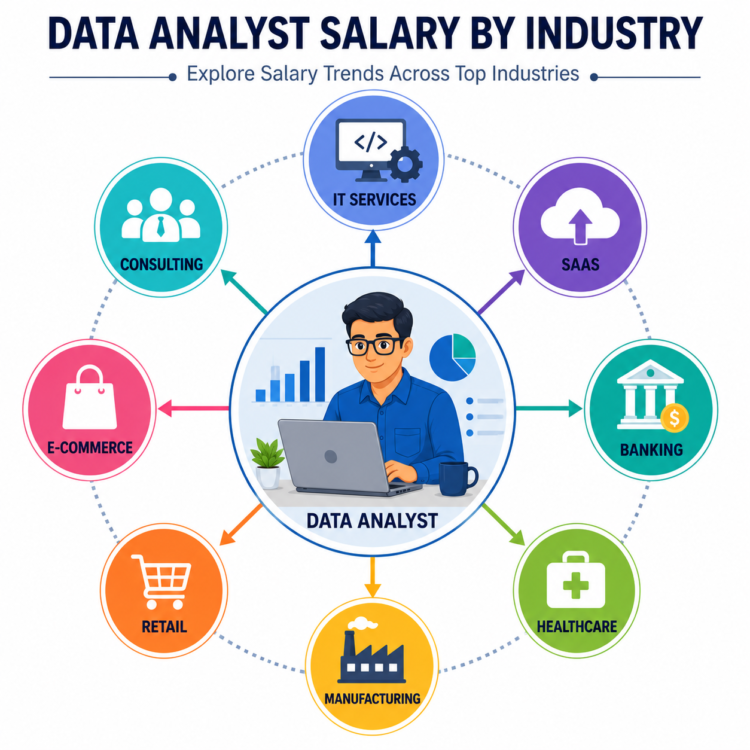
Salary by Industry
Industry significantly affects salary levels. Some sectors depend heavily on analytics. Others mainly use analytics for operational improvements.
| Industry | Salary (Approx.) |
|---|---|
| IT Services | ₹4–8 LPA |
| SaaS Companies | ₹6–14 LPA |
| Banking | ₹5–10 LPA |
| Healthcare | ₹4–8 LPA |
| Manufacturing | ₹4–8 LPA |
| Retail | ₹4–7 LPA |
| E-commerce | ₹5–12 LPA |
| Consulting | ₹6–12 LPA |
IT Services
IT companies hire large numbers of analysts. Projects often serve global clients.
Higher salaries come from:
- International projects.
- Large datasets.
- Technical expertise.
- Long-term client work.
Learning opportunities remain excellent.
SaaS Companies
SaaS businesses rely on customer data daily. Analytics supports product improvements.
Higher salaries result from:
- Product-focused analytics.
- Subscription analysis.
- Customer behavior studies.
- Business intelligence.
Many SaaS firms reward strong performance.
Banking
Banks depend on accurate data. Analysts improve financial decision-making.
Common responsibilities include:
- Risk analysis.
- Customer insights.
- Fraud detection.
- Financial reporting.
Strong analytical skills increase earning potential.
Healthcare
Healthcare generates massive amounts of information. Analysts improve patient services and operational efficiency.
Analytics supports:
- Hospital performance.
- Patient trends.
- Medical reporting.
- Resource planning.
Healthcare continues growing steadily.
Manufacturing
Manufacturers use them to improve production. Better decisions reduce costs.
Analysts work on:
- Inventory management.
- Supply chain reporting.
- Production efficiency.
- Quality control.
Industrial growth increases demand.
Retail
Retail businesses study customer buying habits. Data helps marketing. It also helps in inventory planning.
Common projects include:
- Sales reporting.
- Customer segmentation.
- Product demand.
- Seasonal forecasting.
Retail analytics supports business growth.
E-commerce
Online shopping creates valuable business data. Companies analyze customer journeys constantly.
Analysts improve:
- Product recommendations.
- Customer retention.
- Marketing performance.
- Website conversions.
Fast-growing businesses often pay competitive salaries.
Consulting
Consulting firms solve problems across industries. Projects change frequently.
Consultants work on:
- Business strategy.
- Process improvement.
- Financial analysis.
- Customer insights.
Varied experience accelerates career development.
Learn Prompt Engineering for Free
Get better results from ChatGPT and Gemini with free, beginner-friendly prompt engineering guides. Learn how to write prompts that save time and improve your code, content, and work.
Start Learning FreeSalary by Company Type
Company type influences more than salary. Learning opportunities, work culture, bonuses, and career progression also differ.
| Company Type | Salary (Approx.) |
|---|---|
| Startups | ₹3.5–8 LPA |
| Product Companies | ₹7–18 LPA |
| MNCs | ₹5–12 LPA |
| Service-Based Companies | ₹4–8 LPA |
| Global Capability Centers (GCCs) | ₹8–18 LPA |
Startups
Startups offer practical learning. Employees often handle multiple responsibilities.
Advantages include:
- Faster learning.
- Broader experience.
- Flexible work.
- Greater responsibility.
However, salaries may vary depending on funding.
Product Companies
Product companies usually offer attractive salary packages. Analysts work closely with business products.
Benefits include:
- Better compensation.
- Modern technologies.
- Product ownership.
- Performance bonuses.
Career growth remains strong.
MNCs
Multinational companies provide structured career paths. Training programs are often comprehensive.
Employees benefit from:
- Stable salaries.
- Global projects.
- Employee benefits.
- International exposure.
Promotion cycles may be slower.
Service-Based Companies
Service firms handle multiple client projects. Analysts gain broad industry exposure.
Advantages include:
- Good salary.
- Diverse experience.
- Technical growth.
- Client interaction.
- Project variety.
Learning opportunities remain valuable.
Global Capability Centers (GCCs)
Many global companies operate GCCs in Chennai. These centers support international business operations.
Benefits often include:
- Competitive salaries.
- Advanced technologies.
- Long-term stability.
- Global collaboration.
Many professionals prefer GCC careers.
Skills That Increase Salary
Skills influence salaries more than experience alone. Employers reward professionals who solve business problems effectively.
🗃️ SQL
SQL remains essential for analysts. Almost every company expects SQL knowledge.
SQL helps professionals:
- Retrieve business data.
- Analyze large datasets.
- Create reports.
- Solve business problems.
Strong SQL skills improve interview performance.
Excel
Excel remains widely used across industries. Advanced Excel improves workplace productivity.
Useful Excel skills include:
- Pivot tables.
- Lookup functions.
- Charts.
- Data cleaning.
Many companies still depend on Excel daily.
Python
Python automates repetitive tasks. It also supports deeper analysis.
Python helps analysts:
- Process data faster.
- Build automation.
- Create visualizations.
- Analyze complex datasets.
Python often strengthens salary negotiations.
Power BI
Power BI transforms raw data into dashboards. Managers use dashboards for decision-making.
Learning Power BI helps professionals:
- Present business insights.
- Build interactive reports.
- Improve visualization skills.
- Increase business value.
Tableau
Tableau creates attractive visual reports. Many organizations rely on it.
Tableau improves:
- Dashboard design.
- Data storytelling.
- Business presentations.
- Executive reporting.
Visualization skills attract better opportunities.
Statistics
Statistics helps analysts understand patterns. It improves business decision-making. Companies value professionals who explain data clearly.
Statistics helps with:
- Finding trends.
- Comparing results.
- Measuring performance.
- Making predictions.
Strong statistical knowledge improves analytical confidence.
Machine Learning Basics
Data analysts do not build every AI model. However, basic machine learning knowledge creates more opportunities.
Learning machine learning helps:
- Understand predictive models.
- Work with data scientists.
- Improve business insights.
- Solve advanced problems.
Basic knowledge supports long-term career growth.
Cloud Platforms
Many companies now store data online. Cloud platforms simplify large-scale analysis.
Popular platforms include:
- Microsoft Azure.
- Amazon Web Services.
- Google Cloud.
Cloud skills improve employability across industries.
Data Visualization
Businesses understand visuals faster than spreadsheets. Good dashboards support better decisions.
Visualization skills help analysts:
- Explain complex data.
- Present business trends.
- Improve reporting.
- Support management meetings.
Strong visuals often impress employers.
Business Communication
Communication remains an essential skill. Analysts explain findings to non-technical teams.
Good communication helps professionals:
- Present confidently.
- Explain insights clearly.
- Influence decisions.
- Build stakeholder trust.
Strong communication often supports salary negotiations.
Practical Example
Imagine two analysts with similar experience.
The first analyst knows only Excel.
The second analyst understands SQL, Python, Power BI, and communication.
The second analyst can automate reports, explain business insights, and solve complex problems. These abilities often justify higher salaries during interviews and performance reviews.
Certifications
Certifications strengthen resumes. They also demonstrate structured learning. However, employers usually value practical projects more than certificates alone.
Useful certifications include:
- Google Data Analytics Certificate.
- Microsoft Power BI Certification.
- IBM Data Analyst Professional Certificate.
- Tableau Desktop Certification.
- Microsoft Azure Data Certifications.
- AWS Cloud Certifications.
- Google Cloud Data Certifications.
These certifications help candidates:
- Build technical knowledge.
- Improve interview confidence.
- Learn industry tools.
- Increase job opportunities.
Complete practical projects alongside certifications. Real-world work demonstrates stronger problem-solving abilities than certificates alone.
Join Our Online Data Analytics Course!
Career Growth Roadmap
Data analytics offers excellent career progression. Every role develops new technical and business skills.
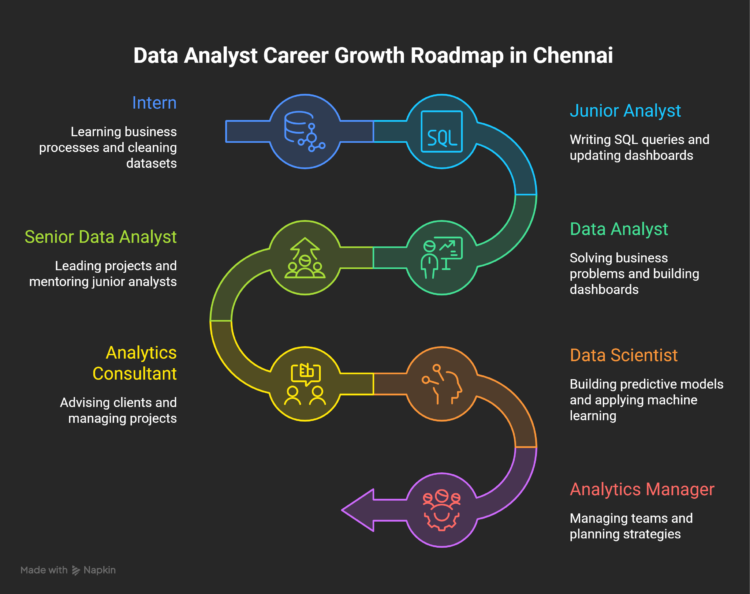
| Role | Experience | Average Annual Salary | Average Monthly Salary |
|---|---|---|---|
| Intern | 0–6 Months | ₹1.8–3.6 LPA (stipend equivalent) |
|
| Junior Data Analyst | 0–1 Years | ₹3–5 LPA |
|
| Data Analyst | 1–3 Years | ₹5–8 LPA |
|
| Senior Data Analyst | 3–6 Years | ₹8–15 LPA |
|
| Analytics Consultant | 5–8 Years | ₹12–20 LPA |
|
| Data Scientist | 4–8 Years | ₹10–22 LPA |
|
| Analytics Manager | 8+ Years | ₹18–30 LPA |
|
Intern
Responsibilities include:
- Learning business processes.
- Supporting senior analysts.
- Cleaning datasets.
- Preparing simple reports.
Focus on learning core tools.
Junior Analyst
Responsibilities include:
- Writing SQL queries.
- Updating dashboards.
- Preparing reports.
- Supporting business teams.
Confidence improves rapidly.
Data Analyst
Responsibilities include:
- Solving business problems.
- Building dashboards.
- Analyzing customer behavior.
- Presenting recommendations.
Business understanding becomes important.
Senior Data Analyst
Responsibilities include:
- Leading projects.
- Improving reporting systems.
- Mentoring junior analysts.
- Supporting strategic decisions.
Leadership skills become valuable.
Analytics Consultant
Responsibilities include:
- Advising clients.
- Solving business challenges.
- Managing analytics projects.
- Improving organizational performance.
Consultants often work across industries.
Data Scientist
Responsibilities include:
- Building predictive models.
- Applying machine learning.
- Automating analysis.
- Solving advanced business problems.
Programming skills become essential.
Analytics Manager
Responsibilities include:
- Managing analytics teams.
- Planning business strategies.
- Reviewing company performance.
- Supporting executive decisions.
Leadership and communication drive success.
Chennai vs Other Cities
Different cities offer different opportunities. Salary is important, but living costs and career growth also matter.
| City | Salary |
|---|---|
| Chennai | ₹4.5–8 LPA |
| Bengaluru | ₹6–12 LPA |
| Hyderabad | ₹5–10 LPA |
| Pune | ₹5–9 LPA |
| Mumbai | ₹6–11 LPA |
| Delhi NCR | ₹5.5–10 LPA |
Chennai
Chennai offers affordable living compared to Bengaluru and Mumbai. The city also provides stable career opportunities across multiple industries.
Best suited for:
- Fresh graduates.
- Long-term careers.
- IT professionals.
- Manufacturing analytics.
Bengaluru
Bengaluru offers the largest analytics ecosystem. Competition also remains higher.
Suitable for:
- Product companies.
- Startups.
- AI careers.
- Global technology firms.
Hyderabad
Hyderabad continues expanding rapidly. Many multinational companies operate here.
Strong opportunities exist in:
- IT.
- Cloud computing.
- Healthcare.
- Data analytics.
Pune
Pune combines technology with manufacturing. Living expenses remain reasonable.
Popular industries include:
- Automotive.
- IT services.
- Engineering.
- Consulting.
Mumbai
Mumbai offers strong financial opportunities. Banking and consulting dominate hiring.
Professionals interested in finance often prefer Mumbai.
Delhi NCR
Delhi NCR supports multiple industries. Many consulting and multinational companies recruit analysts.
Career opportunities remain diverse.
Future Scope
The demand for data analysts continues growing. Businesses depend on data more than ever. Chennai remains an important hiring destination.
AI Supports Analysts
Artificial Intelligence changes workflows. It automates repetitive tasks. However, business interpretation still requires people.
AI helps analysts:
- Prepare reports.
- Detect patterns.
- Clean datasets.
- Build predictions.
Human decision-making remains essential.
Automation Improves Productivity
Automation reduces manual work. Analysts spend more time solving business problems.
Automation supports:
- Faster reporting.
- Better accuracy.
- Improved efficiency.
- Reduced repetitive tasks.
Business Analysts Remain Valuable
Companies need professionals who understand both business and data.
Organizations value analysts who can:
- Explain insights.
- Recommend actions.
- Improve performance.
- Support management.
Business knowledge increases career stability.
Emerging Technologies
New technologies continue changing analytics.
Growing areas include:
- Artificial Intelligence.
- Machine Learning.
- Cloud Analytics.
- Predictive Analytics.
- Real-time Dashboards.
Continuous learning keeps professionals competitive.
Future Hiring Trends
Recruiters increasingly seek versatile analysts.
Future employers prefer candidates with:
- SQL expertise.
- Python knowledge.
- Dashboard skills.
- Cloud experience.
- Strong communication.
Professionals who combine technical and business skills will likely enjoy better career growth.
Final Verdict
Data analytics remains one of Chennai’s fastest-growing careers. Salaries improve steadily with experience, technical skills, and business knowledge. Product companies and GCCs often offer attractive compensation. Practical projects strengthen resumes more than certifications alone. Learning SQL, Python, Power BI, Tableau, statistics, and communication creates better opportunities. Continuous learning also supports long-term success. Chennai offers strong career growth with moderate living costs. Professionals who keep improving their skills and solving real business problems can build rewarding careers in data analytics.
Learn Prompt Engineering for Free
Get better results from ChatGPT and Gemini with free, beginner-friendly prompt engineering guides. Learn how to write prompts that save time and improve your code, content, and work.
Start Learning FreeFrequently Asked Questions
What is the average salary of a data analyst in Chennai?
The average data analyst salary in Chennai generally ranges from ₹4.5 LPA to ₹8 LPA. Actual salaries depend on experience, skills, company type, and industry.
Can freshers get high-paying data analyst jobs in Chennai?
Yes, freshers can earn competitive salaries by building strong technical skills and completing practical projects. Knowledge of SQL, Excel, Power BI, and Python improves job opportunities.
Which industries pay the highest salaries for data analysts in Chennai?
SaaS companies, product-based firms, banking, fintech, and Global Capability Centers (GCCs) often offer higher salaries. These industries rely heavily on data-driven decision-making.
Which skills help increase a data analyst's salary?
Skills like SQL, Python, Power BI, Tableau, Excel, and data visualization improve earning potential. Strong business communication also helps professionals negotiate better salaries.
Do certifications increase a data analyst's salary?
Certifications can improve your resume and technical knowledge. However, employers usually give more importance to practical projects and real-world problem-solving skills.
Are product companies better than service companies for data analysts?
Product companies often offer higher salaries and product-focused work. Service companies provide wider industry exposure and valuable client experience.
Is Chennai a good city for data analysts?
Yes, Chennai offers many opportunities in IT, SaaS, healthcare, banking, manufacturing, and automotive sectors. The city also has a moderate cost of living compared to several other technology hubs.
How can a data analyst grow into senior roles?
Professionals should continue learning advanced tools, improve business knowledge, and gain leadership experience. Consistent skill development supports faster career growth.
Will AI reduce data analyst jobs in the future?
AI will automate many routine tasks but will not replace skilled analysts completely. Companies will continue needing professionals who can interpret data and support business decisions.
Is data analytics a good long-term career in Chennai?
Yes, data analytics continues to grow across many industries in Chennai. Strong technical skills and continuous learning can lead to stable career growth and better salaries.