Table of Contents
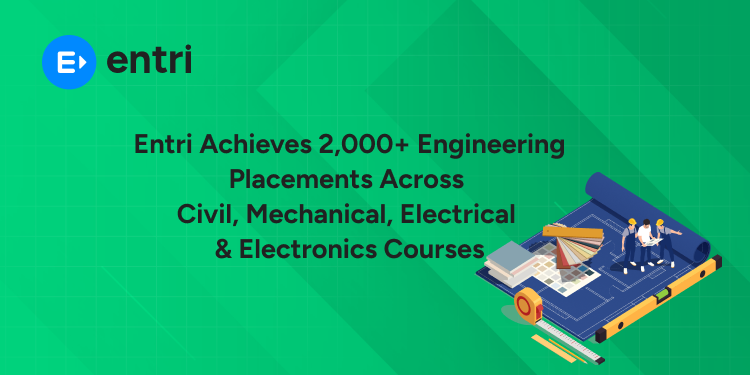
As of May 2026, Entri App has marked a milestone of getting over 2,000 engineering learners placed into jobs. The exact number is 2,013. This spans certifications across MEP, QS, BIM, Structural Design, Embedded Systems and Robotics.
These are primarily fields that map directly to Civil, Mechanical, Electrical and Electronics engineering. The first milestone of 50 placements happened in October 2023 and has now jumped to over 2,000 in under three years. This is driven overwhelmingly by regional-language QS programmes for the Gulf construction industry.
For thousands of civil and mechanical engineering graduates across Kerala, Tamil Nadu, Telangana and Andhra Pradesh, this data point strongly suggests that skilling actually leads to jobs.
Explore Online Courses to Land on your Dream Career!
Key Takeaways
- Entri reached 2,013 engineering placements by May 2026 (1,500 in Dec 2025 and 1,000 in Jul 2025).
- QS Malayalam contributed 1,081 placements.
- MEP courses added 254 placements.
- Regional-language QS courses (Malayalam, Tamil, Telugu) total 1,736 placements.
- BIM, Structural design, and Robotics show growth in specialized civil and mechatronics areas.
- Placement growth accelerated since 2024 – 1,700+ placements in the past 18 months vs 100+ in the first 15 months.
- Self-placed exclusive candidates in 2025 – Malayalam 560, Tamil 348, Telugu 132.
What is Driving Entri’s 2,000+ Placement Milestone?
1: What is the main purpose of a Bill of Quantities (BoQ)?

Entri’s placement growth can be seen as a direct result of its regional-language Quantity Surveying (QS) courses. These basically prepare engineering graduates for high-demand construction and infrastructure roles in the Gulf countries.
QS training teaches learners to estimate, measure and manage construction costs. This is a core skill for civil engineering and BIM/MEP-linked project execution.
As Entri delivers this training in Malayalam, Tamil and Telugu, it removes a major barrier for diploma and degree holders from non-metro India. These groups are fluent in their mother tongue but less confident in English-only technical instruction can find the right job to land consistently.
The Placement Growth Timeline
Entri’s placement numbers didn’t grow in a straight line. They show a clear inflection point that starts in late 2024, when regional QS batches scaled up.
| Milestone | Month Achieved | Time to Reach (from previous) |
| 50 placements | October 2023 | Baseline |
| 100 placements | January 2024 | 3 months |
| 500 placements | December 2024 | 11 months |
| 1,000 placements | July 2025 | 7 months |
| 1,500 placements | December 2025 | 5 months |
| 2,000+ placements | May 2026 | 5 months |
It took over a year to go from 50 to 500 placements. But only five months was required to go from 1,500 to over 2,000. This is the kind of compounding growth curve that is typical of a skilling programme that has found strong product-market fit with employers.
Master Quantity Surveying – Build a Rewarding Career Today!
Gain in-demand skills in cost estimation, project budgeting, and contract management with our Quantity Surveying Course. Learn from industry experts and boost your career in construction and infrastructure. Enroll now and take the first step toward success!
Know MoreWhich Engineering Courses have the Highest Placement Rates?
Placement data by course shows a heavy concentration in Quantity Surveying. Also MEP, BIM, Structural and Robotics/Embedded courses are filling out the rest of Entri’s civil, mechanical and electronics engineering portfolio.
| Course | Category | Total Placements |
| QS Malayalam | Civil / Construction | 1,081 |
| MEP | Mechanical, Electrical & Plumbing | 254 |
| QS Telugu | Civil / Construction | 200 |
| QS Tamil | Civil / Construction | 455 |
| Structural Engineering | Civil | 8 |
| BIM | Civil / Digital Construction | 9 |
| MEP QS | Mechanical + Civil hybrid | 3 |
| Embedded Systems | Electronics | 2 |
| Robotics | Mechanical / Electronics | 1 |
| Total | — | 2,013 |
QS Malayalam alone contributes the major share of placements than every other course combined. This reflects Kerala’s long-standing pipeline of skilled workers migrating to Gulf construction projects.
MEP’s strong second-place is notable because MEP engineering directly bridges mechanical, electrical and civil disciplines. This makes it one of the most versatile certifications on Entri’s roster for Gulf-bound engineers.
How are Regional Markets Performing?

Apart from course-wise numbers, Entri also tracks how many candidates in each regional-language cohort found jobs on their own initiative (self-placed). This is compared against those who found their job through direct employer tie-ups (exclusive) during 2025.
| Region | Self-Placed (2025) | Exclusive Placements (2025) |
| Malayalam | 560 | – |
| Tamil | 348 | 8 |
| Telugu | 132 | – |
The Malayalam-speaking cohort’s high self-placement number reinforces Kerala’s mature, employer-recognized pipeline into Gulf construction roles. The candidates with an Entri QS certificate are confident enough to apply directly rather than waiting for a placement drive.
Study Quantity Surveying With Professional Mentors! Join Now!
Why this Matters for Civil, Mechanical and Electronics Graduates
Whether you are a fresh civil engineering graduate, a mechanical diploma holder, or an ITI-trained electronics technician, the practical question isn’t “is this course popular” but “will this course get me hired.”
Entri’s dashboard answers that with hard numbers rather than marketing claims. This is over 2,000 real job placements, tracked monthly, across distinct engineering specializations. This level of transparency is, in fact, uncommon in India’s edtech and skilling space, where placement claims are often stated but rarely broken down by course, region or time period.
The concentration in QS and MEP also signals where hiring demand actually sits right now. It is heavily in Gulf-facing construction and infrastructure roles rather than purely domestic engineering jobs. For learners deciding between certifications, this is a meaningful data point when planning a career path.
Master Quantity Surveying – Build a Rewarding Career Today!
Gain in-demand skills in cost estimation, project budgeting, and contract management with our Quantity Surveying Course. Learn from industry experts and boost your career in construction and infrastructure. Enroll now and take the first step toward success!
Know MoreConclusion
The milestone of reaching 2,013 placements by May 2026 from 50 placements in October 2025 simply reflects more than just the popularity of Entri’s courses. It clearly reflects real and trackable hiring outcomes for engineering graduates across civil, mechanical, electrical and electronics disciplines.
QS and MEP certifications have become the strong pillars of Entri’s engineering placements. They succeeded in connecting regional-language learners to Gulf and Indian construction industry jobs. Entri continues to expand its BIM, Structural Design, Embedded Systems and Robotics course offerings. This placement curve is likely to keep climbing higher.
Master Quantity Surveying – Build a Rewarding Career Today!
Gain in-demand skills in cost estimation, project budgeting, and contract management with our Quantity Surveying Course. Learn from industry experts and boost your career in construction and infrastructure. Enroll now and take the first step toward success!
Know MoreFrequently Asked Questions
How many total placements has Entri achieved as of May 2026?
Entri has recorded 2,013 total placements as of May 2026, crossing the 2,000 mark that month. This makes it one of the fastest-growing engineering placement pipelines among Indian regional-language skilling platforms.
Which course has produced the most placements at Entri?
QS Malayalam is Entri’s top-performing course with 1,081 placements. It alone accounts for more than half of all placements recorded on the platform.
How long did it take Entri to go from 1,000 to 2,000 placements?
Entri crossed 1,000 placements in July 2025 and reached over 2,000 by May 2026 — a gain of roughly 1,000 placements in about ten months. This reflects a sharp acceleration compared to its earlier growth phase.
Which regions contribute the most placements to Entri's numbers?
The Malayalam-speaking region leads by a wide margin, followed by Tamil and then Telugu-speaking regions. Together, these three regional QS cohorts make up the vast majority of Entri’s total placements.
Does Entri offer BIM certification, and how many placements has it produced?
Yes, Entri offers a BIM (Building Information Modeling) certification course, which has produced 9 placements to date. BIM is a growing niche within digital construction and civil engineering workflows.
What is "self-placed" versus "exclusive" placement in Entri's data?
Self-placed refers to candidates who secured jobs independently after completing an Entri course, while exclusive placements come through Entri’s direct employer partnerships. In 2025, the Malayalam region recorded 560 self-placed candidates, the highest among all regions.
Are Entri's engineering courses focused on Gulf or Indian job markets?
Entri’s QS, MEP and BIM courses are strongly oriented toward Gulf Cooperation Council (GCC) construction and infrastructure roles, given the heavy overseas demand for these skills. The courses also serve candidates targeting domestic Indian civil and mechanical engineering positions.
When did Entri cross its first major placement milestones?
Entri reached 50 placements in October 2023 and 100 placements by January 2024. It then crossed 500 in December 2024, 1,000 in July 2025, and 1,500 in December 2025.
Why is QS Malayalam so much larger than QS Telugu or QS Tamil?
QS Malayalam benefits from Kerala’s long-established migration pipeline into Gulf construction jobs, giving it stronger employer recognition and demand. QS Tamil (455 placements) and QS Telugu (200 placements) are newer regional cohorts that are still scaling.
Is Entri's placement data updated regularly?
Yes, Entri maintains a monthly-updated placement dashboard tracking course-wise and region-wise hiring outcomes. This transparency allows prospective learners to evaluate real employment outcomes before enrolling in a course.