
Table of Contents
Introduction
Meta Connect 2026 focused on three major areas: artificial intelligence, smart glasses and immersive computing. During the two-day event held on September 23 and 24, Meta introduced new AI-powered eyewear, a lightweight virtual reality device, updates to its existing Ray-Ban smart glasses and several new entertainment experiences.
The biggest announcement was Meta VR Glasses, a new wearable designed to combine the portability of glasses with the capabilities of a VR headset. Meta also revealed camera-free audio glasses, the third-generation Ray-Ban Meta, new features for Meta Ray-Ban Display, and a compact AI device called Muse Charm.
Here is a complete overview of the major announcements from Meta Connect 2026.
Meta VR Glasses
Meta VR Glasses were the main hardware announcement at this year’s event. Unlike traditional VR headsets, the device uses a glasses-style design without a large head strap. Meta says the glasses weigh approximately 100 grams, making them five times lighter than the Meta Quest 3.
The glasses connect to a pocket-sized computing puck that contains the processor, battery and storage. They use Qualcomm’s Snapdragon Reality Elite platform and feature 128GB of storage and 12GB of RAM.
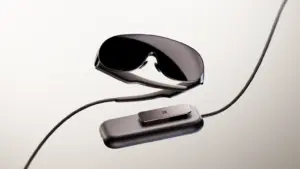
Main features
- A 5K “Infinite Display”.
- Resolution of 2,412 × 2,288 pixels per eye.
- Refresh rates of up to 120Hz.
- Full-colour passthrough video.
- Eye tracking and hand tracking.
- Support for Touch Plus controllers.
- Compatibility with Meta Quest games and applications.
- Xbox Cloud Gaming support.
- Wireless and USB-C connectivity.
- Virtual displays for Windows PCs and Macs.
- Support for spatial audio and holographic avatars.
Meta says the VR Glasses will support cinema-style viewing, 3D movies, immersive sports and productivity features. They are also expected to become the first IMAX Enhanced-certified VR device.
Users will be able to connect the glasses to a computer and work with virtual monitors. Meta also showed a virtual keyboard and touchpad system that allows users to interact with a digital workspace while using the glasses.
The Meta VR Glasses are scheduled to launch in spring 2027. They will cost approximately $1,299.99 in the United States.
Ray-Ban Meta Audio Glasses
Meta introduced Ray-Ban Meta Audio, its first pair of camera-free smart glasses. The glasses are designed for users who want hands-free audio, phone calls and AI assistance without the privacy concerns associated with wearable cameras.
The glasses include microphones, speakers and Meta’s AI assistant, but they cannot capture photos or videos.
Ray-Ban Meta Audio features
- No built-in cameras.
- Music and podcast playback.
- Voice calls.
- Access to an AI assistant.
- Up to 12 hours of battery life.
- Up to 48 hours of additional power through the charging case.
- A lightweight 43-gram design.
- Support for prescription lenses.
- 23 frame and lens combinations.
Ray-Ban Meta Audio will be available in styles including Clubmaster and Burbank. Pre-orders opened during the event, with shipping scheduled to begin on October 13, 2026. Prices start at $349.
This product may appeal to people who want the convenience of smart glasses while avoiding a device that visibly records its surroundings.
Ray-Ban Meta Gen 3
Meta also announced the third generation of its camera-equipped Ray-Ban Meta smart glasses. The new model has a slimmer design, longer battery life and improved audio performance.
The glasses provide up to nine hours of use on a single charge, compared with around eight hours for the previous generation. Meta has also added a customisable action button for quick access to Meta AI.
Ray-Ban Meta Gen 3 highlights
- 12MP camera.
- 3K video recording.
- Up to nine hours of battery life.
- Six-microphone audio system.
- More than 90% background-noise reduction, according to Meta.
- New Aviator and Zena frame styles.
- 27 colour and lens combinations.
- Dolby Atmos spatial audio capture planned for videos.
- AI-assisted photo selection.
The glasses also include a dynamic photo feature that captures multiple images and helps users select the best shot. Meta is retaining the recording indicator LED, which is intended to make it clear when the camera is active.
Ray-Ban Meta Gen 3 is available from $449. Special editions and collaboration models, including collections associated with Kylie Jenner and Blackpink’s Lisa, will also be available.
More Meta Glasses Styles
Meta announced additional frame options for its own Meta Glasses range. One of the key additions is a lower-cost version of the Meta Adventurer, which starts at $249.
The new model includes black frames, grey lenses and a plug-in charging case. Pre-orders opened during Meta Connect, and the glasses are expected to reach stores on October 23, 2026.

Meta is also expanding its style options through a Mix & Match programme. Customers will be able to customise combinations of:
- Frames.
- Lenses.
- Case colours.
- Prescription options.
The company also announced new EssilorLuxottica styles, additional colour options for the Kylie Jenner Starfire frame and a collaboration collection with Blackpink’s Lisa.
Meta Glasses are expanding into markets such as Singapore, South Korea, Mexico and the United Arab Emirates. Availability in Brazil is expected to follow.
Meta Ray-Ban Display Updates
Meta Ray-Ban Display glasses are also becoming available in more countries. The glasses can display information directly in front of the wearer and are designed to support navigation, notifications, photography and AI-assisted features.
The product is now available in the United Kingdom and Canada. Meta also announced pre-orders in France, Germany and Italy, with sales in those countries scheduled to begin on October 13. In the United States, customers can order the glasses online.
New Ray-Ban Display features
- Cycling directions.
- Public transport directions.
- Landmark-based walking guidance.
- Mirrored phone notifications.
- Photo editing through the glasses.
- Dolby Atmos video capture.
- Access to the Explore app.
- Web-based experiences designed for smart glasses.
- Holographic avatars for video calls.
The hologram feature is expected to initially arrive for WhatsApp calls in the United States. Users will need to create an avatar through the Meta AI app before using the feature.
Muse AI Comes to Meta’s Wearables
Meta placed significant attention on Muse, its AI agent. The company confirmed that it is working to bring Muse to its AI glasses, allowing users to interact with the assistant without using a phone or computer.
Muse will be activated through voice commands and could assist with everyday tasks such as:
- Guiding workouts.
- Logging meals.
- Booking appointments.
- Creating shopping lists.
- Helping users purchase products they see.
- Scheduling activities.
- Completing digital tasks.
Meta also announced that Muse will support video conversations through a customisable live avatar. Muse agents will receive their own email addresses, allowing them to communicate with users and complete certain tasks more independently.
Meta’s official announcement also highlighted plans to make Muse available on its glasses for hands-free access. Users will be able to activate the agent by saying its name.
Muse Charm
At the end of the keynote, Mark Zuckerberg introduced Muse Charm, a small AI-powered device designed to keep a user’s personal Muse agent within reach.

The compact gadget resembles a small digital companion or keychain device. It includes:
- A small display.
- Speakers.
- Microphones.
- A fingerprint sensor.
- Real-time voice interaction.
- An AI avatar experience.
Muse Charm is intended to work as a standalone companion rather than simply acting as an accessory for a smartphone. Users can reportedly activate it through the fingerprint sensor and speak with Muse directly.
Meta has not yet announced final pricing or complete specifications. The company said additional information would be shared later, with the device expected to arrive around the holiday season.
Hearing Enhancement for Meta Glasses
Meta announced a hearing-enhancement feature for its smart glasses. The tool is designed primarily for people who can hear normally but have difficulty following conversations in busy or noisy places.
Users will complete a hearing setup process by listening to tones in a quiet environment. The glasses can then adjust their audio settings based on the user’s hearing profile.
The feature can be activated with the voice command “Hey Meta, start hearing enhancement.” Meta says it will first become available in the United States later in 2026. It will eventually support Meta Glasses, Ray-Ban Meta Gen 3 and Ray-Ban Meta Audio.

The company plans to offer a 30-day trial. After that, the feature will cost $149 as a one-time payment, although it will also be included with a Meta One subscription. Meta says the service may qualify for FSA and HSA reimbursement in the United States.
This feature is not positioned as a replacement for a medical hearing aid. Instead, it is aimed at improving speech clarity in challenging listening environments.
Beat Saber Gets Its Biggest Update
Meta announced a major update for Beat Saber, one of the most popular VR rhythm games. The update will introduce hand tracking, allowing players to interact with the game without Touch Plus controllers.

A new single-player mode called Flux will give players special abilities, including the Flux Tether. The mode will launch with 35 songs and will be available on Meta Quest and Meta VR Glasses.
The Beat Saber update will also include:
- A revamped single-player campaign.
- A stronger narrative structure.
- New missions.
- A redesigned menu.
- A progression and rewards system.
- More customisation options.
- Additional music and content.
Players will still be able to use traditional controllers if they prefer a more precise control system.
Supernatural Returns to Meta Quest
Supernatural, Meta’s VR fitness platform, is returning to the Meta Horizon Store. The service is being developed by an independent team after changes within Meta’s VR and metaverse operations.
Existing user progress, including points, streaks and badges, will remain available. The new version is expected to include more high-definition environments, workouts and music.
The return of Supernatural gives Meta another opportunity to promote VR as a fitness and wellness platform rather than only a gaming product.
More VR Games
Meta also revealed several upcoming games and applications for its VR ecosystem.

Payday: Aces High
Payday: Aces High is coming to Meta Quest 3 and Quest 3S. The game will support co-operative cross-play with the PC VR version. An open playtest is scheduled to begin on October 19, 2026.
Tetris Effect
A mixed-reality version of Tetris Effect is in development for Meta VR Glasses. The game will include hand-tracking support and is expected to arrive in 2027.
Two Point Hospital
Two Point Hospital is coming to Meta Quest 3 and Quest 3S. The game will support hand tracking, allowing users to interact with parts of the virtual hospital environment more naturally.
Phoenix Wright: Ace Attorney VR
Phoenix Wright: Ace Attorney – Dual Destinies is coming to Meta VR Glasses and Meta Quest. The VR version will include hand tracking and voice activation.
Players will be able to point at witnesses and use familiar courtroom commands such as “Objection!” in a more immersive environment.
3D Movies and Immersive Cinema
Meta is expanding its focus on film and television content for VR users. Disney+ subscribers in selected countries will be able to watch films such as The Avengers and Black Panther in 3D from November.
Meta VR Glasses users will also receive access to immersive versions of major films, including Avengers: Infinity War and Star Wars: A New Hope. These experiences will be delivered through a new Disney Immersive Cinema application developed by ILM.
The experiences are designed to combine:
- 3D visuals.
- Spatial audio.
- Dynamic effects.
- Immersive environments.
- Cinema-style viewing.
Meta also said that users in the United States will be able to rent or purchase hundreds of 2D and 3D films later in 2026. The service is expected to expand to additional countries before the launch of Meta VR Glasses.
Immersive Sports Content
Meta announced plans to bring more sports programming to its VR platform. The company is working with sports partners to provide immersive broadcasts, including 180-degree viewing and 8K streaming.

The Immersive Sports service will begin with college football and expand to other sports in 2027. Meta also expects to provide more than 100 live sports events each year through partnerships involving MLB, NBC Sports, TNT Sports and UFC.
This could make VR more attractive to sports fans who want a wider field of view or a more arena-like viewing experience from home.
National Geographic and Meta Quest TV
Meta introduced the National Geographic: Beyond app, which will offer 180-degree 3D experiences focused on nature and exploration.
The company also announced Open Season, a docuseries planned for the Meta Quest TV app. The series follows Golden State Warriors player Draymond Green during therapy sessions from the 2025–26 season. It is the first project in Meta’s Meta Presents original content programme.
Additional streaming services available across Meta’s VR ecosystem include:
- Amazon Prime Video.
- YouTube.
- DirecTV.
- AMC+.
- Crunchyroll.
- Plex.
- Tubi.
- Peacock.
- HBO Max.
- Paramount+.
Some services will also provide 3D content.
What Meta Connect 2026 Means for Users
Meta Connect 2026 showed that the company is moving beyond conventional VR headsets. Its product strategy now combines AI assistants, lightweight eyewear, voice interaction and spatial computing.
The announcements also reveal three clear priorities:
- AI everywhere: Meta wants Muse to assist users through glasses, standalone devices and virtual avatars.
- More wearable choices: Users can choose between camera-equipped glasses, camera-free audio glasses, display glasses and full VR glasses.
- VR as an entertainment platform: Meta is investing in games, fitness, films, streaming services and immersive sports to make VR useful beyond social experiences.
For consumers, the biggest decision may be whether they want an unobtrusive audio device, a camera-equipped smart-glasses experience or a full spatial-computing system. Meta’s product range now covers all three categories.
Final Takeaway
Meta Connect 2026 was largely centred on making AI and immersive technology more portable. Meta VR Glasses brought full virtual reality into a lighter glasses-style design, while Ray-Ban Meta Audio offered a camera-free alternative for audio and AI features.
At the same time, Meta expanded its smart-glasses lineup, introduced new Muse capabilities and announced more games, films, sports and fitness experiences. If Meta delivers on its plans, the company’s next phase will be defined not by one headset, but by an ecosystem of AI-powered wearables designed for different everyday situations.
Frequently Asked Questions
What is Meta Connect 2026?
Meta Connect 2026 is Meta’s annual event for announcing developments in artificial intelligence, smart glasses, virtual reality, mixed reality and developer technology. The 2026 edition took place on September 23 and 24.
What are Meta VR Glasses?
Meta VR Glasses are lightweight virtual reality glasses connected to a separate computing puck. They are designed for gaming, spatial computing, productivity, immersive films and sports.
How much do Meta VR Glasses cost?
Meta VR Glasses are expected to cost $1,299.99 in the United States. They are scheduled to launch in spring 2027.
Do Ray-Ban Meta Audio glasses have cameras?
No. Ray-Ban Meta Audio glasses do not include cameras. They are designed for listening to audio, making calls, and using an AI assistant. The camera-less glasses are directed at those who are concerned about the privacy breach of the Ray-Ban Meta glasses with cameras.
What is Muse Charm?
Muse Charm is a small, keychain-style AI device that houses Meta’s Muse agent. It includes a display, microphones, speakers and a fingerprint sensor.
What is the cheapest new Meta glasses model?
The new lower-cost Meta Adventurer model starts at $249. Ray-Ban Meta Audio starts at $349, while Ray-Ban Meta Gen 3 starts at $449.
Is Meta bringing Muse to smart glasses?
Yes. Meta says Muse is being developed for its AI glasses. It will offer hands-free access to the assistant through voice commands and support tasks such as workout guidance, meal logging and appointment booking.