
Table of Contents
Introduction
Meta has introduced its most ambitious virtual reality product yet: the Meta VR Glasses. Priced at $1,299.99, the glasses are scheduled to launch in spring 2027 and aim to combine immersive entertainment, gaming and spatial computing in a slimmer design than conventional VR headsets.
The announcement was made at Meta Connect 2026 on 23rd September, where the company also revealed new AI glasses, updates to its Muse AI agent, the Muse Charm device and several software and gaming experiences.
What Is Meta Connect?
Meta Connect is the company’s annual event for showcasing new developments in virtual reality, mixed reality, artificial intelligence, and wearable technology. The event brings together developers, creators, technology enthusiasts, and industry professionals to explore Meta’s future hardware and software ecosystem.
At the 2026 edition, Meta focused heavily on the connection between personal AI and wearable devices. The company announced plans to bring Muse, its AI agent, to its smart glasses for hands-free assistance. Users will be able to ask Muse questions about objects in front of them, products on shelves, signs, and other visual information.
Meta also presented a wider range of AI-enabled eyewear across its Ray-Ban, Oakley and Meta brands. The company said that more than 100 styles of AI glasses will be available by the end of 2026.
Major announcements at Meta Connect 2026
The key announcements included:
- Meta VR Glasses, a lightweight virtual reality device priced at $1,299.99.
- Ray-Ban Meta Gen 3 glasses with a slimmer design, longer battery life and new frame styles.
- Ray-Ban Meta Audio glasses with open-ear audio and AI features.
- Muse Charm, a compact device designed for interacting with Meta’s Muse AI agent.
- New AI features such as guided workouts, nutrition tracking, visual shopping assistance and navigation based on landmarks.
- New VR games and updates, including a hand-tracking mode for Beat Saber.
- Hologram video calling for more realistic virtual conversations.
Read in detail: Everything Announced at the Meta Connect 2026
Meta VR Glasses: An Overview
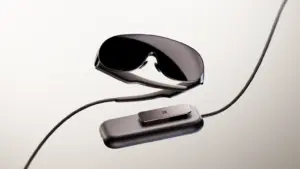
Meta VR Glasses are designed to offer the functions of a cinema, gaming console and multi-screen workstation in a glasses-like form factor. Unlike traditional headsets that use thick straps and place most components on the user’s face, the new device separates the display hardware from the processing system.
The glasses weigh approximately 100 grams, making them around five times lighter than the Meta Quest 3. A separate computing puck contains the processor, battery and storage. Users can clip the puck to a belt, pocket or bag, while an optical tether connects it to the glasses.
This two-part design allows Meta to reduce the weight placed on the wearer’s face without removing the high-performance hardware needed for VR experiences.
Where Meta Got the Upper Hand Over Apple
Meta appears to have addressed some of Apple Vision Pro’s biggest weaknesses: high price, heavy design and limited gaming appeal. Its VR Glasses cost $1,299.99 and place most of the processing hardware in an external puck, reducing the weight on the face to approximately 100 grams compared with up to 800 grams for Apple Vision Pro.
Meta also offers access to the established Quest gaming library, optional controllers, hand-tracking games and support for Windows, Mac and other gaming devices. Another practical advantage is that users can interact with virtual keyboards and touchpads on a desk or even while their hands are resting in their lap, rather than keeping their hands raised in front of the headset.
In this sense, Meta has made VR lighter, cheaper and more gaming-focused, while Apple Vision Pro remains stronger in premium spatial video and Apple ecosystem integration.
Meta VR Glasses Price and Release Date
Meta VR Glasses will cost $1,299.99 in the United States. Meta plans to make the device available in spring 2027. The company has not yet announced detailed pricing for India or confirmed the exact launch date in every market.
The price places the glasses above the Meta Quest 3 but below Apple’s Vision Pro. This positioning makes the product a premium alternative for consumers who want high-quality VR without purchasing Apple’s most expensive spatial-computing device. The Verge also described the price as sitting between mainstream VR hardware and high-end products such as the Vision Pro.
Quick specifications
| Feature | Meta VR Glasses |
|---|---|
| Price | $1,299.99 |
| Expected release | Spring 2027 |
| Weight | Approximately 100 grams |
| Display | 5K Infinite Display using micro-OLED panels |
| Refresh rate | Up to 120Hz |
| Processor | Qualcomm Snapdragon Reality Elite |
| Storage | 128GB |
| Battery | Up to three hours of continuous high-resolution media playback |
| Input | Eye tracking, hand gestures and optional controllers |
| Connectivity | Wireless and USB-C connections |
| Operating system | Meta’s VR platform with Meta AI integration |
Design and Comfort
The most noticeable difference between Meta VR Glasses and traditional VR headsets is the design. The device sits on the ears like a large pair of glasses rather than being secured with a heavy head strap.
Meta says the glasses use a magnesium-alloy construction that provides strength while helping manage heat. The open-sided design and colour passthrough cameras also allow users to remain aware of their surroundings while wearing the device.
The lighter form factor could make short VR sessions more convenient. Users may be able to put on the glasses to watch a film, check a virtual workspace or play a game without the sense of wearing a large piece of equipment.
However, the glasses are not identical to ordinary spectacles. They still have thick frames, front-facing cameras and a wired connection to the computing puck. Their glasses-like design reduces the physical burden, but the overall experience remains that of a dedicated VR system.

Display Quality
Meta VR Glasses feature what the company calls a 5K Infinite Display, built with micro-OLED panels. The display offers 37 pixels per degree and a refresh rate of up to 120Hz. These specifications are designed to improve image clarity, motion smoothness and text readability.
The device also uses compact pancake lenses developed specifically for the glasses. Meta says the display supports Dolby Vision, which can deliver stronger contrast, brighter highlights and more vivid colours in compatible content.
This could make the glasses particularly useful for:
- Watching films on a cinema-sized virtual screen.
- Reading text across multiple virtual monitors.
- Viewing 3D films and immersive video.
- Watching sports from virtual front-row perspectives.
- Playing games with detailed environments.
The Verge’s hands-on experience highlighted the large virtual display and described film and sports demonstrations as some of the most impressive uses of the device.
Entertainment Features
Meta is positioning the glasses as a portable personal cinema. Users can watch content on a large virtual display without needing a physical television or monitor.
The company has partnered with several entertainment providers, including Disney, IMAX and major streaming services. Meta says the device will support services such as:
- Disney+
- Prime Video
- YouTube
- HBO Max
- Peacock
- Paramount+
- Crunchyroll
- Plex
- Tubi
- ESPN
- NBA
- MLB
Meta VR Glasses will also be the first VR device to receive IMAX Enhanced certification, according to Meta. This means selected films may be presented in an expanded aspect ratio and with a more cinema-oriented viewing experience.
Disney 3D and immersive cinema
Meta is working with Disney and Industrial Light & Magic on immersive film experiences. Selected Disney+ films, including The Avengers and Black Panther, will be available in 3D in supported countries.
Meta also announced VR Enhanced versions of films such as Avengers: Infinity War and Star Wars: A New Hope. These experiences are designed to make the virtual environment react to scenes in the film, adding visual effects and spatial elements beyond a standard flat screen.[meta]
Productivity and Virtual Workspaces
Meta VR Glasses are not limited to entertainment. The company is also presenting them as a portable workstation.
Users can create multiple virtual displays and position them around themselves. They can also connect a Mac or Windows computer wirelessly or through USB-C, allowing them to extend or mirror their existing screens.
The glasses support full-colour passthrough, so users can continue seeing their physical keyboard, desk, phone and nearby surroundings while working.[meta]
Built-in virtual keyboard and touchpad
One of the more practical features is the ability to use a table or desk as an input surface. When users place their hands on a suitable surface, the system can generate a virtual keyboard and trackpad.
This may be useful for:
- Replying to short messages.
- Writing quick emails.
- Browsing websites.
- Controlling virtual applications.
- Adjusting the layout of multiple screens.
During its hands-on demonstration, The Verge found the virtual keyboard and trackpad surprisingly usable for short typing tasks, although a physical keyboard and mouse would likely remain faster for extended work.

Eye Tracking and Hand Gestures
Meta VR Glasses are designed to reduce dependence on handheld controllers. Users can look at an item to select it and use hand gestures to navigate menus or interact with applications.
The glasses use eye-tracking cameras to identify where the user is looking. Six external cameras track hand movements, allowing the system to recognise gestures such as pinching and scrolling.
Common interactions include:
- Looking at an app or menu item to highlight it.
- Pinching the thumb and index finger to select.
- Moving the thumb across a closed hand to scroll.
- Using hand movements to interact with supported games.
- Speaking to Meta AI to open apps or change the workspace.
Touch Plus controllers will still be supported for users who prefer traditional VR controls. The device will also support Bluetooth controllers for compatible games.
Gaming Support
Meta VR Glasses will provide access to the existing Meta Quest catalogue, which includes thousands of applications and games. Meta also says more than 75 games will support hand-based gameplay at launch.
One of the headline gaming updates is Beat Saber: Flux. In this mode, players use their hands to interact with energy effects and targets instead of relying only on traditional virtual lightsabers.
Other announced or upcoming titles include:
- Phoenix Wright: Ace Attorney – Dual Destinies
- Tetris Effect: Mixed Realities
- Two Point Hospital
- Dragon Grove
- Cardmada
- Dice Throne Digital
- Supernatural
Users will also be able to access Xbox Cloud Gaming by connecting a Bluetooth gamepad. The glasses can connect to other gaming devices, including handheld consoles, to display games on a large virtual screen.
Meta AI Integration
Meta has integrated its AI agent directly into the Meta VR Glasses experience. Users can use voice commands to ask the glasses to open apps, rearrange virtual screens, play films or search for information.
This could make the device easier to use because users would not always need to navigate menus manually. For example, a user could say:
“Open my laptop screen, place it on the left and play my film on a large display in front of me.”
Meta AI could then complete the request through voice interaction.
The glasses are part of Meta’s wider plan to bring its Muse AI agent to wearable devices. According to Meta, Muse will be able to respond to what users are looking at and help with tasks such as identifying products, reading information or understanding objects in the user’s surroundings.
Hologram Video Calls
Another major feature is hologram-based video calling. Meta says the device can create a photorealistic digital representation of the user, including facial expressions and real-time reactions.
During a call, the other participant may appear as a spatial hologram in front of the wearer. The user’s hologram can also appear on the other person’s phone or computer, even if that person is not using VR glasses. The feature is designed to work with calling platforms such as WhatsApp and Zoom.
This could make remote meetings and family calls feel more natural. Instead of viewing a small video tile, users may feel as if the other person is positioned within the same virtual space.
Battery Life and Performance
The computing puck includes the Snapdragon Reality Elite processor, storage and battery. Meta says the battery can provide up to three hours of continuous high-resolution media playback and supports 45W fast charging.
The Verge reported that the puck includes 128GB of storage and 12GB of RAM. Keeping these components outside the glasses helps reduce the weight on the user’s face, but it also means the user must carry an additional device connected by a cable.
Battery life may be sufficient for a film or a short work session, but it could be a limitation for users expecting all-day use. The actual battery performance will likely depend on brightness, refresh rate, applications and whether the glasses are connected to another device.

Advantages and Limitations
Potential advantages
- Much lighter than conventional VR headsets.
- Large, high-resolution virtual displays.
- Support for movies, games and productivity.
- Access to the Meta Quest software catalogue.
- Eye and hand tracking without mandatory controllers.
- AI integration for hands-free control.
- Support for 3D, IMAX Enhanced and immersive video.
- Ability to connect to computers and gaming devices.
Possible limitations
- The external computing puck must be carried separately.
- A wired tether connects the glasses and puck.
- Battery life is limited to approximately three hours for high-resolution media playback.
- The $1,299.99 price may be high for casual users.
- Exact regional pricing and availability remain unknown.
- Some entertainment and 3D content may depend on subscriptions or regional licensing.
- The device is still not as discreet as ordinary prescription glasses.
Are Meta VR Glasses Worth Waiting For?
Meta VR Glasses may be worth considering for users who want a lighter alternative to traditional VR headsets and have a strong interest in films, gaming or virtual workspaces.
They could be particularly appealing to:
- Frequent travellers who want a private cinema screen.
- Remote workers who need multiple virtual monitors.
- Gamers interested in hand-tracking experiences.
- Film enthusiasts who want 3D and immersive content.
- Early adopters interested in wearable AI and spatial computing.
However, buyers may want to wait for independent reviews before making a decision. Important details such as comfort during long sessions, heat management, prescription-lens support, real-world battery performance and availability in markets such as India are yet to be confirmed.
Final Thoughts
Meta VR Glasses represent a major change in the company’s VR hardware strategy. Instead of making a more powerful version of a conventional headset, Meta is attempting to create a device that looks and feels closer to ordinary glasses while still offering high-end virtual reality.
The product combines a 5K micro-OLED display, eye and hand tracking, AI control, virtual workspaces, immersive entertainment and access to the Quest gaming ecosystem. Its lightweight design is its biggest advantage, while the external computing puck, wired connection and limited battery life may influence how practical it is for everyday use.
With a $1,299.99 price and a spring 2027 release, Meta VR Glasses will be one of the most closely watched VR products of the year. Its success will depend on whether consumers see it as a genuinely convenient new form of computing—or simply a lighter version of an existing VR headset.
Frequently Asked Questions
What are Meta VR Glasses?
Meta VR Glasses are a new glasses-style virtual reality device announced at Meta Connect 2026. They combine immersive displays, VR gaming, virtual workspaces, entertainment and AI-powered controls in a lighter design than traditional VR headsets.
How much do Meta VR Glasses cost?
Meta VR Glasses are priced at $1,299.99 in the United States. Regional pricing, including the price for India, has not yet been announced.
When will Meta VR Glasses be released?
Meta plans to launch the VR Glasses in spring 2027. The company has not confirmed an exact release date or detailed availability for every market.
How much do Meta VR Glasses weigh?
The glasses weigh approximately 100 grams. Their processor, battery and cooling components are placed in a separate computing puck, which helps reduce the weight on the wearer’s face.
Do Meta VR Glasses require a cable?
Yes. The glasses connect to the external computing puck through a cable. The puck contains important hardware, including the processor and battery, and can be carried in a pocket or attached to clothing.
How long does the battery last?
Meta says the device can provide up to three hours of high-resolution media playback on a single charge. Actual battery life may vary depending on the display settings, applications and type of content.
What display do Meta VR Glasses use?
The glasses use micro-OLED displays with a 5K Infinite Display, approximately 37 pixels per degree and a refresh rate of up to 120Hz. They also support Dolby Vision for compatible content.
Can Meta VR Glasses play games?
Yes. The glasses support the Meta Quest game catalogue, hand-tracking experiences, optional Touch Plus controllers and Xbox Cloud Gaming with a compatible Bluetooth controller. Meta has also announced more than 75 games with hand-based gameplay support.
Do Meta VR Glasses come with controllers?
Controllers may not be included with every purchase. Users can buy Touch Plus controllers separately or use compatible controllers from devices such as the Meta Quest 3 or Quest 3S. Some retail bundles may include controllers.
Can Meta VR Glasses be used for work?
Yes. Users can connect Mac and Windows computers and create multiple virtual screens. The glasses can also generate a virtual keyboard and trackpad on a physical surface for supported tasks.