Table of Contents
For persons who like exercise, health, coaching, and helping others accomplish their fitness objectives, a job as a fitness trainer can be satisfying. But being a good fitness trainer is more than just being physically active. Professionals need to be knowledgeable about the science of exercise, they need to be able to communicate well, they need to have experience, they need to have the right credentials, and they need to be able to work with people from all different backgrounds and levels of fitness.
There are a few different avenues you can pursue in a fitness trainer career. A person can start as a gym instructor or entry-level fitness trainer and move on to become a personal trainer, specialized coach, senior trainer, fitness manager, online coach, educator or fitness business owner.
The travel doesn’t have to be on one particular route. Your education, certifications, interests, experience and selected specialization can impact how quickly and in which direction your career will develop.
Key Takeaways:
- Beginner fitness trainers can advance to specialized and senior jobs.
- Practice teaches novices training and client-management skills.
- Professional certifications provide specialization and career advancement.
- Personal trainers, fitness coaches, online trainers, and fitness supervisors are mid-level trainers.
- Fitness managers, expert coaches, consultants, and business owners are possible for experienced individuals.
- For career progress, continuous learning, excellent communication, and professional development are essential.
Become a General Fitness Trainer and turn your passion into a Profession!
What Is the Career Path of a Fitness Trainer?
Obtaining an acceptable entry-level accreditation and gaining an understanding of fundamental fitness ideas are often the first steps in the career path of a fitness trainer. After completing the required training, novices have the opportunity to obtain experience in a variety of fitness contexts, including gyms, fitness centers, studios, sports facilities, and other fitness settings.
A progression that is usual might look like this:
Fitness Enthusiast → Fitness Certification → Entry-Level Trainer → Personal Trainer → Senior Trainer → Specialised Fitness Professional → Fitness Manager/Expert → Independent Trainer or Fitness Business Owner.
Initially trainers often have an emphasis on building basic knowledge and learning how to securely engage with customers. They can develop experience to take on additional responsibility and work with certain populations or fitness goals.
For instance a trainer may start working with general gym members, then specialize in:
- Strength & Conditioning
- Functional fitness
- Athletic performance
- Working in a group
- Fitness for seniors
- Fitness for youth
- Assistance with weight control
- Online Fitness Coaching
- Mobility and Flexibility Drills
Entry-Level Fitness Trainer Roles
For those who are just entering the fitness profession, entry-level fitness trainer jobs would be quite helpful. These employment can help beginning employes obtain practical experience, enhance their communication skills, and learn how to work with a variety of clients. With the right credentials and significant hands-on experience, you may begin building a solid base for long-term career growth.
Typical entry level positions are:
- Exercise Equipment Monitor: Helps members properly use workout equipment and oversees basic workout programs.
- Fitness Assistant: Helps senior trainers in client sessions and gym activities.
- Personal Trainer Trainee: Performs assessments and develops basic exercise plans under supervision.
- Group Fitness Instructor: Conducts beginner level group fitness classes after successful completion of requisite training.
- Fitness Center Assistant: Assists members, equipment, scheduling and daily operations of the facility.
The stress now has to be on practical experience, communication skills and a good comprehension of exercise and fitness ideals.
Skills You Need to Get Started

When it comes to fitness, having an interest in the field is a solid beginning point; nevertheless, professional trainers require a far more diverse set of skills.
Understanding of Human Anatomy
Trainers need to know basic human anatomy to understand what muscles and movement patterns are used in different exercises.
This enables them to explain activities and make appropriate program selections within their scope of professional practice.
Exercise physiology
Knowledge of exercise science allows trainers to grasp things such as:
- Development of strength
- Cardio fitness
- Mobility Recovery Flexibility
- Intensity of exercise
- Frequency of training
- Progressive training
This understanding allows trainers to design more rational and efficient programs.
Communication Skills
A trainer must be able to explain the exercises in a language that the client can understand.
For example, the trainer might need to say something like, “Do this exercise.
- Beginning Point
- Movement style
- Breathing
- Common technique errors
- How to alter the movement
Also, good communication helps trainers to grasp what their clients really desire.
Motivation
Sometimes clients struggle with consistency or motivation.
Good trainers motivate customers, yet without pushing or discouraging them.
Observing Skills
Trainers need to watch their clients closely during a workout.
They should be able to detect flaws of technique and make suitable modifications within their professional competence.
Time Management
Most personal trainers have a number of customers to work with during the day.
They have to handle:
- Appointments
- Training sessions
- Program planning
- Client’s Files
- Administrative roles
- Professional development
Professionalism
Trainers will trust you if you behave professionally.
This includes:
- Being on time
- Client privacy protected
- Maintaining healthy borders
- Open communication
- Safety procedures are followed.
- Post-secondary education
Turn Your Passion for Fitness into a Profession
Learn practical skills, get certified, and step into the growing fitness industry with confidence.
Join the CourseMid-Level Career Growth Opportunities
After gaining experience in a fitness job at the entry level, trainers have the opportunity to advance to mid-level positions that involve increasing responsibility and client work that is more specialized. It is common practice for specialists to begin working with individual clients at this time, establishing specialized knowledge in specific areas of fitness and designing individualized exercise plans.
Typical job paths available at the mid-level include:
- Personal Trainer: A personal trainer is someone who provides one-on-one training and creates workout regimens that are specifically designed to meet the needs of individual clients.
- Senior Fitness Trainer: The Senior Fitness Trainer is responsible for catering to more sophisticated training requirements and may also be in charge of junior trainers.
- Strength and Conditioning Coach: Providing assistance to clients in improving their strength, endurance, mobility, and general physical performance is the responsibility of a strength and conditioning coach.
- Group Fitness Instructor: Participates in the facilitation of specialized group sessions, such as functional training or fitness classes, as a group fitness instructor.
- Online Fitness Coach: Provides guidance on workout routines and fitness programs through various internet-based platforms.
- Fitness Supervisor: Providing assistance with the supervision of trainers, client sessions, equipment, and the day-to-day operations of the gym is the responsibility of the Fitness Supervisor.
Certifications That Boost Your Career
The acquisition of professional certificates can enhance your knowledge and expand the chances available to you in the workplace. You may want to consider obtaining recognized credentials in areas such as the following, depending on your location and the job ambitions you have.
- Personal Training
- Conditioning and strength training
- Exercise in groups
- Nutrition for athletes
- Exercising for correction
- Performing functional exercises
- Senior fitness and youth fitness
Before selecting a certification, it is important to determine whether or not it is acknowledged by companies and professional organizations that are pertinent in your specific country.
Becoming an Expert Fitness Trainer
Gaining expertise is not merely a matter of gathering certificates.
Expertise is developed through a mix of:
Education + Practical Experience + Specialization + Communication + Continuous Learning
- A skilled trainer knows that different clients need various techniques.
- For example, a beginner may need a totally different program to an experienced athlete. Likewise, an older adult may have different considerations for exercise than a young recreational athlete.
Develop a Specialization
One of the most powerful methods to take your job to a new level is to establish expertise in a particular area.
Instead of just selling yourself as a “fitness trainer”, you might someday be an expert in fields like:
- Strength & conditioning
- Athletic ability
- Functional Training
- PE class
- Senior fitness
- Online Mentoring
Specialization should be supported by relevant education and experience
Develop client management skills
Successful training is more than picking exercises—advanced trainers know that.
They have to understand:
- Customer expectations
- Communications Motivation
- Program compliance
- Progress monitoring
- Comments
- The profession’s borders
Learn to analyze training programs
Trainers with experience should be able to assess whether a program is appropriate and modify it based on client progress and comments.
They must also know about ideas such as:
- Training amount
- Intensity of training
- Frequency Recovery Progression
- Choice of exercises
Develop Leadership Skills
- Experienced trainers might eventually supervise other experts.
- Thus, leadership qualities might be vital for job advancement.
Become a Mentor
- Veteran trainers can teach their knowledge to newcomers.
- Mentorship may also improve the overall quality of a fitness staff and develop the seasoned trainer as a competent professional.
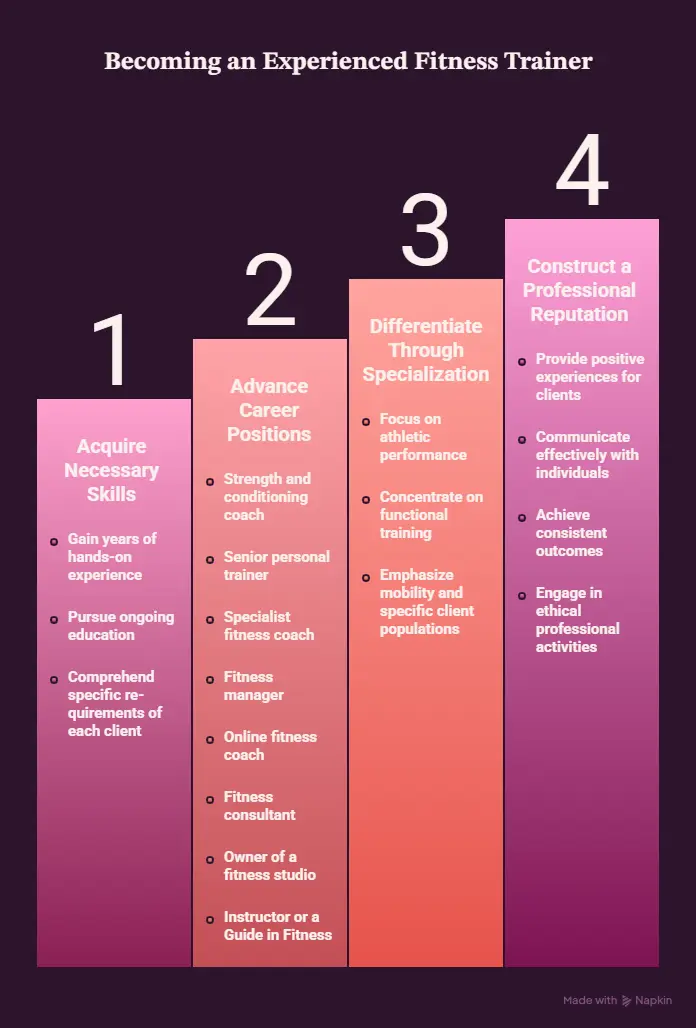
A common way for expert trainers to differentiate themselves from general fitness professionals is by developing a specialization in their field. The areas of athletic performance, functional training, mobility, or working with specific client populations may be the primary areas of concentration for these individuals.
In addition to this, it is essential to construct a solid professional reputation. It is possible for trainers to establish themselves in the field by providing positive experiences for their clients, effectively communicating with them, achieving consistent outcomes, and engaging in ethical professional activities.
Also read: Career Opportunities for Fitness Trainers in Kerala
Career Growth Tips
You should take into consideration the following job advice if you wish to advance from being a novice to becoming an experienced fitness trainer:
- To get started, obtain a qualification that is recognized: Using an adequate fitness training regimen, you can construct a solid foundation.
- Acquire hands-on experience by working with a variety of customers and gaining the ability to apply your knowledge in scenarios that pertain to the real world.
- Continue to educate yourself: Ensure that you are up to date on the latest discoveries in the fields of exercise science, training methodologies, and fitness technology.
- Select a particular area of expertise: Improving your knowledge and skills in a certain field can help you stand out from the crowd.
- Enhance your communication skills: One of the most significant aspects of performing personal training is being able to comprehend and inspire your clients.
- Develop your professional skills and connections: Establish connections with clubs, trainers, wellness professionals, and other fitness professionals.
- Work on developing your own personal brand: Your ability to reach potential customers can be facilitated by having a website that is informative or a professional presence on social media.
- Focus on the safety of the customer: It is important to adhere to established professional standards and refrain from providing advice that goes beyond your qualifications.
- Learning about marketing, budgeting, scheduling, and client management are all important business skills to acquire if you intend to work independently.
- Keep tabs on your advancement: Maintain a consistent review schedule for your credentials, experience, comments from customers, and professional aspirations.
Become a General Fitness Trainer and turn your passion into a Profession!
Turn Your Passion for Fitness into a Profession
Learn practical skills, get certified, and step into the growing fitness industry with confidence.
Join the CourseConclusion
A career as a fitness trainer has a lot of opportunities for professional growth and development. You can begin as an entry-level employee and obtain the experience you need to develop in the fitness business. This could lead you into personal training, specialty coaching, management or even starting your own fitness business. Gradually develop from a novice to an experienced fitness professional by becoming a certified fitness professional, continuing your education, and staying current with the industry norms.
Turn Your Passion for Fitness into a Profession
Learn practical skills, get certified, and step into the growing fitness industry with confidence.
Join the CourseFrequently Asked Questions
What qualifications do I need to become a fitness trainer?
Requirements vary by country and employer. Generally, aspiring trainers complete a recognised fitness or personal training certification and develop practical knowledge of exercise, safety, and basic anatomy.
Can fitness trainers work independently?
Yes. Experienced trainers may work as independent personal trainers, online coaches, consultants, or fitness business owners, depending on their qualifications and local requirements.
Is fitness training a good career option?
Fitness training can be a rewarding career for people interested in exercise, health, coaching, and working with clients. Career opportunities can expand as trainers gain experience and additional qualifications.
How long does it take to become a fitness trainer?
The time varies depending on the qualification and certification you choose. Basic training can often be completed in a few months, followed by practical experience.
Can I become a fitness trainer without a degree?
In many cases, a university degree is not required. A recognised fitness or personal training certification may be sufficient, depending on local requirements and employers.
Is online fitness coaching a good career option?
Online coaching can provide another career pathway for qualified trainers. It allows them to work with clients remotely and use digital platforms to deliver training programmes.
How can a beginner gain experience as a fitness trainer?
Beginners can gain experience through internships, gym-based roles, supervised training, practical placements, and working alongside experienced fitness professionals.