Table of Contents

How to Choose Your Points in a Group Discussion
Choosing the right points is important during GDs. Every statement should connect with the topic. Avoid speaking simply to increase participation.
Start by understanding the topic clearly. Identify its main issue and possible perspectives. Then select two or three strong points.
Consider these factors before speaking:
- Relevance: Stay directly connected to the topic.
- Clarity: Present one idea at a time.
- Logic: Support opinions with reasonable explanations.
- Examples: Use simple and relevant examples.
- Balance: Consider different sides of the issue.
- Current knowledge: Include recent developments when relevant.
- Originality: Add points others have not mentioned.
- Practicality: Connect arguments with real situations.
Avoid repeating another candidate’s argument. However, useful points can be developed further. For example, an earlier candidate may discuss AI productivity. A later speaker can discuss AI-related reskilling needs.
Become an HR Expert – Enroll in Our HR Management Course Today!
Unlock the secrets to effective Human Resource Management with our expert-led course! Learn recruitment, employee relations, performance management, and more to build a thriving workplace. Start your journey toward a successful HR career today!
Know MoreHow to Start, Participate and Conclude in a GD
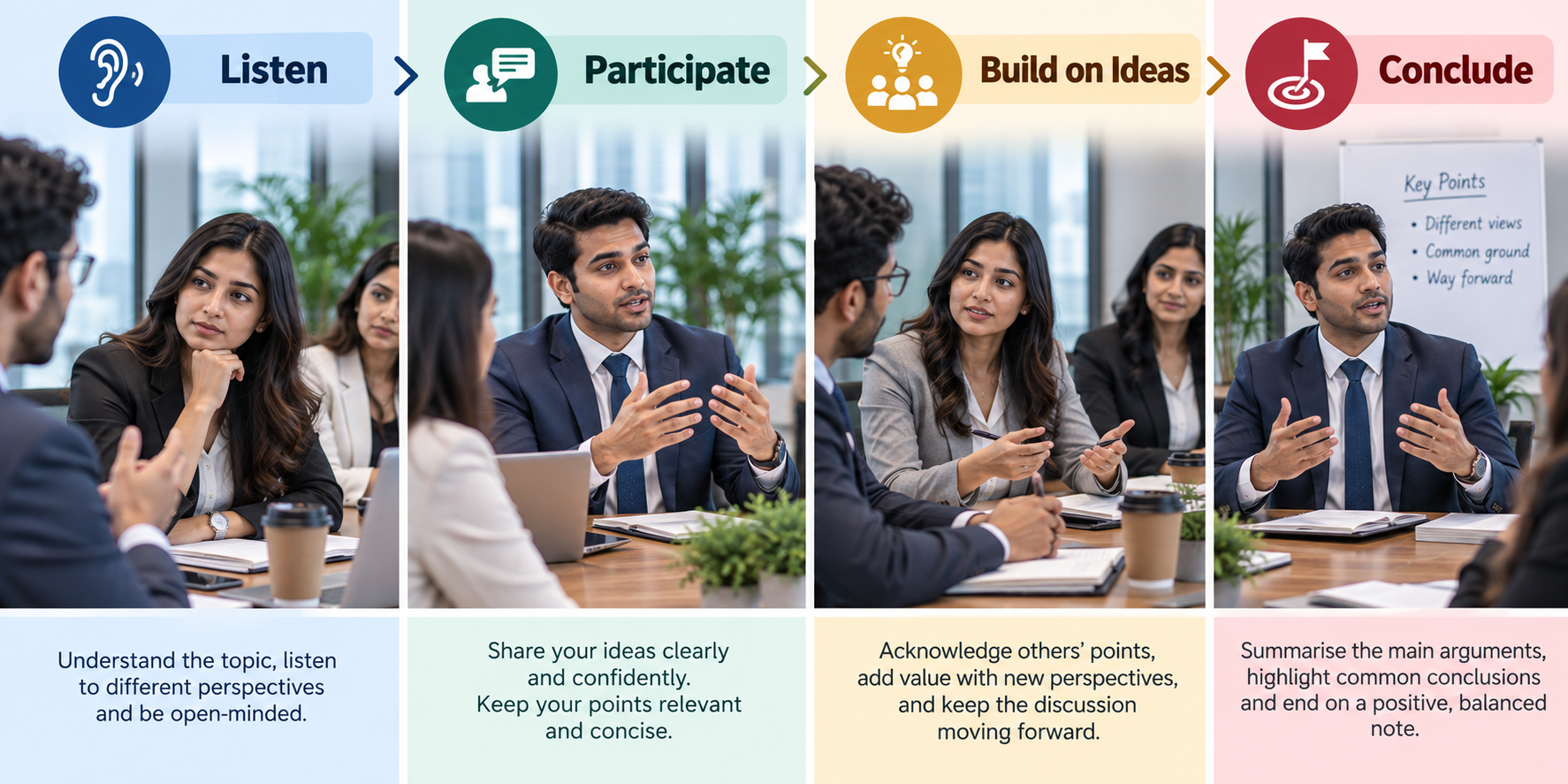
A GD usually has three important participation stages. These are starting, participating, and concluding.
How to Start a Group Discussion
Starting the discussion can create early visibility. However, the opening statement should be well-prepared.
A strong opening can follow this structure:
- Define the topic briefly.
- Explain its current relevance.
- Present the main issue.
- Mention two possible perspectives.
- Invite further discussion.
For example, consider “AI and the Future of Jobs.”
A candidate could begin by explaining AI’s workplace impact. Then, the discussion can cover productivity and employment. Reskilling can provide another important perspective.
Avoid giving an extremely long opening. Other participants need enough discussion space.
How to Participate Effectively
Good participation requires active listening. Listen carefully before presenting another point.
Useful participation techniques include:
- Build on existing arguments.
- Introduce relevant new perspectives.
- Ask useful questions when appropriate.
- Politely challenge unsupported claims.
- Connect multiple viewpoints.
- Give practical examples.
- Keep statements concise.
- Allow others to contribute.
- Maintain professional body language.
Interruptions should be avoided whenever possible. If interruption occurs, remain calm and continue later.
Useful phrases can also support smooth participation.
- “Adding to that point…”
- “Another perspective is…”
- “A practical example would be…”
- “There is another factor to consider…”
- “That point is relevant, but…”
- “A different viewpoint could be…”
How to Conclude a Group Discussion
The conclusion should summarise the main arguments. It should not introduce an entirely new topic.
A good conclusion can include:
- The central issue.
- Major arguments discussed.
- Important opposing viewpoints.
- A balanced final observation.
For example, an AI discussion may include benefits and risks. The conclusion can mention productivity alongside responsible implementation.
A conclusion should remain brief and neutral. It should reflect the group’s overall discussion.
Is being an HR your dream? Enrol now for our course on Human Resource!
GD vs Personal Interview: What Is Different?
Group discussions and personal interviews assess different behaviours. Both can appear during recruitment processes.

| Factor | Group Discussion | Personal Interview |
|---|---|---|
| Format | Multiple candidates | Individual candidate |
| Main focus | Group participation | Individual responses |
| Communication | Discussion-based | Question-and-answer |
| Teamwork | Highly visible | Less directly assessed |
| Leadership | Observed through interaction | Discussed through examples |
| Subject knowledge | Applied during discussion | Tested through questions |
| Interaction | Peer and evaluator interaction | Candidate and interviewer |
A personal interview focuses more on individual suitability. Questions may cover education, experience, skills, and career goals.
A GD focuses more on group behaviour. Recruiters observe communication, listening, reasoning, and teamwork.
Candidates therefore need different preparation strategies. Memorising interview answers alone is insufficient for GD preparation.
Common Mistakes Candidates Should Avoid in GDs
Several mistakes can reduce effective participation. Most mistakes involve communication or discussion behaviour.
1. Speaking Without Understanding
Candidates should understand the topic first. Random points can quickly become irrelevant.
2. Dominating the Discussion
Speaking continuously does not demonstrate teamwork. Allow other participants enough opportunities.
3. Remaining Completely Silent
Very limited participation makes skills difficult to assess. Candidates should contribute meaningful points.
4. Interrupting Constantly
Frequent interruptions can disrupt discussion flow. Wait for suitable opportunities to speak.
5. Repeating Existing Points
Repeating the same argument adds little value. Develop a fresh perspective instead.
6. Using Aggressive Language
Disagreement should remain respectful and professional. Personal criticism should always be avoided.
7. Giving Unsupported Claims
Opinions should have reasonable explanations. Current topics require especially careful factual accuracy.
8. Ignoring Other Participants
A GD is not a series of individual speeches. Candidates should respond to relevant points.
9. Losing Track of Time
Long explanations can reduce participation opportunities. Keep important arguments concise.
10. Using Memorised Speeches
Prepared knowledge is useful for GDs. However, rigid speeches may sound disconnected from discussion.
How to Prepare for Group Discussion Topics in 2026
Effective preparation should combine knowledge and communication practice. Candidates should prepare topics from multiple categories.
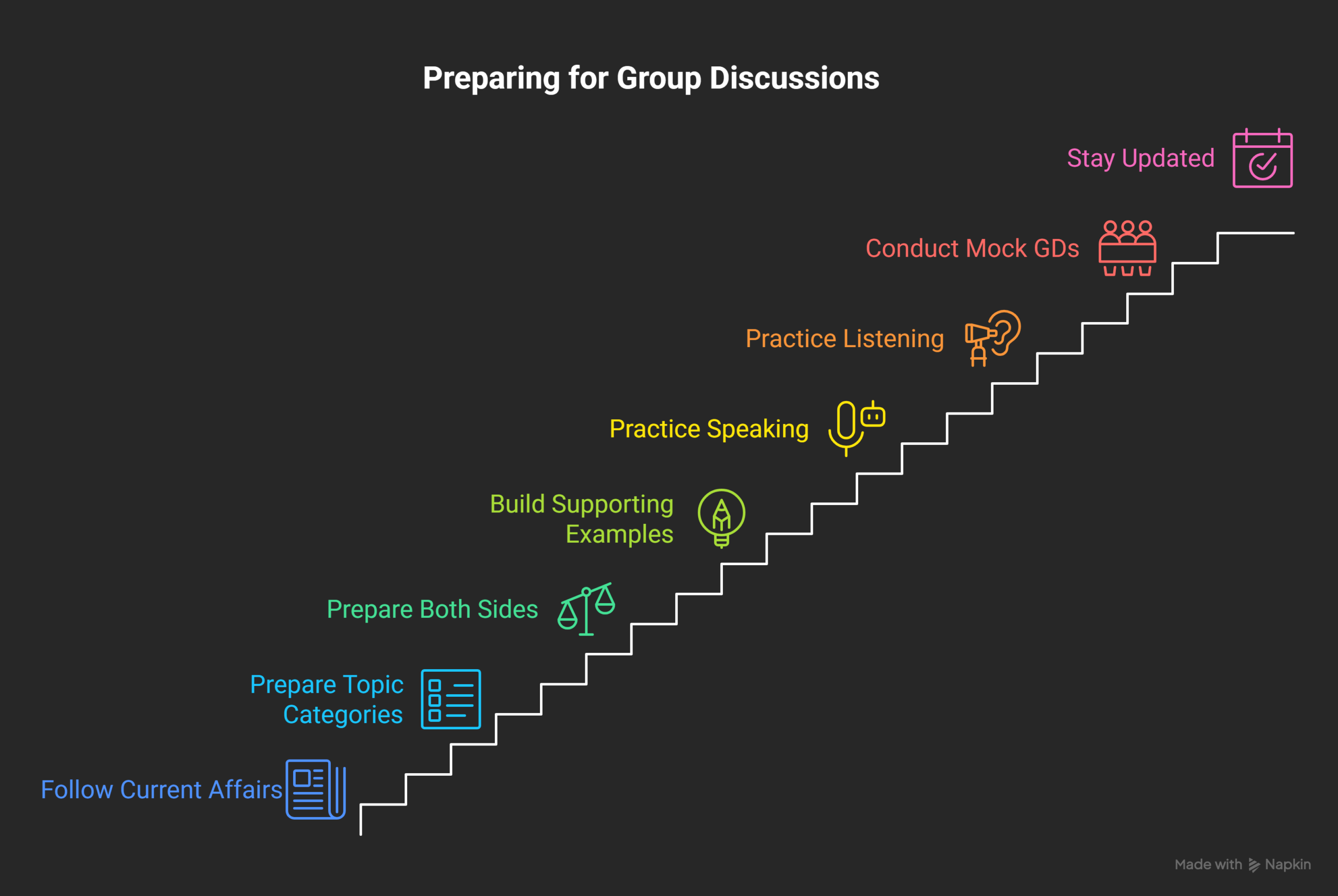
1. Follow Current Affairs Regularly
Read major national and global developments. Focus on business, technology, employment, and society.
2. Prepare Topic Categories
Create separate lists for major GD categories.
- Current affairs.
- Artificial intelligence.
- Technology.
- HR and workplaces.
- Business.
- Social issues.
- Ethics.
- Abstract topics.
This approach makes revision easier before interviews.
3. Prepare Both Sides
Avoid preparing only supporting arguments. Identify benefits, drawbacks, risks, and alternatives.
For example, remote work has several advantages. It can also create communication and collaboration challenges.
4. Build Supporting Examples
Examples make arguments easier to understand. Use businesses, workplaces, industries, or everyday situations.
5. Practice Speaking
Choose one topic each day. Speak continuously for two minutes.
Record practice sessions when possible. Review clarity, speed, and unnecessary repetition.
6. Practice Listening
GD performance depends heavily on listening skills. Practice summarising another person’s argument.
7. Conduct Mock Group Discussions
Mock GDs create realistic practice conditions. Include several participants with different viewpoints.
After every mock session, review:
- Number of useful contributions.
- Quality of arguments.
- Listening behaviour.
- Interruptions.
- Speaking speed.
- Confidence.
- Body language.
- Closing ability.
8. Stay Updated Before the Interview
Review recent developments shortly before the interview. This is particularly important for current-affairs topics.
What to Do After Clearing the GD Round?
Clearing the GD round usually means progressing further. The next stage depends on the employer’s recruitment process.
Candidates may face a personal interview next. Some organisations may include additional assessment rounds.
Preparation should continue immediately after the GD.
Focus on:
- Resume-based questions.
- Educational background.
- Internship or project experiences.
- Technical knowledge.
- HR questions.
- Company information.
- Career goals.
- Strengths and weaknesses.
- Situational questions.
The GD experience can also help prepare interview answers. Questions about teamwork and communication may refer to group activities.
Conclusion
Group discussions test more than speaking ability. They assess communication, teamwork, reasoning, and awareness. Preparing diverse topics can improve discussion readiness.
For 2026 interviews, AI and workplace trends deserve attention. Current affairs and business topics also remain relevant. Regular practice helps candidates participate with greater confidence.
Become an HR Expert – Enroll in Our HR Management Course Today!
Unlock the secrets to effective Human Resource Management with our expert-led course! Learn recruitment, employee relations, performance management, and more to build a thriving workplace. Start your journey toward a successful HR career today!
Know MoreFrequently Asked Questions
What is a GD in an HR interview?
A GD is a group-based discussion round. It evaluates communication and teamwork skills.
What topics are common in HR GDs?
Topics include AI, business, current affairs, and workplaces. Social and abstract topics are also common.
Which AI topics should candidates prepare?
Prepare AI and jobs, automation, and AI ethics. Generative AI is another useful topic.
How should candidates prepare for GD topics?
Follow current affairs and practise major topic categories. Mock discussions can improve preparation.
Should candidates speak first in a GD?
Speaking first can create early visibility. However, the opening should contain relevant points.
How many times should candidates speak?
There is no fixed number of times. Quality contributions matter more than frequency.
What skills are tested in a GD?
Recruiters assess communication, teamwork, and reasoning. Listening and leadership may also be observed.
Can abstract topics appear in HR GDs?
Yes, abstract topics can appear in GD rounds. They test creativity and logical thinking.
What mistakes should candidates avoid?
Avoid interrupting, dominating, and repeating points. Personal criticism should also be avoided.
How can candidates improve GD performance?
Practise speaking and listening regularly. Mock GDs can build confidence and discussion skills.