Table of Contents
The fastest way out for an unemployed BTech Electrical graduate right now is picking one in-demand specialization and building proof of skill in it.
Electrical engineering hasn’t shrunk as a field. It has simply moved, with the best-paying roles now sitting in embedded systems, EV/battery management, renewable energy and industrial automation rather than traditional core-sector jobs.
Fresher pay in these tracks realistically runs ₹3.5 LPA to ₹8 LPA, climbing to ₹9 LPA to ₹20 LPA within 3 to 7 years. This is for engineers who back their degree with tools like Embedded C, MATLAB/Simulink, PLC/SCADA or AutoCAD Electrical.
Master EV architecture with Hands-On Training at Entri App. Join Now!
Key Takeaways
- India’s graduate employability is 56.35% and unemployment 11.2%. This is a skills gap, not a job shortage.
- Top fresher pay for electrical grads: embedded systems, EV/BMS, renewables, automation (₹3.5 LPA to ₹12 LPA).
- Projects and certifications matter more than college brand.
- A focused 6-month plan can take most candidates from unemployed to job offers.
- Start with one project this week; consistency beats perfection.
Why Many Electrical Graduates Face Unemployment
Unemployment for BTech electrical graduates is like a blocked road, full of bumps. Reports show 83% of engineers are jobless or underemployed.
The unemployment isn’t really about a shortage of jobs. It is a mismatch between what colleges teach and what companies hire for.
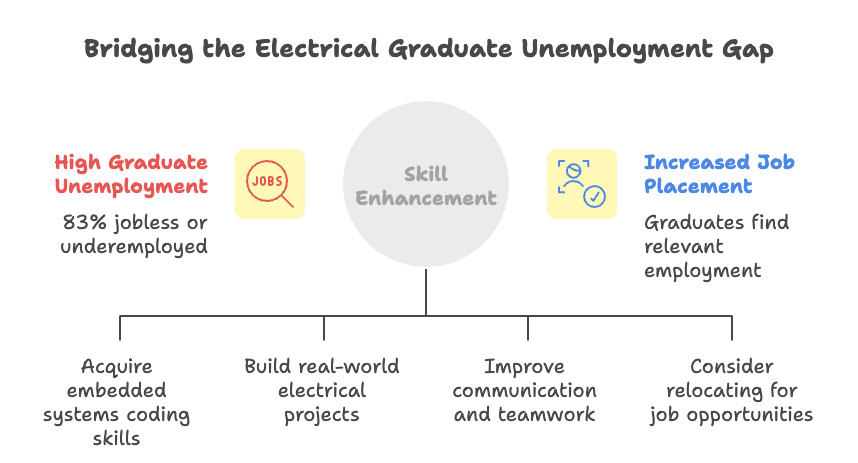
Here’s what’s actually driving it for electrical graduates specifically:
- Curriculum-industry gap:
Colleges still lean heavily on circuit theory and power systems, while employers want hands-on Embedded C, PLC/SCADA, MATLAB and PCB design experience.
- Volume vs. openings:
India produces roughly 1.5 million engineering graduates every year, and core-sector openings haven’t scaled at the same pace, so competition for traditional power-sector roles is intense.
- No project portfolio:
Employability studies have repeatedly found that a large share of graduates have never built a real project outside their syllabus, which shows up immediately in interviews.
- Tier-2/3 college disadvantage:
Placement support and industry tie-ups are thinner outside top-tier institutes, so students there need to build visibility themselves.
- Weak interview and communication skills:
Technical knowledge alone doesn’t clear panel rounds; structured explanation and problem-solving under pressure matter just as much.
Myths that Keep Graduates Stuck
|
Myth |
Reality |
| “A BTech degree guarantees a job” | A degree is an entry ticket; recruiters now hire on demonstrated skills and projects |
| “Only IIT/NIT graduates get hired” | Tier-2/3 graduates with embedded, EV or automation skills regularly land ₹4–8 LPA roles |
| “Government jobs are the only stable option” | EV, renewable energy and embedded-systems firms now offer comparable or better pay with faster growth |
| “You need an MTech to get hired” | A focused certification in Embedded C, PLC/SCADA or BMS often pays off faster than a two-year MTech |
Master Embedded Systems Programming!
Launch your tech career with our Embedded Systems Course, designed for hands-on learning and industry readiness.
Know MoreHigh-Paying Career Opportunities for Electrical Graduates
Electrical graduates have doors open, like windows in a power plant. High paying jobs wait in embedded systems, MEP, power, telecom. Here’s a look at top roles, pay, scope in India.
| Role | Fresher (0–2 yrs) | Mid-Level (3–7 yrs) | Typical Hiring Sectors |
| Embedded Systems Engineer | ₹4–8 LPA | ₹10–20 LPA | Automotive electronics, IoT, semiconductors |
| EV / Battery Management Systems Engineer | ₹6–12 LPA | ₹12–25 LPA | EV OEMs, battery and cell manufacturers |
| Power Electronics Engineer | ₹5–9 LPA | ₹10–20 LPA | EV, solar inverters, industrial drives |
| Automation / SCADA Engineer | ₹4–8 LPA | ₹10–18 LPA | Industrial automation, manufacturing, EPC |
| Renewable Energy Engineer (Solar/Wind) | ₹3.5–6 LPA | ₹8–15 LPA | Solar EPC, wind O&M, grid integration |
| Power Systems Engineer (PSU track) | ₹4–8 LPA (private) | Up to ₹14–22 LPA CTC in Maharatna PSUs | NTPC, Power Grid, BHEL and similar PSUs |
Embedded Systems Engineer
Embedded systems engineers build smart devices, like phones, cars. They code microcontrollers, fix circuits. For example, design a sensor for factory machines. Indian firms like Bosch, Tata need them.
Scope is big, market grows 30% yearly, NASSCOM says. Skills like C++, Python get jobs fast. So, learn embedded, land high pay.
MEP Engineer
MEP engineers plan electrical, plumbing, heating in buildings. They design wires, pipes for offices, hospitals. For example, set up lights, AC for a mall. Indian companies like L&T, Schneider hire them.
Demand rises with construction boom. Skills like AutoCAD, ETAP open doors. So, MEP is steady, pays well.
Power Systems Engineer
Power systems engineers manage electricity flow, like grids, plants. They fix faults, plan lines. For example, design a solar farm. PSUs like NTPC, BHEL recruit.
Senior roles hit ₹15 lakh. India’s power sector needs over1.2 million engineers by 2026. Skills like MATLAB, power tools help. So, power jobs offer security, good money.
Control Systems Engineer
Control systems engineers design automation, like robots, machines. They program PLCs, fix loops. For example, set up factory controls. Companies like Siemens, Honeywell hire.
With experience, pay reaches ₹10 lakh. Scope is high in manufacturing. Skills like SCADA, PLC get jobs. So, control work is future-proof, pays big.
Telecommunications Engineer
Telecom engineers build networks, like 5G towers. They test signals, fix lines. For example, install fiber optics. Firms like Bharti Airtel, Ericsson need them.
Telecom grows 12% yearly. Skills like MATLAB, networking open doors. So, telecom is fast, rewarding.
Electronics Engineer
Electronics engineers design circuits, devices. They test boards, fix signals. For example, build a smart watch. Companies like Texas Instruments hire.
Electronics market has crossed $70 billion. Skills like VLSI, PCB design help. So, electronics offers innovation, high pay.
Renewable Energy Engineer
Renewable energy engineers plan solar, wind setups. They design panels, grids. For example, build a wind farm. Firms like Adani Green hire.
With 3 years, pay hits ₹10 lakh. India’s renewable sector grows 20% yearly. Skills like solar design, MATLAB get jobs. So, green energy is bright, pays well.
Automation Engineer
Automation engineers program robots, systems. They fix loops, test controls. For example, set up factory arms. Companies like ABB need them.
Automation market booms in India. Skills like PLC, SCADA open doors. So, automation is future job, good money.
Project Manager
Project managers lead electrical projects, like power lines. They plan budgets, teams. For example, oversee a substation build. Firms like L&T hire.
Projects grow with infrastructure. Skills like MS Project, leadership help. So, management pays big for grads.
R&D Engineer
R&D engineers innovate, like new batteries. They test ideas, build prototypes. For example, design EV chargers. Labs like ISRO need them.
R&D grows 15% yearly. Skills like MATLAB, simulation get jobs. So, R&D offers creative work, high pay.
These roles pay ₹4–12 lakh for freshers. Embedded, MEP stand out for growth. Indian grads can land them with skills. So, pick one, learn, earn big.
Skills that Actually Get You Hired
Recruiters in 2026 screen for tool proficiency first and theory second. Build depth in one track rather than spreading thin across all of them.
- Embedded systems/IoT:
Embedded C/C++, microcontrollers (Arduino, STM32, ESP32, ARM Cortex-M), protocols (UART, SPI, I²C, CAN Bus), RTOS basics (FreeRTOS), and tools like Keil or STM32CubeIDE.
- EV/battery systems:
Li-ion and LiFePO4 battery basics, BMS architecture, power electronics (DC-DC converters, inverters), and simulation in MATLAB/Simulink or LTspice.
- Renewable energy/power systems:
AutoCAD Electrical, ETAP, PVSyst, load-flow and protection-coordination basics, and familiarity with smart grid or battery energy storage concepts.
- Automation/control:
PLC programming (Siemens, Allen-Bradley, Schneider), SCADA platforms (Wonderware, Ignition, WinCC), and industrial protocols like Modbus or Profibus.
Alongside tools, employers consistently flag communication, structured problem-solving, cross-functional teamwork and adaptability as the soft skills that separate shortlisted candidates from the rest. Technical ability gets you the interview, but these get you the offer.
Kickstart your embedded systems career and turn your tech passion into high-demand skills!
Roadmap for Unemployed Electrical Graduates
Unemployed grads have a path, like a road with signs. Follow this 6-month plan to land high paying jobs for unemployed BTech electrical graduates in embedded, MEP.
A Realistic 6-Month Roadmap
| Month | Focus | What to actually do |
| 1 | Pick a niche, close skill gaps | Choose one track (embedded, EV, renewable, automation); enrol in one focused online or offline course; put in 2–3 hours of daily practice |
| 2 | Build 3–5 portfolio projects | Ship small, real projects (e.g., ESP32 home automation, solar charge controller, PLC-based conveyor control); document each on GitHub and LinkedIn |
| 3 | Go deep on one tool, get certified | Master one primary tool in your track; complete one recognised certification and add it to your resume |
| 4 | Network and apply strategically | Optimise your LinkedIn profile, connect with 10–15 relevant professionals a day, and send 5–10 customised applications daily rather than mass-applying |
| 5 | Prepare for technical interviews | Revise core subjects, practise coding/technical problems relevant to your track, run mock interviews, and research target companies’ recent projects |
| 6 | Fill any remaining gaps | If offers haven’t come through, take on an internship or freelance project (PCB design, MATLAB simulation) to add real-world experience, then re-apply with an updated profile |
Roadmap Tips
- Track progress weekly, like a list.
- Invest on courses.
- Make 5 projects for resume.
- Apply to 100 jobs total.
- Network with 20 pros.
Master Embedded Systems Programming!
Launch your tech career with our Embedded Systems Course, designed for hands-on learning and industry readiness.
Know MoreConclusion
Being unemployed after a BTech in Electrical Engineering isn’t a dead end. It is a signal to redirect effort toward where the hiring actually is. Employability gaps are real and measurable. But so is the demand in embedded systems, EV, renewable energy and automation.
Pick one specialisation, build a handful of genuine projects, get one certification that matters, and apply with intent rather than volume. Most graduates who commit to this for even a few months see it turn into real offers.
Master Embedded Systems Programming!
Launch your tech career with our Embedded Systems Course, designed for hands-on learning and industry readiness.
Know MoreFrequently Asked Questions
Why do so many BTech electrical graduates stay jobless?
Too many graduates, too few jobs. India makes 1.5 million engineers yearly, but only 120,000 real jobs exist, per NASSCOM. Skills don’t match. Colleges teach theory, not coding or wiring.
What high paying jobs can electrical graduates get?
Jobs in embedded systems, MEP, power pay ₹4–12 lakh a year. Embedded engineers code smart devices, earn ₹4–7 lakh starting. MEP engineers design building wires, get ₹3.5–5 lakh. Power engineers manage grids, earn ₹4–6 lakh.
Is embedded systems a good job for electrical graduates?
Yes, embedded is like the brain of machines, perfect for electrical grads. They code microcontrollers, fix circuits. Demand is high, jobs grow 30% yearly. Indian freshers with C++, Arduino skills get hired fast. Mistakes like skipping coding hurt. Fix by learning C++ in 30 days. So, embedded is hot, pays big.
Can unemployed grads get jobs in Gulf countries?
Yes, Gulf jobs pay ₹8–15 lakh a year for electrical grads. UAE, Qatar, Saudi hire for MEP, power, embedded. For example, a Dubai MEP fresher earns ₹60,000 monthly with free housing. Indian grads need skills, English, visa. Pay is tax-free, savings are big. Living costs are high, ₹20,000 monthly rent. Mistakes like weak English hurt. Fix by practicing talks daily. So, prep well, move to Gulf, earn big.
What skills do employers want from electrical grads?
Employers want coding, software, problem fixing, like tools in a work bag. C++, Python for embedded. AutoCAD, ETAP for MEP. MATLAB for power. PLC, SCADA for automation. Fix by building 5 devices, like a temperature checker. Soft skills like talking, planning help too. Practice short talks, daily lists. So, learn 3 tech skills, 2 soft skills to land ₹5 lakh jobs.
How can grads build skills without a job?
Build skills like stacking bricks, one by one. Take online courses for C++, AutoCAD, ₹5,000–15,000. For example, learn Python in 30 days on YouTube. Do projects, like an IoT light switch. Use free tools like Arduino, Tinkercad. Join online groups for tips. Indian grads skip practice, a mistake. Fix by doing 2 hours daily. So, build 3 projects in 2 months, add to resume, get calls.
Is a certification helpful for unemployed grads?
Yes, certifications are like a golden key to jobs. Embedded systems, MEP, PLC courses cost ₹10,000–₹50,000. Indian companies like Siemens, L&T prefer certified grads. Online platforms offer short courses, 1–3 months. Mistakes like skipping certs keep you jobless. Fix by taking 1 course in 60 days. So, get certified, stand out, land ₹6 lakh roles.