Table of Contents
Are you wondering how to become a professionally qualified robotics developer? If you have the skills in robotics, electronics, sensors, software development and control systems, you can easily become a robotics developer. An upgraded skill set is the key to becoming a robotics developer.
You can start slowly by learning C/C++ and Python and gradually build advanced skills and tools to manage electronics. Unlocking the fundamentals of robotics and having a grip on microcontrollers such as Arduino or ESP32 will eventually help you to excel in the field of robotics development.
You can work with platforms such as Gazebo, ROS 2, computer vision, and simulation tools, along with expertise in robot programming to aid you in becoming a robotic developer.
-Learn the key concepts of Python, C++, robotics fundamentals and electronics to build a strong career in robotic development.
-Develop practical skills through hands-on experience with Arduino, ESP32 projects, Gazebo, and OpenCV.
– Document all the real-world projects and build a strong portfolio
Theoretical and practical knowledge is the key to success in the field of robotics development. The major qualification that one needs to have is a degree in electronics, robotics, computer science, electrical and mechanical engineering, mechatronics, or any fields associated with robotics as the base of a robotic developer.
Your practical knowledge in upskilling yourself in the tools and techniques is mandatory. You should practise and gain expertise in building robots; doing projects; practical assignments; documentation of work; handling industrial tools; internships; and competitions to secure experience as a robotic developer. You have to create a portfolio that reflects your knowledge, skills and expertise.
Technology is the key to the future. In the coming year, automation and robotics are going to rule the business industries. The skilled robotics developer is in high demand. Your skill set, experience and expertise definitely make a difference in your career path.
Why Robotics Development Is Becoming a High-Demand Career
Robotics is now the need of the hour. Robotics is used in different industries for conducting dangerous and physically challenging tasks. Robotics is used to automate tasks that are repetitive and dangerous at the same time. The manufacturing, healthcare, logistics, agricultural, automotive, inspection, and research sectors are widely using the services of robotics.
Robotics works alongside artificial intelligence, autonomous systems, IoT, computer vision, etc. Robotics is providing opportunities for individuals to learn and achieve highly demanding careers. Instead of just focusing on one single technical skill, robotics developers should focus on multiple skill developments since the field covers all areas of human intervention.
The core functions of robotics developers include:
- Robot programming
- Sensor integration
- Alignment with camera works
- Hardware-software connection
- Robot movement testing
- Simulation environment creation
Start learning robotics today! Build strong fundamentals with expert-led training.
Who Is a Robotics Developer?
A technologically qualified professional who tests and develops the software along with the hardware integration to ensure that the robots work on specific tasks. This is the major role of a robotics developer. The robotics developer also involves themselves in the processes mentioned below.
- Hardware-software integration
- Robotic system testing
- Software-hardware integration debugging
- Robot control program development
- Actuator and sensor integration
- Movement algorithm and navigation development
- Robot operating system regulation, control and working
- Communication interface building
- Computer vision implementation
- Robot simulation before the actual deployment
- Autonomous function development
Depending upon the demands of the organisation with which you work, the responsibilities of a robotics developer change. Robotics developers sometimes focus only on software development while others work alongside the engineering side.
Master Robotics and AI!
Ready to build the future? Join our comprehensive robotics course to bridge the gap between complex code and physical motion. You’ll gain hands-on experience giving you the technical edge needed to lead in the age of automation.
Know MoreSkills You Need to Become a Robotics Developer
Becoming a robotics developer is not an easy task. You should have the required skill sets to become a robotics developer. You need to have a combination of hardware, software, programming, problem-solving, and mathematics skills.
Programming Skills
This is the most crucial skill required for a successful robotic developer. You have to understand the working of the algorithm, debugging, data structures, and version control to perform well in the sector.
- You should have a thorough knowledge of Python for AI, robotics, data processing, automation and scripting.
- Basic command line and Linux skills
- C/C++ for robotics frameworks and embedded systems
Electronics
The interaction of the electronic components is crucial for robotics developers. You need to learn about sensors, motors, microcontrollers, current and voltage power systems and batteries, basic circuit design and protocols for communication.
- Your hands-on experience in handling development boards such as Arduino and ESP32 is quintessential.
Fundamentals of Robotics
Learn the fundamentals of robotics, which include feedback systems, dynamics, kinematics, coordinate systems, motion control, path planning, etc.
Mathematics
Your advanced robotics project definitely includes the basics of mathematical skills. This includes calculus, geometry, statistics, linear algebra, probability and trigonometry. The computer vision, localisation, control and robot motion areas revolve around your mathematical skills and knowledge.
Computer Vision and AI
The surroundings are interpreted by the camera and AI tools by the robots. The developers can have a strong grip on object detection, sensor fusion, image processing, machine learning, deep learning and so on.
Problem-Solving Skills
Troubleshooting is part of robotics development. To identify the core problem and give logical solutions to it requires problem-solving skills. In the case of robotic development, sensor noise, mechanical friction, calibration, wiring, or even power issues may occur all of a sudden, but a robotic developer should give solutions to problems without wasting time.
Educational Path to Become a Robotics Developer
The educational route to becoming a robotic developer is not simple. A bachelor’s degree is the most essential requirement to become a robotic developer.
- Computer science
- Electrical engineering
- Mechanical Engineering
- Robotic Engineering
- Mechatronic engineering
- Electronics and communication engineering
- Artificial intelligence
Students from other backgrounds can also become qualified robotic developers by working on relevant programming/electronics/robotics.
At the time of your graduation, you can gain practical knowledge and expertise along with the academic or theoretical knowledge. You have to participate in competitions, projects, conferences, research projects or internships to enhance your knowledge arenas. You have to create a strong portfolio to show your practical knowledge and skills.
Start learning robotics today! Build strong fundamentals with expert-led training.
Step-by-Step Roadmap to Become a Robotics Developer
Here is the proper guidance to become a robotics developer.
- Start with learning programming.
- Learn Python and C/C++ and slowly build small projects that include automation scripts, sensor data programs, microcontroller applications and so on.
- Learn the fundamentals of electronics.
- Gain practical knowledge in handling sensors, power supplies, motors, microcontrollers, and communication protocols. Start working on ESP32 and Arduino projects.
- Learn the fundamentals of robotics.
- Gain more knowledge about motion planning, robotic sensors, navigation, control systems and so on.
- Build small robots
- Enrich your portfolio by building small robots. Small projects such as robotic arms, line-following robots, and autonomous mobile robots will boost your productivity.
- Learn the key features of Linux. X
- Robotics development revolves around Linux. The package management, permissions, networking and scripting
- Learn ROS 2
- Modern robotics development can be explored with the aid of ROS 2 frameworks.
- Learn more about the messages, parameters, transforms, topics, nodes and so on.
- Learn simulation
- Instead of using physical hardware, you can test and develop simulations. Tools such as Gazebo can be used for proper simulation.
- Computer vision and AI addition
- You can use algorithms, cameras and machine learning techniques for advanced learning.
- Portfolio projects building
- Document the projects that you are undertaking. You can work on code, design, CAD models, testing process, improvements, etc.
- Gain First-hand industry experience
- Internship and research opportunities should be utilised and worked on
Master Robotics and AI!
Ready to build the future? Join our comprehensive robotics course to bridge the gap between complex code and physical motion. You’ll gain hands-on experience giving you the technical edge needed to lead in the age of automation.
Know MoreEssential Tools Every Robotics Developer Should Learn
A robotics developer should make use of the essential tools for the development of their career.
- Programming language
- Python and C/C++
- Robotics framework: ROS 2
- Simulation – Gazebo
- Computer vision – OpenCV
- Development platforms: Arduino, ESP32, ESP32, Raspberry Pi
- CAD Software – FreeCAD, AutoCAD, Fusion, Solidworks
- Version Control – Learn ESP32, Git and GitHub
Start learning robotics today! Build strong fundamentals with expert-led training.
Robotics Developer vs Robotics Engineer
Both these roles involve robotics, but both roles are different in their own terms. Understand the key difference between a robotics developer and engineer here.
| Robotics Developer | Robotics Engineer |
| Focuses on robot software | Focuses on the robot system |
| Generates and debugs code | Hardware and software design |
| Python, C++, ROS tools are used | Sensors, controllers and motors are the working associates |
| Software testing | Real-world robot validation |
| Limited hardware involvement | Extensive hardware involvement |
Industries Hiring Robotics Developers
Across multiple industries, robotics developers can be hired. Robotics developers are an in-demand career. The industries that hire experienced experts are listed below.
- Manufacturing Industry
- Robots are used for inspection, welding, material handling and production tasks.
- Automotive Industry
- Advanced driver assistance and vehicle manufacturing sections use robots for work.
- Logistics and warehouse
- Transportation, inventory management, picking, sorting and warehouse management use robots. Healthcare
- Deployed in laboratory automation, rehabilitation and surgery
- Agriculture
- Deployed in harvesting monitoring, spraying and precision farming
- Defence and Aerospace
- Inspection, remote operations, and specialised missions make use of robots
- Consumer technology
- Consumer products, vacuum cleaners, drones, service robots, and smart devices make use of robots.
- Research and education
- Autonomous systems, perception, control and AI are utilised in universities and laboratories.
Career Growth and Salary Prospects
Depending on education, skills, experience, expertise and technical expertise, the career growth of each individual can vary. The career ladder for a robotics developer is as follows:
- Robotics intern
- Junior robotics developer
- Robotics developer
- Senior robotics developer
- Robotics lead
- Robotics engineering
- Technical leadership
Experienced experts can move into sectors such as embedded robotics, computer vision, autonomous navigation, robotics software, and research and development.
The single salary description is unavailable for the robotics developer role. Based on the organisation’s policies, individuals can acquire financial stability and career growth.
Common Challenges in Robotics Development
Here is the list of common challenges faced by robotics developers
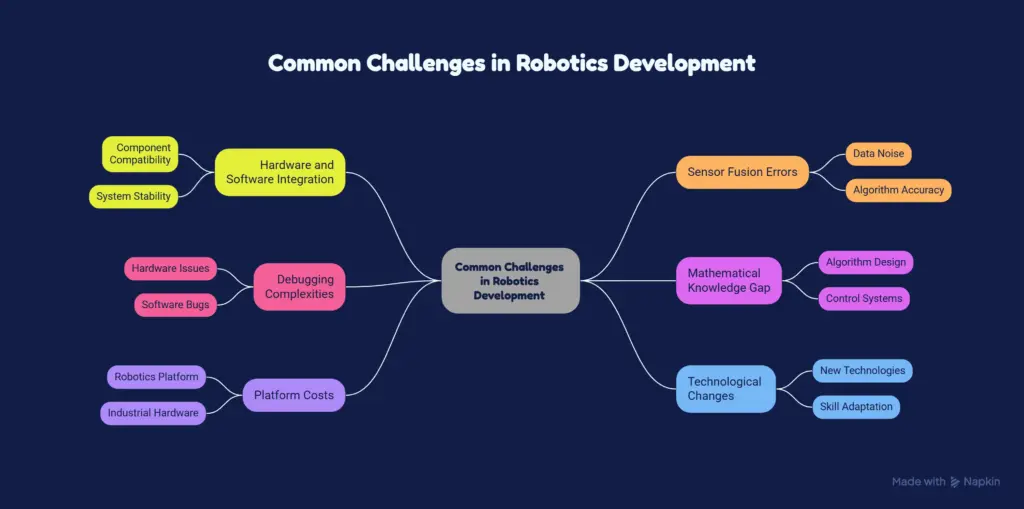
- Issues in hardware and software integration
- Filtering or sensor fusion errors
- Complexities while debugging hardware and software
- Lack of significant mathematical knowledge
- Expensive nature of the robotics platform and industrial hardware
- Rapid change in technology
Tips to Stand Out as a Robotics Developer
Here are the tips and tricks to survive in the robotics developer sector.
- Create a strong portfolio which includes your skills and experiences
- Work on real-world projects
- Learn to solve specific problems with robots
- Document the projects that you undertake
- Combine multiple skills to demonstrate your capabilities
- Work on debugging to avoid errors while using
- Participate in teamwork, projects, research competitions, etc. interdisciplinarily.
- Work on internships to gain industry experience
- Develop your skills in communication as you work interdisciplinarily.
Is Robotics Development the Right Career for You?
If you are strongly into machines, electronics, experimentation, technology and programming, robotics development will clearly excite you.
You can work on hardware and software integration, troubleshooting, working with motors and sensors, programming, and physical system building while upgrading yourself and learning multiple aspects.
Robotics can be challenging and rewarding at the same time. Robotics is an interdisciplinary field; if you have skills and interest in working in an interdisciplinary sector, you can go for a robotics developer career option.
Conclusion
The career of robotics developers is highly alluring. More than academic knowledge, you need practical skills and theoretical expertise combined to become a robotics developer. You need to understand mechanical systems, algorithms, electronics and sensors to become a qualified professional.
As a beginner, you can start with small projects and slowly move on to large-scale projects. You need to enhance and upgrade your skills to become a qualified robotic developer.
Master Robotics and AI!
Ready to build the future? Join our comprehensive robotics course to bridge the gap between complex code and physical motion. You’ll gain hands-on experience giving you the technical edge needed to lead in the age of automation.
Know MoreFrequently Asked Questions
Is robotics an interesting career option?
Robotics is an interdisciplinary field; if you have skills and interest in working in an interdisciplinary sector, you can go for a robotics developer career option.
How can you become a qualified robotic developer?
You can start slowly by learning C/C++ and Python and gradually build advanced skills and tools to manage electronics. Unlocking the fundamentals of robotics and having a grip on microcontrollers such as Arduino or ESP32 will eventually help you to excel in the field of robotics development.
Who is a robotic developer?
A technologically qualified professional who tests and develops the software along with the hardware integration to ensure that the robots work on specific tasks.
What is the major qualification to become a robotic developer?
The major qualification that one needs to have is a degree in electronics, robotics, computer science, electrical and mechanical engineering, mechatronics, or any fields associated with robotics as the base of a robotic developer.
Why problem solving skill is important for a robotic developer?
To identify the core problem and give logical solutions to the troubleshooting, a robotic developer needs requires problem-solving skills.
What are the key functions of a robotic developer?
The key functions of a robotic developer include robot programming, Sensor integration, Alignment with camera work, Hardware-software connection, robot movement testing, and simulation environment creation
What is the essential qualification to become a robotic developer?
A bachelor’s degree is the most essential requirement to become a robotic developer.