Table of Contents
Robotics is an in-demand career option for aspirants. The field of robotics has tremendously grown in the past few years. The prospects of robotics make it an in-demand career option for those who are looking for a stable job and income.
Many industries are looking for experienced experts to perform tasks such as solving errors and developing software that aids in performing the tasks of the robots. Industries are widely making use of modern technologies by creating robots in the real physical world.
-Python is the best beginner-friendly programming language for robotics development.
-C++ is integral for high-performance robots
-Based on your career goals, choose the programming language wisely
-Learn multiple programming languages to build a strong career in robotics.
Automation, programming, electronics, mechanical and software engineering and artificial intelligence are combined to build the robots.
These robots sense the environment using sensors, detect movement, and move using microcontrollers and perform the assigned tasks. The performance of the robots is controlled by the programming language. Even if you
To process sensor data, you need a programming language. The implementation of artificial intelligence, developing algorithms and data sensing are all controlled and enhanced with the aid of a programming language.
Your foundation should be strong enough to start a career in robotics. If you are an aspirant planning to start a career in robotics, get a strong command over the programming language. Based on the type of robotics system you wish to learn and work with, you can prioritise the programming language that you wish to develop.
Which Programming Language Should You Learn for Robotics?
As a robotics beginner, Python is the best programming language to learn and is widely used for AI, computer vision, machine learning and robotics development.
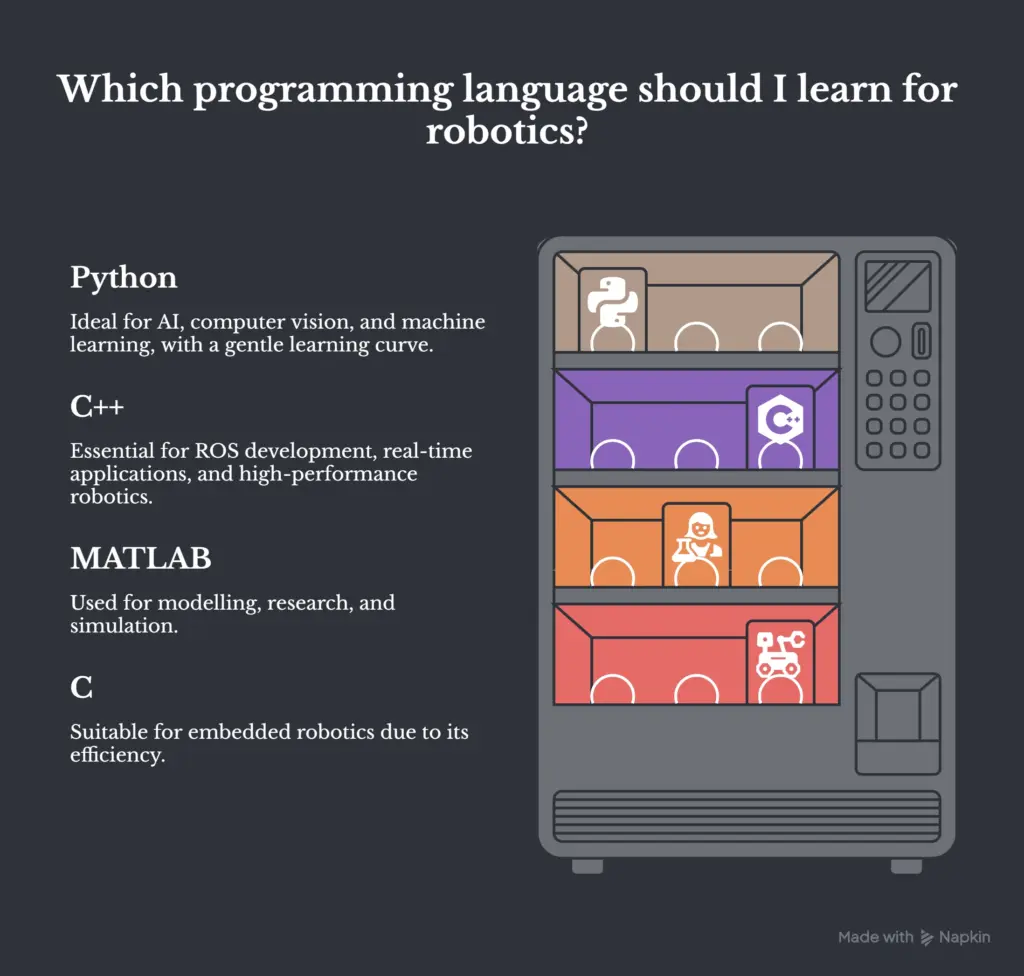
Another essential language that you can have a grip on is C++. C++ is recognised widely for its usage in ROS development, real-time applications and high-performance robotics.
MATLAB is used on a large scale for modelling, research and simulation. Meanwhile, embedded robotics uses the “C” language for its smooth working.
It’s better to begin with Python and slowly move towards C++
Why Programming Languages Matter in Robotics
To process the instructions and information and to interact with the real world, a robot needs guidance and instructions in a language it can process. The programming language plays a very critical part in making robots adhere to the instructions. To interpret the data, a robot makes use of the software to process sensor data and make decisions, controlling movement.
Movement and motors navigate the environment and communicate with other systems. The programming language affects the following aspects of your career –
- Hardware compatibility
- Real-time capabilities
- Speed of development
- Performance processing
- Career prospects
- Support on robotics frameworks
- Machine learning and AI integration
One of the fundamental skills required for the robotic engineer is to understand the language of the robot, i.e., understanding programming. To make the robot do the tasks assigned, you need to give the appropriate instructions. It is possible only if you have the skills to understand the programming.
Master Robotics and AI!
Ready to build the future? Join our comprehensive robotics course to bridge the gap between complex code and physical motion. You’ll gain hands-on experience giving you the technical edge needed to lead in the age of automation.
Know MoreBest Programming Languages for Robotics
Wondering which are the best programming languages for robotics? Explore here!
Python
Python is the most popular and best programming choice for beginners. The syntax of Python is simple, which makes it easier to learn and comprehend. Python supports data processing, computer vision, prototyping, embedded systems, robotics research and artificial intelligence.
C++
The performance-intensive applications of robots mainly make use of the
C++ programming language. C++ provides greater control over the robotic memory and system resources when compared to Python
C++ can be effectively used for the development of ROS, industrial robots, autonomous robots, and real-time robotic applications.
C
Programming of embedded systems, sensors, motor control, and microcontrollers that play an essential role in controlling the hardware of the robot makes use of C.
MATLAB
The mathematical modelling, simulation, algorithm development, academic research, control systems, and robotic research make use of MATLAB.
Java
The programming language Java can be used for robotics applications, Android-based systems, product- focused projects and education-based projects.
Start learning robotics today! Build strong fundamentals with expert-led training.
Programming Languages Compared
Python is the beginner-friendly programming language. Once you learn the fundamentals of Python, you can
Move on to the advanced level, which comprises C++ and C. While you explore the possibilities of hardware and associated systems, you require a programming language more than Python. The C and C++ languages come in handy there.
| Programming Languages | Best Application |
| Python | Beginner-friendly, AI, automation, ROS |
| C++ | ROS, high-performance applications, industrial robots |
| C | Sensors, microcontrollers, embedded systems |
| Java | Applications – Android-based mobile robotics |
| MATLAB | Algorithm development, research |
Which Language Should You Learn Based on Your Goal?
Based on your career objectives, the language you ought to learn changes. Here is the list of career paths along with the language you ought to learn:
Robotics projects are multidisciplinary; learning more than one programming language helps you to work at full swing. You can attain flexibility if you are up to learning multiple programming languages. This enhances your skills and expertise in the robotics industry.
| Programming Languages | Goal |
| Phython | Beginner |
| C++ | Industrial Robotics |
| C | Embedded Robotics |
| Java | Mobile Robotics |
| MATLAB | Research |
Start learning robotics today! Build strong fundamentals with expert-led training.
Master Robotics and AI!
Ready to build the future? Join our comprehensive robotics course to bridge the gap between complex code and physical motion. You’ll gain hands-on experience giving you the technical edge needed to lead in the age of automation.
Know MorePopular Robotics Frameworks and Their Preferred Languages
Popular robotics frameworks allow you to simply explore the tools that can help in robotics development. For robotics frameworks, you need to use specific languages to pursue the development of robotics. ROS 2 is the most essential technology to learn and understand the concepts of the software development of robots.
| Popular Robotics Framework | Programming Languages |
| ROS | Phython, C++ |
| Gazebo | C++ |
| Webots | C++, Java, Python |
| OpenCV | Phython, C++ |
| MATLAB Simulink | MATLAB |
| Arduino IDE | C++, C |
| Movement | C++ |
| ESP-IDF | C++, C |
Factors to Consider Before Choosing a Robotics Programming Language
As a beginner, you should be very careful before choosing the robotics programming language. Here are the factors that one should consider before learning the programming language.
Learning curve
As a beginner, you need to start slow. Python is the most beginner-friendly programming language. Once you learn Python, you can move on to C or C++.
Career goal
In AI robotics, choose the branch you wish to study. Based on the chosen branch and career development plan, you can easily choose the programming language you wish to pursue. Choose amongst autonomous vehicles, academic research, and industrial automation embedded systems as your area of study.
Hardware Requirements
If you work with microcontrollers, the C or C++ programming language is more suitable for your career growth and development.
Performance
Languages such as C++ are required for the high performance of the robots and real-time working environments.
Industry Demand
Research the industry demand and fix your career choice. Based on this, you have to identify the required language for your desired career path and learn the language accordingly to enhance your career prospects.
Start learning robotics today! Build strong fundamentals with expert-led training.
Real-World Applications
Throughout different areas of the robotics industry, the language requirements can vary. Your strong command of more than one programming language can help you excel at the application level of robotics.
- Industrial robots make use of C++ and other programming languages to handle the automation and control of the robots in real time.
- Autonomous vehicles make use of Python and C++ for AI-related navigation, development and perception in the physical world.
- Drones make use of C or C++ for flight control, whereas Python supports the higher-level applications of the system.
- Robot vision widely makes use of Python to work on machine learning and computer vision.
- Educational robots, on the other hand, make use of Python and C++ for learning and prototyping.
Advantages and Challenges of Popular Robotics Languages
Challenges are part of learning programming languages. Dive deep into the advantages and challenges of learning each programming language. No language is completely perfect for robotics. Every language has its own challenges and shortcomings.
| Programming Language | Advantages | Challenges |
| Python | AI support Easy learning Automation Rapid Prototyping Computer vision |
Slower compared to C/C++ Needs more time for intensive tasks |
| C++ | High Performance Used in ROS Popular in Industrial Robotics Memory Control |
Syntax is complex, and the learning curve is steeper. |
| C | Widely Used in Microcontrollers Embedded Systems SensorsHardware Control |
Complex software development is less convenient. |
| Java | Portable Widely Used in Android-based Robotics Object-Orientated |
Least common compared to Python or C++ |
| MATLAB | Used for Simulation,
Control Systems |
Less common in robot deployment and specialised software requirements |
Common Mistakes Beginners Make
While learning the robotics languages, it is common to make mistakes. These mistakes will empower you to learn more aggressively.
- Never put effort into learning multiple languages at the same time
- Never focus only on programming while ignoring electronics
- Never skip the fundamentals of programming
- Without working on projects, spending your entire time learning theory
- Stop by learning Python and ignore the importance of learning C++
- Completely ignoring robotics frameworks such as ROS
- Without having a thorough understanding, learning AI-generated code
- As a beginner, take it slow. Start with learning a single language and then slowly build upon it. Learn multiple languages and explore the vast possibilities of robotics.
Robotics Learning Roadmap
Here is the structured and practical roadmap for learning robotics programming.
- Learn the basic programming fundamentals.
- Begin with Python and start
- building new and simple projects
- Learn the fundamentals of actuators, sensors and electronics
- Explore the concepts of microcontrollers, Arduinos
- Tackle C++ for advanced programming
- Learn ROS 2 to enhance your knowledge arena
- Practise using Gazebo or Webots to have a real-time robotic experience
- Create a portfolio in GitHub after building real-world robotic projects
The combination of hardware knowledge along with programming and practical experience helps you advance in your career.
Conclusion
Python is regarded as the best programming language for you as a beginner. While moving on to the intermediate or advanced level, you can even depend on the C++ language.
For embedded systems, you have to use the C language, whereas for the purpose of simulation and academic research, you could make use of MATLAB.
Learn to choose based on your career goals and expand your skill sets once you learn the fundamentals. You have to build a strong foundation to excel in the robotics career path.
Master Robotics and AI!
Ready to build the future? Join our comprehensive robotics course to bridge the gap between complex code and physical motion. You’ll gain hands-on experience giving you the technical edge needed to lead in the age of automation.
Know MoreFrequently Asked Questions
For a robotics beginner, which programming language is best suited?
As a robotics beginner, Python is the best programming language to learn and is widely used for AI, computer vision, machine learning and robotics develop
Is it worth to learning more than one programming language at a time?
Your strong command of more than one programming language can help you excel at the application level of robotics.
Which are the most popular programming languages in Robotics?
Python, C++, C, Java, and MATLAB are the most popular programming languages in robotics.
What are the key advantages of learning Python?
The key advantages of learning Python are AI support, Easy learning, Automation, Rapid Prototyping and Computer vision
Where are programming language C best applicable in?
Sensors, microcontrollers, and embedded systems make use of the C language.
What are the key application area of MATLAB?
The mathematical modelling, simulation, algorithm development, academic research, control systems, and robotic research make use of MATLAB.