Table of Contents
You might be wondering whether someone can start a 3D printing business at home. And your answer is a big ‘Yes’; you can start a 3D printing business from home with high earnings. At home, you can start a 3D printing business by creating a small setup.
-A 3D printing business needs one reliable FDM 3D printer in a home setup.
-Understand the market and focus on the needs and profitable niche. Price based on the quality of materials, product development time, packaging cost, machine time and so on
-Never compromise on the quality of the products and keep on expanding your business
You can start small by selling customised products that are educational models, decorative items, and replacement parts.
You can also gradually move on to selling educational and engineering models and components at a reasonable price. From home, you can start a 3D printing business with relatively less cost and provide ample 3D printing services to customers.
Why Home-Based 3D Printing Businesses Are Growing
Owning a printer is only the first step of your business; it cannot define your success. Understanding the importance of 3D printing and the workings of the 3D printer can, however, create a business flow.
The first step of starting a 3D printing business from home is to own a 3D printer which focuses on quality, reliability and accessibility. The business success depends on various factors. Here is a list of factors that should be taken into consideration while looking forward to making 3D printing a source of income.
- Understanding the needs of your customers and aligning the designs to them
- Working nature of the 3D printer
- Maintaining the quality of the print
- Stressing the reliability part
- Choosing the best and the right niche
- Cost calculation in accuracy
- Proper sales channel building and trending
- Quick introduction of new designs
- Without the aid of expensive moulds, new prototypes can be created
- Can make use of online channels for business marketing
- Maintain standards while dealing with customer requirements.
As a beginner who is new to the field of 3D printing, you can firmly depend upon one reliable FDM 3D printer. At the budding stage, instead of investing in multiple machines to satisfy the print requirements, you can focus on a specific product category and fewer materials.
The success of every business starts with starting slow and aiming big. As a 3D printing business entrepreneur, you need to become more practical than simply wasting money and energy on multiple channels and machines.
The 3D printing business has gained more currency in recent times. People started to think about the various possibilities of 3D printing and look forward to making it a full-time business. 3D printing allows customers to have low-volume manufacturing needs satisfied.
Kickstart your embedded systems career and turn your tech passion into high-demand skills!
3D printing allows increasing the accessibility of customised 3D printing needs. More accessibility creates more requirements.
Without the aid of larger inventories, you can produce small quantities, and this makes the modern 3D printing business different from traditional ways. The flexibility in developing customised 3D prints makes the business more user-friendly and accessible.
As an entrepreneur who works from home, you need to narrow down the potential customers.
This includes
- Startups
- Robotics enthusiasts
- Designers
- Engineers
- Educators
- Students
- Local businesses
- Hobbyists
- Customers with keen eyes for customised products.
If you qualify as an MSME in India, you can directly register on the Udyam portal. Based on the self-declaration, you can register for free and explore vast possibilities of self-employment.
3D printing has changed the way small business entrepreneurs start approaching product development, along with customised manufacturing. On-demand printing of products based on requirements is possible while you start a 3D printing business at home.
The rise of mobile interest in DIY electronics engineering projects, robotics, gaming and personalised gifts has increased the chance of getting customers for small-scale 3D printing.
Decide What You Want to Sell
Instead of trying to sell everything, narrow down the specific 3D printing business niche.
Customised products
Creating personalised items is trending nowadays. Customised products differentiate themselves from the mass production, and this can benefit the small-scale 3D printing business.
- Key chains
- Phone stands
- Home decor
- Desk organisers
- Name plates
- Event accessories
Engineering and prototyping services
The prototyping services can be provided to customers who need to work on projects as part of their academic and practical needs.
- Startups
- Mechanical Engineers
- Robotics enthusiasts
- Product designers
- Engineering students
- Researchers
Replacement parts
The replacement parts, such as clips, holders, brackets, and mounts, can be provided to the customers. Before committing to such tasks, you need to ensure that the specifications and requirements are met in a satisfactory condition.
Educational products
The educational products, such as parts, prototypes, components, models and projects, can be printed out. The potential customers are the students. Their requirements can be of different kinds.
- Demonstration model
- Robotics part
- Mathematical models
- Engineering models
- Science projects
- Architectural prototypes
Master Embedded Systems Programming!
Launch your tech career with our Embedded Systems Course, designed for hands-on learning and industry readiness.
Know MoreWhat You Need to Get Started
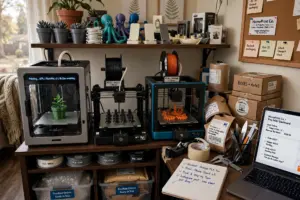
To start a small-scale 3D printing business at home, you need a relatively small setup and space instead of a large factory. You need certain things to enhance your business idea
A reliable printer
Based on the product you intend to sell, you have to choose an FDM printer. PLA and PETG materials can be used if you are using an FDM printer. The product quality will not be compromised at any cost.
CAD software
Customised services can be provided only if you have thorough knowledge of CAD software such as FreeCAD, Solidworks, Fusion, and so on.
Slicing software
Instructions required by the printer are converted from a 3D model with the aid of slicing software. Choosing the best slicing software works like magic.
Filament
The filament used for 3D printing is of utmost importance. You can choose PLA in the initial stage and slowly move towards PETG, TPU, or ASA based on the printer that you use in the advanced stage.
Basic tool requirement
As you are starting your business in a home setup, you need to arrange the basic tools before beginning the work. This includes
- Cleaning supplies
- Storage containers
- Digital calipers
- Screwdrivers
- Cutting tools
- Nozzles
Workspace
The workspace should be spacious and properly ventilated. The workspace should have filament storage and filament. Electrical safety should be ensured.
Packaging materials
The packaging must be clean and protective. It should enhance the need for customers to book again from you. The labels, shipping materials and boxes should be included in the proper packaging.
Business essentials
You have to be very careful in handling the business essentials. The tax registration, accounting, invoicing, local permission, payment system, etc. should be considered. Based on the business structure, the requirements can differ at any time.
Step-by-Step Guide to Starting Your Business
Before starting your 3D printing business from home, you need to have a proper understanding of how it should be done perfectly.
Choose a niche and start slow
Concentrate on a particular group of customers in the initial stage instead of serving everyone. You could start with 3D printing for electronics students, personalised gifts or robotics in the initial stages and slowly build upon them.
Market study
Research the demand for the items in the market and understand which products are trending. The buying trend should also be traced. Market study is essential to understand the demand and need for the products and limitations in the market.
Calculate costs
Filament cost should never be the product cost. You should include-
- Material
- Electricity
- Failed prints
- Profit
- Platform fees
- Design time
- Machine time
- Packaging
These costs should also be included in your calculation and are helpful in preventing yourself from underpricing.
Sample product creation
High-quality samples should be created. Sample products should be photographed from different angles, and the use should be made public for the purpose of marketing.
Pricing set-up
Customised orders and standard products should have different pricing rules. You can charge the customers for colour changes, custom designs, larger dimensions, urgent delivery, etc.
Branding
Develop your own brand by creating a business name, logo, and social media identity along with the product style. Your business presentation can make it more appealing and approachable.
Selling strategies
You can use Instagram, WhatsApp Business, a website, college communities, engineering groups, and online platforms as channels for marketing.
Collaboration
Collaborate with popular influencers or public figures to help your product reach people.
Customer feedback collection
Collect feedback from your customers and work on the areas where you could improve. The quality and product delivery can be improved.
Track orders and profits
Keep a record of the revenue, returns, failed prints and expenses, and identify whether the delivered products are profitable or not.
Gradual scaling
After you receive consistent orders, you can enhance the scaling by buying another printer and expanding your production.
Where to Find Customers
Finding customers is much more difficult than the production itself.
You can use social media platforms to find customers and influence them.
Social media
Instagram and Facebook are now used by many to enhance the brand. 3D printing can be visually demonstrated, and short videos can be consistently uploaded to add customer attraction.
WhatsApp business
Local customers can be lured with the aid of WhatsApp Business by providing the prices, description and product photographs.
College and educational institutions
Engineering colleges and colleges can be an easy customer hub for prototypes, models, project component printing and so on.
Local business
Local cafes, restaurants, event companies, retailers, and offices may need prototypes, fixtures or promotional products. Their aid can help you to grow your business.
Referrals
Customer satisfaction can be your next channel for marketing. Reviews and referrals on products before use and after use can help you to secure orders.
Kickstart your embedded systems career and turn your tech passion into high-demand skills!
Master Embedded Systems Programming!
Launch your tech career with our Embedded Systems Course, designed for hands-on learning and industry readiness.
Know MoreHow Much Can You Earn?
The 3D printing business from home is not based on fixed income. The pricing, paper utilisation, product and material cost of each item differ.
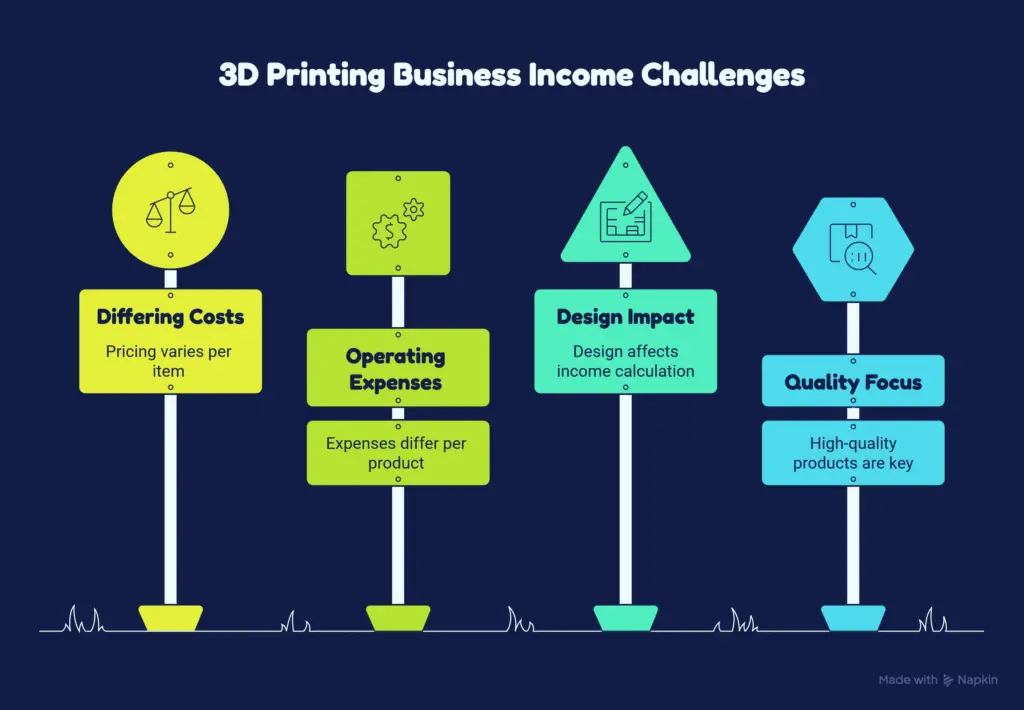
The operating expenses of products are different as well. So we cannot fix on a particular amount or income. The design and prototype of the work will be affected when calculating the income. Instead of selling low-priced products, you should deliver high-quality products.
The net profit of a product is calculated based on the sales revenue minus the total business cost.
Common Challenges and How to Overcome Them
Learn about the common challenges and the ways to deal with it here!
Failure in prints
Profitability can be reduced. The printer should be maintained neatly and carefully, and new designs should be tested before accepting larger orders.
Underpricing
Never ignore the machine time and labour while focusing only on the filament costs; this results in underpricing.
The pricing model should always include all the direct and indirect costs.
Inconsistent quality
Consistent quality should be maintained. Quality checks should be done frequently. The printer profiles, materials and colours should be standardised.
Long print times
The printing time increases if the products are large. Revenue should be analysed along with prioritising strong, profitable products.
Customer difficulties
Over-specifications and customer disagreements can happen. Specifications should be considered very carefully before production starts.
Intellectual property issues
Downloadable 3D models can or cannot be sold as physical products. The design license should be checked, and proper rights and ownership should be given to the rightful owners.
Tips to Grow Your Home-Based 3D Printing Business
Instead of buying multiple printers, you need to maintain consistency once the product starts selling. Your customers should connect with your products in a limited time. To do that, you need to build a recognisable niche.
The order value shall be increased with the aid of mass creation of product bundles and personalised versions. Design along with printing options shall be provided to the customers rather than simply sticking to printing. Designing and manufacturing the part will be taken care of as the best assurance that your brand can provide.
Catalogues on multiple products should be set for immediate needs. The profitable products should be identified, and less profitable ones should be ignored. The confirmation, tracking, and invoicing should be automated in the meantime once the product kicks in.
Kickstart your embedded systems career and turn your tech passion into high-demand skills!
Is Starting a 3D Printing Business Worth It?
A 3D printing business from home is worth starting. Approach it as a proper business. Customer needs should be satisfied, and customer service should be provided appropriately.
The selling of 3D printing is profitable if you know how to channelise your creativity and expertise in the right direction. Make sure to create customised prototypes and enclosures as per the needs of the customers. The financial risks will be tremendously reduced if you are starting slowly and gradually building upon it.
Final Thoughts
The small-scale manufacturing business is gaining more popularity now. The 3D printing business from home is the most accessible business, along with the possibility of expanding it.
Financial stability can be easily attained with a 3D printing business. Cost management, customer satisfaction, quality control, profit analysis, material management, CAD design and product selection should be done along with the 3D printing.
Start small and test a smaller number of products. Maintain consistency and know the market demand and requirements. The flexibility of 3D printing makes it easy for even homemakers to start a 3D printing business at home.
Master Embedded Systems Programming!
Launch your tech career with our Embedded Systems Course, designed for hands-on learning and industry readiness.
Know MoreFrequently Asked Questions
What is the first step of starting 3D printing business from home?
The first step of starting a 3D printing business from home is to own a 3D printer which focuses on quality, reliability and accessibility
What is the first step to start 3D printing?
You could start with 3D printing for electronics students, personalised gifts or robotics in the initial stages and slowly build upon them.
As a beginner which printer can be used for 3D printing business?
As a beginner who is new to the field of 3D printing, you can firmly depend upon one reliable FDM 3D printer.
What is the significance of workspace in starting 3D printing business at home?
The workspace should be spacious and properly ventilated. The workspace should have filament storage and filament. Electrical safety should be ensured.
What is the importance of collecting customer feedback in 3D printing business from home?
Collect feedback from your customers and work on the areas where you could improve. The quality and product delivery can be improved.
What is the signifance of choosing a reliable printer?
Based on the product you intend to sell, you have to choose an FDM printer. PLA and PETG materials can be used if you are using an FDM printer. The product quality will not be compromised at any cost.