Table of Contents
Robotics has now turned out to be the most popular sector where individuals are working enthusiastically, inventing, reinventing and building new technologies using robots. The robotics industry is transforming the outlook of the healthcare, manufacturing, logistics, automobile and aerospace sectors.
The robotics sector is closely aligned with the skills of a software engineer. Are you a software engineer looking for a career switch? If yes, this is the right time to explore the possibilities of robotics.
-Software engineers can easily transition to robotics by polishing their existing skills.
-Learn Python, algorithms, AI, C++ and software development to excel in your career.
-Bridge the gap between software and robotics by working on essential skills.
The skill sets required to excel in the field of robotics are closely associated with the software engineer. The debugging, programming, problem-solving, designing, mathematical, and analytical skills are essential skills required to build your career in the robotics sector.
If you are looking for a proper guide on how to transform your software engineering career into robotics, here is a complete guide on how you can transform yourself. As per your interest in AI automation, autonomous systems or industrial robots, you as a software engineer can transition your software engineering knowledge into robotics.
Can a Software Engineer Transition into Robotics?
If you are still wondering whether a software engineer can transition into robotics. It’s a yes. A software engineer with the required skill set, experience and knowledge can transition successfully into robotics.
The updated skill sets in programming, handling Python and C++, debugging, algorithms, and software development are highly recommended for robotics.
You can be job-ready in a limited period of time by learning the Robot Operating System (ROS), computer vision, control systems, embedded systems and sensors. Your enhanced practical knowledge and skills in handling real-world situations are of great importance.
You can convert your software development skills and expertise into robotics frameworks. Transition your expertise into working on hands-on projects and development of hardware fundamentals and integration.
The hiring team of a company will always look out for software developers who understand the pulse of the projects and how robots interact with the real world to create reliable software solutions.
Why More Software Engineers Are Moving into Robotics
Robotics is now in high demand. Due to the advancement of artificial intelligence, the robotics industry has gained high popularity. Most of the individuals are turning to robotics for better career prospects. Companies are looking for experienced software professionals who can diligently work on software development and intelligent robotic system updates and upgrades.
The sectors which require the assistance of robotics include
- Healthcare robotics
- Warehouse robotics
- Autonomous vehicle
- Consumer robotics
- Industrial automation
- Agricultural automation
These major fields point out the fact that robotics is an in-demand career. The career opportunities for software engineers are high. The demand for software engineers in robotics should be considered a positive sign of career growth.
If you are willing to expand your skill sets and upgrade yourself for the next level of growth, you can definitely climb the ladder of success.
Start learning robotics today! Build strong fundamentals with expert-led training.
Master Robotics and AI!
Ready to build the future? Join our comprehensive robotics course to bridge the gap between complex code and physical motion. You’ll gain hands-on experience giving you the technical edge needed to lead in the age of automation.
Know MoreWhich Software Engineering Skills Already Give You an Advantage?
The skills of a software engineer can already be transformed into the robotics field. Here is the list of skills that are identical to both sectors.
| Skills | Advantage |
| Python | Automation, AI, ROS scripting |
| C++ | High applications, robot control system |
| Git | Version control |
| Debugging | Troubleshooting |
| Machine Learning | Autonomous decision-making |
| Algorithm | Navigation |
| APIs | System integration |
| Backend development | System integration |
| Computer Vision | Perception and detection |
| Data structures | Robot software |
Your knowledge and expertise in computer vision, machine learning and backend systems will allow you to excel in robotics development. These are the key concepts upon which the entire robotics sector revolves.
Skills You’ll Need to Learn for Robotics
You already have various skill sets that are required to excel in the robotics sector. But that is not enough. You have to evolve yourself. Learn new skills daily. You have to focus on learning additional advanced skills to transition yourself to the next level.
- Embedded systems – Learn ROS
- The working nature of Arduino, Raspberry Pi, and microcontrollers should be tackled. Robot Operating Systems (ROS) – Learn about the robotics frameworks that are part of industry standards.
- Control systems – Knowledge of PID controllers and robot movements and management
- Sensors – Learn more about IMUs, LiDAR, cameras, and Ultrasonic sensors
- Computer Vision – Learn object detection and navigation systems using OpenCV
- Simulation Tools – Learn and practise using Webots or Gazebo before working with real robots in a real working environment.
Start learning robotics today! Build strong fundamentals with expert-led training.
Software Engineering vs Robotics Engineering
Both software and robotics development focus on human assistance. Software development is a part of robotics engineering. Along with software development, machine learning, problem solving, embedded systems and electronics are combined together to solve real-world problems.
| Features | Software engineering | Robotic Engineering |
| Focus | Software systems and applications | Physical systems and robots |
| Programming Language | Python, Java, C++ | Python, C, C++ |
| Hardware Knowledge | Minimal | Essential |
| Testing | Software testing | Hardware and software testing |
| AI Integration | optional | Common |
| Core skills | Databases, coding, software design, algorithms | Control systems, electronics, programming |
Master Robotics and AI!
Ready to build the future? Join our comprehensive robotics course to bridge the gap between complex code and physical motion. You’ll gain hands-on experience giving you the technical edge needed to lead in the age of automation.
Know MoreStep-by-Step Roadmap to Transition into Robotics
As a software developer, all you have to do is understand the structured roadmap to become a robotics engineer.
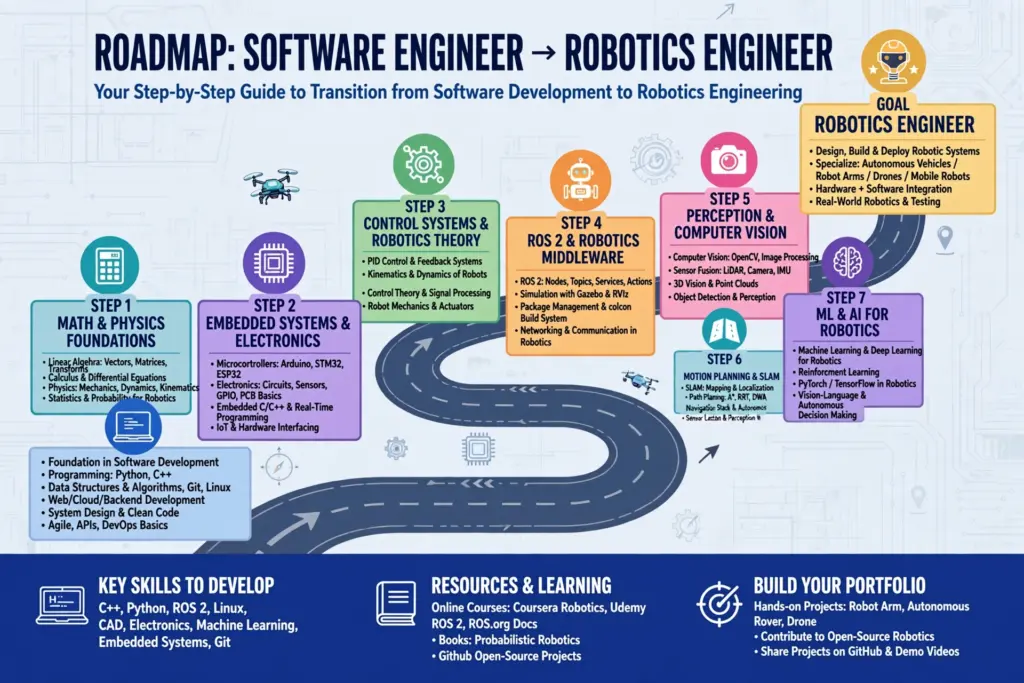
- Learn the programming language Python
- Understand Linux fundamentals, especially Ubuntu
- Master the core elements of ROS for the development of robotics
- Learn more about movements, microcontrollers, embedded systems and electronics
- Understand the concepts revolving around sensor integration
- Practise OpenCV for getting a grip on computer vision
- Work on practical robotic projects and document your work.
- Develop a GitHub portfolio to demonstrate your work
The gap between software development and robotics will thus be levelled up, and now you are truly ready for exploration in the robotics sector.
Start learning robotics today! Build strong fundamentals with expert-led training.
Recommended Learning Path
Here is a smooth practical learning roadmap for you to transform yourself from a beginner to the intermediate or advanced level. You can enhance both your technical and practical knowledge through experience and dealing with real-world scenarios.
| Learning Stage | Area of Focus |
| Beginner | Python, Programming basics, Linux |
| Intermediate | Arduino, Electronics, ROS 2 |
| Advanced | OpenCV, C++, robotics algorithms |
| Professional | Portfolio building, real-world projects, internships |
Essential Tools Every Aspiring Robotics Engineer Should Know
Tools are required to enhance your skill set. As an aspiring robotics engineer, you need to get a handle on the tools that are widely accepted and used in the robotics industry.
- ROS
- Arduino
- Raspberry Pi
- Webots
- Ubuntu Linux
- Gazebo
- GitHub
- OpenCV
Your knowledge in using these tools improves your chances of getting hired by the most reputed organisation. Understanding the tools and applying them in the right context makes you an excellent career candidate.
Robotics Projects That Strengthen Your Resume
Your practical skills improve your chances of employability. Hands-on project experience is more valuable than theoretical knowledge or certifications.
Your practical knowledge is the key to unlocking better prospects in the robotics field. If you can work on projects that expose you to real-world scenarios, your expertise will increase. Here is the list of projects that you can work on as a beginner.
- Obstacle-avoiding robot
- Robotic arm controller
- Line-following robot
- Object detection robot
- Autonomous mobile robot
Make sure to document all the projects with detailed explanations, videos, and code on GitHub to enrich your portfolio.
Industries Hiring Robotics Engineers
Across the globe, industries are in search of qualified robotics engineers. Robotics is an in-demand career. The defence, healthcare, manufacturing, logistics, aerospace, agriculture and consumer electronics industries are in search of qualified robotics engineers to facilitate smooth and innovative workflows.
Many industries are in direct search for professionals who could combine software expertise with the robotics sector to create error-free solutions in ten industries.
Common Challenges During the Transition
While transitioning to the robotics sector, you as a software engineer may encounter various challenges, which include the following:
- Debugging issues of hardware
- Thorough understanding of mechanical concepts
- Learning the fundamentals of electronics
- Working conditions of a Linux environment
- Real-time system management
These challenges can be easily overcome with the aid of regular hands-on practical experience.
Benefits of Switching to Robotics
The advantages of switching to the robotics sector are as follows:
- Integrating work with AI and the opportunity to improve your productivity
- Strong career progression
- Highly competitive salary scale
- Cross-disciplinary skill enhancement and growth
- Global-level employment opportunities
The robotics field develops software that demonstrates direct interaction with the physical world. This improves the chances of developing robots in real time.
Is a robotics certification or course worth it?
Yes, especially when you are switching careers, your certification in robotics and courses are worth it. The structured training programme can boost your productivity and performance. With a comprehensive robotics course, you can learn ROS systematically; an industry-ready portfolio can be easily built.
You will be guided throughout the process and can gain excellent mentorship support. You will be well prepared for the robotics interview as well. Along with the theory, you need to place stress on practical projects as well. While choosing the course, make sure that you are opting for a course that gives more priority to practical knowledge and hands-on projects along with the theoretical framework.
Career Opportunities After Transitioning
The initial step is to develop the essential knowledge and skills required for transitioning your position from software engineering to robotics engineering. The next step is to pursue other job roles, such as:
- ROS Developer, Robotics Software Engineer
- Automation Engineer
- Computer Vision Engineer
- Embedded systems engineer
- AI robotics engineer
- Autonomous systems engineer
These career roles combine both software engineering skills and robotic technologies to enable a more flexible workforce.
Final Thoughts
The transition from robotic engineering to software engineering is not a difficult career choice at all. In fact, with the acquired skill sets, experience and training, you can easily switch your career.
As the world is complex and automated, the career opportunities are too. Robotics is now an in-demand career. Your experience in software development has given you a strong foundation. You have to get a strong understanding of embedded systems, sensors, controllers, ROS and computer vision to excel in the robotics field as well.
Learn in a structured manner with projects and real-world exposure. Build a strong portfolio to demonstrate your knowledge and expertise in the field. With confidence and effort, you can successfully transition into the robotics industry.
Master Robotics and AI!
Ready to build the future? Join our comprehensive robotics course to bridge the gap between complex code and physical motion. You’ll gain hands-on experience giving you the technical edge needed to lead in the age of automation.
Know MoreFrequently Asked Questions
Is Robotics an in- demand career?
Companies are looking for experienced software professionals who can diligently work on software development and intelligent robotic system updates and upgrades.
What is computer vision?
Computer vision is the skill required to learn object detection and navigation systems using OpenCV in Robotics development
Which industries are hiring qualified robotic engineers in large scale?
The defence, healthcare, manufacturing, logistics, aerospace, agriculture and consumer electronics industries are in search of qualified robotics engineers to facilitate smooth and innovative workflows.
Is transition from software engineer to robotic engineer really possible?
Yes. You can convert your software development skills and expertise into robotics frameworks. Transition your expertise into working on hands-on projects and the development of hardware fundamentals and integration.
What is the connection between software development and robotic engineering?
Software development is a part of robotics engineering. Along with software development, machine learning, problem solving, embedded systems and electronics are combined together to solve real-world problems.