Table of Contents
Ideal Team Size for Workplaces: The Quick Answer
An ideal team has 5 to 9 members. However, no universal team size works everywhere. Smaller teams often communicate faster and coordinate better. They also create clearer ownership for tasks.
The right size depends on a lot of factors. Which include workload, goals, roles, and complexity. Teams expand when workloads exceed capacity. New skills require additional members.
Key Takeaways:
- 5–9 members suits many workplace teams.
- Smaller teams often support faster decisions.
- Complex work may require larger teams.
- Workload should guide team size.
- Teams should expand when capacity becomes limited.
Is being an HR your dream? Enrol now for our course on Human Resource!
Why Team Size Matters in the Workplace
Team size directly affects performance of the workplace. It influences communication. It also effects collaboration, and decision-making. Team size also shapes employee relationships and accountability.
Smaller teams usually have simpler communication structures. Members can share information more quickly. They can also resolve issues without delays. Everyone usually understands their responsibilities clearly.
Larger teams create different workplace dynamics. More members bring diverse skills and experiences. However, communication becomes more complicated. More opinions can also slow decisions.
Team size also affects management requirements. Managers must coordinate tasks across team members. Larger teams require stronger coordination systems. They may also require additional leadership layers.

Several workplace outcomes depend on team size:
- Communication:
- Smaller teams communicate more directly.
- Collaboration:
- Fewer members simplify coordination.
- Accountability:
- Individual contributions become easier to identify.
- Decision-making:
- Smaller groups often reach decisions faster.
- Innovation:
- Moderate diversity can encourage new ideas.
- Workload:
- Larger teams can distribute tasks better.
- Management:
- Larger teams require stronger oversight.
- Engagement:
- Smaller teams may feel more connected.
The goal is not maximum team size. The goal is effective collaboration. Teams need enough people for their responsibilities. They also need manageable communication and coordination.
Become an HR Expert – Enroll in Our HR Management Course Today!
Unlock the secrets to effective Human Resource Management with our expert-led course! Learn recruitment, employee relations, performance management, and more to build a thriving workplace. Start your journey toward a successful HR career today!
Know MoreWhat Is the Ideal Team Size?
Most workplace work well with 5 to 9 members. This range balances collaboration. Individual accountability is also taken care. It also supports diverse skills without excessive complexity.
Teams of three to five members offer simplicity. Communication remains direct and highly manageable. Members can also develop stronger working relationships.
Teams with five to nine members offer greater flexibility. They can include several complementary skills. They can also distribute responsibilities more effectively.
Teams above nine members need additional structure. Communication paths increase as membership grows. Meetings can also become longer and less focused.
Team size should therefore match the team’s purpose. Different workplace functions need different staffing levels.
Consider these common team-size situations:
- 3–5 members: Suitable for focused projects.
- 5–9 members: Suitable for many workplace teams.
- 10–15 members: Suitable for broader responsibilities.
- 15+ members: Better managed through smaller subteams.
A large team does not automatically perform poorly. Its structure determines much of its effectiveness. Clear roles can reduce coordination problems significantly.
There is also an important distinction here. Team size differs from department size. A department may have dozens of employees. Those employees can work within smaller teams.
For example, a marketing department may have 30 employees. Those employees could form several specialized teams. Each team can handle a specific business function.
The ideal team size also changes over time. Early projects may need fewer specialists. Growth can create new workload requirements. Organizational changes may require different team structures.
Therefore, team size should remain flexible. Managers should review team capacity regularly.
What Determines the Right Team Size?
Several factors determine an effective team size. Organizations should consider these factors before adding members.
1. Nature of the Work
Different tasks need different team size. Routine work need fewer specialized members. Complex projects require broader expertise.
Simple tasks often suit smaller teams. Complex tasks can require multidisciplinary collaboration.
2. Project Complexity
Complex projects involve multiple responsibilities. They may require several specialized skills. Larger teams can provide that expertise.
However, adding members can increase coordination demands. Teams should avoid unnecessary staffing.
3. Workload
Workload is one of the major staffing consideration. Employees must have enough capacity for responsibilities assigned.
Excessive workloads means understaffing. Persistent workload pressure reduce performance.
Managers should monitor:
- Task volume.
- Deadlines.
- Employee capacity.
- Overtime requirements.
- Unfinished work.
- Service delays.
- Quality problems.
These indicators can reveal staffing gaps.
4. Required Skills
Teams need the right combination of skills. More employees do not always solve skill shortages.
Managers should first identify capability gaps. Then they can determine appropriate staffing needs.
A smaller team with strong skills may outperform. A larger team with overlapping skills may struggle.
5. Communication Requirements
Communication becomes harder with larger teams. Every additional member creates more interaction possibilities.
Smaller teams usually need fewer coordination processes. Larger teams need clearer communication systems.
Managers should consider:
- Meeting frequency.
- Reporting structures.
- Communication channels.
- Decision-making processes.
- Information-sharing requirements.
These factors become increasingly important as teams grow.
6. Team Interdependence
Some employees depend heavily on others. Such teams require frequent coordination.
High interdependence can increase communication demands. Smaller teams may handle these relationships better.
Independent tasks can support larger team structures. Members need fewer interactions to complete work.
7. Leadership Capacity
Managers can only provide limited individual attention. Larger teams increase management responsibilities.
A manager with too many direct reports may struggle. Coaching and feedback can become less frequent.
Organizations should consider management capacity carefully. Additional leadership may become necessary during growth.
8. Business Goals
Team size should support organizational objectives. Growth targets may require additional specialists.
Cost reduction may encourage leaner teams. Innovation goals may require broader expertise.
Therefore, staffing decisions should follow business priorities.
9. Technology and Collaboration Tools
Technology can improve communication across larger teams. Project management tools can also improve coordination.
However, technology cannot eliminate every communication problem. Human interaction still requires effective team structures.
10. Employee Experience
Experienced employees may handle broader responsibilities. Newer employees may need closer guidance.
Teams with inexperienced members may need stronger support. Managers should consider this when setting team size.
11. Deadlines and Time Pressure
Urgent projects may require additional team members. Tight deadlines can increase workload rapidly.
Temporary staffing can sometimes solve these challenges. Permanent expansion may not always be necessary.
12. Customer and Service Requirements
Customer-facing teams may need sufficient coverage. Service delays can indicate inadequate staffing.
Customer demand should influence team capacity. Seasonal demand may also require temporary expansion.
Overall, the right team size balances several needs. It should support productivity without creating unnecessary complexity. The best size remains practical and adaptable.
Is being an HR your dream? Enrol now for our course on Human Resource!
Small vs. Medium vs. Large Teams
Workplace teams generally fall into three broad categories. Each category offers different strengths and challenges.

Small Teams
Small teams usually contain 3 to 5 members. They provide direct communication and strong collaboration.
Members often understand each other’s responsibilities clearly. Decisions can also happen quickly.
Advantages include:
- Faster communication.
- Easier decision-making.
- Stronger personal connections.
- Clearer accountability.
- Fewer coordination issues.
- Greater flexibility.
However, small teams have limitations. They may lack specialized skills. Employee absence can also create significant gaps.
Small teams work well for focused responsibilities. They suit startups, projects, and specialist functions.
Medium Teams
Medium teams usually contain 5 to 9 members. This size often balances expertise and coordination.
These teams can include diverse professional skills. They can also distribute responsibilities effectively.
Advantages include:
- Balanced workload distribution.
- Broader skill coverage.
- Manageable communication.
- Strong team relationships.
- Reasonable management requirements.
- Better project flexibility.
Medium teams often suit business functions well. They can handle moderate project complexity effectively.
Large Teams
Large teams usually contain 10 or more members. They provide greater workforce capacity and diversity.
These teams can manage broader responsibilities. They can also support complex operational requirements.
However, communication becomes more challenging. Meetings may become longer and less productive.
Common challenges include:
- More communication channels.
- Slower decision-making.
- Greater coordination requirements.
- Reduced individual visibility.
- More potential conflicts.
- Higher management demands.
Large teams benefit from clear structures. Subteams can make large groups easier to manage.
For example, 15 employees could form three subteams. Each subteam could contain five members. Team leaders could then coordinate broader objectives.
The best structure depends on workplace requirements. Size alone does not determine team performance. Purpose, workload, and coordination matter equally.
Become an HR Expert – Enroll in Our HR Management Course Today!
Unlock the secrets to effective Human Resource Management with our expert-led course! Learn recruitment, employee relations, performance management, and more to build a thriving workplace. Start your journey toward a successful HR career today!
Know MoreHow Team Size Affects Workplace Performance
Team size directly influences workplace performance. It affects how employees communicate and collaborate. It also shapes productivity and decision-making speed.
Smaller teams often communicate more efficiently. Members can share updates without complex processes. Decisions can also happen with fewer delays.
Larger teams provide broader skills and resources. However, they often need stronger coordination. Too many members can create communication overload.
Team size can affect performance through several areas:
- Productivity: Balanced teams distribute workloads effectively.
- Communication: Smaller teams reduce communication barriers.
- Decision-making: Fewer members can speed up decisions.
- Innovation: Diverse teams can generate more ideas.
- Accountability: Smaller groups clarify individual responsibilities.
- Engagement: Manageable teams can strengthen employee connections.
- Conflict: Larger groups may experience more disagreements.
- Meetings: Smaller groups usually need fewer meetings.
- Work quality: Balanced workloads can improve output quality.
The best team supports efficient collaboration. It should avoid both understaffing and overstaffing.
Advantages of Maintaining an Optimal Team Size
An optimal team size creates better workplace conditions. Employees can collaborate without excessive coordination demands.
Several important benefits can result from proper sizing.
Better Communication
Smaller groups usually exchange information more easily. Important updates can reach everyone quickly.
Faster Decision-Making
Fewer participants can simplify workplace decisions. Teams can discuss issues without prolonged debates.
Clearer Responsibilities
Optimal teams make ownership easier to establish. Each member can understand their assigned responsibilities.
Stronger Collaboration
Balanced teams encourage regular employee interaction. Members can support each other effectively.
Greater Accountability
Smaller groups make individual contributions more visible. Employees can understand their performance responsibilities clearly.
Reduced Coordination Costs
Larger groups require additional coordination processes. Optimal teams can reduce unnecessary meetings and approvals.
Better Employee Engagement
Manageable teams can create stronger workplace relationships. Employees may also feel more involved.
Improved Productivity
Proper staffing prevents excessive workload pressure. It also reduces unnecessary employee capacity.
Easier Leadership
Managers can provide better guidance to employees. Feedback can also become more consistent.
Maintaining the right size supports sustainable performance. It also helps teams adapt to changing workloads.
Problems Caused by the Wrong Team Size
Incorrect team sizing creates several workplace problems. These problems can occur with small teams. They can also occur with oversized teams.
Problems With Teams That Are Too Small
Small teams can become overloaded quickly. Employees may handle too many responsibilities.
Common problems include:
- Excessive workloads.
- Limited specialist knowledge.
- Higher employee dependency.
- Greater absence-related risks.
- Slower completion during workload peaks.
- Increased pressure on individual employees.
Small teams may also struggle during rapid growth. Additional responsibilities can quickly exceed available capacity.
Problems With Teams That Are Too Large
Large teams create different challenges. Communication becomes harder as membership increases.
Common problems include:
- Longer meetings.
- Slower decision-making.
- Communication overload.
- Reduced individual accountability.
- Greater coordination requirements.
- Increased workplace conflicts.
- Overlapping responsibilities.
- More complicated reporting structures.
Large teams can also reduce employee visibility. Individual contributions may become harder to recognize.
The solution involves finding a practical balance. Teams should match actual business requirements.
How to Decide the Right Team Size for Your Workplace
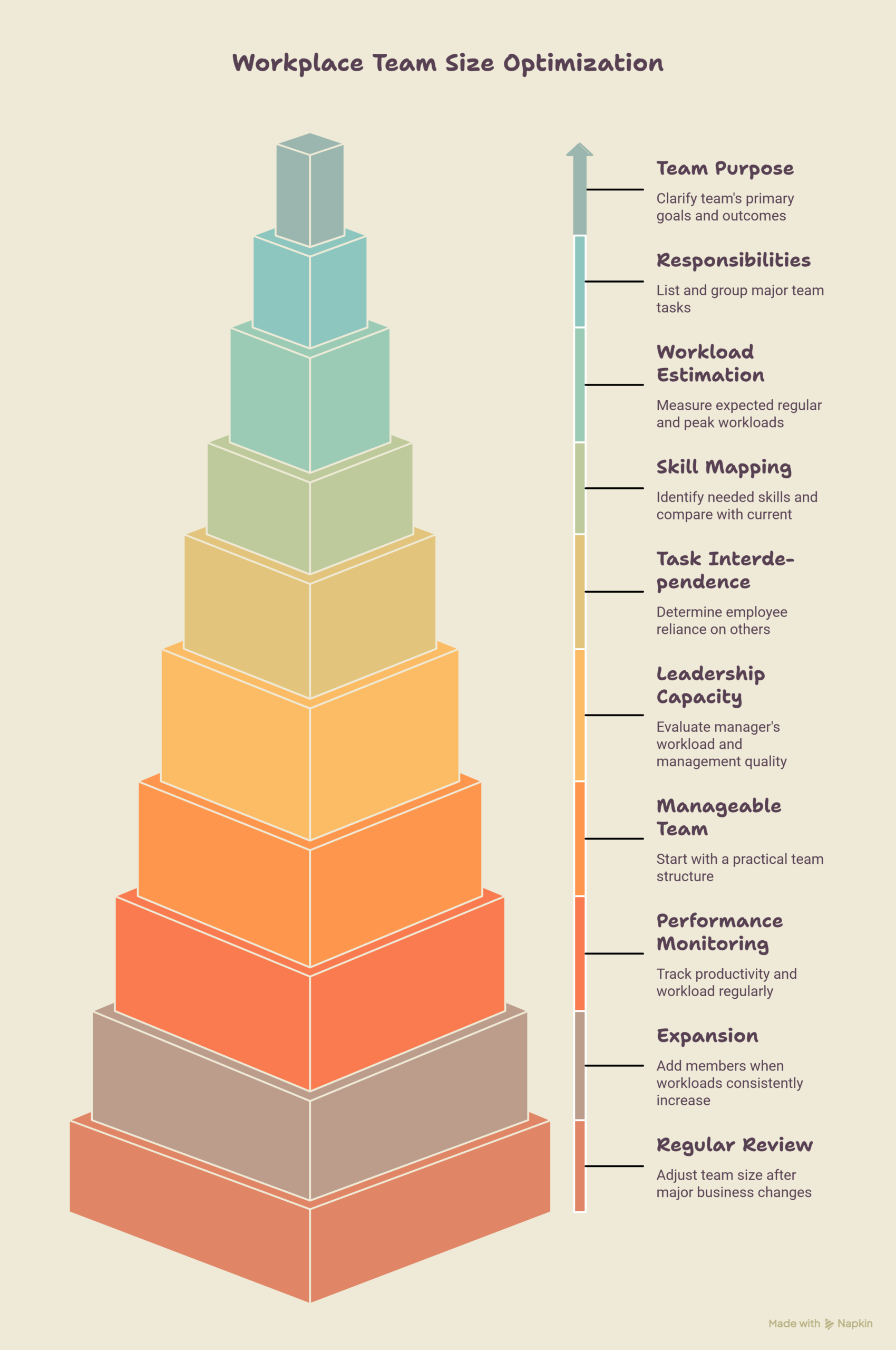
Choosing team size requires a structured approach. Managers should consider several workplace factors.
1. Define the Team’s Purpose
Start by identifying the team’s primary purpose. Clarify its expected outcomes and responsibilities.
A focused purpose often supports smaller teams. Broader responsibilities may require additional members.
2. Identify Required Responsibilities
List every major responsibility within the team. Group similar responsibilities together.
This process reveals potential workload overlaps. It can also identify missing responsibilities.
3. Estimate the Workload
Measure the team’s expected workload carefully. Consider both regular and peak workloads.
Look at:
- Number of active projects.
- Customer requests.
- Weekly task volume.
- Deadlines.
- Required service hours.
- Administrative responsibilities.
Consistent overload may indicate understaffing.
4. Map Required Skills
Identify skills needed for successful performance. Then compare them with current capabilities.
Avoid adding employees without clear skill requirements. Every new member should address a specific need.
5. Assess Task Interdependence
Determine how frequently employees depend on others. Highly connected tasks need efficient coordination.
Smaller groups may suit highly interdependent work. Independent tasks can support broader teams.
6. Evaluate Leadership Capacity
Consider the manager’s current workload. Excessive direct reports can weaken management quality.
Managers need time for coaching and feedback. They also need time for performance management.
7. Start With a Manageable Team
Avoid creating oversized teams immediately. Begin with a practical structure.
Monitor how employees handle their responsibilities. Review performance after implementation.
8. Monitor Performance
Track productivity and workload regularly. Watch for signs of capacity problems.
Important indicators include:
- Missed deadlines.
- Rising error rates.
- Excessive overtime.
- Employee turnover.
- Customer complaints.
- Growing project backlogs.
These signals can reveal staffing problems.
9. Expand When Needed
Teams should expand when workloads increase consistently. New members should address identifiable capacity gaps.
Expansion may also support new business requirements. New skills can justify additional hiring.
10. Review Team Size Regularly
Workplace needs change over time. Team structures should change accordingly. Review team size after major business changes. Consider growth, restructuring, and new technology.
The ideal team size is therefore flexible. It should respond to actual workplace conditions.
Does the Ideal Team Size Vary by Department?
Yes, team size varies across departments. Different functions have different responsibilities and workflows.
Marketing Teams
Marketing teams often need varied creative skills. Content, design, analytics, and strategy require coordination.
Smaller specialist groups can improve campaign execution.
Sales Teams
Sales teams may require larger member counts. Customer coverage often influences staffing requirements.
Sales territories can also affect team size.
Software Development Teams
Development teams often benefit from moderate sizes. Developers, testers, and designers need close coordination.
Smaller development teams can maintain faster communication.
Human Resources Teams
HR teams depend heavily on employee populations. Larger organizations usually need more HR specialists.
Recruitment and employee support may require separate groups.
Finance Teams
Finance teams often require specialized expertise. Accounting, payroll, compliance, and planning may differ.
Separate specialist teams can improve efficiency.
Customer Support Teams
Support teams depend heavily on customer volume. Service hours also influence staffing requirements.
Large support operations may need multiple smaller teams.
Operations Teams
Operations teams often depend on workload and location. Shift requirements can also influence staffing levels.
Some operations require larger teams for coverage.
Research and Development Teams
R&D teams usually require specialized knowledge. Smaller groups can encourage deeper collaboration.
Complex research may still require multiple specialists.
Therefore, department size should follow business needs. A single standard cannot suit every function.
Conclusion
The ideal workplace team usually balances several factors. Smaller teams often provide faster communication and decisions. However, larger teams can support broader responsibilities. Workload, skills, complexity, and goals should guide sizing.
Organizations should review team capacity regularly. Flexible team structures can support long-term workplace performance.
Become an HR Expert – Enroll in Our HR Management Course Today!
Unlock the secrets to effective Human Resource Management with our expert-led course! Learn recruitment, employee relations, performance management, and more to build a thriving workplace. Start your journey toward a successful HR career today!
Know MoreFrequently Asked Questions
What is the ideal team size?
The ideal team size is usually 5 to 9 members. However, workplace needs can vary.
Why are smaller teams often effective?
Smaller teams support faster communication and decisions. They also provide clearer individual accountability.
Can a team be too small?
Yes, very small teams may lack skills. They may also struggle with heavy workloads.
Can a team be too large?
Yes, large teams can create communication problems. Decision-making may also become slower.
What factors determine team size?
Workload, goals, skills, and complexity influence team size. Leadership capacity also matters.
Does team size affect productivity?
Yes, team size can influence productivity significantly. Balanced teams usually manage workloads better.
When should a team be expanded?
Teams should expand when workloads exceed capacity. New skills may also require additional members.
What is a good size for project teams?
A team of 5 to 9 often works well. Complex projects may require additional specialists.
Does ideal team size vary by department?
Yes, different departments have different requirements. Sales, HR, and operations may need different sizes.
How often should team size be reviewed?
Teams should be reviewed after major changes. Regular workload reviews can also identify staffing needs.