
Table of Contents
The Infosys interview process for freshers in 2026 generally includes an online assessment, a technical interview, and an HR interview. However, the exact test pattern, salary, and interview depth vary by hiring track: Systems Engineer (SE), Digital Specialist Engineer (DSE), and Specialist Programmer/Power Programmer (SP/PP).
- Rounds: Online test → Technical interview → HR interview; some drives include a managerial round.
- Main fresher tracks: SE, DSE, and SP/PP.
- Typical fresher CTC: SE around ₹3.6 LPA; DSE around ₹9 LPA; SP/PP roughly ₹9.5–21 LPA.
Key Takeaways
- Infosys hires freshers mainly for Systems Engineer, Digital Specialist Engineer, and Specialist Programmer/Power Programmer roles.
- The standard process is online assessment, technical interview, and HR interview; some drives add a managerial round.
- SE is typically the standard entry track, while DSE and SP/PP require stronger coding, cloud, AI/ML, or specialized skills.
- HackWithInfy and InfyTQ are important routes to higher-paying Specialist Programmer/Power Programmer opportunities.
- Preparation should focus on aptitude, pseudocode, coding, OOPs, SQL, DBMS, DSA, and project explanation.
Infosys Hiring Process 2026
1: Which of the following data structures allows elements to be added and removed in a Last-In, First-Out (LIFO) order?
The Infosys hiring process for freshers in 2026 generally includes an online assessment, technical interview, and HR interview. However, the exact stages, test pattern, and compensation vary by hiring route and role—especially for Systems Engineer (SE), Digital Specialist Engineer (DSE), and Specialist Programmer/Power Programmer (SP/PP) roles.
Infosys Recruitment Process at a Glance
| Stage | What happens | What Infosys evaluates |
|---|---|---|
| 1. Application | Apply through a campus placement drive, Infosys Careers portal, off-campus drive, employee referral, HackWithInfy, or InfyTQ. | Eligibility, academic record, resume, and role fit |
| 2. Online assessment | A proctored online test with aptitude, reasoning, verbal, pseudocode, technical, and/or coding questions, depending on the drive. | Speed, accuracy, logical ability, programming fundamentals, and communication |
| 3. Technical interview | A discussion on programming, DSA, OOPs, DBMS/SQL, projects, internships, and core computer-science subjects. | Problem-solving, coding clarity, project ownership, and technical depth |
| 4. Managerial interview, if applicable | Some drives include a managerial or project-discussion round. | Ownership, teamwork, decision-making, and role-specific experience |
| 5. HR interview | A conversation about motivation, relocation, shift flexibility, strengths, weaknesses, and career goals. | Communication, culture fit, and role/location flexibility |
| 6. Offer and onboarding | Shortlisted candidates receive an offer letter, followed by document verification and onboarding. | Background verification and document completion |
Important: Infosys does not follow one identical process for every candidate. The online assessment can differ across campus, off-campus, HackWithInfy, InfyTQ, and experienced-hiring drives.
Infosys Eligibility Criteria 2026
Eligibility requirements can change by drive, so always check the official job description before applying. The following are the common criteria for Infosys fresher hiring.
| Criterion | Typical requirement |
|---|---|
| Qualification | B.E., B.Tech, M.E., M.Tech, MCA, or an equivalent degree |
| Academic score | Usually 60% or 6.5 CGPA and above in Class 10, Class 12, and graduation; some 2026 drives mention 65% or 6.5 CGPA |
| Backlogs | No active backlogs at the time of selection |
| Education gap | Usually no education gap of more than two years, though this is drive-specific |
| Experience | Freshers should generally not have prior full-time experience, unless the job posting says otherwise |
| Application route | Campus placement, Infosys Careers, off-campus drive, referral, HackWithInfy, or InfyTQ |
Infosys Online Test Pattern 2026
The Infosys online test pattern is not fixed across all drives. Recent 2026 fresher assessments have included sections such as Mathematical Ability, Analytical Reasoning, Verbal Ability, Pseudocode, Puzzle Solving, English Grammar, and English Writing.
| Section | Questions | Duration |
|---|---|---|
| Mathematical Ability | 10 | 35 minutes |
| Analytical Reasoning | 15 | 25 minutes |
| Verbal Ability | 20 | 20 minutes |
| Pseudocode | 5 | 10 minutes |
| Puzzle Solving | 4 | 10 minutes |
| English Grammar | 5 | 10 minutes |
| English Writing | 1 | 10 minutes |
Some assessments may also include coding questions, technical ability questions, or role-specific programming tasks.
Key points to remember:
- There is generally no negative marking, but confirm the instructions shown in your specific test.
- Some drives may use sectional timing or cutoffs, so avoid spending too long on any single question.
- For coding-based assessments, practise writing complete, executable solutions rather than only pseudocode.
- Check your test invitation for the login window, permitted browser, webcam, microphone, internet, and system requirements.
Infosys SE vs DSE vs Specialist Programmer
Infosys hires freshers through multiple role tracks. Your preparation should change based on the track you are targeting.
| Track | Best suited for | Typical entry route | Indicative fresher CTC |
|---|---|---|---|
| Systems Engineer (SE) | Software development, testing, support, and general engineering roles | Campus/off-campus drive or InfyTQ | Around ₹3.6 LPA |
| Digital Specialist Engineer (DSE) | AI/ML, cloud, data engineering, full-stack, and digital skills | Specialized assessment or InfyTQ-based hiring | Around ₹9 LPA |
| Specialist Programmer / Power Programmer | Strong DSA, problem-solving, and advanced software engineering | HackWithInfy or InfyTQ | Around ₹9.5–21 LPA |
SE is usually the standard entry-level engineering role. DSE is for candidates with stronger digital, cloud, AI/ML, data, or full-stack skills. SP/PP is the advanced coding track, where candidates are expected to handle more difficult DSA and algorithmic problems.
Learn Prompt Engineering for Free
Get better results from ChatGPT and Gemini with free, beginner-friendly prompt engineering guides. Learn how to write prompts that save time and improve your code, content, and work.
Start Learning FreeHackWithInfy and InfyTQ
HackWithInfy
HackWithInfy is Infosys’s competitive coding program for students aiming at Specialist Programmer or Power Programmer opportunities. It begins with virtual coding rounds hosted on the Infosys Assessment Platform, followed by further coding challenges and a Grand Finale. Top performers can receive a pre-placement interview opportunity.
Prepare for:
- Arrays, strings, hashing, stacks, queues, linked lists, trees, and graphs
- Sorting, searching, recursion, greedy methods, and dynamic programming
- Time and space complexity analysis
- Clean implementation, edge cases, and debugging under time pressure
InfyTQ
InfyTQ is Infosys’s learning-and-certification pathway for eligible engineering students. Candidates typically register on the platform, complete learning modules, attempt the certification assessment, and may then be invited to the interview stage. The certification result can determine whether a candidate is considered for an SE or DSE band.
Prepare for:
- Java or Python fundamentals
- OOPs concepts
- DBMS and SQL
- Basic data structures and algorithms
- Hands-on coding questions
Technical Interview
The Infosys technical interview usually lasts around 30–60 minutes, though the duration depends on the interviewer, role, and drive. Expect questions on your resume, projects, programming language, DSA, OOPs, DBMS/SQL, and basic computer-science fundamentals.
Common areas include:
| Area | What to prepare |
|---|---|
| Programming | Java, Python, C, or C++; syntax, functions, loops, arrays, strings, and debugging |
| DSA | Arrays, strings, linked lists, stacks, queues, trees, graphs, searching, sorting, hashing, recursion, and dynamic programming |
| OOPs | Classes, objects, inheritance, polymorphism, abstraction, encapsulation, constructors, interfaces, and method overriding |
| DBMS and SQL | Normalization, keys, joins, indexes, transactions, ACID properties, and SQL queries |
| OS and CN | Process vs thread, scheduling, deadlock, memory management, OSI model, TCP/IP, HTTP, and DNS |
| Projects | Problem statement, architecture, tech stack, your individual contribution, challenges, trade-offs, and results |
How to answer technical questions:
- Restate the problem and clarify constraints.
- Explain your approach before coding.
- Discuss brute force first, then optimize it.
- Mention time and space complexity.
- Write clean code with meaningful variable names.
- Test it with a normal case, edge case, and invalid input.
HR and Managerial Interview
The HR round checks whether you are a good fit for Infosys, the role, and the work location. Common questions include “Tell me about yourself,” “Why Infosys?”, “What are your strengths and weaknesses?”, “Where do you see yourself in five years?”, and questions about relocation or shift flexibility.
Be prepared to discuss relocation and shift flexibility honestly. Location flexibility can improve your chances for certain roles, but refusing relocation does not automatically mean rejection; it may only limit the locations or opportunities available to you.
Use the STAR method for behavioural answers:
- Situation: Briefly explain the context.
- Task: State your responsibility.
- Action: Explain what you did.
- Result: Share the outcome and what you learned.
Learn Prompt Engineering for Free
Get better results from ChatGPT and Gemini with free, beginner-friendly prompt engineering guides. Learn how to write prompts that save time and improve your code, content, and work.
Start Learning FreePractice Questions
Try these before your Infosys assessment or interview:
- A train travels 180 km in 3 hours. What is its average speed?
Answer: 60 km/h. - Find the next number in the series: 2, 6, 12, 20, 30, ?
Answer: 42. The differences increase by 2: 4, 6, 8, 10, 12. - If
x = 5, what is the output ofx += x++ + ++xin a language with standard left-to-right evaluation?
Answer: Do not memorize this blindly—such questions depend heavily on language-specific evaluation rules. In C/C++, this expression involves undefined behaviour becausexis modified multiple times without a sequence point. - Which data structure is best for checking balanced parentheses?
Answer: A stack. - What is the time complexity of binary search?
Answer: O(log n), provided the array is sorted.
Infosys Technical Interview Questions (Role-Based)

For System Engineer Role
Sample Questions:
- Explain OOP principles with examples.
A. Encapsulation bundles data and methods into a single unit. Example: a Car class with private speed variable and public accelerate() method. Inheritance allows child classes to reuse parent code. Example: ElectricCar extends Car. Polymorphism lets methods do different things based on object type. Example: drive() method behaves differently for ManualCar and AutomaticCar. - What is polymorphism? Provide code examples.
A. Polymorphism means many forms. Compile-time polymorphism uses method overloading—same method name with different parameters. Runtime polymorphism uses method overriding—child classes provide specific implementations of parent methods. - Write an SQL query to find the second highest salary.
A. SELECT MAX(salary) FROM employees WHERE salary < (SELECT MAX(salary) FROM employees); - What is normalization? Explain up to 3NF.
A. Normalization removes data redundancy. 1NF eliminates duplicate columns. 2NF removes partial dependencies. 3NF removes transitive dependencies. - Difference between abstract class and interface?
A. Abstract classes can have both abstract and concrete methods, with instance variables. Interfaces traditionally had only abstract methods, but Java 8 allows default methods. A class can extend only one abstract class but implement multiple interfaces. - Explain your final year project architecture.
A. Walk through the tech stack, database design, API endpoints, and challenges faced. Interviewers check if you actually built it.
Experience the power of our web development course with a free demo – Enroll now!
For Specialist Programmer Role (Higher Package)
Focus areas include data structures, algorithms, and time complexity.
Sample Questions:
- Reverse a linked list iteratively and recursively.
- Find if a binary tree is a BST.
- Implement a least recently used (LRU) cache.
- Explain time complexity of quicksort in best, average, and worst cases.
- Design a URL shortening service like TinyURL.
Coding problem example: Given an array of integers, find the longest increasing subsequence. Explain the DP approach and optimize it.
For Digital / Cloud Roles
Focus areas include cloud platforms, APIs, and DevOps.
Sample Questions:
- What is a REST API? Explain HTTP methods and status codes.
- Difference between AWS EC2 and S3?
- Explain CI/CD pipeline stages.
- What is Docker? How is it different from virtual machines?
- How do you handle session management in microservices?
Experience the power of our web development course with a free demo – Enroll now!
Real Infosys Interview Experience
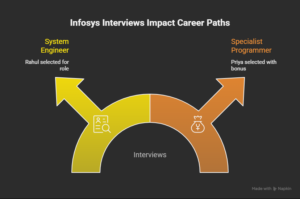
Disclaimer: These are candidate-shared experiences and may not reflect every 2026 drive.
Experience 1: System Engineer (On-Campus 2026)
Rahul, a 2026 batch CSE graduate from Pune, shared his experience on AmbitionBox.
“The online test had 3 coding questions. Two were easy—reverse a string and find factorial. One was tricky—merge two sorted arrays without extra space. I cleared it and got a technical interview after 2 weeks.”
Technical Interview:
“The panel had one senior engineer. He started with my project. I explained my hostel management system built with Java and MySQL. He asked why I chose MySQL over MongoDB. I said because of ACID compliance for financial transactions. He nodded.
Then came OOPs questions. He asked for polymorphism examples from my project. I explained how the payment method worked differently for cash and card payments. He liked that.
The unexpected question was about multithreading. I hadn’t prepared well. I admitted I knew the basics but needed more depth. He appreciated the honesty and moved to SQL queries.
HR Round:
“Very smooth. Asked about family background, willingness to relocate to Mysore for training, and why Infosys. I mentioned their digital transformation work and training programs.”
Result: Selected. Offer letter arrived after 3 weeks with a joining date in September 2026.
Experience 2: Specialist Programmer (Off-Campus 2026)
Priya, a 2025 graduate with 1 year of experience, applied through the off-campus drive.
“I applied through the Infosys careers portal in January 2026. The off-campus drive for SP roles had packages up to ₹21 LPA. I was nervous but excited.”
Online Assessment:
“Three hours long. Two coding problems—medium difficulty. The first was to find the longest palindromic substring. The second was a graph problem—detect a cycle in a directed graph. I solved both partially. Got shortlisted for an interview.”
Technical Interview:
“Live coding on shared screen. The interviewer asked me to implement binary tree level order traversal. I did it using queues. Then he asked to optimize space complexity. We discussed BFS vs DFS trade-offs.
Next was system design. Design a parking lot system. I drew classes, explained relationships, and discussed edge cases. He pushed me on how I’d handle concurrent entry and exit. I suggested database locks and queueing.”
Managerial Round:
“Scenario question: Your teammate isn’t contributing. What do you do? I said first understand why—maybe personal issues or skill gaps. Then offer help, involve the manager if needed. He seemed satisfied.”
Result: Selected with ₹9.5 LPA package. Joining bonus of ₹50,000.
Infosys Salary Structure 2026

Salary packages vary by role, experience, and hiring track.
| Role | Experience Level | Average CTC (₹ LPA) |
| System Engineer | Fresher | 3.6 – 4.5 |
| Specialist Programmer | Fresher (SP) | 6.5 – 9.5 |
| Power Programmer | Fresher (PP) | 9.5 – 21.0 |
| Digital Specialist Engineer | Fresher | 5.7 – 7.5 |
| System Engineer | 2 years | 8.8 |
| Specialist Programmer | 2 years | 9.4 – 12.1 |
| Senior Systems Engineer | 3 years | 11.0 – 12.1 |
| Technology Lead | 6–7 years | 17.6 – 22.2 |
| Senior Associate Consultant | 5 years | 44.0 |
For 2026, Infosys has introduced record packages for Specialist Programmers: Level 3 at ₹21 LPA, Level 2 at ₹16 LPA, and Level 1 at ₹10 LPA plus ₹1 lakh joining bonus. These roles target candidates with strong coding skills in cloud, cybersecurity, data engineering, and AI.
Experienced hires can negotiate based on current salary. The data shows backend engineers with 5 years of experience average ₹10.35 LPA, while 10-year veterans earn around ₹28 LPA.
How to Crack Infosys Interview (Step-by-Step Strategy)
Step 1: Clear Written Exam Cutoff
Practice aptitude daily. Focus on time and work, percentages, and data interpretation. Use previous years’ papers.
Solve coding questions on platforms like LeetCode. For System Engineer, easy to medium problems suffice. For SP and PP, practice medium-hard problems.
Step 2: Prepare 2 Strong Projects
Choose projects that showcase your skills. For each project, prepare to explain :
- Architecture diagram
- Tech stack choices and why
- Database design
- Challenges faced and solutions
- Your specific contribution
Interviewers love stories about how you debugged a tough problem.
Step 3: Master OOPs + SQL
These are the most frequently asked topics. Practice writing SQL queries for joins, aggregations, and subqueries. Understand OOPs with real-world analogies.
Step 4: Practice HR Answers
Common HR topics :
- Relocation flexibility
- Handling team conflicts
- Career goals
- Strengths and weaknesses with examples
Use the STAR method for behavioral questions. Keep answers concise and honest.
Step 5: Utilize InfyTQ and HackWithInfy
Register on InfyTQ platform. Complete courses and get certified. This is the primary gateway to SP and PP tracks.
Participate in HackWithInfy. Even if you don’t win, participation strengthens your resume and prepares you for coding rounds.
Experience the power of our web development course with a free demo – Enroll now!
About Infosys and Hiring Tracks
Back in 1981 N R Narayana Murthy along with a handful of other engineers with a dream decided to set up a small outfit called Infosys – and since then its grown to become one of the BIGGEST IT services companies in India – but it all started in a much smaller way, providing consulting, outsourcing and digital transformation services to clients in over 50 countries. In the Indian IT sector Infosys is basically a household name – they’ve got a workforce of over 300,000 people scattered across the globe, and are based out of Bengaluru.
One of their bigger subsidiaries is Infosys BPM which is involved in business process management services. You can’t deny that Infosys has been a highly sought after employer here in India – not just because of the size of their campus in Mysore but also because of the innovation they’ve been driving on AI, cloud tech and digital engineering – we’re talking about a company that consistently leads the pack when it comes to salary hikes and bringing in the specialist technical talent they need to stay ahead in 2026.
Common Reasons Candidates Get Rejected
Understanding rejection reasons helps you avoid them.
Weak communication: You might know the answer, but fail to explain clearly. Practice speaking your solutions aloud.
Poor project explanation: Listing technologies is not enough. Explain your role, decisions, and challenges.
No clarity in fundamentals: Rote learning fails when interviewers ask follow-up questions. Understand the why behind concepts.
Lack of confidence: Hesitation and uncertainty create doubt. Be honest if you don’t know something, but show willingness to learn.
Weak online-test time management: Infosys tests may have sectional timing and cutoffs.finalroundai+1
Generic project answers: Candidates should explain the problem, design choices, trade-offs, and their individual contribution.
Conclusion
The Infosys interview process in 2026 is your ticket to a six-figure salary at India’s leading IT services company. Freshers can look forward to salary packages ranging from 3.6 Lakhs per annum for System Engineers to a whopping 21 Lakhs per annum for top-of-the-line Specialist Programmer (L3) roles. The key to success is going to be how well you prepare for it: mastering those online assessments (aptitude, pseudocode, technical MCQs, and coding skills), acing the role-specific technical interviews, which will put your OOPs, SQL, data structures, and algorithm knowledge to the test, and making a good impression in the HR round.
Learn Prompt Engineering for Free
Get better results from ChatGPT and Gemini with free, beginner-friendly prompt engineering guides. Learn how to write prompts that save time and improve your code, content, and work.
Start Learning FreeFrequently Asked Questions
How many rounds are there in the Infosys interview process?
Most Infosys fresher drives include three main rounds: an online assessment, a technical interview, and an HR interview. Some drives may also include a managerial or project-discussion round, especially for specialized or experienced roles.
What is the Infosys online test pattern for 2026?
The test pattern varies by drive and role. Recent fresher assessments have included Mathematical Ability, Analytical Reasoning, Verbal Ability, Pseudocode, Puzzle Solving, English Grammar, and English Writing. Some assessments may also include coding questions, particularly for DSE and Specialist Programmer/Power Programmer roles.
Is there negative marking in the Infosys online test?
Infosys assessments generally do not have negative marking, but you should always read the instructions in your specific test invitation. Rules can differ by drive.
What are the eligibility criteria for Infosys freshers?
Candidates usually need a B.E., B.Tech, M.E., M.Tech, MCA, or equivalent degree, with no active backlogs at the time of selection. Many drives require around 60% or 6.5 CGPA in Class 10, Class 12, and graduation, though some 2026 drives mention 65% or 6.5 CGPA.
Can I apply to Infosys with a backlog?
You generally cannot join if you have an active backlog at the time of selection. Some drives may allow you to apply while clearing a backlog, but the offer is usually conditional on clearing all subjects before joining.
What is the difference between Infosys SE, DSE, and Specialist Programmer?
Systems Engineer (SE) is the standard fresher engineering role. Digital Specialist Engineer (DSE) is for candidates with stronger AI/ML, cloud, data, or full-stack skills. Specialist Programmer/Power Programmer is the advanced coding track, usually for candidates with strong DSA and problem-solving skills.
Which Infosys role has the highest fresher salary?
Specialist Programmer and Power Programmer roles generally offer the highest fresher packages, often in the range of ₹9.5–21 LPA, depending on the drive and candidate performance. DSE roles are usually higher than SE roles, while SE is the standard entry-level package.
How can I apply for Infosys as a fresher?
You can apply through campus placement, the Infosys Careers portal, off-campus drives, employee referrals, HackWithInfy, or InfyTQ. The exact route depends on your college, graduation year, and the role you are targeting.
What is HackWithInfy?
HackWithInfy is Infosys’s competitive coding program for students aiming for Specialist Programmer or Power Programmer opportunities. It includes virtual coding rounds hosted on the Infosys Assessment Platform, followed by advanced coding challenges and a Grand Finale for top performers.
Who is eligible for HackWithInfy?
Eligibility changes each year, so check the official HackWithInfy terms and conditions. The 2026 edition was open to eligible B.E., B.Tech, M.E., M.Tech, dual-degree, MS (Research), MCA, and five-year integrated M.Sc students graduating in 2027, subject to residency and age requirements.