Table of Contents
Becoming an Enrolled Agent (EA) is moderately difficult. It is not easy, but it is very doable. There is no degree needed. You must pass three exam parts on US tax. Most people finish in 3 to 6 months.
For Indian candidates, the exam feels hard mainly because US tax law is new. It is not taught in Indian colleges. But you can learn it step by step. The exam has three parts. Each part has 100 multiple-choice questions. The pass score is 105 out of 130.
To become an EA, you need a PTIN from the IRS. You then pass all three parts of the Special Enrollment Examination (SEE). After that, you apply to the IRS for enrollment. A commerce or accounting background helps, but it is not a must. A beginner in US taxation can also pass. What matters most is a clear plan, steady study and lots of practice questions.
The exam is tough because of new rules, many numbers and case-based questions. Good prep makes it much easier. With the right course and regular revision, most serious candidates can clear it.
Become an Accounting Pro – Learn from Industry Experts!
Key Takeaways:
- The EA exam is moderate in difficulty.
- No degree is needed to start.
- The exam has three parts.
- Most people take 3 to 6 months.
- US tax is new to most Indians, but it can be learned.
- Beginners can pass with a good plan.
- Practice questions and mock tests matter the most.
What Is an Enrolled Agent?
An Enrolled Agent is a US tax expert. The IRS gives this title. The IRS is the US tax department.
What an EA can do
- File tax returns for people and companies
- Give tax planning advice
- Help clients who have tax problems
- Speak for clients before the IRS
An EA can represent any taxpayer in the US. This is a strong right. Not every tax expert has it.
Why the title matters
The IRS checks every EA. So clients trust the title. It is also known across the world.
Why Indians want this title
Many US firms send tax work to India. They need people who know US tax rules. An EA fits this need well.
You can work with a firm in India. You can also work for yourself and serve US clients from home.
A simple example
A US family needs help with a tax return. A US firm sends the work to its team in India. An EA on that team checks the forms and files the return. If the IRS asks a question, the EA can reply for the family.
How EAs differ from other tax preparers
Many people can prepare a tax return. But only some have the right to represent clients before the IRS. An EA has this right. This is why the title carries weight.
How Difficult Is the Enrolled Agent Exam for Indian Candidates?
1: Accounting provides information on
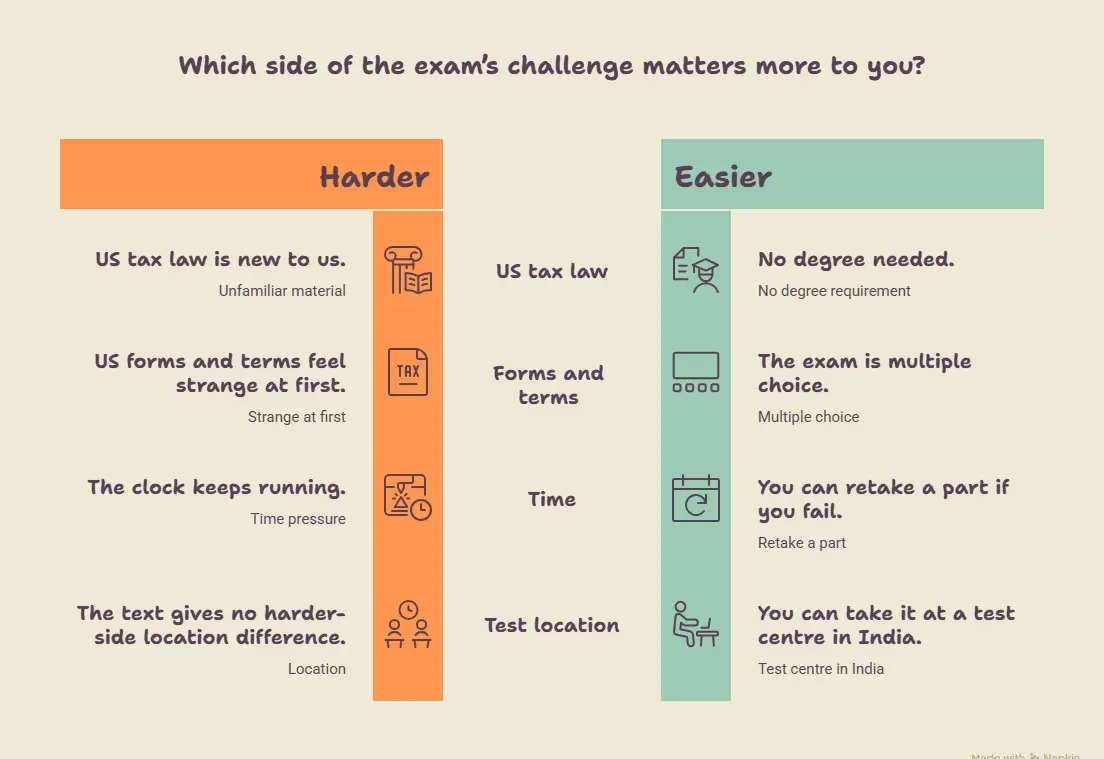
The exam is not a walk in the park. But for most people, it is easier than CA or CPA.
Why many find it fair
- No degree is needed
- You can take the parts in any order
- You book your slot when you are ready
- You can retake a part if you fail
The exam in short
The exam is called the SEE. It stands for Special Enrollment Examination.
| Point | Details |
|---|---|
| Parts | 3 |
| Questions per part | 100 multiple-choice |
| Time per part | 3 hours 30 minutes |
| Pass score | 105 out of 130 |
| Where in India | Prometric centers |
The three parts
- Part 1: Individuals. This is tax for people.
- Part 2: Businesses. This is tax for firms and companies.
- Part 3: Representation, Practices and Procedures. This is about IRS rules and ethics.
Which part is the hardest?
It depends on you. Many find Part 2 the hardest. It has long topics like partnerships and corporations.
Part 1 is a good start. Part 3 has less content. But it has many small rules to remember.
What the pass rate tells us
Pass rates are not the same for every part. Some parts have a lower pass rate than others. This tells us one thing. You cannot skip prep. But people who study well do pass.
A fair way to see it
The exam is hard if you start late and study little. It is fair if you start early and study often. Your plan decides your result more than the exam does.
Placement Oriented PWC Business Accounting Course
PWC Certified Business Accounting Course by Entri App: Master in-demand skills, ace interviews, and secure top-tier jobs.
Join Now!What Makes the EA Exam Difficult for Someone in India?
The exam is fair. But some things make it harder for Indian candidates.
1. US tax law is new
Indian students know income tax and GST. US tax is a new world.
You must learn new terms:
- Filing status
- Standard deduction
- Form 1040
- Schedule C
At first, this feels strange. After a few weeks, it gets easier.
2. Many rules and many numbers
US tax has many rules and limits. Some amounts change each tax year. You must know the latest ones.
This needs good memory. It also needs regular revision.
3. Case-based questions
Many questions tell a short story. You read it. Then you pick the right answer.
You need two skills:
- Reading fast
- Spotting the key detail
4. Time pressure
3 hours 30 minutes sounds long. But 100 questions is a lot. You have about two minutes for each one.
5. Study material made for the US
Some books use examples from the US. These may feel far from India. You need extra effort to connect the dots.
6. Study along with work
Many candidates work full time. Some are still in college. Finding study hours is the real test.
7. Fear of failing
Many students fear the exam before they start. This fear makes the exam look bigger than it is. A small start each day beats a big plan that never begins.
What Are the Requirements to Become an Enrolled Agent?
The rules are simple. Here they are in steps.
Step 1: Get a PTIN
PTIN means Preparer Tax Identification Number. You get it from the IRS. You need it to book the exam.
Step 2: Book your exam
You book each part on the Prometric site. Prometric has test centers in India. So you can take the exam in your city or a nearby one.
Step 3: Pay the fee
Each part has a fee. It is paid in US dollars. The cost is around 200 USD per part. Check the latest fee before you book.
Step 4: Pass all three parts
Each pass stays valid for two years. So plan your timing well.
You can retake a part if you fail. There is a limit on attempts in each testing window. Check the IRS rules before you book.
Step 5: Apply for enrollment
After you pass, you apply to the IRS. You use Form 23. The IRS then checks your tax record and background. This is called a suitability check.
Other points to know
- Degree: Not needed
- CA or CPA: Not needed
- Work experience: Not needed
- Age: At least 18 years
This makes the EA open to many people.
What about the testing window?
The IRS runs the exam in a yearly testing window. Plan your dates inside it. Book early, as slots can fill up.
How Long Does It Take to Become an Enrolled Agent in India?
Most people take 3 to 6 months. It depends on your time and your background.
Three study speeds
- Fast track: 2 to 3 months. You study many hours each day.
- Normal pace: 3 to 6 months. You study a few hours each day.
- Slow pace: 6 to 12 months. You study on weekends only.
How many hours do you need?
Many candidates study about 80 to 120 hours for each part. So the total is around 250 to 350 hours. This is a rough guide. You may need less or more.
A sample study plan
- Month 1: Learn the basics and finish Part 1
- Month 2: Study Part 2 and take the exam
- Month 3: Study Part 3 and take the exam
- Month 4: Apply for enrollment
You can change this plan to fit your life.
Tips to save time
- Study at a fixed time each day
- Book your exam date early
- Do not wait for perfect prep
- Revise every week
Do not forget the two-year rule
Your pass for each part is valid for two years. So do not leave one part too late. Plan all three parts before you start.
Placement Oriented PWC Business Accounting Course
PWC Certified Business Accounting Course by Entri App: Master in-demand skills, ace interviews, and secure top-tier jobs.
Join Now!Is Becoming an EA Easier for Commerce and Accounting Graduates?
Yes, a little. A commerce background gives you a head start.
How it helps
- You know basic accounting
- You know terms like assets, income and expenses
- You can read a balance sheet
- You understand how tax works in general
So you can focus on US rules. You do not start from zero.
What if you are not from commerce?
You can still do it. It may take a little more time. You must learn the basics first.
Many non-commerce students have passed. They started with simple topics. They also took help from a good course.
What about CA and CMA students?
CA students often follow the topics fast. They already know tax and audit. But US law is still new. So they must study the US rules well.
CMA students know cost and management. They may find Part 2 a bit easier. They still need to learn the tax side.
Can a complete beginner pass?
Yes. The key is to start slow. Learn one topic at a time. Do not rush. Ask for help when you are stuck.
Enrolled Agent vs Other Tax and Accounting Certifications
You may ask, “Which course is right for me?” Here is a simple view.
| Course | Focus | Degree needed | Time |
|---|---|---|---|
| EA | US tax | No | Months |
| CPA (US) | Audit, tax, law and business | Yes, with credit hours | Longer |
| CMA (US) | Management accounting and cost | Yes | Months to a year or more |
| CA (India) | Indian tax, audit and law | No, but steps are long | Years |
| ACCA | Global accounting | No, for most routes | Years |
EA vs CPA
- The EA is about US tax only.
- The CPA is wider. It covers audit, tax, law and business.
- The CPA has more rules and takes more time.
- The EA is faster.
EA vs CMA
- The EA is about tax.
- The CMA is about cost and strategy.
- Pick the EA if you like tax. Pick the CMA if you like cost and planning.
EA vs CA
- The EA is about US tax. It takes months.
- The CA is about Indian tax, audit and law. It takes years.
- They are not rivals. Many CAs add an EA to work with US clients.
EA vs ACCA
- The EA is narrow and deep.
- The ACCA is broad.
- ACCA gives a wide base. The EA gives a deep skill in one area.
Which one should you pick?
Pick the EA if:
- You want to work in US tax
- You want a faster path
- You do not have a commerce degree
- You want to add a skill to your current course
You can also pick more than one. Many people do the EA and CMA together.
What Are the Advantages of Becoming an Enrolled Agent in India?
The EA brings many benefits. Here are the main ones.
1. Strong job demand
Many US firms use teams in India for tax work. They need people who know US rules.
2. Many job roles
- US tax associate
- Tax analyst
- Tax consultant
- Senior tax reviewer
- Tax manager
3. Fair cost
There is no big degree fee. You pay the exam fees and the course fees. This is less than many other courses.
4. Short time
Many finish in under a year. So you start your career sooner.
5. Global value
The EA is an IRS title. It adds weight to your resume.
6. Chance to work for yourself
You can start your own practice. You can serve US clients from India. Many EAs work as freelancers.
7. A title that stays
You keep the title as long as you meet the renewal rules.
How renewal works
An EA must complete CPE hours. CPE means Continuing Professional Education.
- 72 hours every three years
- At least 16 hours each year
- 2 hours of ethics each year
Challenges and Concerns to Consider Before Pursuing the EA
The EA is a good path. But think about these points first.
1. It covers only US tax
The EA does not cover Indian tax or audit. If you want a wide skill base, add another course.
2. Odd work hours
Many US-linked jobs run on US time. This may mean night shifts. Some firms offer flexible hours. Ask before you join.
3. Busy season pressure
US tax work peaks at some times of the year. Work gets heavy. Long hours are common.
4. Rules change every year
US tax laws change. You must keep learning. This is part of the job.
5. Fees are in dollars
The exam fee is paid in USD. The cost can rise if the rupee falls. Plan your budget well.
6. Study needs discipline
No one can study for you. A weak plan leads to delays.
7. A title is not a job
The EA helps. But you still need skills. You still need to do well in interviews. Practice with real cases when you can.
Questions to ask before you start
- Do I want a career in US tax?
- Can I give 8 to 10 hours a week?
- Am I ready for odd work hours?
- Is my budget ready for the fees?

How to Make the EA Exam Easier to Prepare For
Good prep makes a big difference. Here are simple tips.
1. Start with the basics
Do not jump to hard topics. Learn the key terms first.
2. Make a study plan
- Write down your dates
- Set weekly goals
- Keep the plan short and clear
3. Study one part at a time
Do not mix all three parts. Finish one. Take the exam. Then move on.
4. Pick good study material
Choose a course made for Indian students. It should:
- Explain topics in simple words
- Give plenty of practice questions
- Offer doubt-clearing help
- Be updated for the current tax year
5. Practice a lot
Practice questions are the best tool. Solve many. Check your wrong answers. Learn from each one.
6. Take mock tests
Mock tests feel like the real exam. They help you with time. They also reduce fear.
7. Make short notes
Write key rules in your own words. Keep a list of limits and numbers. Revise it often.
8. Revise every week
Do not wait until the end. Weekly revision helps memory.
9. Learn the exam style
- Read the question slowly
- Spot the key detail
- Remove the wrong options first
- Then pick the best one
10. Rest before the exam
Sleep well the night before. Eat well on the day. Reach the center early. A calm mind works better.
11. Join a study group
Study with others. Share doubts and tips. It keeps you moving.
12. Learn from your mistakes
Keep a list of questions you got wrong. Look at it before each exam. Small gaps become big marks.
Become an Accounting Pro – Learn from Industry Experts!
Conclusion
So, is the EA tough? Honestly, it depends on where you start. US tax will feel strange in the first few weeks, and Part 2 may test your patience. But the exam is not out of reach. You need no degree, and most people get through in about 3 to 6 months.
What helps most is not talent. It is habit. Study an hour or two a day, solve lots of practice questions, and go back to the ones you got wrong. If US tax work is what you want, the EA is worth the effort.
Placement Oriented PWC Business Accounting Course
PWC Certified Business Accounting Course by Entri App: Master in-demand skills, ace interviews, and secure top-tier jobs.
Join Now!Frequently Asked Questions
What is an Enrolled Agent?
An Enrolled Agent (EA) is a tax professional authorised by the US IRS to represent taxpayers before the IRS.
Can Indians become Enrolled Agents?
Yes. People living in India can become Enrolled Agents by meeting the IRS requirements and passing the required exams.
Is it difficult to become an Enrolled Agent in India?
The process requires preparation and a good understanding of US taxation. Regular study and practice can help candidates prepare for the exams.
Is a B.Com degree enough to become an Enrolled Agent?
A B.Com degree can provide a useful accounting background. However, candidates must meet the IRS requirements and pass the required EA exams.
How many exams are required to become an Enrolled Agent?
Candidates must pass three parts of the Special Enrollment Examination (SEE). These cover individual taxation, business taxation and representation, practices and procedures.
Do I need US work experience to become an EA?
No. Passing the SEE is the main exam route. Candidates must also meet the IRS suitability requirements to receive the EA credential.
Can I work from India after becoming an Enrolled Agent?
Yes. EAs in India may find opportunities with tax firms, accounting companies and businesses that handle US tax work. Job options depend on skills and experience.
How long does it take to become an Enrolled Agent?
The time varies from person to person. It depends on exam preparation, exam dates and how quickly the candidate passes all three parts and completes the remaining IRS requirements.