

Table of Contents
The United States pays Enrolled Agents the most. Most sources show about $45,000 to $90,000 a year, and senior roles can go higher. India comes next for opportunity. EAs there often earn ₹4 to ₹8 lakh at the start and ₹8 to ₹18 lakh at mid level. The EA is a US title, so it is most useful where US tax work exists. For pay, pick the US. For easy entry and many jobs, India is a strong choice.
Key Takeaways
- The US has the highest pay for EAs.
- The EA is a US title. It works best with US tax work.
- India has many US tax jobs, but pay is lower in dollars.
- Other countries have fewer EA-linked jobs.
- Pay depends on your role, skills and years of work.
- Numbers differ from site to site. Treat them as a guide.
Become an Accounting Pro – Learn from Industry Experts!
What Is an Enrolled Agent?
An Enrolled Agent is a US tax expert. The IRS gives this title. The IRS is the US tax department.
What an EA can do
- File US tax returns
- Give tax advice
- Help clients with tax problems
- Speak for clients before the IRS
How do you become one?
You pass three exam parts. You get a PTIN. Then you apply to the IRS for enrollment. You do not need a degree.
Why this matters for pay
The EA is a US credential. It does not belong to any other country. So its value depends on one thing. Is there US tax work in that country?
What Determines an Enrolled Agent’s Salary?
1: Accounting provides information on
Pay is not the same for everyone. Many things change it.
1. Country
This is the biggest factor. The US pays more in dollars. Other countries pay in their own money.
2. Years of work
More years means more pay. A new EA earns less than one with ten years of work.
3. Job role
Roles differ in pay.
- Tax associate
- Tax analyst
- Senior analyst
- Tax reviewer
- Tax manager
- Own practice
4. Type of employer
- Big 4 firms
- Mid-size accounting firms
- Outsourcing firms
- Company tax teams
- Small tax practices
Big firms and company tax teams often pay more.
5. City
A big city often pays more. But the cost of living is higher too.
6. Skills
Extra skills raise pay.
- Tax software
- Excel
- Business tax knowledge
- Review skills
- Client talks
7. Other titles
Some EAs also hold a CPA, CA or CMA. This can raise pay.
8. Season and hours
Tax season is busy. Some firms pay extra for long hours.
9. Self-employed or not
Some EAs run their own practice. Their income depends on their client list.
A simple note on numbers
Salary sites do not agree. One may show an average near $42,000. Another may show about $60,000. Another may show above $70,000. The reason is simple. They use different data and different job titles. So think in ranges, not one number.
Placement Oriented PWC Business Accounting Course
PWC Certified Business Accounting Course by Entri App: Master in-demand skills, ace interviews, and secure top-tier jobs.
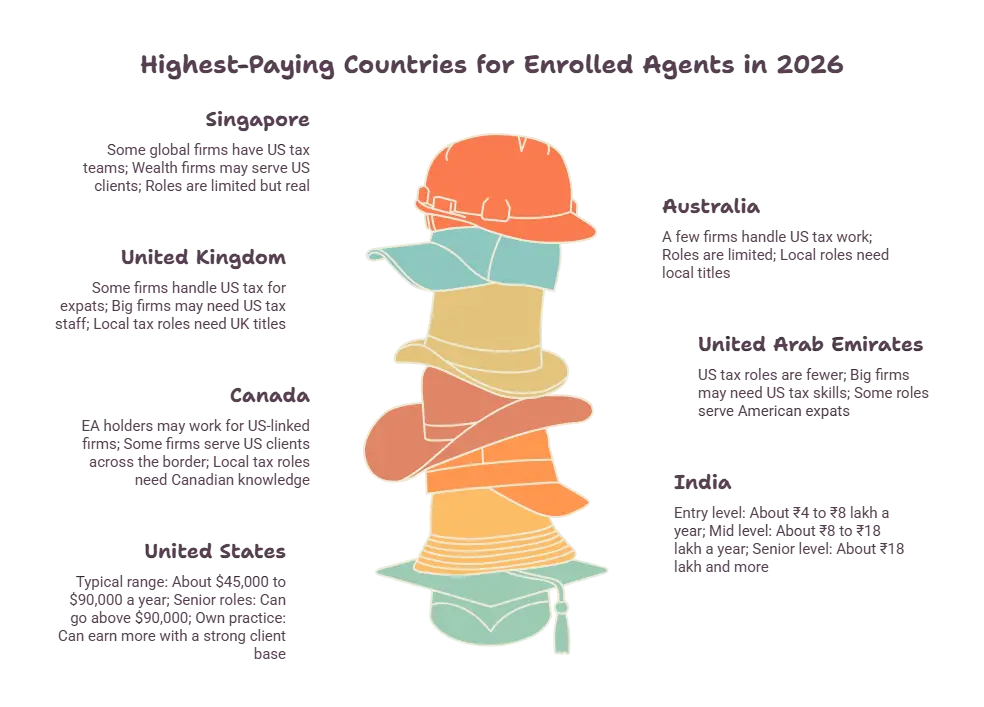
Join Now!Highest-Paying Countries for Enrolled Agents in 2026
Here is an honest look. The EA is a US title. So the US leads. Other countries come into play only when they have US tax work.
1. United States
The US pays the most in dollars.
- Typical range: About $45,000 to $90,000 a year
- Senior roles: Can go above $90,000
- Own practice: Can earn more with a strong client base
Some sources show lower averages. Some show higher. It depends on the city and the role.
Why the US pays more
- The clients are there
- The IRS work is there
- Firms need EAs for client work
- Pay scales are set in dollars
One big point
The EA title does not give you a work visa. You need legal permission to work in the US. This is a big step for Indian candidates.
2. India
India has many US tax jobs. Firms send US tax work here. They hire EAs for it.
- Entry level: About ₹4 to ₹8 lakh a year
- Mid level: About ₹8 to ₹18 lakh a year
- Senior level: About ₹18 lakh and more
These are indicative ranges. Pay depends on the firm and the city.
Why India matters
- Many US tax jobs
- Easy entry for freshers
- No visa needed
- Big 4 firms and company teams hire here
- Cost of living is lower
India pays less in dollars. But it offers the most jobs for Indian EAs.
3. Canada
Canada has its own tax system. The EA is not a Canadian title.
- EA holders may work for US-linked firms
- Some firms serve US clients across the border
- Local tax roles need Canadian knowledge
Pay depends on the role and the firm. There is no clear EA-only pay data for Canada. So check job posts before you plan a move.
4. United Arab Emirates
The UAE has many global firms. Some serve US clients.
- US tax roles are fewer
- Big firms may need US tax skills
- Some roles serve American expats
Pay depends on the firm and role. EA-only data is thin. Check current job posts.
5. United Kingdom
The UK has its own tax system. The EA is not a UK title.
- Some firms handle US tax for expats
- Big firms may need US tax staff
- Local tax roles need UK titles
6. Australia
Australia also has a separate tax system.
- A few firms handle US tax work
- Roles are limited
- Local roles need local titles
7. Singapore
Singapore is a global finance hub.
- Some global firms have US tax teams
- Wealth firms may serve US clients
- Roles are limited but real
Enrolled Agent Salary Comparison by Country
Here is a simple table. Use it as a guide only.
| Country | EA value | Pay view | Job volume |
|---|---|---|---|
| United States | Very high | Highest in dollars, about $45,000 to $90,000 | High |
| India | High | ₹4 to ₹8 lakh at entry, ₹8 to ₹18 lakh at mid | Very high |
| Canada | Low to medium | Depends on role | Low |
| UAE | Low to medium | Depends on role | Low |
| United Kingdom | Low | Depends on role | Low |
| Australia | Low | Depends on role | Low |
| Singapore | Low to medium | Depends on role | Low |
How to read this table
- “EA value” means how much the title helps you.
- “Pay view” is a rough guide, not a promise.
- “Job volume” means how many EA-linked jobs exist.
US vs India: a quick look
| Point | United States | India |
|---|---|---|
| Pay in local money | Higher in dollars | Lower in dollars |
| Cost of living | Higher | Lower |
| Jobs for freshers | Fewer for foreigners | Many |
| Visa needed | Yes | No |
| Work type | Client-facing | Back-end and review |
| Growth | Strong | Strong |
A note on buying power
A lower pay in India can still buy a lot. Rent, food and travel cost less. So compare the cost of living too, not just the salary.
Where Is the Enrolled Agent Qualification Most Valuable?
The EA is most valuable where US tax work happens.
1. In the United States
This is the home of the title. EAs can represent clients before the IRS. They can start their own practice. They can work for tax firms.
2. In India
India is the biggest hub for US tax outsourcing. Many Big 4 firms, KPOs and global teams hire here. The EA helps you stand out. Some sources say it gives a pay edge over non-certified peers.
3. In firms that serve US expats
Some firms help US citizens who live abroad. They file US returns for them. An EA fits this work well.
4. In global company tax teams
Large firms with US ties have tax teams in other countries. They may need US tax skills.
5. In wealth and fund firms
Firms that serve US investors may need US tax reporting.
Where the EA is less useful
- Roles that need only local tax knowledge
- Roles that need a local license
- Audit-only roles
A simple rule
Ask one question. Does this job involve US tax? If yes, the EA helps. If no, it may not.
Placement Oriented PWC Business Accounting Course
PWC Certified Business Accounting Course by Entri App: Master in-demand skills, ace interviews, and secure top-tier jobs.
Join Now!Can Enrolled Agents Work Outside the United States?
Yes. But with limits.
What you can do from outside the US
- Work for a US firm remotely
- Work in a India-based US tax team
- Serve US clients online
- Work for a firm that handles US expat taxes
- Run your own practice for US clients, subject to rules
What the EA does not give you
- It does not give you a work visa
- It does not let you practice local tax in other countries
- It is not a license for any country other than the US
What about client work from abroad?
Some EAs serve US clients from India. They work online. Pay can be good. But you must follow IRS rules and local rules. Check both before you start.
What about working in the US?
You need legal work permission. This is not part of the EA process. Check the visa rules with an official source or a legal expert.
What about other titles?
Some people add a CPA or other local title. This opens more doors in some countries.
Factors to Consider Before Choosing a Country
Do not pick a country by pay alone. Think about these points.
1. Visa and work rules
Can you work there legally? This is the first question. Without it, the rest does not matter.
2. Job availability
Are there EA-linked roles? Look at real job posts. Count how many you find.
3. Cost of living
High pay can vanish into high rent. Check what a normal month costs.
4. Tax in your new country
You pay tax where you live. Check how much you will keep after tax.
5. Currency
If you earn in dollars and live in India, the rupee rate matters. A small change in rate can change your income.
6. Work culture
Some countries have long hours. Some have better balance. Ask people who work there.
7. Shift timing
If you work for US clients from India, you may work on US time.
8. Career growth
Check if you can grow. Look for a clear path from analyst to manager.
9. Family and lifestyle
Moving abroad is a big step. Think about family, language and food.
10. Cost of moving
Visa, flight and first month rent add up. Plan your budget.
11. Rules for practice
Local rules may limit what you can do. Check them before you start.
12. Long-term plans
Do you want to stay for a few years or forever? Your answer changes the choice.

Advantages and Challenges of Working as an Enrolled Agent Abroad
Advantages
1. Higher pay in some places
The US pays more in dollars. Even India offers a fair pay for a fresher.
2. A global title
The EA is known across many firms. It adds weight to your resume.
3. Remote work chance
Some roles allow remote work for US clients.
4. A niche skill
US tax is a niche skill. It can set you apart.
5. Fast path
You can get the EA in months. This is faster than many other titles.
6. Many growth paths
You can move into review, management or your own practice.
Challenges
1. Visa limits
Working in the US needs a visa. This can be hard.
2. Title is US-only
It does not carry weight in local tax roles in other countries.
3. Odd work hours
Remote work for US clients may mean night shifts.
4. Busy season
US tax season is heavy. Hours can be long.
5. Cost of living
High-pay countries cost more to live in.
6. Competition
Many people want US tax jobs. You need real skills.
7. Rule changes
US tax rules change each year. You must keep learning.
8. Distance from clients
Remote work can feel lonely. You must build trust online.
How to handle these
- Check visa rules early
- Learn the local rules
- Build a good Excel and tax base
- Join groups of tax staff
- Plan for the busy season
How to Increase Your Earning Potential as an Enrolled Agent
You can raise your pay with a few smart steps.
1. Gain real work experience
Experience is the best raise. Start in a US tax role as soon as you can.
2. Learn tax software
Learn the tools firms use. Even basic skills help.
3. Get strong in Excel
Excel is used every day. Learn pivot tables and lookups.
4. Pick a niche
Some areas pay more.
- Business tax
- Partnership returns
- International tax
- Expat tax
- Tax for funds and wealth firms
5. Learn to review
Reviewers earn more than preparers. Practice checking others’ work.
6. Add another title
Think about a CPA, CMA or CA. They can raise your pay later.
7. Build soft skills
- Clear emails
- Good calls
- Teamwork
- Time management
8. Join a bigger firm
Big 4 firms and big company tax teams often pay more. They also give strong training.
9. Switch jobs wisely
After a few years, a move can bring a big raise. Check the offer, not just the pay.
10. Work with US clients
If you can, deal with US clients directly. It adds value.
11. Start your own practice
After enough years, you can serve clients on your own. Income can grow with the client list.
12. Keep learning
Do your CPE hours. Stay up to date on tax changes.
13. Build a network
Talk to other tax staff. Many jobs come by word of mouth.
A simple growth path
| Stage | Role | Focus |
|---|---|---|
| Start | Tax associate | Learn the basics |
| Year 2 to 4 | Senior analyst | Build speed |
| Year 4 to 7 | Reviewer | Check and guide |
| Year 7 and up | Manager or own practice | Lead and grow |
Conclusion
The United States pays Enrolled Agents the most, but the EA is a US title. Its value depends on US tax work. India offers many jobs, and pay grows well with years of work. Other countries have fewer EA-linked roles. Before you choose, check visa rules, job posts and the cost of living. Salary numbers differ from site to site, so use them as a guide. Build strong skills, gain real experience and keep learning. That will raise your pay in any country.
Placement Oriented PWC Business Accounting Course
PWC Certified Business Accounting Course by Entri App: Master in-demand skills, ace interviews, and secure top-tier jobs.
Join Now!Frequently Asked Questions
Which country pays the highest salary to Enrolled Agents?
The USA is a key job market for Enrolled Agents because the qualification focuses on US federal taxation. However, salaries vary by employer, experience, location, and job role. Some international companies also hire EAs in other countries.
Can Enrolled Agents earn a good salary in India?
Yes. Enrolled Agents can work in US tax preparation, tax consulting, and accounting support roles in India. Salary depends on experience, practical skills, and the company. Professionals with strong tax knowledge may qualify for senior positions over time.
What is the average salary of an Enrolled Agent in the USA?
There is no single salary for all Enrolled Agents. Pay depends on the job title, years of experience, employer, and location. Tax preparers, tax analysts, and senior tax consultants may earn different salaries. Check current job listings for the latest salary ranges.
Can I work abroad after completing the Enrolled Agent qualification?
Yes. You can apply for suitable tax roles in countries where employers need professionals with US tax knowledge. However, the EA qualification does not automatically give you permission to work in another country. You must meet the employer’s requirements and local visa rules.
Does work experience affect an Enrolled Agent's salary?
Yes. Experience can make a difference in salary. Beginners may start with tax preparation and basic return review tasks. Experienced EAs may handle complex tax cases, review returns, guide junior staff, or manage client accounts.
Which countries offer job opportunities for Enrolled Agents?
The USA is the main market for EA-related work. Opportunities may also be available in India, Canada, the UAE, and other locations where accounting firms or multinational companies support US tax clients. Actual openings depend on employer demand.
Is the Enrolled Agent qualification enough to get a high-paying job abroad?
The qualification can help you apply for specialised US taxation roles, but it does not guarantee a high salary. Employers may also look for practical experience, tax software knowledge, communication skills, and the ability to handle tax returns accurately.
How can I increase my salary as an Enrolled Agent?
Build practical experience in US tax preparation and learn to handle different types of tax returns. Keep up with IRS rules and improve your tax software skills. As you gain experience, you can apply for senior tax analyst, tax reviewer, or tax consultant positions.