Table of Contents
An Enrolled Agent (EA) is a US tax expert licensed by the IRS. Yes, EAs can build careers in India’s banking and financial-services sector, mostly in roles linked to US tax. The top 10 roles are US tax analyst, FATCA and CRS executive, NRI tax officer, tax documentation specialist, information reporting analyst, withholding tax analyst, wealth tax associate, cross-border tax specialist, fund tax reporting associate and US tax reviewer.
What jobs can an EA get in banking?
An EA can work in tax, compliance and reporting roles. These are roles where a bank deals with US taxpayers or US tax rules. Most of these jobs sit in banks with global links, foreign banks and financial-services firms.
Is an EA certification useful in India?
Yes, but in a focused way. It is not a must for most bank jobs. It helps most in roles that touch US tax. It makes your profile stand out.
Which banking functions need US taxation expertise?
- FATCA and CRS reporting
- NRI banking and tax services
- Tax documentation checks
- Withholding and information reporting
- Wealth and private banking
- Fund and investment reporting
What skills do you need besides the EA?
You need banking basics, Excel, clear English, an eye for detail and a good grip on compliance rules. Some roles also need knowledge of bank software.
Become an Accounting Pro – Learn from Industry Experts!
Key Takeaways
- The EA is a US tax title, not a banking title.
- EA jobs in banking are mostly in niche tax and compliance roles.
- FATCA and NRI services are strong entry points.
- You do not need an EA for most normal bank jobs.
- Banking knowledge plus an EA makes a strong mix.
- Excel and compliance skills matter a lot.
Why Enrolled Agents Have Opportunities in India’s Banking Sector
At first, the EA and Indian banking may look far apart. The EA is a US title. Indian banks mostly follow Indian rules. But the two meet in a few important places.
1. Banks must follow US tax rules for some clients
A law called FATCA asks banks outside the US to report accounts held by US taxpayers. Indian banks do this too. So they need people who understand US tax terms and forms.
2. India has many NRIs with US ties
Many Indians live and work in the US. They keep bank accounts in India. They also invest in India. Banks need staff who can help them with US tax questions.
3. Foreign banks and global firms run offices in India
Many global banks and financial firms run teams in India. These teams handle US tax work, reporting and compliance. An EA fits in well.
4. Financial services link to the US market
Fund houses, wealth firms and fintech firms often deal with US clients. They need tax reporting for those clients.
5. Compliance is a big topic
Banks must follow many rules. Tax compliance is a big part. People who know US tax rules are useful.
6. Outsourcing keeps growing
US firms move tax work to India. Some of this work comes from banks and financial firms.
A fair note
Most Indian banks do not ask for an EA in their normal job posts. Roles that value the EA are fewer, and they are mostly in niche areas. But these roles do exist. And they are a good fit if you plan well.
Top 10 Enrolled Agent Career Opportunities in Banking
1: Accounting provides information on
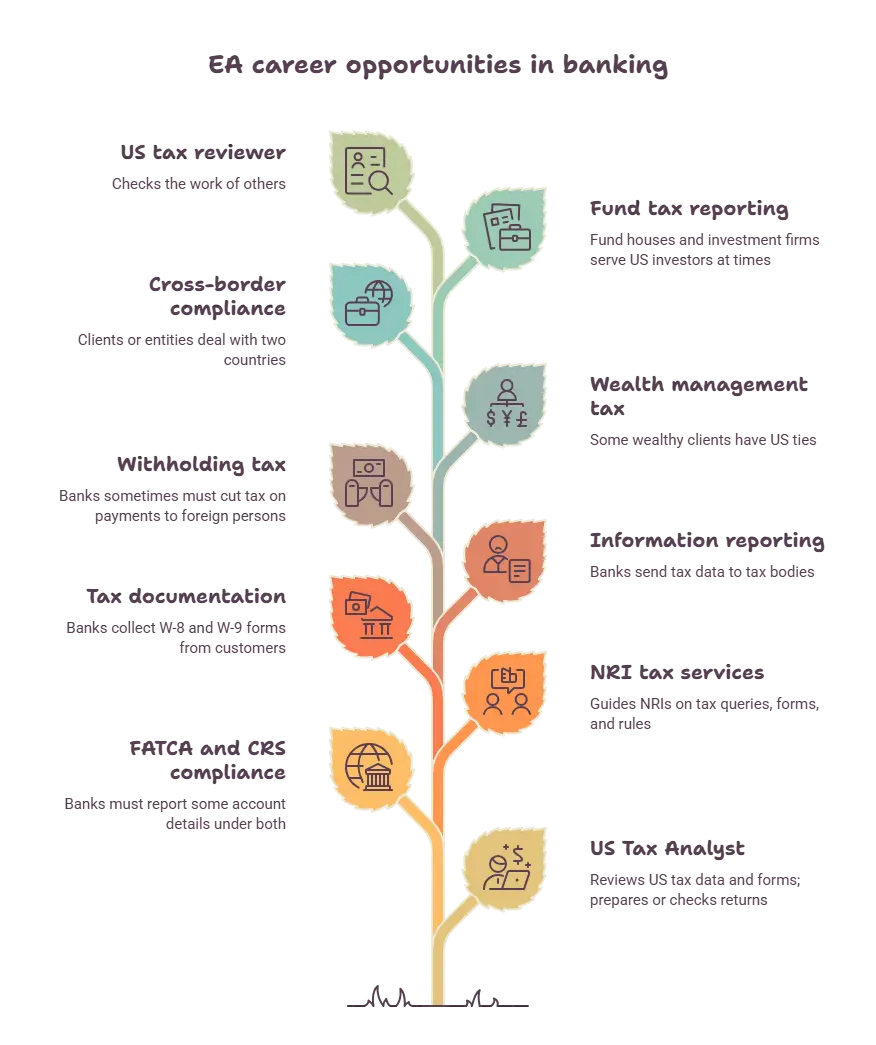
Here are 10 roles where an EA can shine. Titles may differ from firm to firm.
1. US Tax Analyst
This is the most common starting role.
- Reviews US tax data and forms
- Helps prepare or check returns
- Works in bank GCCs and financial-services firms
Why the EA helps: You already know US tax rules.
2. FATCA and CRS Compliance Executive
FATCA is a US law. CRS is a global standard. Banks must report some account details under both.
- Checks if a customer is a US person
- Reviews customer forms
- Prepares reports for tax authorities
Why the EA helps: You know US tax status rules.
3. NRI Tax Services Officer
Many banks have NRI desks. These desks guide NRIs.
- Answers tax queries for NRIs
- Helps with forms
- Explains the effect of US and Indian tax rules
Why the EA helps: You understand the US side.
4. Tax Documentation Specialist
Banks collect tax forms from customers. These include W-8 and W-9 forms.
- Checks if forms are complete
- Spots errors
- Updates customer records
Why the EA helps: You know what each form means.
5. Information Reporting Analyst
Banks send tax data to tax bodies. In the US, this includes forms like 1099 and 1042-S.
- Prepares yearly reports
- Checks data for errors
- Fixes mismatches
Why the EA helps: You know these forms.
6. Withholding Tax Analyst
Banks sometimes must cut tax on payments to foreign persons.
- Works out the right tax rate
- Checks the claim for tax treaty benefits
- Keeps records ready for audits
Why the EA helps: You know withholding rules.
7. Wealth Management Tax Associate
Wealth teams serve rich clients. Some have US ties.
- Supports advisers on US tax questions
- Reviews client tax data
- Helps plan investments with tax in mind
Why the EA helps: You bring tax skills to the table.
8. Cross-Border Tax Compliance Specialist
This role handles clients or entities that deal with two countries.
- Reviews tax rules in both countries
- Flags risks
- Keeps the bank safe from tax errors
Why the EA helps: You know the US side well.
9. Fund and Investment Tax Reporting Associate
Fund houses and investment firms serve US investors at times.
- Prepares tax reports for funds
- Handles investor tax forms
- Supports year-end tax filings
Why the EA helps: You know how US tax reports work.
10. US Tax Reviewer or Manager
This is a senior role. You check the work of others.
- Reviews returns and reports
- Trains junior staff
- Talks to US clients and teams
Why the EA helps: The EA is seen as a trusted title in US tax.
A quick view of the 10 roles
| No. | Role | Main focus |
|---|---|---|
| 1 | US Tax Analyst | US tax review |
| 2 | FATCA and CRS Executive | Account reporting |
| 3 | NRI Tax Services Officer | Customer tax help |
| 4 | Tax Documentation Specialist | Form checks |
| 5 | Information Reporting Analyst | Yearly tax reports |
| 6 | Withholding Tax Analyst | Tax cut on payments |
| 7 | Wealth Tax Associate | Client tax support |
| 8 | Cross-Border Tax Specialist | Two-country rules |
| 9 | Fund Tax Reporting Associate | Fund and investor tax |
| 10 | US Tax Reviewer or Manager | Review and lead |
Where are these jobs?
- Global capability centers
- Foreign banks with India offices
- Financial-services firms
- Fund and wealth firms
- Big accounting firms that serve banks
- Fintech firms
How to start
- Get your EA title
- Learn basic banking
- Apply to bank GCCs and financial-services firms
- Start with a tax analyst or compliance role
Placement Oriented PWC Business Accounting Course
PWC Certified Business Accounting Course by Entri App: Master in-demand skills, ace interviews, and secure top-tier jobs.
Join Now!Enrolled Agent Roles vs Traditional Banking Roles
Many people mix up the two. Here is a simple view.
| Point | EA-linked banking roles | Traditional banking roles |
|---|---|---|
| Main work | US tax and compliance | Loans, deposits, customer service |
| Key skill | US tax knowledge | Sales, service, credit |
| Qualification | EA, plus a degree | Degree, banking exams |
| Where | GCCs, foreign banks, financial firms | Bank branches, head offices |
| Customer contact | Less, mostly behind the scenes | More, face to face |
| Work hours | May follow US time | Normal bank hours |
| Entry route | Direct hiring | Exams like IBPS or SBI |
| Job type | Specialist | Generalist or officer |
What traditional banking roles look like
- Clerk
- Probationary Officer
- Relationship manager
- Loan officer
- Credit analyst
- Branch manager
Most of these jobs are filled through bank exams or direct hiring. They do not ask for an EA.
What EA-linked roles look like
They are back-office or specialist roles. You deal with forms, reports and rules. You do not sit at a branch counter.
Which is better?
Neither one. They suit different people.
- Pick traditional banking if you like customer work and branch life.
- Pick EA-linked roles if you like tax, rules and detail.
Can you do both?
Yes. Some people start in banking and add an EA later. They then move to a tax or compliance team in the same bank.
Skills You Need Along With an Enrolled Agent Certification
The EA alone is not enough. These skills make you ready.
1. US tax knowledge
This is the base. Know the forms. Know the main rules. Keep up with changes.
2. Banking basics
Learn how banks work.
- Types of accounts
- Loans and deposits
- Payments and transfers
- KYC and AML basics
3. FATCA and CRS basics
Learn what they are. Learn who must report. Learn how banks check customer status.
4. Compliance mindset
Banks follow many rules. You must follow them too.
- Follow steps
- Keep records
- Meet deadlines
5. Excel
Excel is used in almost every role.
- VLOOKUP or XLOOKUP
- Pivot tables
- Filters and sorting
- Data checks
6. Banking and tax software
Learn tools like tax software, bank systems and reporting tools. Even basic exposure helps.
7. Attention to detail
A small error in a tax form can cause big trouble. So you must check your work.
8. Clear English
You will write emails and reports. You may talk to US teams.
- Write short and clear
- Speak slowly on calls
- Ask when unsure
9. Data skills
Some roles use large data sets. Learn how to clean and check data.
10. Basic Indian tax knowledge
NRI roles need both sides. Know the basics of Indian income tax and the rules for NRIs.
11. Time management
Tax and compliance work has fixed deadlines. Plan your work well.
12. Teamwork
You will work with banking, legal and compliance teams. Be polite. Share information.
13. Willingness to learn
Rules change. You must keep learning.
How to build these skills
- Take short courses on banking and compliance
- Practice Excel each week
- Read about FATCA and CRS
- Learn on the job
- Join groups of tax and compliance staff
Career Growth and Progression for Enrolled Agents in India
Your path can grow step by step. Here is a simple view.
Typical path
| Level | Role | Experience |
|---|---|---|
| Entry | Tax analyst, compliance executive | 0 to 2 years |
| Mid | Senior analyst, specialist | 2 to 5 years |
| Senior | Reviewer, team lead | 5 to 8 years |
| Leader | Manager, head of tax or compliance | 8 years and above |
Years are only a guide. Growth depends on your skills and your firm.
Entry level
You do the daily work. You check forms. You prepare reports. You learn the tools.
Mid level
You handle harder cases. You guide juniors. You work with other teams.
Senior level
You review the work of others. You make decisions on tricky cases. You talk to US teams.
Leader level
You lead a team. You plan the tax and compliance work. You deal with auditors and regulators.
Ways to grow faster
- Learn FATCA and CRS well
- Pick up a second skill, like data or compliance
- Add another title, such as CPA or CMA
- Learn about audit and risk
- Take small lead roles early
- Build a good network
Other paths from here
- Tax consultant
- Compliance manager
- Risk and audit roles
- Tax adviser in a wealth firm
- Own practice for US clients
- Finance leadership roles
What about pay?
Pay depends on the firm, city, skills and years of work. Do not rely on one number. Check current job posts and ask people in the field.

Placement Oriented PWC Business Accounting Course
PWC Certified Business Accounting Course by Entri App: Master in-demand skills, ace interviews, and secure top-tier jobs.
Join Now!Advantages and Challenges of an EA Career in Banking
Advantages
1. A niche skill
Few people have both banking and US tax knowledge. This helps you stand out.
2. Quick certification
The EA takes months, not years. You get a global title sooner.
3. Good base for compliance
Tax and compliance skills are in demand in banks.
4. Global exposure
You work with US rules and teams. This adds value to your resume.
5. Many ways to grow
You can move to tax, compliance, audit or wealth teams.
6. Steady demand
Banks must follow tax rules each year. So the need does not stop.
7. Fair cost
The EA costs less than many other courses.
Challenges
1. Fewer direct EA jobs in banks
Most bank posts do not ask for an EA. You must look for the right firms.
2. You may need other skills
You need banking and compliance knowledge too. The EA alone is not enough.
3. US time shifts
Some roles follow US hours. This can mean evening or night work.
4. Rules change
US tax and compliance rules change often. You must keep learning.
5. Detail-heavy work
The work has a lot of forms and checks. It can feel repeat and dull at times.
6. Competition
Many finance graduates want these jobs. You need a strong profile.
7. Peak seasons
Year-end reporting can be busy. Work hours may go up.
How to handle the challenges
- Build banking basics early
- Pick firms that value the EA
- Plan your shift and routine
- Keep learning
- Use checklists to reduce errors
Is Enrolled Agent Certification Worth It for a Banking Career in India?
It is worth it in some cases. Let us see when.
It is worth it if:
- You want a career in US tax or compliance
- You want to work in bank GCCs or foreign banks
- You like forms, rules and detail
- You are open to US-time shifts
- You want a quick, global title
It may not be worth it if:
- You want a regular branch job at a bank
- You only plan to clear IBPS or SBI exams
- You dislike tax work
- You cannot work odd hours
A simple way to decide
Ask yourself:
- Do I enjoy tax and rules?
- Do I want a niche role?
- Can I add banking skills?
- Am I ready to keep learning?
If most answers are yes, the EA is a good bet.
Smart ways to get more value
- Pair the EA with banking and compliance courses
- Learn FATCA and CRS
- Get Excel skills
- Apply to bank GCCs and global firms
- Add CPA or CMA later if you want to grow
What to remember
The EA does not give you a bank job on its own. It opens doors. You still need to walk through them with the right skills.
Become an Accounting Pro – Learn from Industry Experts!
Conclusion
An Enrolled Agent can build a good career around Indian banking, mostly in US tax, FATCA and compliance roles. Most normal bank jobs do not need an EA. But bank GCCs, foreign banks and financial firms do hire for these niche roles. To stand out, add banking basics, Excel and compliance skills to your EA title. With the right mix, you can start as a tax analyst and grow into a reviewer or manager over time.
Placement Oriented PWC Business Accounting Course
PWC Certified Business Accounting Course by Entri App: Master in-demand skills, ace interviews, and secure top-tier jobs.
Join Now!Frequently Asked Questions
Can I work in India after becoming an Enrolled Agent?
Yes. You can apply for jobs in tax consulting firms, accounting companies, and global firms that handle US tax work. Some companies in India hire EAs to prepare tax returns and support US clients.
What are the job opportunities for Enrolled Agents in India?
Enrolled Agents can apply for roles such as US Tax Associate, Tax Analyst, Tax Consultant, and Senior Tax Preparer. With experience, they may move into team leadership or tax review roles.
Can Enrolled Agents work in Indian banks?
Yes, some banking and financial services organisations may have roles related to US taxation, tax compliance, or financial reporting. However, EA certification is mainly focused on US federal taxation, so it may not be required for most regular banking jobs.
What is the salary of an Enrolled Agent in India?
Salary depends on the employer, job role, location, and experience. Freshers may start in junior US tax roles, while experienced professionals may earn more in senior or specialist positions. Check current job listings to compare salaries.
Is the Enrolled Agent qualification useful for B.Com graduates?
Yes. B.Com graduates can pursue the EA qualification to build knowledge of US federal taxation. It may help them apply for specialised tax roles, especially when combined with practical training and good communication skills.
Do Enrolled Agents need to move to the USA for work?
No. You can work in India for companies that provide US tax services. Some employers may also offer opportunities to work with overseas teams or clients. Moving to the USA depends on the job and your visa eligibility.
Can freshers get a job after completing the EA qualification?
Yes, freshers can apply for entry-level US tax jobs. However, employers may also look for practical knowledge of tax returns, tax software, and US tax rules. Internship experience or job-focused training can help.
How can I grow my career as an Enrolled Agent in India?
Start by building practical experience in US tax preparation and learning relevant tax software. Improve your knowledge of IRS rules and stay updated on tax changes. With experience, you can apply for senior tax roles, review positions, or team lead opportunities.