
Table of Contents
Strategic HR means planning HR work around what the company wants to do. Hiring, training and pay all link to the company’s goals.
It puts the right people in the right jobs at the right time. It also helps keep them and helps them grow.
Traditional HR takes care of daily work, like payroll, leave and records. Strategic HR plans for the next three to five years. It starts early.
A company may have a good plan. But if the team does not have the skills, the plan will not move. Strategic HR fills that gap before it becomes a problem.
Is being an HR your dream? Enrol now for our course on Human Resource!
Key Takeaways
- Strategic HR plans for the people a company needs later, not just today.
- HR still does payroll and leave. Planning comes on top.
- HR needs simple numbers to plan, like how many people quit.
- Tell HR your plans early. It helps.
- First see who you have. Then see what skills are missing.
- Strategic HR planning is only one part of strategic HR management.
What Does Strategic HR Management Mean?
It means HR sits at the same table as the business leaders. It does not wait for orders.
Here is a simple case. A company wants to open 50 new stores in two years. Traditional HR may wait until the stores are nearly ready. Then it starts hiring in a rush.
Strategic HR begins on day one. It asks a few questions:
- How many store managers will we need?
- Can any of our current staff take those roles?
- How long does training take?
- What pay will work in the new cities?
So when the first store opens, the team is already there.
The Main Idea
HR choices should match business goals. That is the whole idea.
A company that wants to grow fast needs quick hiring and quick training. A company that wants to cut costs needs HR to find savings without hurting the team. A company that is launching a new product needs people with new skills.
What It Covers
Strategic HR looks at a person’s whole time at a company.
- Hiring plans
- Training
- Pay and rewards
- Career growth
- Culture
- Exits and replacements
How Strategic HR Management Developed
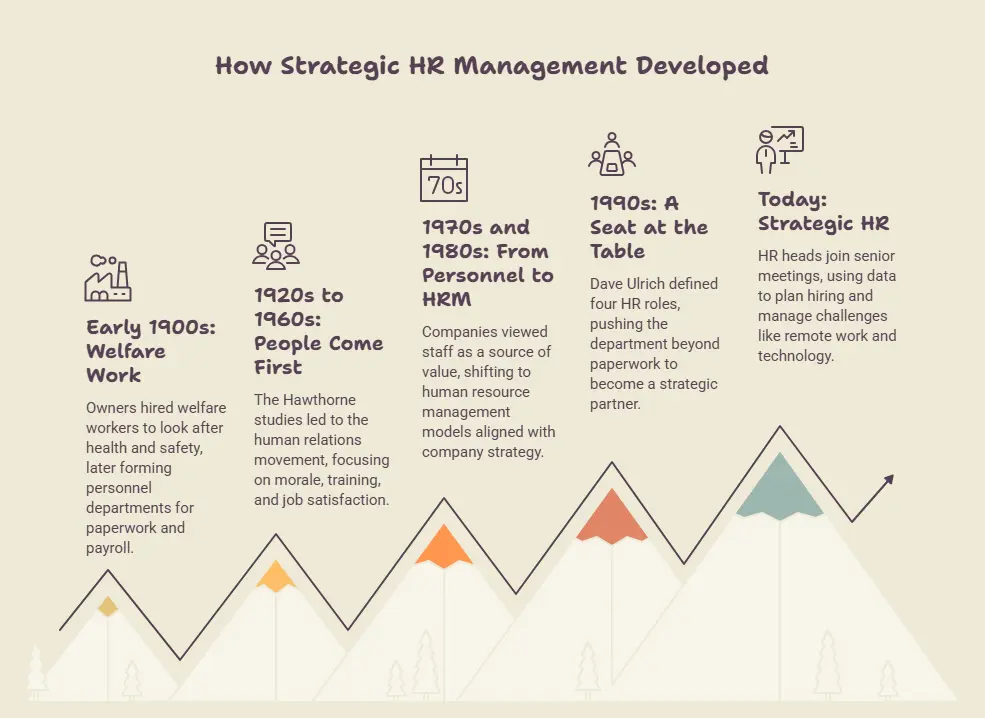
HR was not always a planning job. It took about a hundred years to get here.
Early 1900s: Welfare Work
Factories grew fast in the early 1900s. Some owners hired “welfare workers.” Their job was to look after workers’ health and safety.
Later, many firms set up personnel departments. These teams kept files, hired staff and ran payroll.
- The work was mostly paperwork
- Rules and records came first
- HR had little say in big decisions
1920s to 1960s: People Come First
In the 1920s and 1930s, researchers studied workers at a factory in the United States. These are known as the Hawthorne studies. They found that people worked better when they felt noticed. Pay was only part of the story.
This led to the human relations movement. Companies started to care about morale and how managers treated their staff.
- More training
- Managers began to listen
- Job satisfaction started to count
1970s and 1980s: From Personnel to HRM
Competition grew. Companies began to see staff as a source of value, not just a cost. The word “personnel” slowly gave way to “human resource management.”
In 1984, two well-known models appeared. One came from the University of Michigan. The other came from Harvard. Both said HR should fit the company’s strategy.
1990s: A Seat at the Table
In 1997, a professor named Dave Ulrich described four roles for HR. They were strategic partner, change agent, administrative expert and employee champion. His ideas pushed HR to do more than paperwork.
Around the same time, firms started asking what makes them hard to copy. Many said it was their people.
Today
HR heads now join senior meetings in many companies. They use data to plan hiring and to see who might leave. Remote work and fast-changing technology have added to the pressure.
Become an HR Expert – Enroll in Our HR Management Course Today!
Unlock the secrets to effective Human Resource Management with our expert-led course! Learn recruitment, employee relations, performance management, and more to build a thriving workplace. Start your journey toward a successful HR career today!
Know MoreWhat Are the Key Elements of Strategic HR Management?
Strategic HR has several parts. They depend on each other. If one is weak, the rest suffer.
Link to Business Goals
Everything starts here. HR must know where the company is going.
- What are the goals for the next few years?
- Which products or markets matter most?
- What kind of people will be needed?
Without answers, HR is just guessing.
Workforce Planning
Compare the team you have today with the team you will need later.
- List the current skills
- Spot the gaps
- Decide whether to hire or train
A company might have plenty of sales staff and almost no data analysts. That tells HR where to spend its time.
Smart Hiring
Filling an empty chair is not the goal. The goal is to find people who fit the plan.
- Write clear job roles
- Look for skills the company will need later
- Check culture fit as well as the resume
Training and Development
People have to grow as the business grows.
- Teach new skills before they are needed
- Prepare people for bigger roles
- Show them how they can move up
Pay and Rewards
Pay can push people in a direction. It should push them toward what the company wants.
- Salaries that match the market
- Bonuses tied to results that matter
- Benefits that people really use
If the company wants better customer service, it should reward good service. A bonus only for speed will send people the wrong way.
Performance Management
This is how a company tracks progress and helps people improve.
- Set clear goals
- Give feedback through the year, not just once
- Connect personal goals to company goals
Culture and Engagement
Culture is how people behave when no one is watching. HR can help shape it.
- Build trust
- Ask for feedback and act on it
- Keep people interested in their work
Data and Measurement
Strategic HR depends on numbers.
- How many people leave each year?
- How long does it take to fill a job?
- Which teams feel most engaged?
These numbers help leaders decide with facts, not feelings.
Strategic HR Management vs Traditional HR Management
A company needs both. They just have different jobs.
Traditional HR
This is the day-to-day side of HR.
- Keeps records
- Runs payroll
- Handles leave and attendance
- Follows labour laws
- Fixes problems when they appear
Its focus is today.
Strategic HR
This is the planning side of HR.
- Starts with business goals
- Plans hiring and skills early
- Uses data to guide choices
- Works with senior leaders
- Tries to stop problems before they begin
Its focus is the future.
Side-by-Side View
| Point | Traditional HR | Strategic HR |
|---|---|---|
| Focus | Daily tasks | Long-term goals |
| Time view | Short term | Long term |
| Role | Support | Partner |
| Approach | Reacts | Plans ahead |
| Decisions | Based on rules | Based on data and strategy |
| Link to business | Weak | Strong |
A Simple Example
An employee resigns. Traditional HR posts the job and hires a replacement.
Strategic HR does that too. But it also asks why the person left. Are others unhappy? Is it pay, or is it the manager? The answers may change how the whole team is managed.
Do They Work Together?
Yes. Payroll still has to run on time. Records still have to be correct. Strategic HR does not replace any of that. It builds on top of it.
Why Is Strategic HR Management Important?
A company can only grow as far as its people can take it. Here is how strategic HR helps.
1. It Helps the Company Reach Its Goals
Plans fail when the team is not ready. Strategic HR builds the skills in advance.
- The right people in the right jobs
- Fewer delays
- Better results
2. It Cuts Hiring Mistakes
A bad hire costs time and money. Rushed hiring makes bad hires more likely.
- Clear job needs
- Better matches
- Lower turnover
3. It Helps Keep Good Employees
People leave when they cannot see a future. Strategic HR shows them one.
- Clear career paths
- Fair pay
- Chances to learn
4. It Prepares the Company for Change
Markets shift. New tools arrive. Laws change. A company with a people plan can adjust faster.
- Early training on new skills
- Backup plans for key roles
- Teams that expect change
5. It Saves Money Later
Strategic HR can cost more at the start. Over time it often costs less.
- Less spending on rushed hiring
- Fewer exits
- Better use of the current team
6. It Builds a Stronger Culture
People work with more purpose when they know where the company is going.
- Shared goals
- Better teamwork
- Higher motivation
7. It Gives the Company an Edge
A product can be copied. A strong team is much harder to copy.
- Skilled staff
- Loyal employees
- A good name among job seekers
Become an HR Expert – Enroll in Our HR Management Course Today!
Unlock the secrets to effective Human Resource Management with our expert-led course! Learn recruitment, employee relations, performance management, and more to build a thriving workplace. Start your journey toward a successful HR career today!
Know MoreHow Does Strategic HR Management Work in an Organization?
It works in simple steps. Most companies follow something like this.
Step 1: Understand the Business Plan
First, HR finds out what the company wants to do. It talks to the leaders and reads the plan.
- Where is the company going?
- What will change in the next few years?
Step 2: Check the Current Team
Next, HR looks at who is already there.
- Number of staff
- Skills and experience
- Ages and likely retirement dates
- Strong and weak areas
Step 3: Find the Gaps
Now HR compares what the company has with what it needs.
- Which skills are missing?
- Which teams are too small?
- Which roles will be hard to fill?
Step 4: Make the HR Plan
This is where the main choices are made.
- Who to hire, and when
- Who to train
- Who to promote
- How to set pay
- How to keep key people
Step 5: Put the Plan into Action
HR works with managers to carry out the plan. It takes teamwork.
- Run hiring drives
- Start training programs
- Update pay and benefits
- Explain the plan to staff
Step 6: Track the Results
HR checks if the plan is working.
- Are open roles getting filled?
- Are people finishing their training?
- Are fewer people quitting?
- Is performance getting better?
Examples of Strategic HR Management
These are simple cases to show how it works. They are made-up examples, not reports on real companies.
Example 1: A Retail Chain Opening New Stores
A retail chain plans to open stores in ten new cities.
- HR works out how many managers it needs
- It starts training staff who could become managers
- It checks local pay in each city
- It builds a hiring plan for each opening
Stores open on time with trained teams.
Example 2: A Software Firm Moving Into AI
A software firm decides to build AI tools. Very few people on its team have those skills.
- HR finds who already has some experience
- It offers courses to current staff
- It hires a few experts to lead the work
- It ties bonuses to AI projects that succeed
The firm gets the skills it needs. It does not have to replace everyone.
Example 3: A Hospital Facing a Nurse Shortage
A hospital sees that many of its nurses will retire within five years.
- HR studies the ages of its nursing staff
- It builds ties with nursing colleges
- It offers scholarships and early job offers
- It reviews shift timings to keep current nurses
The hospital avoids a sudden gap in its staff.
Example 4: A Call Centre That Keeps Losing Staff
A call centre loses nearly half its staff every year.
- HR runs exit interviews and finds long shifts are the main reason
- It tests shorter and more flexible shifts
- It trains team leaders to coach their teams
- It checks exit numbers every month
Over time, fewer people leave. Hiring costs drop.
Example 5: A Factory Planning for New Leaders
A manufacturing firm knows several top managers will retire soon.
- HR picks promising employees
- It gives them leadership training
- It lets them lead small projects first
- It plans who will take over each senior role
When a leader retires, someone trained is ready.
Advantages and Challenges of Strategic HR Management
Strategic HR has clear benefits. It also has real problems.
Advantages
1. A better match between people and goals
The right skills are in place when the company needs them.
2. Lower hiring costs
Planning ahead means fewer rushed hires.
3. Better retention
People stay when they can see a way forward.
4. Stronger decisions
Leaders get real data about their people.
5. Readiness for change
The company can adjust faster when the market moves.
6. A better employer name
Good companies attract better candidates.
7. More respect for HR
HR is seen as a partner, not only a support team.
Challenges
1. Leaders may not listen
Some senior leaders see HR as paperwork. They may leave it out of early talks.
2. The future is hard to predict
Business plans change. A people plan built on old goals may no longer fit.
3. Some HR teams lack business skills
Many HR professionals are strong with people but less sure with numbers and strategy.
4. Poor data
Without clean records, planning is hard.
5. It takes time and money
Training, tools and planning all cost money. Results may take years.
6. Staff may push back
Some employees will not like new roles or new ways of working.
How Is Strategic HR Management Different From Strategic Human Resource Planning?
The two terms sound alike. Many people mix them up.
Strategic HR Management
This is the big picture. It covers all the HR work that supports the business plan.
- Hiring
- Training
- Pay
- Performance
- Culture
- Planning
Planning is one piece of it.
Strategic Human Resource Planning
This sits inside strategic HR management. It answers one question. How many people will we need in the future, and with what skills?
- Looks at future staff needs
- Compares them with the current team
- Plans how to close the gap
- Usually covers one to five years
Quick Comparison
| Point | Strategic HR Management | Strategic HR Planning |
|---|---|---|
| Scope | Wide | Narrow |
| Covers | All HR work linked to strategy | Future staff needs |
| Nature | An ongoing approach | A planning process |
| Output | A full HR approach | A workforce plan |
Is being an HR your dream? Enrol now for our course on Human Resource!
Conclusion
If you want to work in HR, start with the basics. Learn how payroll works. Learn how contracts are written. These two things teach you a lot about how a company runs.
After that, pick one number and follow it. It could be how many people leave each year. When that number jumps, ask why. That one question is how many HR people begin to think about planning.
You don’t need a big title to start. Just get curious about what the company will need next.
Check it inside the full blog, since short pieces swing a lot. A real detail from your own work will help more than any rewording. For example, a turnover number you have seen at a job.
| Related Links | |
| Top Human Resource Blogs to Follow | How to build a remote HR career |
| HR Certification vs HR Degree | Which one to choose? | 15 HR Intern Interview Questions and Sample Answers |
Become an HR Expert – Enroll in Our HR Management Course Today!
Unlock the secrets to effective Human Resource Management with our expert-led course! Learn recruitment, employee relations, performance management, and more to build a thriving workplace. Start your journey toward a successful HR career today!
Know MoreFrequently Asked Questions
What is strategic HR management?
Strategic HR management means planning HR work based on the company’s goals. It helps the company prepare for future hiring, training, and employee needs.
Why is strategic HR management important?
It helps companies plan ahead, train employees, and find the skills they need. This makes it easier to work towards business goals.
What are the main functions of strategic HR management?
The main functions include hiring, workforce planning, employee training, performance reviews, salary planning, and employee retention.
What is the difference between traditional HR and strategic HR?
Traditional HR handles daily tasks like payroll, leave, and employee records. Strategic HR also plans for future staff needs and company goals.
Who is responsible for strategic HR management?
HR managers and company leaders work together on strategic HR management. They plan how employees can support the company’s future needs.
How does strategic HR management help employees?
It helps employees learn new skills and grow in their jobs. It can also improve communication and give them more chances to develop their careers.
Can you give an example of strategic HR management?
If a company plans to open a new branch, HR can plan how many employees it needs, what skills they should have, and when to hire them.
What skills are needed for strategic HR management?
HR managers need communication, planning, problem-solving, and decision-making skills. Understanding employee needs and company goals is also important.