Table of Contents
India’s clothing traditions change almost every few hundred kilometres, and it is not just the state borders that decide – climate, local crafts and the communities too play a huge role in shaping these.
You can find a single state with several completely different dress styles depending on where you are, who you are or what you’re celebrating.
This incredible diversity has a solid foundation to back it up too. The office that is in charge of looking after handloom weavers run weavers’ service centres and the India Handloom Brand scheme to make sure authentic hand-woven stuff isn’t lost.
Learn Advanced Designing & Boutique Skills with Experts. Join Now!
Key Takeaways
- Indian clothing is all about where you are, who you are, what the weather’s like and what the occasion is.
- You’ve got your classic – Sarees, lehengas, dhotis, mundus and shawls. But they all vary wildly by region.
- Different places have their own special fabrics, weaves, embroidery styles & the way you wear them.
- In Northeast India, different communities have their own, pretty unique, clothing traditions.
- Handloom initiatives are there to help keep the authentic stuff alive, support weavers and make sure they get a fair deal.
- Clothes from way back still have a huge influence on what people wear to weddings, work and when they’re celebrating.
Traditional Dresses of Indian States at a Glance
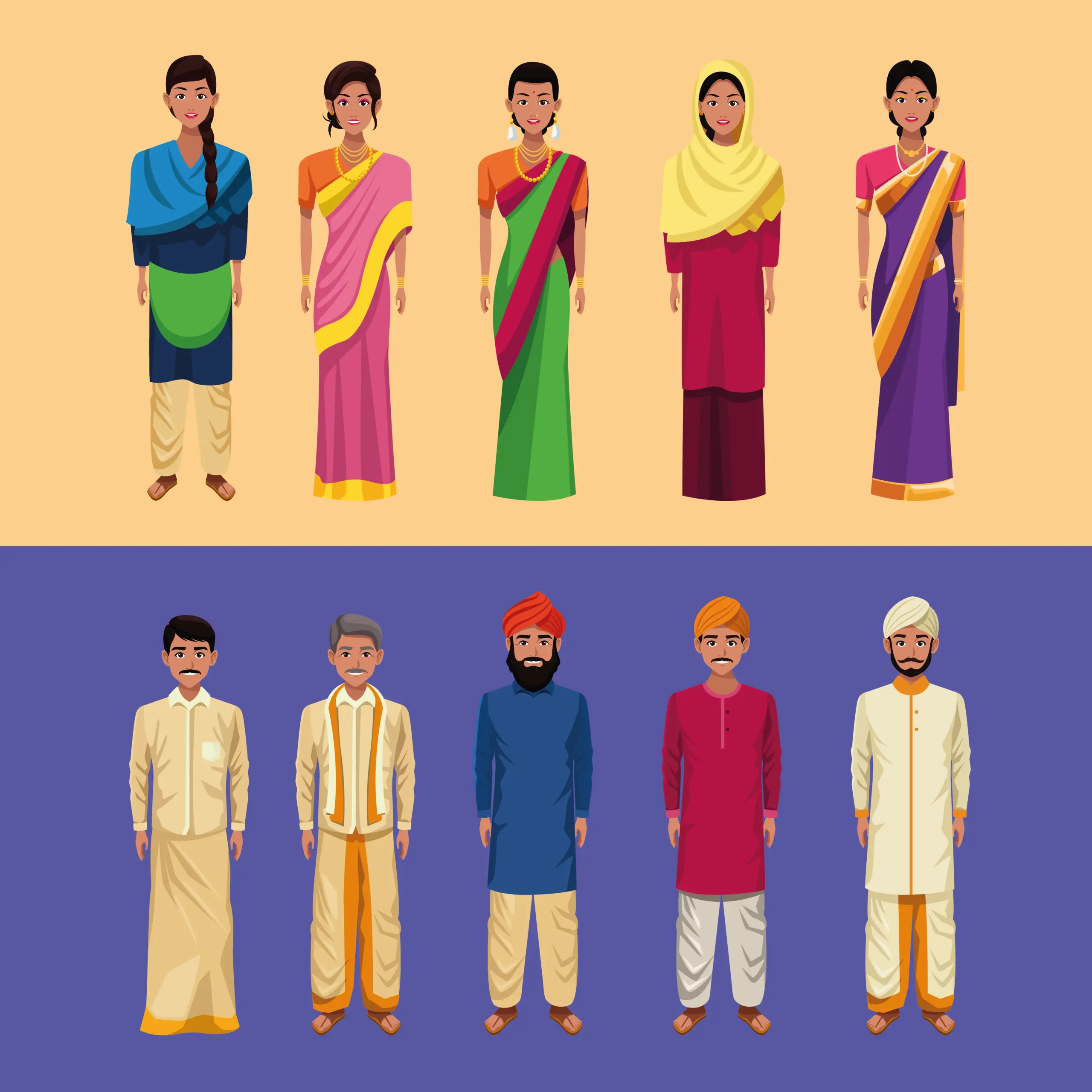
| State | Women’s Attire | Men’s Attire | Signature Textile |
| Andhra Pradesh | Saree, langa voni | Pancha, kurta | Kalamkari, Mangalagiri |
| Arunachal Pradesh | Community-specific woven attire | Community-specific garments | Wool, tribal motifs |
| Assam | Mekhela chador, riha | Dhoti, kurta, gamosa | Muga, eri, pat silk |
| Bihar | Saree, tussar silk saree | Dhoti, kurta | Tussar silk |
| Gujarat | Chaniya choli, saree | Kediyu, chorno | Bandhani, mirror work |
| Himachal Pradesh | Pattu, ghagra, shawl | Chola, kurta, cap | Wool weaves |
| Karnataka | Ilkal saree, Mysore silk | Panche, shirt | Ilkal weave, silk |
| Kerala | Kasavu saree, mundum neriyathum | Mundu, shirt | Kasavu handloom |
| Maharashtra | Nauvari, Paithani saree | Dhoti, kurta, pheta | Silk, zari |
| Odisha | Sambalpuri, Bomkai saree | Dhoti, kurta | Ikat weaving |
| Punjab | Salwar kameez, Patiala salwar | Kurta pajama, turban | Phulkari |
| Rajasthan | Ghagra choli, odhni | Dhoti, angrakha, pagari | Bandhani, block print |
| Tamil Nadu | Kanchipuram saree, pavadai davani | Veshti, shirt | Silk, zari |
| Telangana | Pochampally, Gadwal saree | Pancha, kurta | Ikat, handloom |
| Uttar Pradesh | Banarasi saree, chikankari | Kurta pajama, sherwani | Banarasi silk, chikankari |
| West Bengal | Tant, Baluchari, Kantha saree | Dhoti, panjabi | Jamdani, Kantha |
Note:
These are commonly recognised examples, not the only garments worn in each state. Community and regional variations exist widely.
Master Fashion Designing and Create Your Signature Style
Unlock your creative potential with our expert-led Fashion Designing course. Build in-demand skills and step confidently into the world of fashion!
Begin Your Fashion Career Today!North India: Bold Colours and Warm Weaves
Punjab
When you think of Punjab, the first thing that probably comes to mind is the salwar kameez. That is the traditional outfit the women wear here, along with the Patiala salwar, and usually paired with some beautiful Phulkari embroidery. And let’s not forget the traditional dress of the men – a kurta pajama, topped off with a turban of course.
Rajasthan
Rajasthan is where the ghagra choli and odhni really come into their own, with all the intricate embroidery and beautiful patterns that bring together bandhani tie-dye, mirror work, gota patti, and block printing in all sorts of bright colours.
And the men here wear a dhoti or angrakha with a pretty distinctive pagari (turban) that usually gives away their region or community.
Himachal Pradesh and Uttarakhand
Up in the hills, in Himachal Pradesh and Uttarakhand, people tend to stick with warm, practical clothing, the kind that will keep you warm in the winter months. This can be pattu, woollen shawls, and the Kumaoni pichora, which is a pretty special wedding outfit.
West India: Mirrors, Silk and Sea Breezes
Gujarat’s chaniya choli just wouldn’t be complete without the mirror work and embroidered flare. It is an essential part of the Navratri celebrations, after all.
And when men get dressed up, they usually wear a kediyu with chorno or dhoti-style trousers. Bandhani is another technique that is pretty unique to India. It is one of the most recognizable tie-dye methods out there.
Maharashtra
It offers two very different silhouettes:
- the practical nine-yard Nauvari saree, draped for ease of movement.
- the richly woven Paithani saree with its silk and zari pallu.
Men traditionally wear a dhoti-kurta with a pheta (turban) for festive occasions.
Goa
Goa’s coastal wardrobe is all about lightweight cotton, the kind that keeps you nice and cool in the sun. So, for women, it is all about the sarees and the Pano Bhaju, while the men wear dhoti-based garments.
South India: Silk, Gold Borders and Handloom Cotton
Kerala
Down in Kerala, the kasavu saree and mundum neriyathum are pretty much worn during all the big festivals – Onam, Vishu, weddings. And the men wear a mundu with a shirt or jubba. Kerala’s handloom clusters are actually officially recognised as part of India’s broader textile heritage.
Tamil Nadu
The Kanchipuram silk saree is just the most prized thing down in Tamil Nadu, especially when it has got its temple borders and contrasting zari. And when it comes to younger women, they usually wear the pavadai davani. For the men, it’s all about the veshti with an angavastram.
Karnataka
Karnataka’s got its own thing going on – the Ilkal sarees, with their distinctive border construction, and the smooth, lustrous Mysore silk. And for the men, it’s all about the panche with a shirt or angavastram.
Andhra Pradesh and Telangana
Andhra Pradesh and Telangana have their own special style going on, with hand-painted Kalamkari and handloom Mangalagiri fabric, and ikat-woven Pochampally and Gadwal sarees.
Master Fashion Designing and Create Your Signature Style
Unlock your creative potential with our expert-led Fashion Designing course. Build in-demand skills and step confidently into the world of fashion!
Begin Your Fashion Career Today!East India: Storytelling through Thread
West Bengal
West Bengal’s got its own three saree traditions going on:
- Tant, which is lightweight and everyday.
- Baluchari, which tells a story through its motifs.
- Kantha, which is embroidery in the form of a running stitch, often on sarees and shawls.
And for the men, you’ll usually see a dhoti with a panjabi.
Odisha
Sambalpuri and Bomkai sarees from Odisha are just amazing examples of ikat weaving.
Bihar
Bihar’s famous for its tussar silk, which has this natural textured surface that is just so unique.
Jharkhand
Jharkhand’s a bit different. It doesn’t really have any one “traditional dress”, as the clothing and motifs vary depending on the tribal community. But what you will see is a lot of hand-woven fabric. So that is the common thread there.
Northeast India: A Mosaic of Community Identity
The Northeast resists any single “state costume” narrative more than any other region in India.
Assam:
In Assam, the mekhela chador (a two-piece drape) and riha are the two most well-known garments, and they are usually woven from some pretty nice silk – muga, eri, or pat. The men, on the other hand, usually wear a gamosa alongside a dhoti-kurta.
Manipur:
Women traditionally wear the phanek and inaphi, tied closely to community weaving traditions.
Meghalaya:
The jainsem and dhara are associated with Khasi and Jaintia women.
Mizoram:
Puanchei, kawrchei and puan reflect Mizoram’s colourful handwoven heritage.
Nagaland, Sikkim, Tripura:
Nagaland has community-specific shawls carrying social meaning; Sikkim’s bakhu suits its mountain climate; Tripura’s rignai and risa vary by community.
Arunachal Pradesh:
Woven textiles differ among the Monpa, Adi, Apatani and Nishi communities, using wool, beads and regional motifs.
Fabrics and Techniques Worth Knowing
| Textile/Technique | Regional Examples | What Makes It Distinct |
| Silk | Kanchipuram, Banarasi, Muga, Baluchari | Rich texture, ceremonial use |
| Cotton | Kasavu, Tant, Mangalagiri | Breathable, everyday comfort |
| Ikat | Odisha, Pochampally, Telangana | Resist-dyed geometric patterns |
| Bandhani | Gujarat, Rajasthan | Dotted tie-dye technique |
| Phulkari | Punjab, Haryana | Colourful floral embroidery |
| Chikankari | Uttar Pradesh | Delicate white-thread embroidery |
| Mirror work | Gujarat, Rajasthan | Festive embellishment |
| Wool | Himachal Pradesh, Uttarakhand, Sikkim | Warmth and layering |
Note:
A garment and a technique aren’t the same thing. A saree is a garment – you can’t just make it with any old weaving method – whereas ikat is a weaving method.
Phulkari is an embroidery tradition and while its the real deal, it doesn’t make a complete outfit on its own.
How Climate Shapes What India Wears
- In the hot, humid regions of Kerala, Tamil Nadu and West Bengal, it is all about cotton and loose-fitting drapes.
- Arid states like Rajasthan and Gujarat are all about flowing garments and odhnis. This is not just because they look good, but because they keep you cool and protected from the sun.
- In the cold, mountainous regions of Himachal Pradesh, Uttarakhand, Sikkim and Arunachal Pradesh, wool and layered clothing are where it’s at.
- And then there are the special occasions – silk, zari and all that fancy embroidery are reserved for weddings, festivals and ceremonies across the board.
Climate isn’t the only thing at play here, though. Local customs, what people do for a living and religious practices all shape regional dress just as much.
Styling Traditional Wear Today
- For everyday or college wear: simple cotton sarees, half-sarees or a basic kurta set from your region.
- Weddings: go big with a Kanchipuram, Banarasi or Paithani silk saree, and make sure you’re wearing the right kind of regional jewellery.
- Office wear: handloom cotton sarees and ikat kurtas are a great combo.
- Design portfolios: one regional textile and not a random collection of swatches – developed through mood boards, fabric samples and a final garment that does the textile justice and gives proper credit.
Learn Advanced Designing & Boutique Skills with Experts. Join Now!
Representing Traditional Dress Respectfully
- When talking about this stuff, use phrases like “commonly associated with” instead of saying “the only dress of”.
- Don’t assume that what’s true for one place is true for another – especially in the Northeast.
- Make a point to distinguish between a state, a community, a textile and a garment.
- Give credit where credit is due – to the artisans and handloom clusters that made it all possible – and do your research before you start using a motif commercially.
Conclusion
India’s traditional dress isn’t some static uniform thing. It is a living record of where you come from, what you do for a living and who you are as a community.
From Kerala’s kasavu saree to Assam’s mekhela chador and Gujarat’s chaniya choli, each garment has a story to tell that goes way beyond just the fabric and the colours.
Master Fashion Designing and Create Your Signature Style
Unlock your creative potential with our expert-led Fashion Designing course. Build in-demand skills and step confidently into the world of fashion!
Begin Your Fashion Career Today!Frequently Asked Questions
Which Indian states are famous for traditional sarees?
Tamil Nadu (Kanchipuram), Uttar Pradesh (Banarasi), Odisha (Sambalpuri, Bomkai) and Kerala (kasavu) are among the best known. Each reflects a distinct regional weaving tradition.
How can fashion designers use traditional Indian clothing as inspiration?
By studying regional silhouettes, embroidery techniques and colour palettes before adapting them thoughtfully. Crediting the source community and understanding cultural context is essential to doing this responsibly.
What fabrics are commonly used in Indian traditional clothing?
Cotton, silk and wool dominate, with regional specialities like Muga silk from Assam and ikat from Odisha and Telangana. The choice usually reflects both climate and local craft tradition.
Is there one traditional dress for every Indian state?
No. Most states have multiple traditional garments that vary by community, region, religion and occasion. A state-wise list should be read as commonly recognised examples, not an exhaustive or singular answer.
Why are handloom textiles important in Indian traditional fashion?
Handloom preserves regional weaving knowledge and supports artisan livelihoods directly. It also gives designers access to sustainable, distinctive fabrics that mass production can’t replicate.
Which Indian traditional outfit is most commonly worn at weddings?
Silk sarees like Kanchipuram, Banarasi and Paithani, along with embroidered lehengas, are popular wedding choices. The choice often depends on regional and community background.
What role does the government play in protecting India's handloom heritage?
The Office of the Development Commissioner for Handlooms, under the Ministry of Textiles, runs schemes like the India Handloom Brand and Handloom Mark to certify authentic hand-woven products. These initiatives also support weaver welfare and market access.