Table of Contents
The world is now technologically advanced. 3D printing is gaining currency now. Engineering students are now depending on 3D printing as the most essential practical tool for their learning and experimentation.
For engineering students, 3D printing connects electronics, robotics, embedded systems, manufacturing, and digital design along with mechanical engineering. The digital creation of the components makes the learning more practically oriented.
-Start your 3D printing projects with beginner-friendly, simple and learner-orientated projects.
-Choose projects that match your skills, engineering batch, budget and practical learning experience.
-Develop CAD modelling, problem-solving, electronic integration and rapid prototyping through the projects.Document your projects and build a strong portfolio.
Learning through theoretical knowledge is not only a requirement of engineering students, but practical knowledge is also key for their development.
Learning 3D printing can help in testing the prototypes manufactured, identifying issues and improving the design by printing it out and analysing. Designing becomes much easier with the advent of 3D printing.
There are umpteen printing projects for engineering students to get hands-on experience with the same. The 3D printing projects for engineering students involve smart dustbins, drone frames, mechanical gear systems, IoT prototypes, automated plant watering systems, robotic arms, mini CNC machines, and engineering component customisation, as well as assistive device inventions and research.
At a beginner level, simple engineering projects such as sensor holders, mechanical assemblies, mini robotic structures, etc. are well suited. When you upgrade yourself to the intermediate level, you can work on automated systems, robotic arms, IoT devices and so on.
Final-year engineering students can work on CAD, 3D printing with embedded systems, programming and sensors. The innovative engineering prototypes can be easily made with the continuous learning process.
Why 3D Printing Matters in Engineering Education
Project-based learning has gained more currency in the engineering field. Students ought to learn how a system works practically rather than only depending on theoretical knowledge.
Once you gain knowledge theoretically, your next aim should be to develop it by properly applying the practical knowledge. Engineering students should have first-hand knowledge and expertise in knowing the interaction of the different components and elements in the real-world space.
3D printing gives an outlook on how each component of the particular design works. The printing allows the students to convert the physical objects into digital objects and aid in working on it and improving it.
For instance, a mechanical engineering student should be capable of designing and printing a gear mechanism, which allows them to understand its workflow. A computer science student can successfully combine 3D-printed structures with sensors to develop an IoT prototype. The engineering students belonging to any sector can develop projects and work upon them with the help of 3D models.
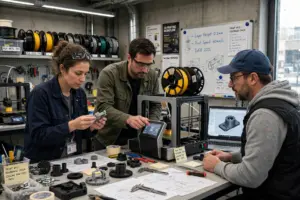
3D printing allows the students to experiment and understand the key concepts revolving around the production and creation of any designs.
- Gain CAD modelling knowledge.
- Quick understanding of prototyping
- Mechanical designs testing
- Development of functional prototypes
- Experimentation and research with advanced materials
- Design flaw identification
- Physical structure integration with electronics
- Design flaw identification
- Use the iteration method to improve product knowledge
- Deeper understanding of modern techniques involving manufacturing
Kickstart your embedded systems career and turn your tech passion into high-demand skills!
Choosing the Right 3D Printing Project
The choice of the right 3D printing project works well when everything aligns with the chosen branch of the student, the technical and professional knowledge of the student, the availability of the equipment, the allocated budget and the duration of the project.
Before confirming your project, you need to consider the following aspects, which include the following:
Engineering branch
Based on the branch of your study, you have to decide on the appropriate project to choose. If the student belongs to the mechanical engineering branch, the student can focus on the development of structural components and gear development.
Students belonging to the electrical or electronic engineering branch can explore the possibilities of sensors, robotics, enclosures and automation. The programming, IoT, and embedded systems can be combined with 3D printing for computer science students.
Equipment
Before selecting the project, make sure to check the availability of the 3Dprinter along with the replacement parts and software, electronic kits, motors, microcontrollers, CAD software, etc.
Skill level
As a beginner, you should start with simple designs and then move towards advanced systems. The advanced projects involve complex mechanical design and structure, programming, sensors, and motors. Before indulging in the complex designs, make sure you know the essence of the fundamental concepts.
Budget
The student projects should always be budget-friendly. The affordability of the FDM printers, PLA filament, and ESP32 modules can help students achieve their desired outcomes.
Real-world value
The engineering projects that could solve practical issues are welcomed for the technical portfolio and academic presentations of the students. The value of the projects should be considered while working on them.
Master Embedded Systems Programming!
Launch your tech career with our Embedded Systems Course, designed for hands-on learning and industry readiness.
Know MoreBest 3D Printing Projects for Engineering Students
Learn through gaining practical experience through 3D printing projects.
3D Printed Robotic Arm
The robotic arm is a widely recognised multidisciplinary project that allows you to design and test without any limitations. The movements can be controlled easily with the aid of servo motors while the operations are done by ESP32.
The students can easily design and print the gear, gripper, arm structure or joints and work on them easily. The skills that are needed to manage those include motor control, robotics, 3D printing, CAD and electronics.
Smart Dustbin
The ultrasonic sensor and servo motor are combined in the 3D printer. The lid will be automatically opened when the sensor detects it as the object approaching it. A smart dustbin is a very easy and possible option for engineering students.
Automated Plant Watering System
A customised 3D-printed water distribution system for plants, along with the integration of it with a microcontroller and soil moisture sensor, can be integrated along with it. Upon soil dehydration, the pump will be automatically activated.
IoT Device Enclosure
The customised 3D-printed enclosure will be made for the IoT devices’ PCB. Battery, sensors, and display. Electronic and mechanical designs can be aligned here together.
Mini CNC Machine
With the aid of the controller and stepper motors, a CNC machine can be developed. The mechanical structure and motion control can be thoroughly analysed and researched.
3D Printed Drone Frame
Lightweight drone frames can be printed and integrated with controllers, sensors, propellers and motors. The project analyses the weight distribution, aerodynamics and structural designs.
Assistive Device Prototype
The physical requirements can be met with the aid of the customised grip gear and other assistive mechanisms. The project has gained high currency since the requirement is really adequate to support human physical performance.
Gear system – Mechanical
Mechanical engineering students can work on gear-based projects. The gears can be designed, printed, assembled, tested and retested. After the redesign, it can help you to understand the exact gear ratios.
Door Model – Sensor-Based Automation
With the aid of the 3D-printed frame, an automatic door model can be made. The sensor-based automation can be activated to understand the working nature of the automatic door system.
Smart Helmet Prototypes
Sensors and electronics can be incorporated in the 3D-printed helmet prototypes for the detection of accidents, communication systems and temperature monitoring. Safety can be highlighted in such projects that not only reflect academic performance but also human safety.
Kickstart your embedded systems career and turn your tech passion into high-demand skills!
Beginner vs Intermediate vs Advanced 3D Printing Projects
There are huge differences between beginner, intermediate, and advanced 3D printing projects. Have a glance here.
| Features | Beginner 3D projects | Intermediate 3D projects | Advanced 3D projects |
| Skill | Beginners | Basic experience | Experienced |
| Print size | Small | Medium | Large |
| Design complexity | Simple | Multiple | complex |
| Project Examples | Phone stand, key chain | Organisers, drones, planters | Robotics, functional prototypes |
| Material | PLA | PETG | ABS, TPU |
| Print time | 30 m-3 hrs | 3-10 hrs | 10+ hrs |
| Post-processing | Minimal | Sanding | Sanding, finishing |
The design-to-print project should be focused more on. The students can develop integrated systems based on the base knowledge.
The advanced projects can be taken up once the work on the main project is complete. Electronics automation and software development can be done smoothly once you complete the beginner-level projects and gain more practical knowledge in it.
Essential Software and Tools
Hardware and software are equally important for the 3D printing projects. The projects will be successful only when the essential tools and software align.
CAD Software
The 3D models can be created with the aid of FreeCAD, AutoCAD, Autodesk Fusion, SolidWorks, and so on. Before moving on to the advanced CAD platforms, beginners can use Tinkercad.
Slicing Software
The slicing software converts instructions into the form that the printer can easily understand. The Ultimaker Cura, PrusaSlicer, and BambuStudio can be used effectively.
Electronic Platforms
The projects involving embedded systems, which include Arduino and ESP32, along with Raspberry Pi, can be used for connectivity, automation and sensors.
Master Embedded Systems Programming!
Launch your tech career with our Embedded Systems Course, designed for hands-on learning and industry readiness.
Know MoreSkills You Develop Through 3D Printing Projects
With the 3D printing projects, the printing skill is not only improved but also advanced to the next level. Students learn 3D modelling and CAD within a short time span. They naturally enhance skills such as problem-solving, testing, programming, rapid prototyping and so on.
When a certain prototype fails, the students should notice and identify the reason for immediate change. Identify the root cause, modify and rework and then test it again. The first design may not necessarily be perfect always. You can improve the design multiple times to find the best version of the design.
Kickstart your embedded systems career and turn your tech passion into high-demand skills!
Common Challenges and How to Overcome Them
Challenges are an integral part of all projects. With challenges come more chances of achieving success. Here are the common challenges you face while handling 3D printing and the solutions that can give you ultimate control over it.
- Use of incorrect dimensions
- Make sure that you are using accurate measurements. Use digital callipers to verify the printed components before the application.
- Poor quality of first layer adhesion
- Make sure to properly clean and calibrate the print bed
- Weak components
- Work on the wall thickness, infill and print orientation. Be careful while choosing the materials by avoiding the weak components.
- Warping: Normalise choosing the required printing settings and temperature for printing. Understand the environmental conditions as well.
- Overcomplicated projects
- Break your project into small, simple modules and work on it before moving on to the complicated, advanced features.
- Avoid overcomplication
It is better to look for simple projects in the beginner stage and then move on to the complicated ones for better practical knowledge.
How These Projects Improve Career Opportunities
The technical portfolio of the students will be improved if you are using the 3D projects to demonstrate your skills. Your rapid prototyping, CAD, embedded system handling, robotics, programming, testing, analysing and technical skills shall be documented.
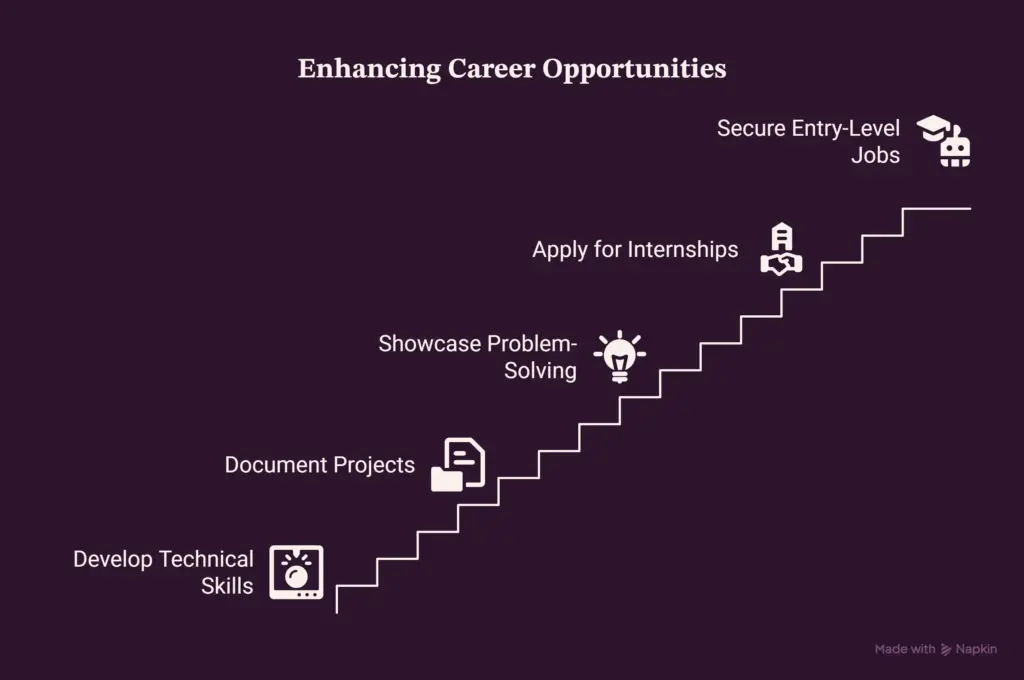
With the help of CAD files, images, documents, videos, photographs, test results, source codes, circuit diagrams and designs, projects can be carefully placed and documented. This documentation will enrich their profile.
To state as evidence that your problem-solving skills are at peak level, you can also add the problems you solved as a part of your academic development. These projects will allow you to apply for internships and entry-level opportunities in product development, embedded systems, robotics and engineering.
Tips for Selecting Your Final-Year 3D Printing Project
While selecting your final year project, you should have a strong objective. Your final year project should solve a problem and provide a solution. The objectives of your project should be measurable. The printing should be meaningfully used in your project.
Your project should also include testing and evaluation of the performance; market analysis should be done to confirm whether it is appropriate for the market. The project should fit within the available budget and allotted timeline. Make sure that your project reflects multiple technical aspects, and the scope of improvement should be given.
Advantages and Limitations of 3D Printing Projects
3D printing projects have both advantages and limitations at the same time. The completion of a 3D printing project seems to be challenging and rewarding at the same time.
Advantages are as follows:
- Hands-on experience
- Quick prototyping
- Ease in design modification
- Components are customised
- Small-scale manufacturing becomes affordable
- Hands-on experience in engineering
- Embedded system and electronics engineering integration
- More rapid experimentation and research possibilities
- Learning interdisciplinary processes
Limitations
- Frequent occurrence of print failure
- Significant time delay for printing
- Choice of materials affects the overall strength of the product. Post-processing is required for printed parts.
- Additional electronics are required for advanced projects
- Final manufacturing materials may not reflect the initial prototype
- Multiple manufacturing methods may be required for large-scale production
The students who are working on 3D printing should consider it as the most suitable development in engineering rather than as a manufacturing replacement.
Conclusion
The 3D printing projects give a suitable opportunity for the students to convert their theoretical knowledge into practical knowledge. They can enhance their skills and expertise by working on the 3D printing projects.
The students working on the 3D printing projects will automatically get opportunities to get practical exposure and experience. The students can start from mechanical components and work to develop, design, test and improve the prototypes in the real world.
The students will also learn to integrate technologies, create digital solutions to the problems identified, perform failure analysis, and develop.
For the engineering students who are planning to pursue a career in engineering, robotics, embedded systems, or project development, you should regard 3D printing as that stepping stone for preparing yourself to be job-ready.
Master Embedded Systems Programming!
Launch your tech career with our Embedded Systems Course, designed for hands-on learning and industry readiness.
Know MoreFrequently Asked Questions
What is the role of 3D printing projects in improving the career of engineering students?
The technical portfolio of the students will be improved if you use 3D projects to demonstrate your skills. Your rapid prototyping, CAD, embedded system handling, robotics, programming, testing, analysing and technical skills shall be documented.
What is the core feature of the 3D printing projects for engineering students?
3D printing gives an outlook on how each component of the particular design works. The printing allows students to convert physical objects into digital objects and aids in working on them and improving them.
What is the purpose of using slicing software?
The slicing software converts instructions into a form that the printer can easily understand. The Ultimaker Cura, PrusaSlicer, and BambuStudio can be used effectively.
Why should an engineering student learn the 3D printing?
Learning 3D printing can help in testing the prototypes manufactured, identifying issues and improving the design by printing it out and analysing. Designing becomes much easier with the advent of 3D printing.
How can 3D printing projects help in career growth?
With the help of CAD files, images, documents, videos, photographs, test results, source codes, circuit diagrams and designs, projects can be carefully placed and documented. This documentation will enrich their profile.
Why is choosing the right 3D printing project matters?
3D printing allows the students to experiment and understand the key concepts revolving around the production and creation of any designs.
What is the purpose of including 3D printing projects in the engineering syllabus?
For engineering students, 3D printing connects electronics, robotics, embedded systems, manufacturing, and digital design along with mechanical engineering.