Table of Contents
One of the core Applied Knowledge papers that are required for the ACCA qualification is Financial Accounting (FA), which is an abbreviation that stands for Financial Accounting. The purpose of this course is to offer students with an introduction to the principles of financial accounting. It teaches students how to record business transactions, construct financial statements, and understand accounting concepts. As a result of the fact that it serves as the foundation for more advanced courses such as Financial Reporting (FR), it is essential for every ACCA student to have a thorough understanding of accounting.
This article will provide you with information regarding the ACCA FA syllabus, the structure of the exam, essential themes, study strategies, common mistakes, and practical tips that will assist you in passing the exam with confidence.
Key Takeaways:
Explore free accounting courses now!
Financial Accounting (FA) at a Glance

One of the three Applied Knowledge exams, the ACCA Financial Accounting (FA) paper is the foundation for comprehending accounting concepts and financial reporting. It is one of the three exams that make up the Applied Knowledge series. This course provides students with an introduction to double-entry bookkeeping, the recording of financial transactions, the preparation of financial statements, and the application of fundamental accounting principles. It offers a flexible beginning point for individuals who are interested in becoming accountants because the examination is computer-based, features an objective structure, and is available on demand throughout the year.
| Feature | Overview |
|---|---|
| Examination Name | Financial Accounting (FA) |
| ACCA Level | Applied Knowledge |
| Exam Duration | 2 Hours |
| Format of the Exam | Computer-Based Exam (CBE) |
| Nature of the questions | Objective Test Questions (OTQs) |
| Total Marks | 100 Marks |
| Pass Mark | 50% |
| Exam Availability | On-demand throughout the year |
| Primary Concentration | Recording financial transactions and putting out fundamental financial accounts respectively |
| Principal Subjects | Double-entry bookkeeping, trial balance, accounting adjustments, financial statements, inventory, depreciation, bank reconciliations, accounting principles Bookkeeping using a double entry system, trial balance, accounting adjustments, financial statements, inventory, depreciation, bank reconciliations, and accounting principles are all examples of accounting principles. |
| The Acquired Abilities | Maintaining accurate accounting records, bookkeeping, financial reporting, and analytical thinking are all important. |
| Specified Amount of Time for Preparation | 6–10 weeks (depending on the client’s level of accounting expertise) |
| Next ACCA Paper | Financial Reporting (FR) |
| Relevance to One’s Profession | Contributes to the development of essential accounting knowledge for positions in bookkeeping, accounting, auditing, and finance: |
What is ACCA Financial Accounting (FA)?
1: Accounting provides information on
The principles of accounting and financial reporting are the primary topics covered in the ACCA Financial Accounting (FA) paper. Through this course, students learn how firms record financial transactions and how to create financial statements in compliance with accounting standards.
Students are able to better comprehend the following thanks to the paper:
- The use of double-entry accounting
- Conventions and concepts pertaining to accounting
- The preparation of the trial balance
- Detailed financial statements
- The accounting of inventory
- In addition to non-current assets, depreciation
- Payables and receivables received
- Reconciliation of cash and bank accounts
- Establishing a record of partnerships
When it comes to higher-level ACCA papers, particularly Financial Reporting (FR), the information that is obtained in Financial Accounting acts as the most important building block.
Placement Oriented PWC Business Accounting Course
PWC Certified Business Accounting Course by Entri App: Master in-demand skills, ace interviews, and secure top-tier jobs.
Join Now!ACCA FA Syllabus
The curriculum for the ACCA Financial Accounting course is broken up into several important sections.
1. The Background and Role of Financial Reporting in the Organization
A student will learn:
- Accounting for finances has a purpose.
- Those who make use of financial statements
- Different kinds of commercial organizations
- Regulatory structure and framework
2. Recording Transactions in the Financial Sector
Among the topics are:
- The use of double-entry accounting
- Books of records and ledgers
- The trial balance
- The stories of suspense
- Changes made to correct errors
3. The practice of keeping financial records
Students are instructed to:
- Valuation of physical stock
- Calculations of depreciation
- Receivables that include accruals and prepayments
- Reconciliation of Payables in the Bank
4. Composing Statements of Financial Position
Included in this section are:
- Declaration of Profit or Loss Statement
- of the Current Financial Situation
- Statements of financial position for sole proprietors
- Partnership financial statements are presented here.
5. The Fundamentals of Accounting
The following are important concepts:
- An ongoing worry
- Continuity of behavior
- The Materiality of Prudence
- The concept of matching
- In the past, the expense
6. Standards for Financial Reporting
The fundamental comprehension of:
- The framework of IFRS
- Accounting requirements that are applicable to students at the first level
ACCA FA Exam Pattern
Your comprehension of accounting principles and your capacity to apply those principles to real-world situations will be evaluated by the ACCA Financial Accounting (FA) exam, which is a Computer-Based Examination (CBE). Every single question on the test is of the objective variety, which is essential in order to ensure that candidates are assessed on every single subject that is covered in the curriculum. If you want to pass, you need a minimum of fifty percent..
| Exam Component | Details |
|---|---|
| Exam Level | Applied Knowledge |
| Exam Runtime | 2 Hours |
| Exam Mode | Computer-Based Exam (CBE) |
| Total Marks | 100 |
| Pass Mark | (50%) |
| Question Type | Objective Test Questions (OTQs) |
| Number of Questions | 35 Objective Test Questions and 2 Multi-Task Questions (MTQs) |
| Question Distribution | Section A: 35 OTQs (70 marks); Section B: 2 MTQs (15 marks each = 30 marks) |
| Negative Marking | No |
| Calculator | A rudimentary on-screen calculator is given; authorized calculators are allowed. |
| Exam Availability | Exams are available on-demand at ACCA-approved locations. |
Important Topics to Prioritize
The following are some of the areas of the curriculum that students should pay particular attention to:
- The use of double-entry accounting
- The trial balance
- Depreciation by means of bank reconciliation
- Valuation of physical stock
- Prepayments and accruals as well
- Payables and receivables received
- In the process of preparing financial statements
- Improvements made to mistakes
- Concepts underlying accounting
The majority of the questions in the examination are based on these quite common topics.
Placement Oriented PWC Business Accounting Course
PWC Certified Business Accounting Course by Entri App: Master in-demand skills, ace interviews, and secure top-tier jobs.
Join Now!How to Prepare for ACCA FA
Accounting concepts, persistent practice, and time management are essential to pass the ACCA Financial Accounting (FA) exam. FA is a basic exam, so know bookkeeping and financial reporting to pass and prepare for advanced ACCA examinations like Financial Reporting.
Understand the Basics
Learn accounting instead of diary entries. Understanding double-entry bookkeeping, accounting, and financial reporting simplifies practical concerns.
Following the ACCA Syllabus
Examine each syllabus section to prevent missing topics. Schedule ample study time for learning, practice, and review.
Do Daily Double-Entry Bookkeeping
FA examinations involve double-entry bookkeeping. Practice makes transaction recording, ledger entry uploading, and trial balance preparation faster and more precise.
Master Financial Statements
Invest more time teaching yourself how to get ready:
Accounting Statement
- Statement of Financial Position
- Statement of Profit or Loss
In order to improve your comprehension, you should practice answering problems that involve adjustments like as depreciation, accruals, prepayments, and inventory valuation.
Answer Many Practice Questions
OTQs help with exam prep. Practice different question types to master the exam format and identify areas for improvement.
Take Mock Exams
Timed mock exams simulate exams. This improves confidence, time management, and Computer-Based Exam preparation.
Point Out Flaws
Learn challenging subjects and review practice exam scores. To better, evaluate mistakes and learn why they happened.
Keep revising.
Avoid last-minute cramming with regular review sessions. Flashcards or notes should cover the most significant accounting principles, formulas, and changes before the exam.
Common Mistakes Students Make
Many students are penalized for the following reasons:
- Neglecting to adhere to accounting theory.
- Instead of understanding topics, you should memorize them.
- Ignore the practice of bookkeeping.
- Inaccuracies in the calculations:
- You should forget about adjustments like accruals and depreciation.
- Invest an excessive amount of time on perplexing questions.
- Stay away from practice tests.
Your performance can be considerably improved if you are able to recognize these faults at an early stage.
ACCA FA vs. Financial Reporting (FR)
While Financial Accounting (FA) and Financial Reporting (FR) are closely related to one another, they are intended to fulfill different tasks within the ACCA certification. This is even though they are strongly tied to one another. In contrast to FR, which builds upon the basis that was established by FA by providing more complicated principles of financial reporting and the application of International Financial Reporting Standards (IFRS), FA is primarily concerned with the fundamentals of accounting and bookkeeping. FR builds on the foundation that was set by FA.
You will be able to strengthen your preparation and obtain a greater appreciation for how these two papers sit within your ACCA journey if you achieve a grasp of the differences that exist between these two papers.
| Feature | Financial Accounting (FA) | Financial Reporting (FR) |
|---|---|---|
| ACCA Level | Applied Knowledge | Applied Skills |
| Aim | Provides an introduction to the fundamentals of financial accounting | Facilitates the development of advanced abilities in financial reporting and analysis |
| Focus | Recording financial transactions and putting out fundamental financial accounts, respectively | Preparing, verifying, and analyzing financial statements in compliance with International Financial Reporting Standards |
| Difficulty Level | Beginner | Intermediate to Advanced |
| Accounting Standards | An introduction to the laws and regulations that govern accounting principles | The International Financial Reporting Standards (IFRS) are being applied often and extensively. |
| Statements of Financial Position | Statements of financial health for sole proprietorships and basic partnerships | Statements of financial position for businesses, including statements of performance for consolidated firms |
| Question Format | Objective Test Questions (OTQs) | Constructed response and objective test questions |
| Exam Duration | 2 Hours | 3 Hours |
| Tests of Abilities | The production of financial statements, as well as bookkeeping, trial balance analyses, and accounting adjustments | In the realm of accounting standards, financial reporting, interpretation, analysis, and implementation are all included. |
| Relevance to One’s Profession | Beginning positions in the fields of accounting and bookkeeping | Responsibilities in the areas of senior accounting, corporate finance, audits, and financial reporting |
How FA Helps in Your ACCA Journey
Due to the fact that it provides support for a number of later ACCA subjects, Financial Accounting is considered to be one of the most significant foundation papers.
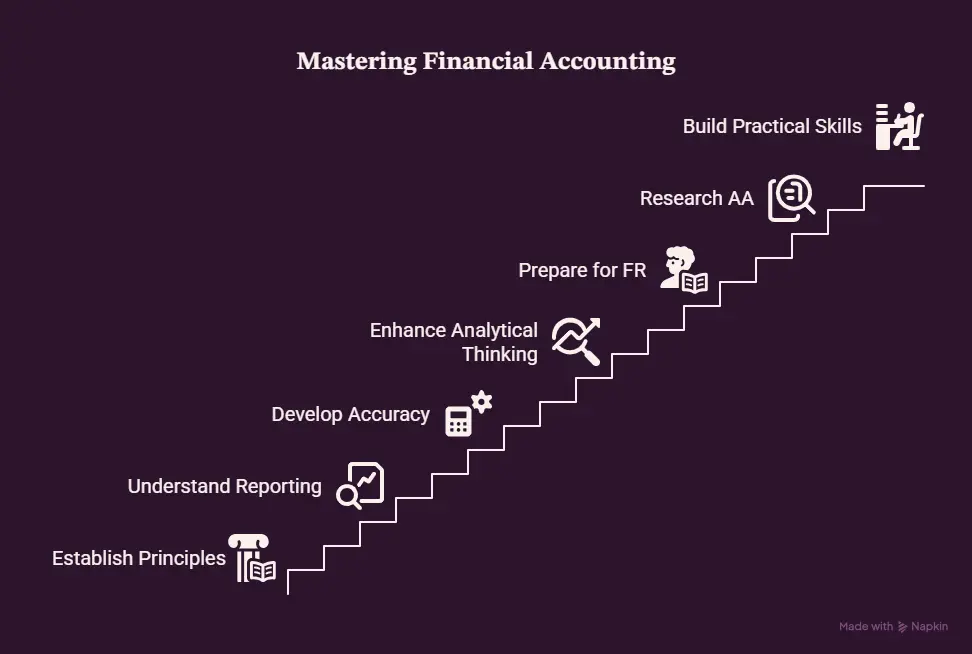
Students benefit from it because:
- Establish the principles of accounting.
- Get familiar with the fundamentals of financial reporting.
- Accuracy in bookkeeping, please develop.
- In order to improve analytical thinking
- Get ready for the Financial Reporting (FR) exercise.
- Academic research in the field of auditing and assurance (AA)
- Build up your practical accounting abilities in preparation for employment.
A comprehensive understanding of FA is beneficial for both upcoming examinations and professional accounting positions.
Tips to Score Well in ACCA FA
- Regular study, as opposed to cramming, is preferable.
- Always make sure to keep accurate records.
- Learn the double-entry method of accounting.
- Perform regular revisions to the financial statements.
- Utilize practice tests to increase your speed.
- Study the errors that you make when you are practicing.
- Before responding, a careful reading of each question is required.
- In the beginning, you should avoid challenging queries and come back to them later.
- Utilize time management skills to your advantage during the test.
- Conduct a review of accounting principles prior to the day of the exam.
Explore free accounting courses now!
Conclusion
To become an ACCA member, you must complete the Financial Accounting (FA) course. You will be able to record transactions, create financial statements, and grasp the concepts of financial reporting after completing this course. If you read the material, practice the objective test questions often, and concentrate on the fundamentals of accounting, you should have no trouble passing the FA exam and will be well-prepared for the more advanced ACCA exams, like FR and AA. Consistent preparation, frequent revision, and practice with mock exams are the keys to getting a respectable result.
Placement Oriented PWC Business Accounting Course
PWC Certified Business Accounting Course by Entri App: Master in-demand skills, ace interviews, and secure top-tier jobs.
Join Now!Frequently Asked Questions
Is ACCA Financial Accounting (FA) difficult?
FA is considered one of the easier ACCA papers because it introduces accounting fundamentals. Students with consistent practice usually perform well.
How long does it take to prepare for ACCA FA?
Most students require 6–10 weeks of regular study, depending on their prior accounting knowledge and study schedule.
Is the ACCA FA exam computer-based?
Yes. ACCA Financial Accounting is conducted as an on-demand Computer-Based Exam (CBE).
Which topics carry the most weight in ACCA FA?
Double-entry bookkeeping, financial statements, trial balance, inventory, depreciation, bank reconciliation, and accounting adjustments are among the most important topics.
Is FA important before studying Financial Reporting (FR)?
Yes. FA provides the essential accounting knowledge required to understand the more advanced concepts covered in Financial Reporting (FR).
What study materials are best for ACCA FA preparation?
Use the official ACCA Study Hub, ACCA-approved study texts and practice kits, revision notes, mock exams, and past-style practice questions to strengthen your preparation.
Is ACCA FA more practical or theoretical?
The FA exam is a combination of both. It tests your understanding of accounting concepts as well as your ability to apply them through practical bookkeeping and financial statement preparation.
Can I self-study for the ACCA FA exam?
Yes. Many students successfully self-study for ACCA FA using ACCA-approved learning resources, online lectures, study texts, and consistent practice. However, coaching can be beneficial if you need additional guidance.