Table of Contents
DevOps is an important skill in many IT jobs. If you are preparing for an Accenture DevOps interview, you should know the basic DevOps topics.
The interview may include questions about:
- Git and GitHub.
- Docker.
- Jenkins.
- Kubernetes.
- Cloud.
- Linux.
- Terraform.
- DevSecOps.
Some questions may also ask about real work situations.
This blog covers common Accenture DevOps interview questions in a simple way. It can help freshers and experienced candidates prepare better.
Learn & Master DevOps with Entri. Enrol now!
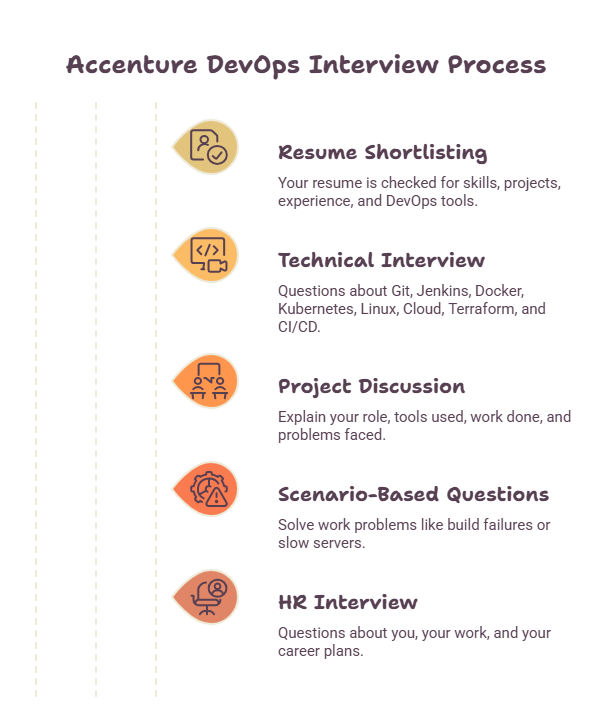
Accenture DevOps Interview Process
The interview process can change based on the role and your experience. You may have a test, technical round, and HR round.
Resume Shortlisting
Your resume is checked first.
It should clearly show your:
- Skills
- Projects
- Experience
- DevOps tools
Technical Interview
You may get questions about:
- Git
- Jenkins
- Docker
- Kubernetes
- Linux
- Cloud
- Terraform
- CI/CD
You may also be asked how you used these tools.
Project Discussion
The interviewer may ask about your project.
Be ready to explain:
- Your role
- Tools you used
- Work you did
- Problems you faced
Scenario-Based Questions
You may get simple work problems.
For example, a build may fail or a server may become slow. You may need to explain what you would check.
HR Interview
The HR round may include questions about you, your work, and your career plans.
DevOps Interview Questions for Freshers
1. What is DevOps?
Answer:
DevOps is a way of working where development and operations teams work together.
It helps teams:
- Build software.
- Test software.
- Release software.
- Fix problems faster.
2. Why is DevOps used?
Answer:
DevOps helps teams deliver software faster and better.
It helps to:
- Save time.
- Reduce manual work.
- Find errors early.
- Improve teamwork.
3. What is Git?
Answer:
Git is a tool used to manage code changes.
It helps developers:
- Save changes.
- Check old versions.
- Work with other developers.
- Track code changes.
4. What is GitHub?
Answer:
GitHub is a platform used to store and share code online.
Developers can use it to:
- Store projects.
- Share code.
- Work with a team.
- Review changes.
5. What is CI/CD?
Answer:
CI/CD is used to build, test, and deliver software faster.
It helps automate many software tasks.
CI means Continuous Integration.
CD means Continuous Delivery or Continuous Deployment.
6. What is Jenkins?
Answer:
Jenkins is a tool used to automate software tasks.
It can help with:
- Building code.
- Testing code.
- Running tasks.
- Deploying software.
7. What is Docker?
Answer:
Docker is a tool used to run applications in containers.
It helps an application run in a similar way on different systems.
8. What is Kubernetes?
Answer:
Kubernetes is a tool used to manage containers.
It can help to:
- Run containers.
- Restart failed containers.
- Manage many containers.
- Keep applications running.
9. What is cloud computing?
Answer:
Cloud computing means using computer services through the internet.
These services can include:
- Servers.
- Storage.
- Databases.
- Networking.
AWS and Azure are examples of cloud platforms.
10. What is Linux?
Answer:
Linux is an operating system often used for servers and DevOps work.
DevOps engineers use Linux to:
- Manage servers.
- Run commands.
- Check files.
- Manage applications.
DevOps Interview Questions for Experienced Professionals
If you have DevOps work experience, you may be asked about your past work. The interviewer may ask about your tools, projects, or problems you faced.
Th questions can cover:
- Git and GitHub.
- CI/CD and Jenkins.
- Docker.
- Kubernetes.
- AWS or Azure.
- Terraform.
- Linux.
- DevSecOps.
- Monitoring.
- Troubleshooting.
Git & GitHub Questions
1. What is git rebase?
Answer:
git rebase is used to move your changes to a new base.
It helps keep the Git history clean.
It is often used when working with branches.
2. What is a remote repository?
Answer:
A remote repository is a Git repository stored on another system.
For example, a project can be stored on GitHub.
Developers can push their changes to it and pull changes from it.
3. What is a Git tag?
Answer:
A Git tag is used to mark a specific point in the code.
It is often used for releases.
For example, a team may create a tag such as v1.0 for a release.
4. What does git clone do?
Answer:
git clone copies a Git repository to your local system.
After cloning it, you can work on the project on your computer.
You can then make changes and push them back to the remote repository.
CI/CD & Jenkins Questions
5. Why are Jenkins pipelines divided into stages?
Answer:
Stages divide the pipeline into different parts.
For example:
- Build.
- Test.
- Deploy.
This makes it easier to see where a problem happened.
6. What is a Jenkins job?
Answer:
A Jenkins job is a task that Jenkins runs.
It can build code, run tests, or deploy an application.
The job can also be started automatically after a code change.
7. What is Jenkins used for?
Answer:
Jenkins is used to automate software tasks.
It can:
- Build applications.
- Run tests.
- Create packages.
- Deploy applications.
8. A Jenkins build fails suddenly. What will you check?
Answer:
First, check the Jenkins console log.
Look for the error message.
Then check:
- Recent code changes.
- Build settings.
- Dependencies.
- Server or agent issues.
- Environment variables.
Find the actual error before making changes.
Docker Interview Questions
9. Why are Docker containers used?
Answer:
Docker containers give an application a separate environment to run in.
The application and its required files can run together.
This makes it easier to move the application between systems.
10. What is the difference between docker stop and docker rm?
Answer:
docker stop stops a running container.
docker rm removes a stopped container.
So, stopping a container and removing a container are two different actions.
11. What is a Docker registry?
Answer:
A Docker registry is a place where Docker images are stored.
Teams can push images to a registry.
They can later pull the images when they need them.
12. How do you check Docker container logs?
Answer:
You can use the docker logs command.
For example:
docker logs <container-name>
It shows the output and error messages from the container.
Kubernetes Interview Questions
13. What is kubectl?
Answer:
kubectl is a command-line tool for Kubernetes.
It is used to work with a Kubernetes cluster.
You can use it to:
- Check Pods.
- View resources.
- Create resources.
- Delete resources.
- Check errors.
14. What is a Kubernetes Node?
Answer:
A Node is a machine in a Kubernetes cluster.
It can be a physical machine or a virtual machine.
Kubernetes runs application Pods on Nodes.
15. What is Kubernetes Ingress?
Answer:
Ingress helps control how outside traffic reaches applications inside a Kubernetes cluster.
It can route requests to different services.
For example, different website paths can be sent to different applications.
16. What is a readiness probe?
Answer:
A readiness probe checks if an application is ready to receive traffic.
If the application is not ready, Kubernetes does not send traffic to it.
This can prevent users from reaching an application that is still starting.
AWS/Azure & Cloud Questions
17. What is Amazon CloudWatch?
Answer:
Amazon CloudWatch is a monitoring service from AWS.
It can collect information about AWS resources and applications.
It can show things such as:
- CPU use.
- Errors.
- Logs.
- System activity.
18. What is AWS S3 lifecycle management?
Answer:
S3 lifecycle management helps manage objects stored in an S3 bucket.
Rules can move old files to cheaper storage.
Files can also be deleted after a set period.
19. What is an Azure Virtual Network?
Answer:
An Azure Virtual Network is a private network in Azure.
It allows cloud resources to communicate with each other.
It can also help control network access.
20. What is cloud load balancing?
Answer:
A load balancer sends incoming traffic to different servers or application instances.
This helps spread the traffic.
It can also help keep an application available when one server has a problem.
Terraform & Infrastructure as Code Questions
21. What is Infrastructure as Code?
Answer:
Infrastructure as Code means managing infrastructure through code.
Instead of creating resources one by one, you define them in files.
Terraform is one tool used for this.
22. What does terraform apply do?
Answer:
terraform apply creates or changes the infrastructure based on the Terraform configuration.
Terraform first shows the changes it plans to make.
After confirmation, it applies those changes.
23. What is terraform init?
Answer:
terraform init prepares a Terraform project.
It downloads the required providers and sets up the working directory.
It is usually run before other Terraform commands.
24. Why should Terraform state be protected?
Answer:
Terraform state contains information about the infrastructure.
It may also contain sensitive details.
So, the state file should be stored safely and access should be limited.
Linux & Shell Scripting Questions
25. How do you view the last lines of a log file in Linux?
Answer:
You can use the tail command.
For example:
tail -n 20 app.log
This shows the last 20 lines of the file.
You can also use tail -f to watch new log entries as they appear.
26. How do you find a file in Linux?
Answer:
The find command can be used to search for files.
For example:
find /home -name "app.log"
This searches for a file named app.log.
27. What does grep do in Linux?
Answer:
grep is used to search for text in files.
For example:
grep "error" app.log
This looks for the word error in the log file.
28. What is an environment variable?
Answer:
An environment variable stores a value that a program or system can use.
It may contain things such as:
- Application settings.
- File paths.
- Environment names.
For example, PATH is a common Linux environment variable.
DevOps Scenario-Based Questions
29. A website becomes slow after a new release. What will you check?
Answer:
First, check what changed in the new release.
Then check:
- Application logs.
- CPU and memory use.
- Database performance.
- Network issues.
- Recent configuration changes.
The aim is to find what caused the slowdown.
30. A deployment gets stuck halfway. What will you do?
Answer:
First, check the deployment logs.
Find the step where it stopped.
Then check the application, server, pipeline, or network related to that step.
If needed, roll back to the last working version.
31. A Docker container exits immediately after starting. What will you check?
Answer:
First, check the container logs.
Use:
docker logs <container-name>
Then check the command used to start the container.
Also check the application settings and required environment variables.
32. A Kubernetes Pod stays in Pending state. What could be wrong?
Answer:
A Pod can stay Pending for different reasons.
Check:
- Available CPU and memory.
- Node status.
- Resource limits.
- Scheduling problems.
- Volume issues.
Kubernetes events can also give useful error details.
33. Terraform wants to change a resource that you did not change manually. What will you check?
Answer:
First, check the Terraform plan.
Look at which resource Terraform wants to change.
Then check:
- Terraform state.
- Configuration files.
- Recent changes.
- Provider changes.
- Changes made outside Terraform.
This helps find why Terraform detected a difference.
DevSecOps & Monitoring Questions
34. What is an uptime check?
Answer:
An uptime check checks whether a website or service is available.
It can send a request to the service at regular times.
If the service does not respond properly, it can raise an alert.
35. What is the difference between logs and metrics?
Answer:
Logs are records of events that happen in a system.
Metrics are numbers that show system activity.
For example:
- Logs can show an application error.
- Metrics can show CPU usage.
Both are useful when finding problems.
36. Why should dependencies be checked for security issues?
Answer:
Applications often use external libraries and packages.
Some of them may have known security problems.
Checking dependencies can help find these issues before they cause problems.
37. Why should passwords not be stored in Git?
Answer:
Git repositories may be shared with many people or systems.
If a password is committed, others may get access to it.
Passwords and other secrets should be kept in a secure secret management system.
38. What is DevSecOps?
Answer:
DevSecOps means adding security to the DevOps process.
Security checks can be done during development, testing, and deployment.
This helps teams find security problems earlier.
Common Interview Mistakes
Some simple mistakes can make an interview harder. Try to avoid them.
Trying to Remember Every Answer
Do not learn answers word by word.
- Understand the topic.
- Use your own words.
- Keep the answer simple.
Adding Tools You Do Not Know
Do not add a tool to your resume if you have not used it.
- Add the tools you know.
- Learn the basics of the tools on your resume.
- Be ready for questions about them.
Not Knowing Your Project
The interviewer may ask about your project.
- Know what you worked on.
- Know the tools you used.
- Remember the problems you faced.
Rushing Your Answer
Do not answer too quickly.
- Listen to the question.
- Take a few seconds.
- Then answer clearly.
Giving a Wrong Answer
You may not know every answer. That is normal.
- Be honest when you do not know.
- Say what you know about the topic.
- Do not make up an answer.
How to Prepare for an Accenture DevOps Interview
Conclusion
An Accenture DevOps interview can have simple questions about tools and basic DevOps work.
Revise Git, Jenkins, Docker, Kubernetes, Linux, cloud, and Terraform. Also go through your project once again. Try the tools yourself before the interview. Run a few commands and do some small tasks. You will understand the tools better this way.
Also, go through your resume once. Know the tools and projects you have mentioned. If the interviewer asks about them, you should be able to explain your work.
| Related Articles | |||||
| DevOps Roadmap for Beginners | DevOps Engineer Roles and Responsibilities | Continuous Integration vs Continuous Delivery | |||
| Can I Learn DevOps in 3 Months? | DevOps Engineer Career Path | ||||
Frequently Asked Questions
What are the common Accenture DevOps interview questions?
Common Accenture DevOps interview questions cover Git, Jenkins, Docker, Kubernetes, CI/CD, cloud, Terraform, Linux, monitoring, and security.
What are the Accenture DevOps interview questions for freshers?
Freshers may get basic questions on DevOps, Git, CI/CD, Jenkins, Docker, Kubernetes, Linux, and cloud computing.
What are the Accenture DevOps interview questions for experienced candidates?
Experienced candidates may be asked about their projects, DevOps tools, deployments, cloud services, CI/CD pipelines, and troubleshooting.
Is Git important for an Accenture DevOps interview?
Yes. Learn basic Git commands, branches, commits, merging, GitHub, and how Git is used in a DevOps workflow.
What Docker questions are asked in Accenture DevOps interviews?
You may get questions about Docker images, containers, Dockerfiles, volumes, registries, and common Docker commands.
What Kubernetes questions should I prepare for an Accenture DevOps interview?
Prepare topics such as Pods, Nodes, Deployments, Services, Ingress, probes, and basic Kubernetes commands.
How can I prepare for an Accenture DevOps interview?
Learn the basic DevOps concepts, practise common tools, revise your project, and practise simple troubleshooting questions.
What skills are needed for an Accenture DevOps job?
Important skills include Git, CI/CD, Jenkins, Docker, Kubernetes, cloud, Terraform, Linux, monitoring, and DevSecOps.